
Official Aspie Answers Companion
Meet Scout
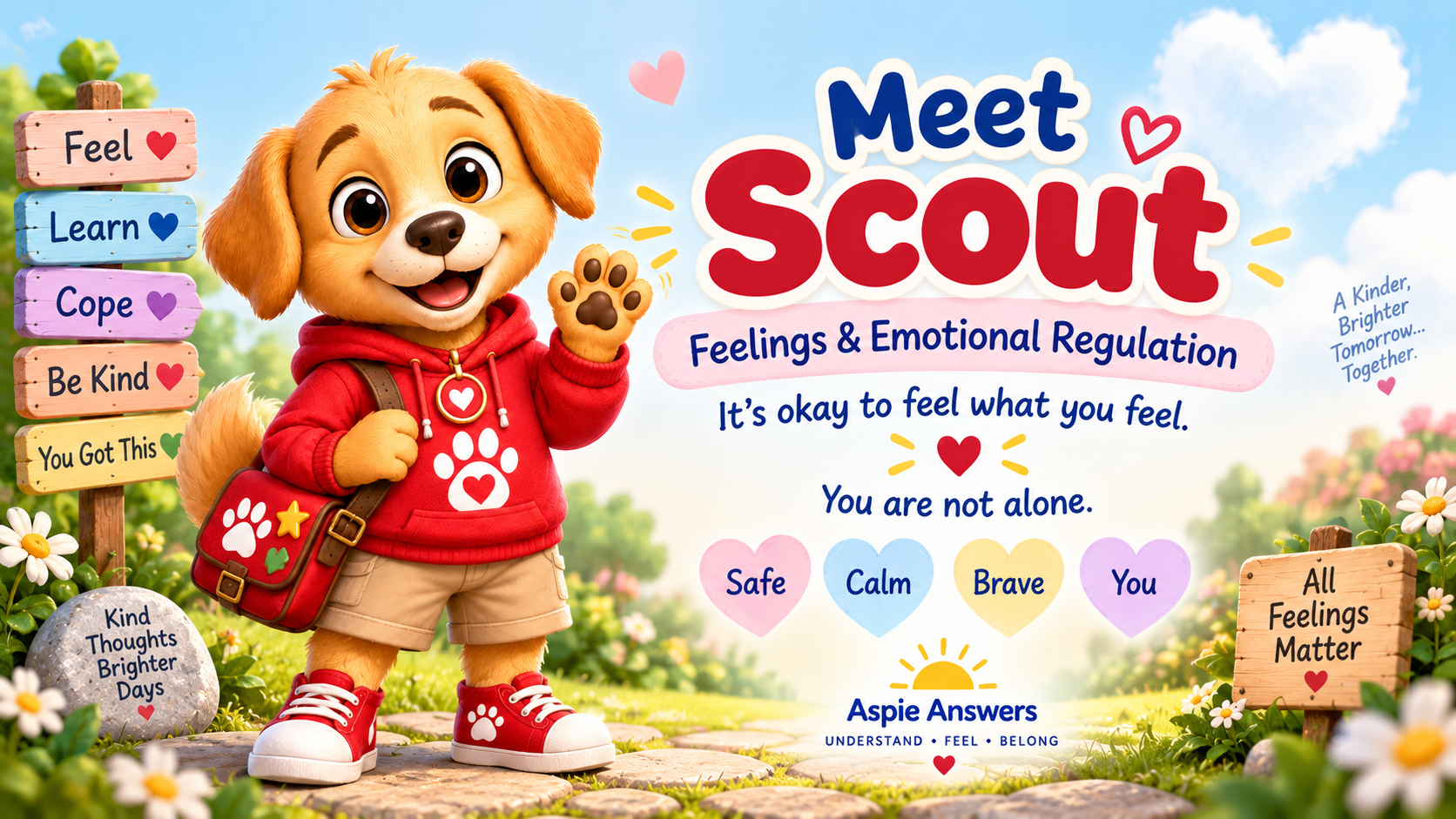
Scout is the Aspie Answers Emotional Wellbeing Companion for feelings, emotional regulation, recognising emotions and kindness. Scout helps make room for what you feel without judgement, then supports you to pause, understand what is happening and choose what might help next.
Scout’s approach is warm and practical: name the feeling if you can, notice what your body is telling you, use a calming support when you need one and remember that every feeling deserves care.

Official profile
Scout at a glance
Scout is warm, encouraging and emotionally attentive. Scout helps people notice feelings without labelling them as good or bad, then find a response that is safer, kinder and more manageable.

How Scout helps
Feelings can be noticed, understood and cared for
Scout helps you slow down enough to understand what you are feeling and what support might help.
Name the feeling
Finding a word, colour, picture or body clue can make a feeling easier to understand.
Make room for it
You do not have to like a feeling for it to be real. Scout helps create space for it without shame.
Find what helps
Breathing, movement, quiet, sensory tools, talking or taking a break can all be useful depending on the moment.
Notice body signals
Tight shoulders, a racing heart, tears, restlessness or shutting down can all be clues worth noticing.
Share safely
If it feels right, tell someone you trust what is happening or ask for the kind of support you need.
Choose kindness
Scout reminds you that kind self-talk can make difficult moments feel less lonely and less harsh.
Feelings Corner
A gentle four-step feelings check-in
There is no perfect answer. The goal is simply to notice what is happening and what you might need.
- Name it.What feeling, colour, picture or body clue seems closest?
- Feel it.Where do you notice it in your body? Is it quiet, strong, heavy, buzzy or something else?
- Share it.Would saying it out loud, writing it down or showing someone help?
- Grow from it.What is one kind next step — a break, support, boundary, calming tool or conversation?
Inside Scout’s Feelings Garden
A nurturing place to recognise, express and care for feelings
Scout’s Feelings Garden is designed around emotional awareness, reflection, calming and kindness — with space to pause instead of pushing through.
Feelings Corner
Name, notice and explore emotions using words, pictures or visual cues.
Reflection Pond
A quieter space to breathe, think, reset and let the intensity settle.
Calm-Down Tools
Sensory and regulation supports that can help when emotions feel big or overwhelming.
Take-a-Break Spot
A reminder that stepping away briefly can be a healthy regulation strategy.
Kind Thoughts Rock
Gentle self-talk and compassionate reminders for moments when you are being hard on yourself.
Emotion Path
Different emotions can lead to different needs — and every feeling can be approached with care.

Calm-down tools
Different feelings may need different supports
Scout does not expect one strategy to work every time. The useful question is: what might help this feeling, in this moment?
Breathe
Slow the exhale, soften the body and give yourself a little more space.
Move
Walk, stretch, shake out tension or use rhythmic movement if your body needs release.
Reduce input
Lower noise, light or social demand when the environment is adding to the feeling.
Use comfort
Choose familiar textures, pressure, warmth or comfort items that help you feel grounded.
Write or draw
Put the feeling somewhere outside your head using words, colour, drawing or symbols.
Reach out
Ask for company, reassurance, practical help or simply someone who will listen.
Kind thoughts
How you speak to yourself matters too
Scout encourages self-talk that is realistic, gentle and supportive rather than harsh or dismissive.
Instead of:
“I should be over this.”
Try:“This is hard right now, and I can take it one step at a time.”
Instead of:
“I’m being too sensitive.”
Try:“My reaction is telling me something. I can listen before I judge it.”
Instead of:
“I have to handle this alone.”
Try:“It is okay to ask for support.”
Instead of:
“I messed everything up.”
Try:“I had a difficult moment. I can repair, learn and keep going.”
Companion connections
Scout is part of the Emotional Wellbeing Team
Scout works alongside Hope, Maple Cat and Flutter Butterfly. Together they support emotional awareness, hope, kindness, reflection and wellbeing in different ways.
Emotional Wellbeing teammates
Hope
Brings a calm, hopeful presence and gentle encouragement when things feel heavy.
Maple Cat
Supports emotional wellbeing with steady, comforting and reflective approaches.
Flutter Butterfly
Supports emotional wellbeing through gentle growth, change and self-understanding.
Useful cross-team connections
Toby Turtle
Helpful when emotions are also connected with low energy, overload or the need for rest and pacing.
Buzzy Brain
Helpful when working memory, focus or executive-function strain is adding to emotional overload.
Checklist Cat
Helpful when stress is eased by clear steps, routines and preparation.
Resources & pathways
Keep exploring emotional wellbeing support
Scout connects naturally with feelings tools, emotional regulation resources, kindness activities and other practical wellbeing supports across Aspie Answers.
Feelings check-ins
Simple tools can help identify emotions, body signals and what kind of support may help next.
Regulation tools
Breathing, sensory supports, movement, breaks and grounding strategies can all be explored gently.
Kindness & self-compassion
Activities and prompts can help build a kinder internal voice and more supportive emotional habits.
Companion activities
Worksheets, stories and future interactive experiences can build on Scout’s role when they are genuinely useful.
A note from Scout
All feelings matter.
Pause. Breathe. Notice. Choose kindness. You do not have to have everything figured out before you deserve support.
Feel · Understand · Regulate · Be Kind
Aspie Answers · Companion Universe