
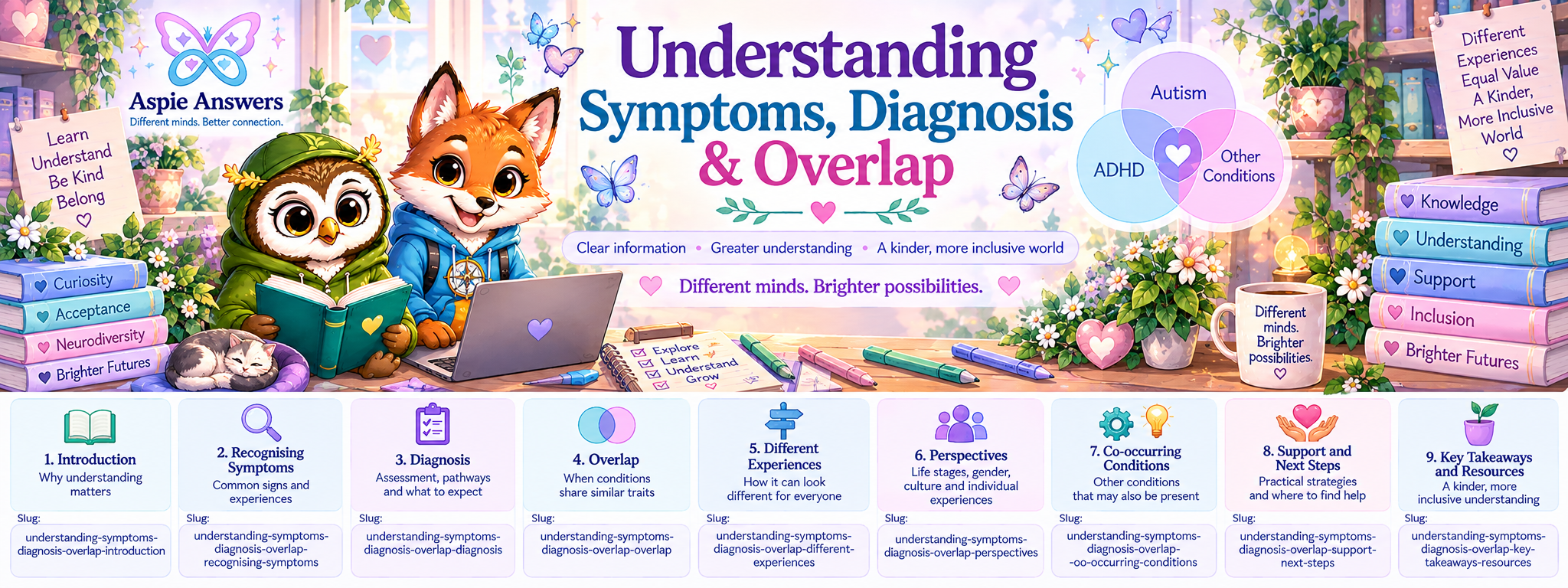
Mental Health Education • Symptoms • Diagnosis • Overlap
Understanding Symptoms, Diagnosis & Overlap
A gentle, plain-language guide to understanding why similar symptoms can appear across different conditions, neurodivergence, physical health, stress and life experiences — and why one symptom rarely tells the whole story.
🌱 Gentle Information Notice
Mental-health information can sometimes feel personal, complicated or like a lot to take in. You do not need to understand everything at once.
You can read one section, pause, come back later or skip ahead to the support information if that is more useful for you right now.
💗 Sensitive Topics Note
This page discusses symptoms, diagnosis, trauma, stress, burnout, physical health and other experiences that may feel difficult for some readers.
Please go at your own pace, take breaks when needed and use support pathways if reading this page becomes overwhelming.
📘 Learning, Not Diagnosing
Aspie Answers provides educational information, lived-experience-informed resources and practical guidance. This page is designed to help you understand concepts, notice patterns and prepare for conversations or next steps.
🩺 Diagnostic Boundary
This page cannot diagnose a mental-health, neurological, developmental or physical-health condition.
Symptoms can have many possible explanations. Diagnosis and assessment require consideration of the whole person, their history, environment, health and circumstances.
✨ Inside This Page You Will Learn
This page brings several connected ideas together so you can build a clearer picture rather than looking at one symptom in isolation.
Including the difference between symptoms, signs and experiences.
Similar experiences can appear in different conditions and circumstances.
Including what diagnosis can help with — and what it cannot do by itself.
Severity, frequency, duration, environment and daily-life impact all matter.
Including co-occurring conditions, differentials and why checklists are only part of the picture.
Ways to track experiences, prepare for appointments and identify useful support.
👀 At a Glance
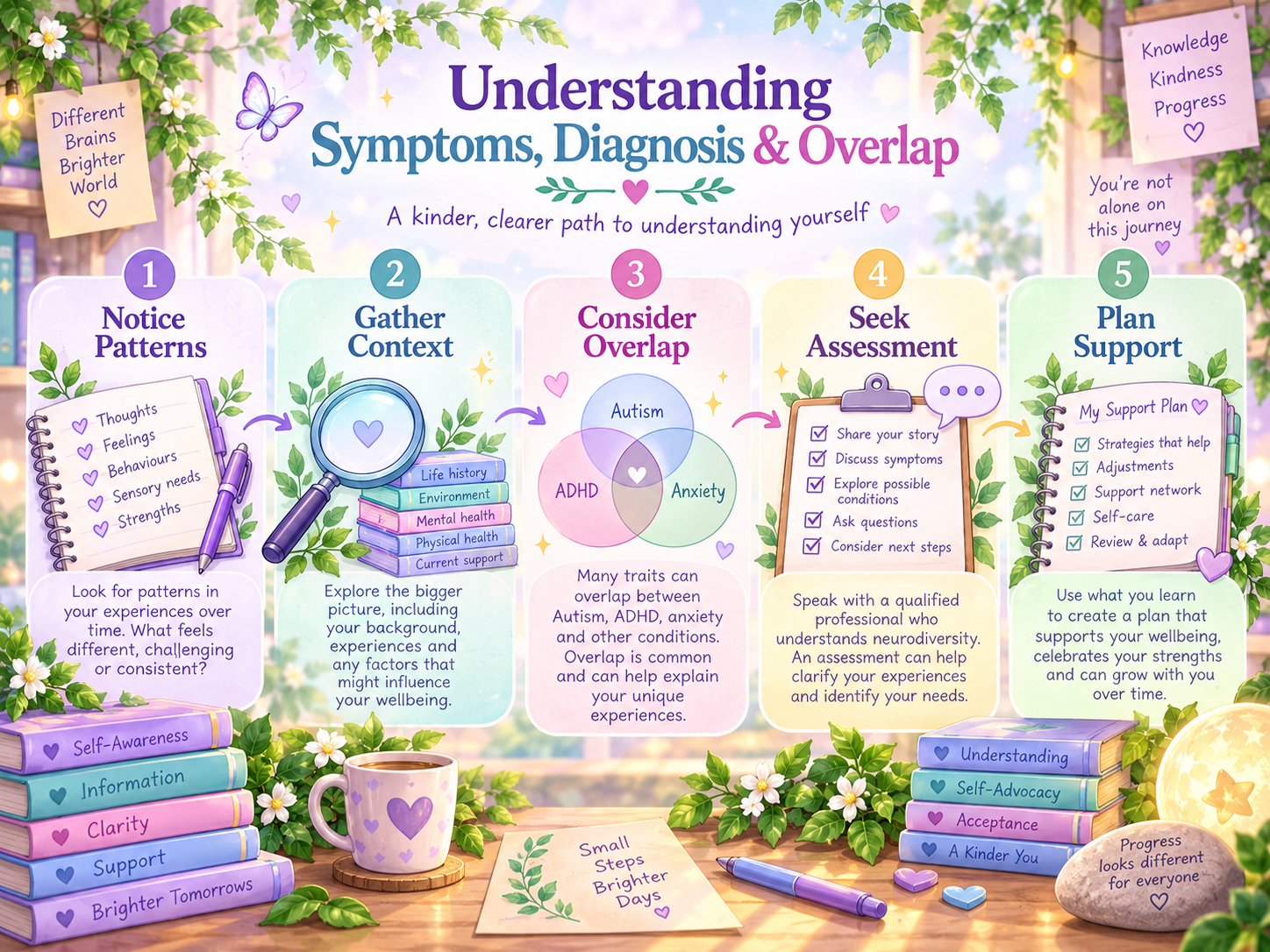
Symptoms overlap
The same symptom can appear in many different conditions and life situations.
Patterns matter
Frequency, duration, intensity and impact often tell us more than one isolated experience.
Diagnosis is a tool
It can support understanding and access to care, but it does not describe the whole person.
Support can start now
Helpful support can still be used while someone is exploring what may explain their experiences.

🌿 Where Do I Start?
A helpful starting point is to remember that one symptom can have several possible explanations .
Look for patterns
What is happening? When does it happen? How often? What seems to make it better or harder?
Keep more than one possibility open
Similar experiences do not automatically mean two people have the same condition.
Focus on what helps
You do not have to wait until every question has an answer before using helpful support.
🦉🦊 Learn With Olive Owl & Finn Fox
Olive Owl and Finn Fox support the learning approach on this page: understanding carefully, asking questions and staying flexible about possible explanations.

Olive Owl
Olive Owl supports learning, study and understanding. He reminds us to gather information and take things one step at a time.
Finn Fox
Finn Fox supports problem-solving, flexibility and independence. He reminds us that sometimes the best approach is to consider several possibilities before reaching a conclusion.
What Is a Symptom?
A symptom is something a person notices or experiences that may indicate a change in mental, emotional or physical wellbeing.
Symptoms can involve thoughts, feelings, behaviour, concentration, energy, motivation, sleep, communication, physical sensations or everyday functioning.
Symptoms
Experiences reported or noticed by the person, such as worry, low mood, tiredness or difficulty concentrating.
Signs
Changes that may also be observed by someone else or identified during assessment.
Experiences
A broader way of describing what someone is going through without assuming it automatically equals a diagnosis.
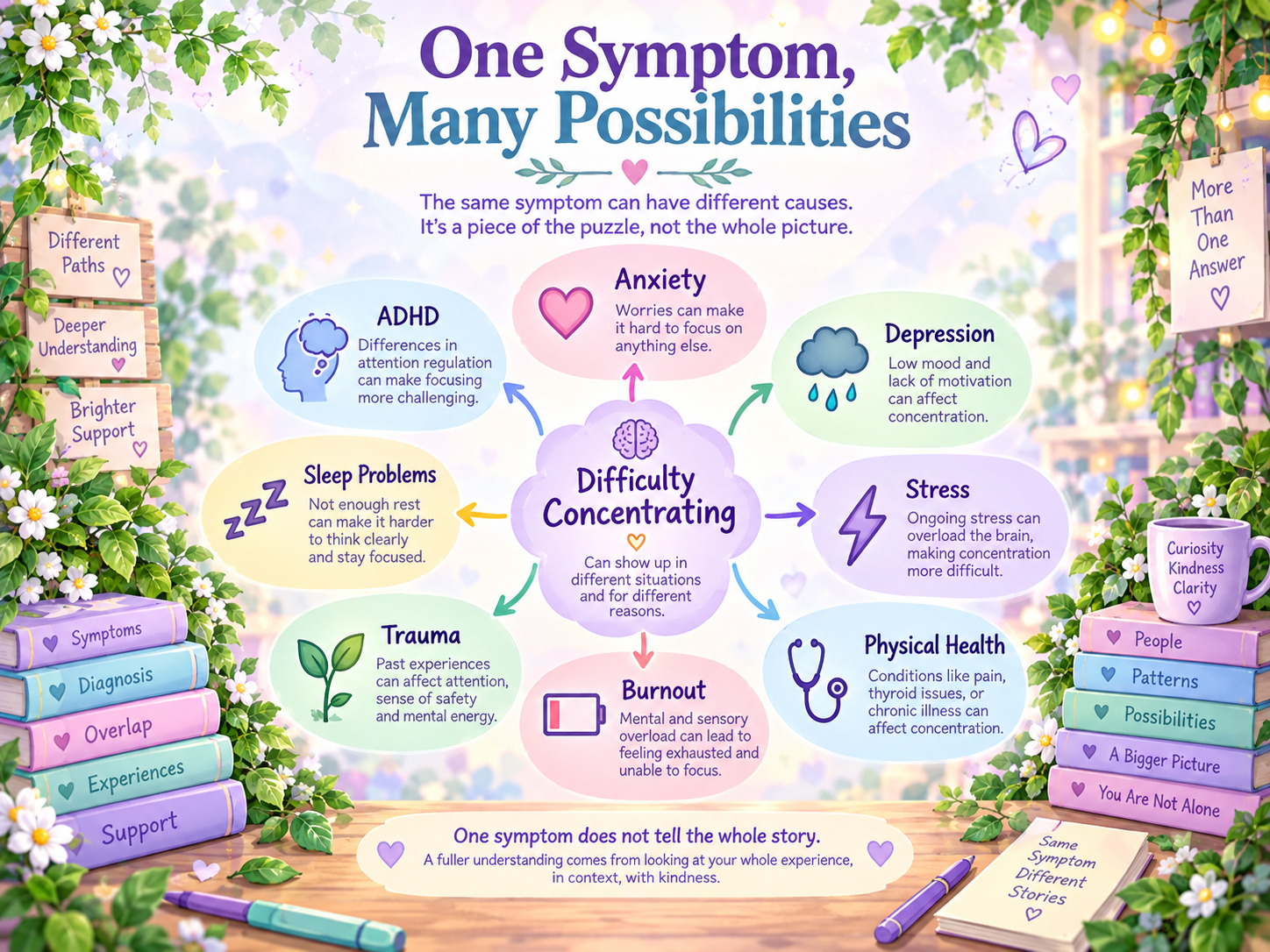
One Symptom, Many Possibilities
A symptom is a clue rather than a diagnosis.
For example, difficulty concentrating may appear alongside anxiety, ADHD, depression, trauma, burnout, sleep difficulties, physical illness, medication effects or significant stress.
Tiredness, low motivation, irritability or forgetfulness can also have more than one possible explanation.
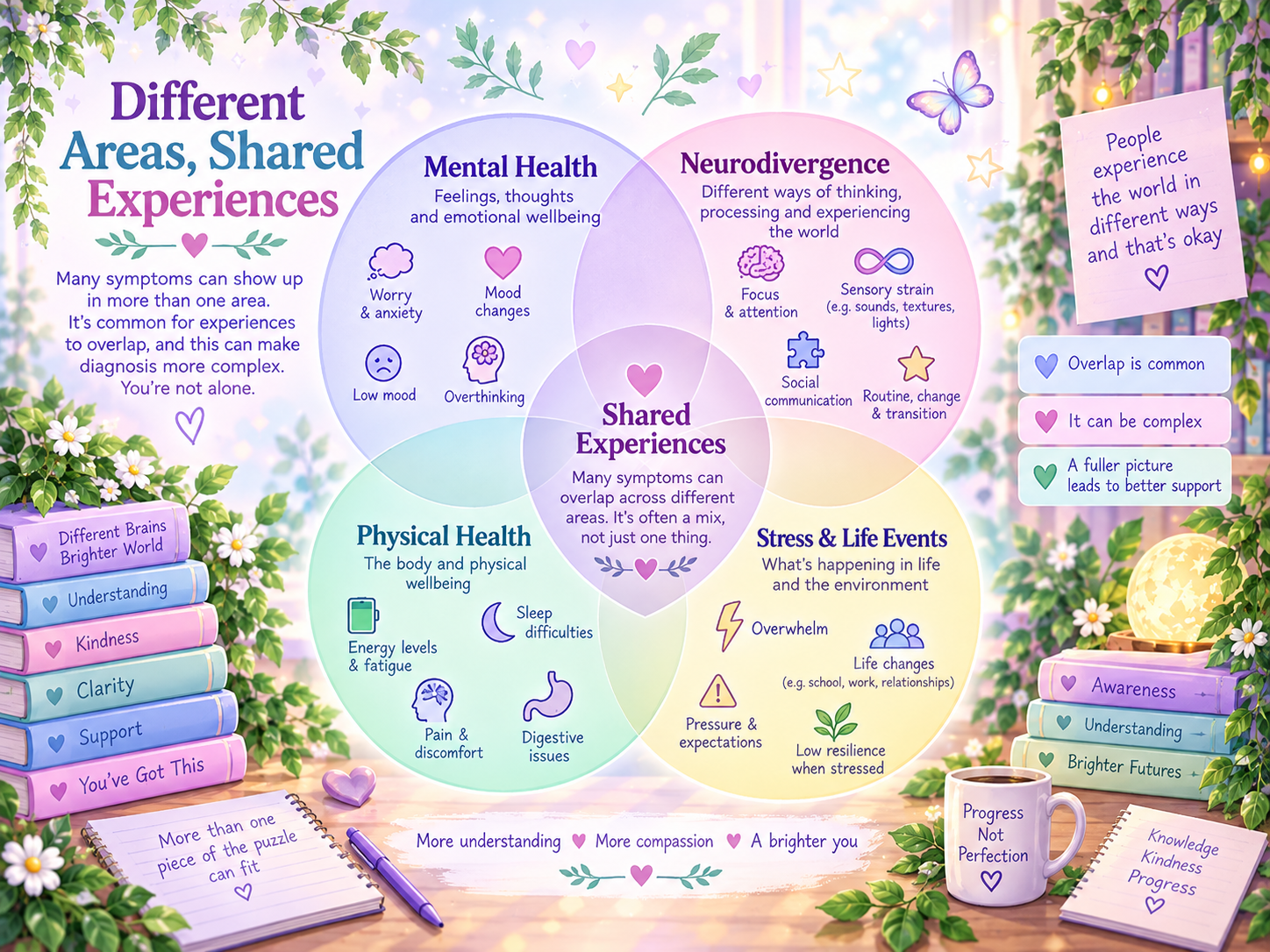
Why Symptoms Can Overlap
Mental health, neurodivergence, physical health, environment and life experiences all interact.
That is why similar experiences can appear for different reasons — and why looking at the wider pattern is more useful than matching one symptom to one answer.
Severity, Frequency, Duration & Functional Impact
Severity
How intense is the experience when it occurs?
Frequency
Does it happen occasionally, frequently or most of the time?
Duration
Has it lasted minutes, days, weeks, months or much longer?
Impact
Does it affect sleep, relationships, learning, work, self-care or everyday tasks?
Symptoms, Time & Environment
Symptoms Can Change Over Time
Experiences can become stronger, milder or different as health, environment, support, stress or responsibilities change.
Environment Can Change How Symptoms Appear
Sensory demands, expectations, safety, accessibility, relationships and workload can all influence how someone feels and functions.
Neurodivergence & Mental Health Overlap
Neurodivergent people may experience sensory differences, executive-function demands, communication differences, social pressure, masking, uncertainty and burnout.
These experiences can sometimes resemble mental-health symptoms, occur alongside mental-health conditions or affect how distress is expressed.
Explore Neurodivergence & Mental Health →Mental Health & Physical Health Overlap
Sleep
Poor or disrupted sleep can affect mood, concentration, memory, energy and stress tolerance.
Physical illness & pain
Illness, pain and chronic-health conditions can influence emotional wellbeing and everyday functioning.
Medication & hormones
Medication effects and hormonal changes may also affect mood, sleep, concentration and energy.
Stress, Trauma & Life Circumstances
Experiences do not happen in isolation. Trauma, grief, relationship changes, financial pressure, study, work, caring responsibilities, housing and major life transitions can all affect mental wellbeing.
Culture, Communication & Language Matter
Culture
Different communities may understand, describe and respond to distress in different ways.
Communication
Some people find it difficult to identify or describe internal experiences, especially when overwhelmed.
Language
The words available to someone can affect how they describe what they are experiencing.
Masking, Compensation & Delayed Recognition
Someone may appear to cope externally while using a great deal of energy to manage privately.
Masking or compensation can sometimes contribute to needs being missed, misunderstood or recognised later.
Co-occurring Conditions
People can experience more than one condition or support need at the same time. This is often described as co-occurrence or comorbidity.
More than one explanation can be true
Having one diagnosis does not automatically mean every experience is fully explained by that diagnosis.
Rule-outs & Other Explanations
Assessment may involve considering several possible explanations and looking at which one best fits the overall picture.
Considering alternatives is not about dismissing someone's experience. It is part of trying to understand it accurately and respectfully.
What Diagnosis Means — and What It Doesn't
A diagnosis may help
- provide language for a set of experiences
- guide treatment or support
- support access to services or accommodations
- help professionals communicate
- help some people understand themselves better
A diagnosis does not
- describe everything about a person
- make everybody with the same diagnosis identical
- automatically explain every symptom
- remove someone's strengths or individuality
- mean understanding can never change
Assessment & Differential Diagnosis
Assessment often involves gathering information from several sources rather than relying on one symptom or one checklist.
Checklists can help — but they have limits
Screening questionnaires and symptom checklists can help identify patterns or areas worth discussing, but they do not usually provide the whole clinical picture by themselves.
Misdiagnosis, Missed Diagnosis & Changing Diagnosis
Sometimes an earlier diagnosis may not explain the whole picture, or another condition may be recognised later.
This can happen because symptoms changed, information was limited, masking occurred or another explanation seemed more obvious at the time.
What If You Don't Have a Diagnosis?
You can still learn about yourself, notice patterns and identify what support helps.
Self-understanding without forcing a label
You can explore what helps, what makes things harder and which environments work better for you while remaining open to different explanations.
Support can be needs-led
Helpful routines, planning tools, sensory adjustments, communication supports, rest and coping strategies can still be valid and useful.
When Professional Assessment May Help
Professional advice may be useful when experiences are persistent, worsening, difficult to understand or significantly affecting daily life.
A qualified professional can consider information that a general educational page cannot assess.
Preparing for an Appointment
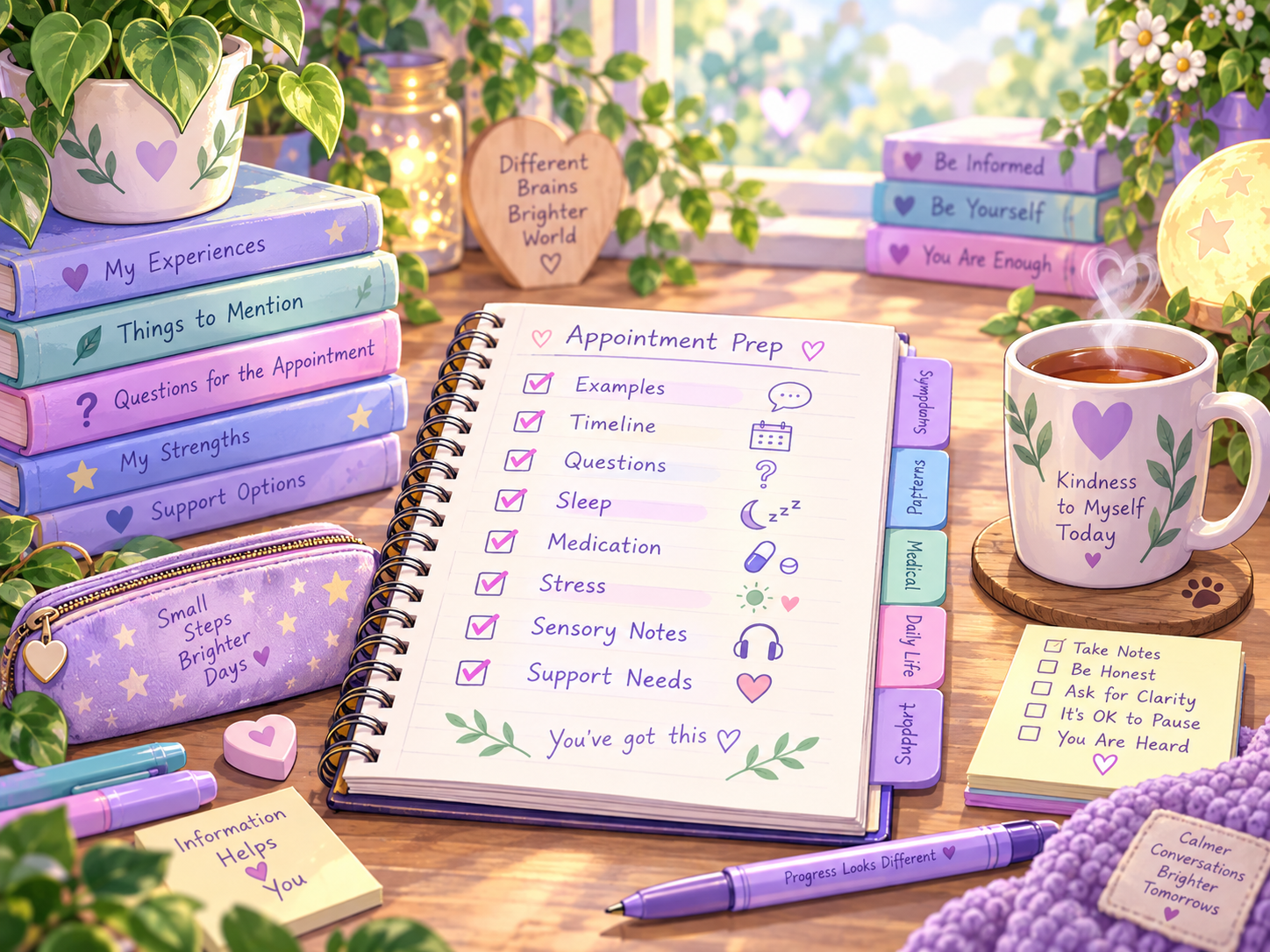
You do not need to remember everything on the spot. Preparing a few notes beforehand can make appointments easier.
What you might bring
- examples of what you have noticed
- a rough timeline
- medication or health information that seems relevant
- sleep, stress or sensory notes
- questions you want to ask
- information about your support needs
Questions you could ask
- What possibilities are you considering?
- Could something else explain these experiences?
- What information would help clarify things?
- What support can I use while we work this out?
- What happens next?
What If You Disagree With a Diagnosis?
It is reasonable to ask how a conclusion was reached, what information was considered and whether other possibilities were explored.
Depending on your circumstances, you may also choose to seek further clarification or another professional opinion.
After Diagnosis
Receiving a diagnosis can bring different emotions: relief, uncertainty, validation, confusion, grief, hope — or a mixture of many feelings.
There is no requirement to process everything immediately.
Tracking Symptoms Without Self-Diagnosing
Keeping simple notes can help you recognise patterns without requiring you to decide on a final explanation straight away.
What happened?
Describe the experience in your own words.
When & where?
Note the timing, environment and what was happening around you.
What helped?
Record anything that reduced distress or made functioning easier.
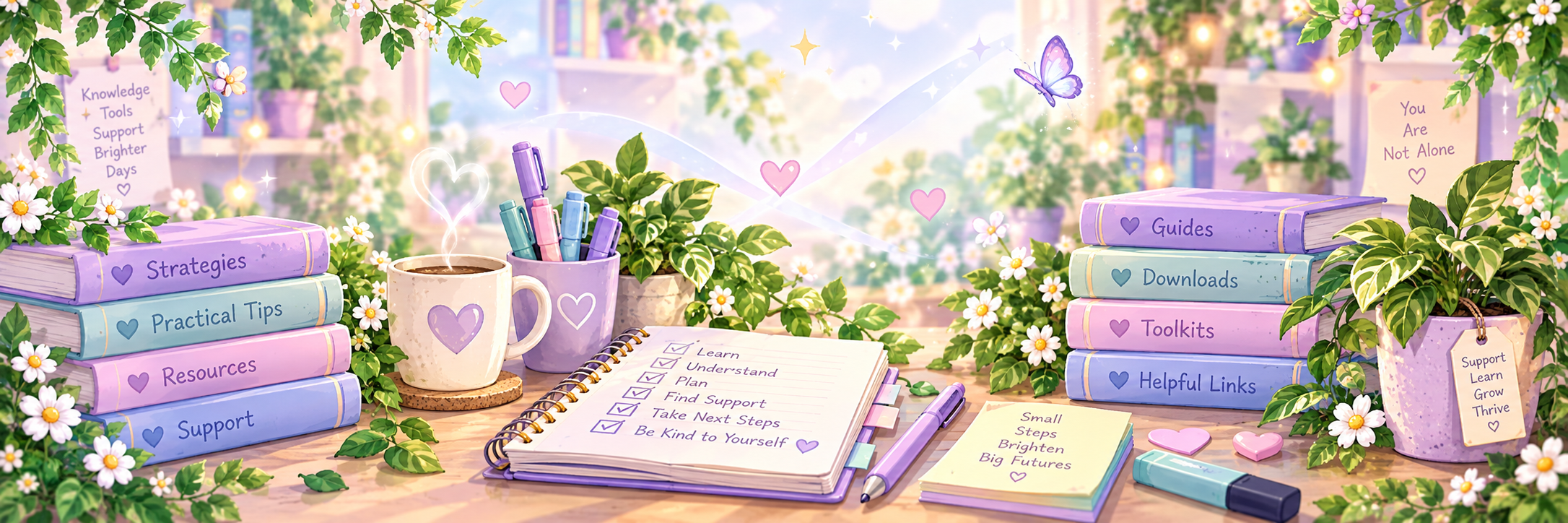
Support, Learning & Helpful Resources
Practical Support & Resources
Mental Health Topics & Conditions
Continue exploring individual topics and conditions in more depth.
Explore Topics & ConditionsMental Health Topics A–Z
Browse mental-health topics alphabetically when you already know what you want to find.
Browse Topics A–ZMental Health Education Hub
Return to the wider Mental Health Education learning pathway.
Mental Health Education HubContinue Learning
Neurodivergence & Mental Health
Explore how neurodivergence and mental wellbeing can interact.
Continue →Wellbeing, Coping & Emotional Skills
Move from understanding into practical emotional wellbeing and coping skills.
Continue →Mental Health Literacy
Build confidence understanding mental-health information, terminology and support choices.
Continue →💜 Understanding Does Not Have to Happen All at Once
Sometimes the most helpful next step is simply finding better words for what you are experiencing.
You can stay curious, use helpful support and gather information without forcing yourself to reach a final answer immediately.
Different minds. Better connection.