What I Offer
Be clear about what the client is buying, what is included and what is outside the service or project.

Work & Employment • Self-Employment & Small Business
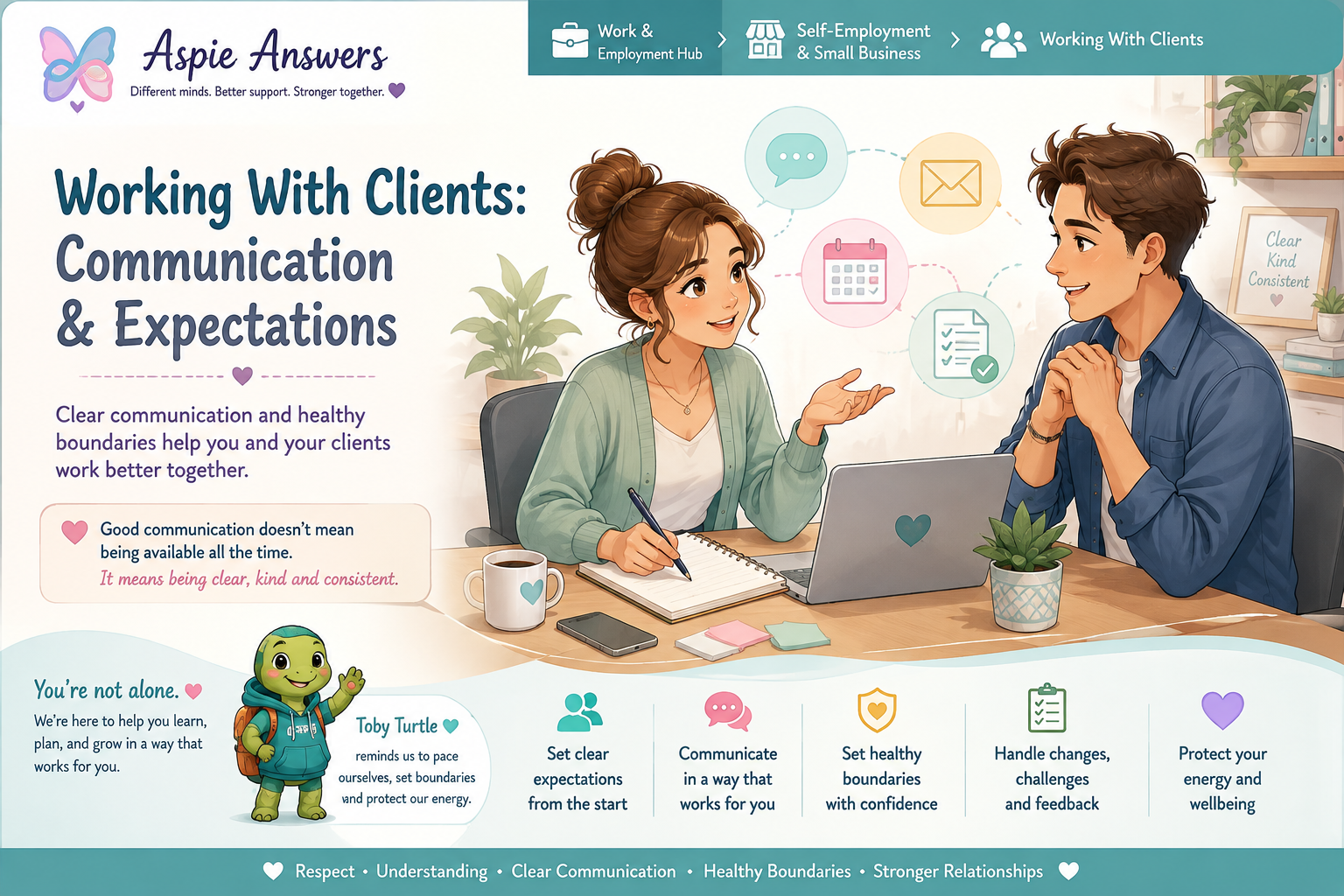
Clear communication can make client relationships easier to understand and manage. You do not have to be available all the time or communicate in exactly the same way as everyone else. Helpful expectations, written agreements and healthy boundaries can support both you and your clients.
Good communication is usually about being clear, respectful and reasonably consistent. It does not require instant replies, constant availability or saying yes to every request.
Clear expectations can prevent many misunderstandings before they happen. They can be explained on your website, in an enquiry reply, proposal, booking form, welcome email or agreement.
Be clear about what the client is buying, what is included and what is outside the service or project.
Explain your preferred contact method, such as email, scheduled calls or a project platform.
Tell clients when they can normally expect a reply rather than creating an expectation of immediate responses.
Use realistic turnaround times and explain what information or approvals you need from the client to keep work moving.
Explain how many revisions are included and what happens when the client asks for additional work.
Make payment dates, deposits, invoices and the next stage of the process as easy to understand as possible.
Different communication methods use different kinds of energy. You can choose methods that help you communicate clearly and reliably rather than copying another business owner's style.
Useful when you prefer time to process information, want a written record or need to answer carefully.
Useful for some discussions, but scheduling calls can be easier than accepting unexpected calls throughout the day.
Quick messaging can be convenient, but clear working hours and expectations may help prevent constant interruptions.
After a verbal conversation, a short written summary can reduce uncertainty about what was decided.
Asking a question is often safer than guessing what the client meant.
Boundaries are part of professional communication. They show clients how your business operates and protect your available time and energy.
Choose when business messages are normally answered.
Give clients a realistic reply window, such as within one or two business days.
Extra tasks do not automatically have to be included in the original price or deadline.
You can decide how much personal information you want to share with clients.
Being a paying client does not give someone permission to communicate abusively or ignore reasonable boundaries.
Clients can be informed when you are unavailable without needing access to you during your time away.
Projects sometimes change. The important part is making the change visible rather than silently absorbing extra work.
Confirm what has changed, whether it affects the deadline and whether there is an additional cost.
A short written confirmation can prevent both sides remembering the change differently later.
Difficult conversations can be easier when you prepare the key point before replying.
You do not always need to respond immediately. Give yourself time to understand what happened.
Describe the specific problem, agreement or next step rather than trying to solve every concern at once.
If live conversation is difficult, a written response may help you communicate more clearly and create a record.
Unexpected problems, low capacity, illness, technical issues or changing workloads can affect a deadline. Communicating early where possible is usually more helpful than disappearing because you are worried about disappointing someone.
Matching communication templates, worksheets and client-support resources can be connected here as they are published in the central Aspie Answers Resources & Downloads Library.
Visit the Resources & Downloads LibraryThe following related pages are part of the planned Self-Employment & Small Business section. They are intentionally not linked here until their live WordPress URLs are confirmed.