
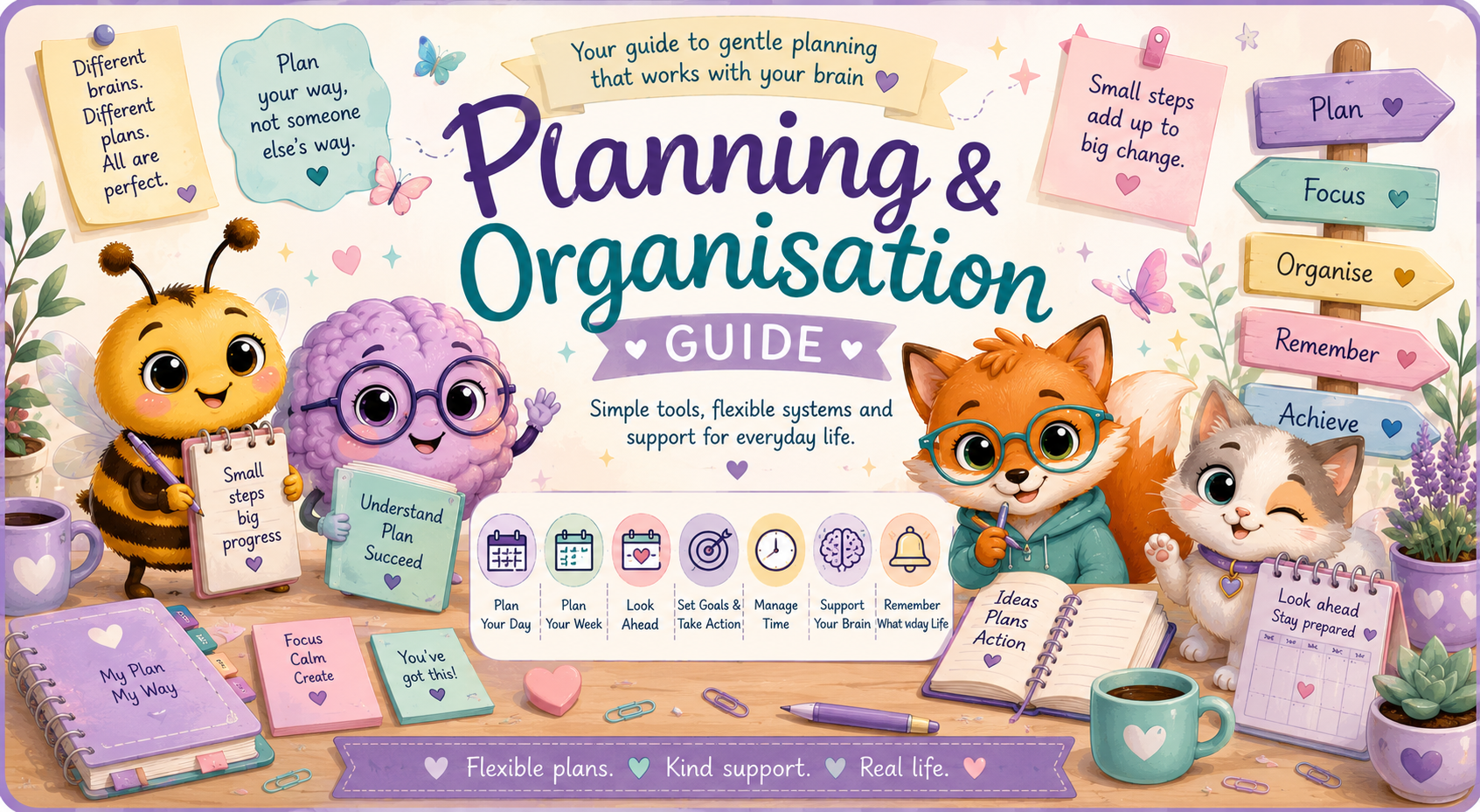
Welcome to the Planning & Organisation Guide. This guide brings together practical, flexible and neurodivergent-friendly support for planning everyday life.
Explore daily and weekly planning, time, memory, executive functioning, goals, priorities, household organisation and practical tools designed to reduce everyday pressure.
You do not need to use every strategy. Browse, experiment and choose the support that works best for you.
A planner does not measure how successful, organised or capable you are.
Plans can change. Lists can remain unfinished. Routines can be adjusted. Different brains often need different systems.
The goal is not perfect organisation. The goal is making everyday life easier to manage.
Search or choose a topic below to explore the planning pages in this guide.
Support starting, sequencing, organising and completing tasks.
ExploreFind a starting point when everything feels equally important.
ExploreExplore simple ways to manage forms and important documents.
ExploreExplore support for starting tasks, organising steps and moving between activities.
Use reminders and external supports instead of expecting your brain to hold everything.
Make time more visible with calendars, timers and gentle prompts.
Reduce choices and identify the next useful step when decisions feel overwhelming.
Goals do not need to begin as detailed five-year plans. You can start with something you would like to change, learn, try or make easier.
Create visual and written prompts for repeated everyday tasks.
Explore ChecklistsPlan home responsibilities without expecting everything to happen at once.
Explore Household PlanningBuild simple systems for important information and documents.
Explore Paperwork SupportGive yourself a moment before trying to organise everything.
Write down the tasks, thoughts or worries taking up mental space.
Ask what needs attention first rather than what needs to be completely finished.
If the step still feels difficult, break it down again.
Let a calendar, alarm, checklist or visual prompt support your memory.
Your plan can change when your energy, priorities or circumstances change.
Small steps, realistic routines, getting started and celebrating progress.
Understanding memory, attention, time and executive functioning.
Problem-solving, organisation and finding another way when a system stops working.
Dates, appointments, calendars and gentle preparation for what is coming next.
Explore practical planning tools, checklists and supports designed for different planning styles and everyday needs.
Our planning collections are growing. Classic, Companion and Kawaii-inspired editions will help you choose planning tools that feel useful, comfortable and motivating for you.
Existing planner resources and future volumes will be organised here as the collections continue to grow.
The Planning & Organisation section will continue to grow with new practical tools, visual supports, planning resources and companion-led collections.
As new resources are added, this guide will help you find the support that best matches what you need.