
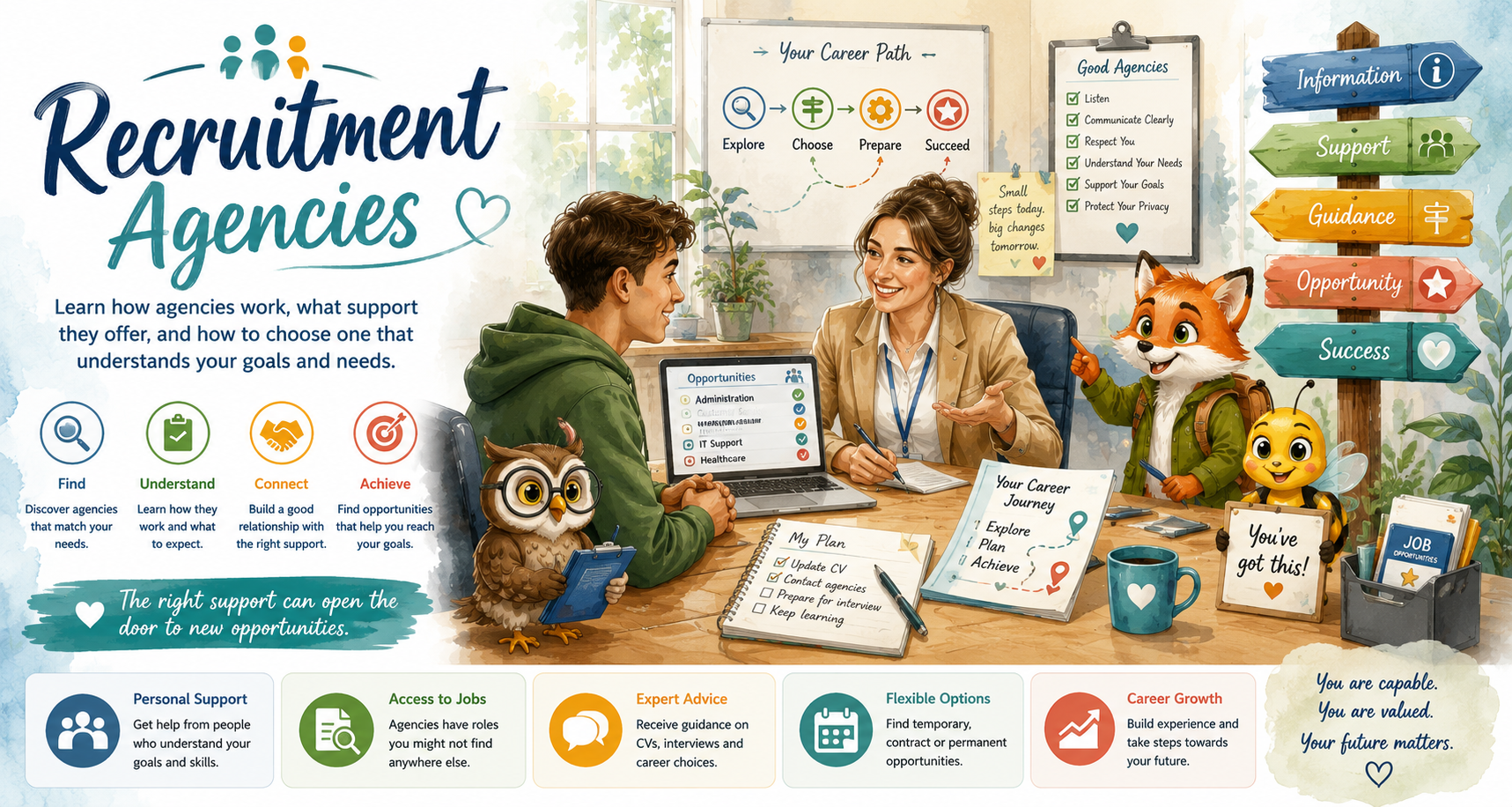
Recruitment Agencies
Recruitment agencies can be one route into work. This guide explains what they do, what to prepare, how to compare agencies, what questions to ask and how to protect your choices, privacy and support needs while using them.
Try words such as register, temporary work, privacy, questions, support needs, fees or CV.
Showing all guide sections.
Access to Vacancies
Some employers give agencies roles that may not be advertised through the usual public job boards.
Application Guidance
A consultant may suggest improvements to your CV, cover letter or overall job-search approach.
Interview Preparation
They may explain what an employer is looking for and help you prepare for the next stage.
Employer Connections
Recruiters can introduce suitable candidates directly to employers in their network.
Different Work Patterns
Some agencies specialise in temporary, part-time, seasonal or contract opportunities.
Career Direction
A thoughtful consultant may help you identify roles that better match your strengths and preferences.

General Agencies
Recruit across several industries and job levels. These may suit people exploring several kinds of work.
Industry Specialists
Focus on particular sectors such as technology, healthcare, trades, administration, education or creative work.
Temporary & Contract Agencies
Place people in short-term, casual, seasonal or project-based roles.
Permanent Recruitment
Help employers fill ongoing positions and may support candidates through several recruitment stages.
Disability Employment Services
May offer more specific knowledge about accessibility, workplace adjustments or supported-employment pathways.
Executive or Professional Agencies
Recruit for specialist, management, leadership and highly experienced roles.
Make Contact
You may complete an online form, email your CV or speak with a consultant.
Discuss Your Background
The consultant may ask about experience, strengths, availability and preferred work.
Confirm Details
You may be asked for identification, references, qualifications or evidence relevant to work eligibility.
Consider Opportunities
The agency may contact you when a potentially suitable role becomes available.

About the Agency
- Which industries and roles do you specialise in?
- How do you communicate with candidates?
- Will I have one main contact person?
About Opportunities
- How will you decide whether a role suits me?
- Will you ask before sending my CV to an employer?
- Can you provide the job details in writing?
About Support
- Can you help me prepare for interviews?
- Can you discuss workplace adjustments with employers?
- Will you give feedback when it is available?
About Privacy & Costs
- How will my information be stored and shared?
- Are there any proposed candidate costs or fees?
- Who can access my documents?
You may find it useful to describe practical working conditions and supports rather than feeling pressured to explain every diagnosis or personal detail. How much you share can depend on the role, what support you are seeking and your own circumstances.
Communication
Written follow-up, clear expectations, extra processing time or one main contact person.
Environment
Noise, lighting, interruptions, workspace arrangement or remote-work possibilities.
Structure
Predictable schedules, task lists, flexible hours or a more gradual onboarding process.
Tick the features you notice. This is a reflection tool, not a formal rating system.
0 of 8 positive signs selected.
Unclear Job Details
The recruiter avoids basic questions about duties, location, hours or employer expectations.
Pressure & Urgency
You are pushed to decide immediately or discouraged from reading information carefully.
Poor Privacy Practices
Your CV or personal information appears to be shared without clear permission or explanation.
You can ask for clarification, request a different consultant, reduce contact or stop using the service. Keep other job-search routes open too, such as direct applications, job boards, networking and specialist support.


Checklist Cat
Prepare your CV, documents, availability, questions and preferences before registration so you have one clear set of information to work from.

Finn Fox
If one recruiter or route is not working, you can try another agency, another contact or a completely different way of reaching employers.
Do recruitment agencies guarantee that I will get a job?
No. An agency may connect you with opportunities, but employers still decide whom to interview and hire.
Can I register with more than one agency?
Often, yes. Keep clear records so you know where your CV has been sent and can avoid duplicate applications.
What if an agency asks me to pay money?
Ask for a clear written explanation of any proposed cost before agreeing to anything, and independently verify the organisation and arrangement if you are unsure.
Do I have to disclose a disability or diagnosis?
What you choose or need to disclose can depend on your circumstances, the role and any relevant safety or legal requirements. You can often begin by discussing the practical supports or working conditions that help you perform well.
What if the recruiter stops contacting me?
Send a polite follow-up, confirm your availability and continue using other job-search routes rather than waiting on one agency alone.