Communication & Information
Written instructions, clearer expectations, agendas, follow-up notes, alternative communication methods or extra processing time.

Work & Employment • Workplace Rights & Employment Guidance
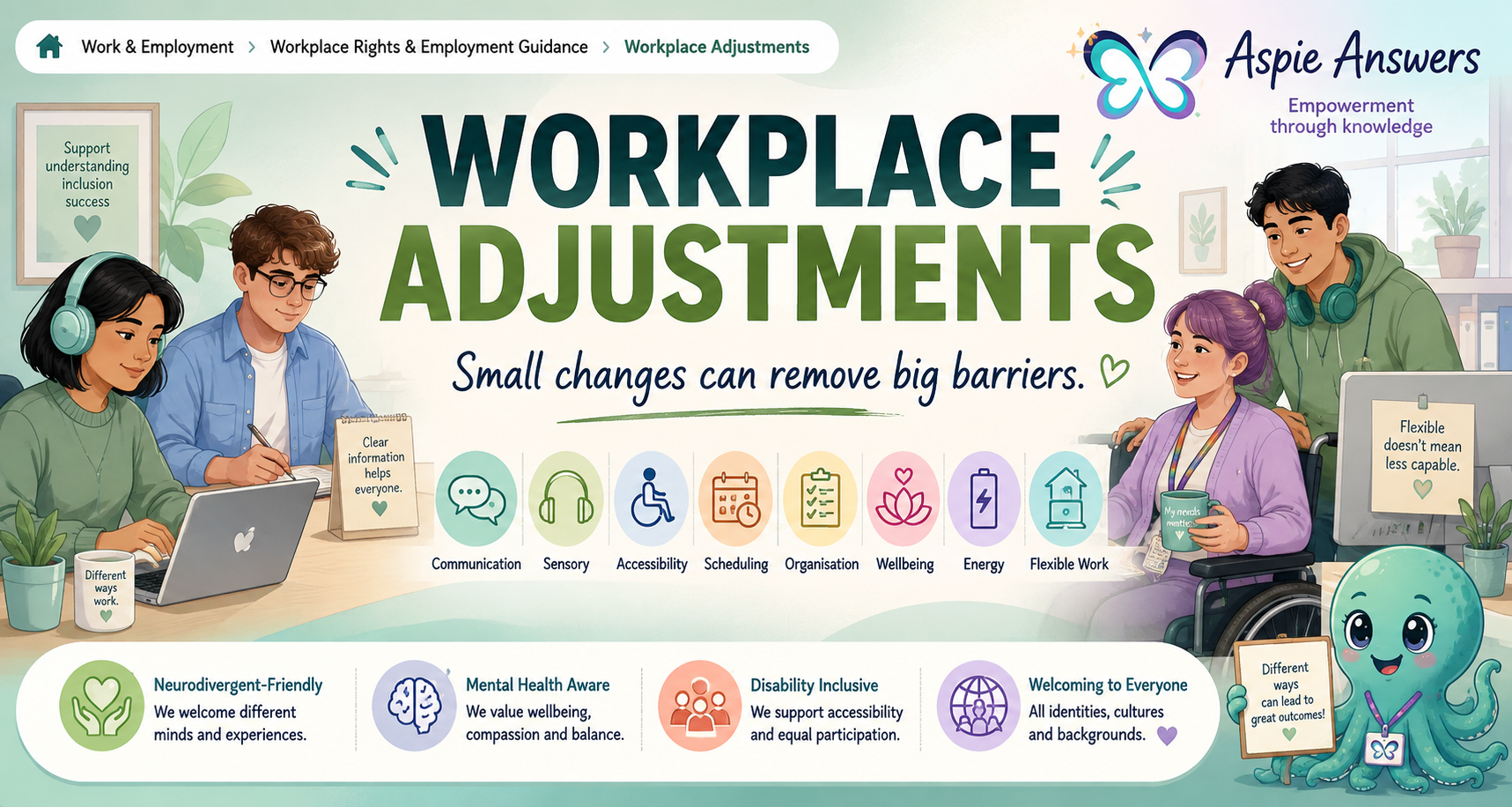
Small changes can remove big barriers. Workplace adjustments can support access, participation, communication, wellbeing, energy and different ways of working.
Workplace adjustments are changes to the way work is organised, communicated, accessed or carried out so that a person can participate more fully and reduce avoidable barriers.
In New Zealand guidance, reasonable accommodation can include adjusting the workplace or providing support so an employee can fully participate at work.
Ollie's organisation and sensory-support role fits this topic well: workplace barriers often become easier to manage when we separate the problem into smaller parts and try practical supports that match the person.
Written instructions, clearer expectations, agendas, follow-up notes, alternative communication methods or extra processing time.
Changes to lighting, noise, seating, workspace location, equipment or access to quieter spaces where practical.
Accessible entrances, workstation changes, suitable furniture, equipment, mobility access or other physical supports.
Predictable schedules, flexible start or finish times, breaks, appointment flexibility or changes to working patterns where appropriate.
Written priorities, task breakdowns, checklists, reminders, clearer deadlines, reduced task-switching or structured workflows.
Predictability, communication changes, agreed check-ins, breaks, reduced unnecessary stressors or support during difficult periods.
Pacing, rest opportunities, workload discussions, gradual changes or flexibility around fluctuating capacity where possible.
Where the job and circumstances allow it, working location can sometimes form part of an accessibility or flexible-working conversation.
You do not always need to begin with the name of an adjustment. It can be easier to begin with the barrier.
What part of the task, environment, schedule, communication or process creates the biggest barrier?
Is the difficulty constant, or does it happen at particular times, during certain tasks or under particular conditions?
Think about strategies, environments, tools or ways of communicating that have worked elsewhere.
Try to connect the adjustment directly to the work barrier rather than feeling you need to justify your whole life experience.
Preparing what you want to say can make the conversation easier. You may want to explain the barrier, what change you are asking for and how it could help you do your work.
Disclosure can be a personal and sometimes legally important decision. The amount of information needed can depend on the work, the adjustment being requested, health and safety considerations, and the laws that apply where you live.
An adjustment does not need to be perfect on the first attempt. Work changes, health changes and sometimes a support that sounded useful on paper does not solve the real barrier.
Has the original problem changed, or was a different barrier underneath it?
Is it being used consistently and in the way that was agreed?
There may be more than one practical way to meet the same access need.
Agreeing to revisit an adjustment can reduce the pressure to find one permanent answer immediately.
A declined request does not automatically mean that no support is possible. Ask for the reason, whether another option could address the same barrier, and what process is available to discuss the decision.
Keep copies of requests, responses, meeting notes and relevant documents, especially if the issue is important or ongoing.
New Zealand guidance recognises reasonable accommodation as adjustments or support that help disabled people participate. Employment New Zealand also recognises a right for employees to ask for flexible working arrangements, with employers required to consider the request.
Official guidance discussing reasonable accommodation and employing disabled people.
Read Employment New Zealand guidanceOfficial Employment New Zealand information about asking for flexible working arrangements.
Read flexible-working guidanceTe Kāhui Tika Tangata / Human Rights Commission information about disabled people's rights and reasonable accommodation.
Read disability-rights guidanceWorkSafe guidance about workers raising health and safety issues and participating in workplace health and safety.
Visit WorkSafe guidanceDifferent countries use different terms such as workplace adjustments, reasonable adjustments, accommodations or reasonable accommodation. The legal tests, eligibility and employer duties are not identical.
As matching resources are completed, this page can connect into the central Aspie Answers Resources & Downloads Library.
Identify barriers, possible supports, questions and review points.
Explore noise, lighting, movement, space and other sensory factors that affect work.
Record useful communication methods, processing needs and ways information is easiest to understand.
A practical worksheet for matching a specific barrier with possible changes or supports.