
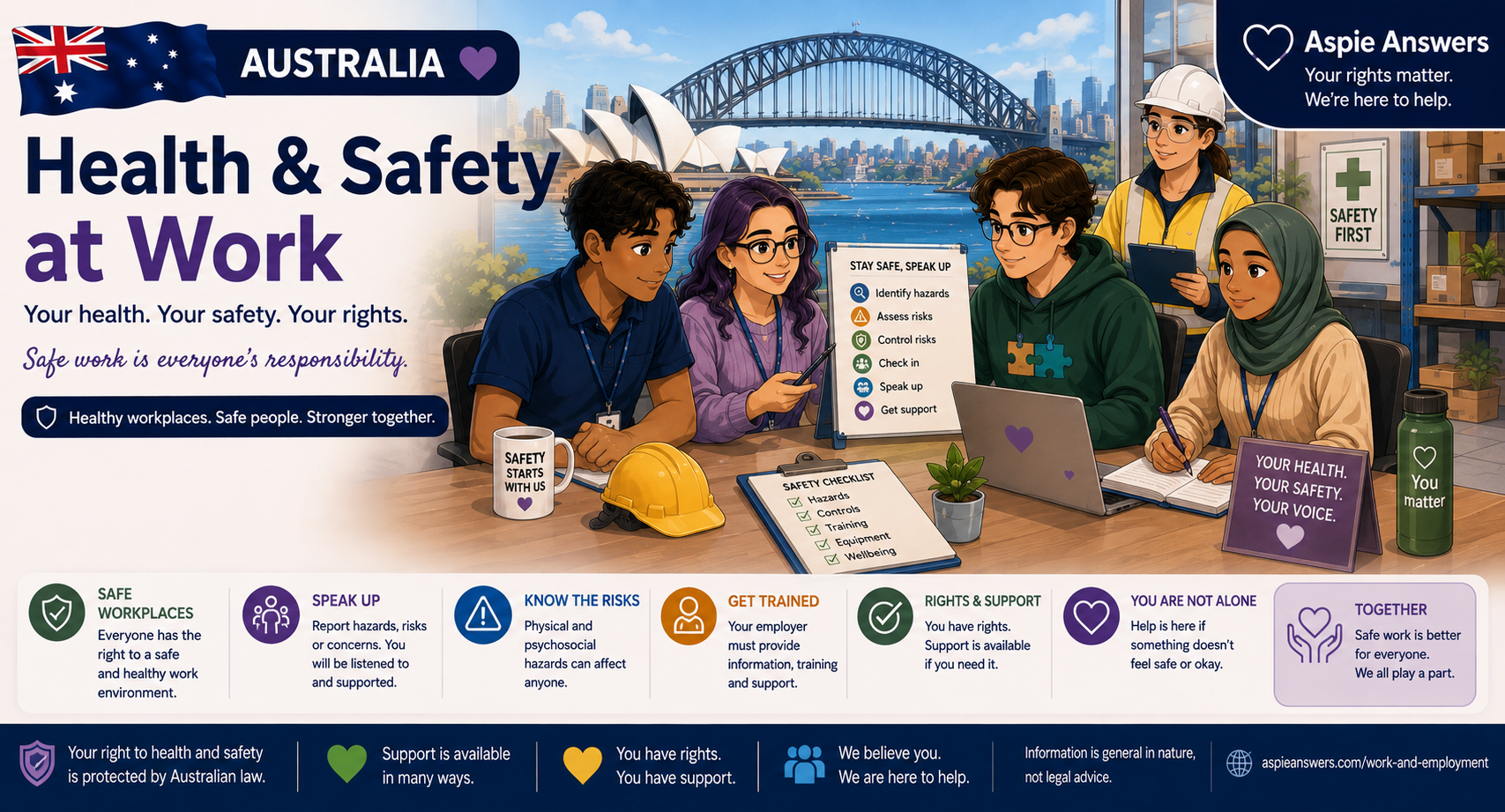
Work & Employment • Workplace Rights & Employment Guidance • Australia
Australia — Health & Safety at Work
Accessible guidance to help workers understand physical and psychological workplace safety, recognise hazards, report concerns, take part in consultation and find the correct Australian WHS support pathway.
🌱 Gentle Legal, Safety & Wellbeing Guidance
This page provides general educational and navigation information. It does not replace individual legal, workplace-safety, medical, mental-health, workers' compensation or other professional advice.
Australian work health and safety laws vary by jurisdiction. Safe Work Australia develops national WHS policy and model laws, while Commonwealth, state and territory regulators regulate and enforce WHS laws in their jurisdictions.
⚠️ Immediate or Serious Danger
If there is an immediate threat to life or safety, follow workplace emergency procedures and use the appropriate Australian emergency service where required. Serious incidents can also have regulator notification requirements for the business or undertaking.
🔎 Search Workplace Health & Safety Guidance
🦺 Understanding Work Health & Safety
Work health and safety is about preventing harm arising from work. Health includes both physical and psychological health.
Businesses & Undertakings
Under the model WHS framework, a person conducting a business or undertaking (PCBU) has primary duties to protect workers and other people from work-related health and safety risks so far as is reasonably practicable.
Workers
Workers also have duties, including taking reasonable care of their own health and safety and taking reasonable care that their acts or omissions do not adversely affect others.
More Than One Duty Holder
More than one person or organisation can hold duties at the same time. WHS responsibilities cannot always be understood by looking only at one employer or one worker.
⚠️ Physical & Environmental Hazards
Hazards vary by job and industry. They can arise from equipment, substances, tasks, the environment, work design and the way work is organised.
Slips, Trips & Falls
Floor surfaces, clutter, access routes, stairs, working at height and other environmental conditions can create risks.
Manual Tasks
Lifting, pushing, pulling, repetitive work, awkward postures and sustained positions can create musculoskeletal risks.
Noise & Sensory Environment
Hazardous noise can affect hearing, while environmental conditions may also interact with concentration, communication and psychological safety.
Chemicals & Airborne Hazards
Hazardous chemicals, dusts, fumes and other airborne contaminants require appropriate risk management.
Plant & Equipment
Machinery, tools, vehicles and other plant can create risks if design, guarding, maintenance, training or systems of work are inadequate.
Heat, Outdoor & Remote Conditions
Temperature, weather, isolation, travel and access to help can all affect workplace risk.
🧩 Identify • Assess • Control • Review
Good WHS practice focuses on controlling hazards rather than expecting an individual worker to simply cope with unsafe conditions.
1. Identify
Look for reasonably foreseeable hazards arising from tasks, systems, equipment, environments and workplace interactions.
2. Assess
Consider who may be exposed and the likelihood and consequences of harm. For psychosocial hazards, duration, frequency and severity of exposure are particularly relevant.
3. Control
Eliminate risks where reasonably practicable. If elimination is not reasonably practicable, minimise risks so far as is reasonably practicable.
4. Maintain
Controls need to remain effective, fit for purpose and appropriate to the work.
5. Review
Review controls when they are not working, circumstances change, a new hazard is identified or consultation indicates review is needed.
6. Improve
Safety management is ongoing. A control that worked previously may need to change as work, technology or people change.
💬 Worker Consultation & Health and Safety Representatives
Consultation is a core part of WHS. Under the model framework, PCBUs must consult workers who are or are likely to be directly affected by a WHS matter, and consult any relevant health and safety representatives (HSRs).
Consultation Can Include
- Sharing relevant safety information
- Giving workers a reasonable opportunity to express views
- Considering those views
- Involving HSRs where applicable
- Communicating decisions and safety changes
Preparing to Participate
- Write down the hazard
- Describe when and where it occurs
- Explain who may be exposed
- Note existing controls
- Suggest practical changes
- Ask how the issue will be reviewed
📝 Reporting a Hazard, Incident or Safety Concern
Workplaces may have reporting procedures for hazards, near misses, injuries, incidents and psychosocial concerns. Use the appropriate process where it is safe and practical to do so.
Record the Basics
Date, time, location, hazard or incident, people affected, witnesses, immediate action and who was notified.
Keep Relevant Documents
Keep lawful copies of relevant reports, correspondence, photos or other records where appropriate and permitted.
Follow Up
Ask what control or investigation is planned, who is responsible and when the issue will be reviewed.
♿ Neurodivergent, Disabled & Sensory Safety
Workplace safety should consider real workers and how they interact with tasks, environments, information and emergency systems. Neurodivergence or disability does not automatically mean a person is unsafe or unable to do a job.
Sensory Environment
Noise, lighting, temperature, crowding, alarms, smells or protective equipment can affect access and safe participation for some workers.
Communication & Instructions
Clear instructions, written steps, demonstrations, accessible training and checking understanding can support safer work.
Executive Function
Checklists, labels, predictable procedures and reduced ambiguity may support safe task sequencing and working memory.
Emergency Planning
Emergency information and evacuation arrangements should be accessible. Individual assistance may need to be planned where appropriate.
Adjustments & Safety
A workplace adjustment can sometimes reduce a barrier and improve safe participation. Safety and accessibility should be considered together rather than automatically treated as competing goals.
Workplace AdjustmentsIndividual Needs
Avoid assumptions based only on a diagnosis. Ask what barrier exists and what practical support or control may help.
🔋 Fatigue, Workload & Recovery
Fatigue can affect concentration, judgement, reaction time and safety. Work demands, shift patterns, long hours, insufficient recovery and other factors can contribute.
Look at Work Design
Consider workload, work duration, shift timing, breaks, task demands, environmental conditions and opportunities for recovery.
Do Not Reduce Every Issue to Personal Resilience
Where work design creates risk, effective prevention should address the work and its controls rather than relying only on an individual worker to manage the consequences.
🏡 Remote, Isolated & Home-Based Work
WHS duties can still be relevant when work occurs away from a traditional workplace. Risks may involve isolation, communication, emergencies, workstation setup, workload, violence or aggression, travel and access to assistance.
🛡️ Bullying, Harassment & WHS Can Overlap
Bullying, harassment, sexual and gender-based harassment, violence, aggression and workplace conflict can raise WHS concerns as well as employment or discrimination issues.
Think About Health & Safety
Ask what risk the behaviour creates and what controls are needed to prevent or minimise harm.
Think About Other Rights Too
The same conduct may also involve Fair Work, discrimination or other legal pathways. One pathway does not necessarily replace another.
Bullying, Harassment & Discrimination🩹 Injury, Workers' Compensation & Return to Work
If you are injured or become ill because of work, workers' compensation and return-to-work systems may become relevant. These systems differ between Australian jurisdictions.
Record & Report
Follow relevant workplace injury-reporting processes and keep important records about the incident, medical care and communications.
Jurisdiction Matters
Workers' compensation authorities and claim processes differ by state, territory and Commonwealth scheme. Use the correct authority for your employment circumstances.
🇦🇺 Finding the Correct WHS Regulator
Safe Work Australia is the national policy body, not the workplace regulator. For workplace-specific compliance questions, reports or enforcement information, use the relevant Commonwealth, state or territory WHS authority.
Official Regulator Directory
Use Safe Work Australia's directory to find WHS regulators and workers' compensation authorities.
Find Your Regulator ↗Aspie Answers — States & Territories
Our Australian jurisdiction guide is designed to make state and territory pathways easier to navigate.
Link this card to the confirmed Page 3 URL during the final Australia link audit.📋 A Simple “Something Feels Unsafe” Pathway
1. Is There Immediate Danger?
Use emergency procedures and urgent assistance where needed.
2. What Is the Hazard?
Describe the task, environment, behaviour or work-design issue as clearly as you can.
3. Who May Be Exposed?
Consider yourself, co-workers, contractors, customers and other people.
4. What Is Already Controlling It?
Identify existing controls and whether they are actually working.
5. Report & Consult
Use workplace reporting and consultation pathways where safe and appropriate.
6. Escalate if Needed
If the risk remains, identify the correct HSR, union, regulator, workers' compensation or other support pathway for the issue.
📥 Resources & Downloads
Workplace Hazard Spotter
Identify physical, environmental and psychosocial hazards in a calm step-by-step format.
More resources are coming soon.Safety Concern Record
Record the hazard, exposure, impact, existing controls, report and follow-up.
More resources are coming soon.Psychosocial Hazard Checklist
Explore workload, control, support, role clarity, change, behaviour and other psychosocial factors.
More resources are coming soon.WHS Meeting Preparation Sheet
Prepare key points before talking with a manager, HSR, union or safety representative.
More resources are coming soon.Sensory & Safety Profile
Organise environmental, communication and access factors that may affect safe participation.
More resources are coming soon.Incident & Follow-Up Log
Track incidents, reports, actions, controls and review dates.
More resources are coming soon.📚 Related Collections
🦺 Workplace Safety Tools
Hazard spotting, reporting, consultation and incident-record resources.
More resources are coming soon.🧠 Psychosocial Safety
Workload, role clarity, support, workplace behaviour and psychological-health resources.
More resources are coming soon.♿ Accessible & Neurodivergent Workplaces
Sensory access, communication, adjustments and practical safety-support resources.
More resources are coming soon.🔗 Related Aspie Answers Guidance
Australia — Workplace Rights & Employment Guidance
Australia ParentWorkplace Adjustments
Workplace AdjustmentsBullying, Harassment & Discrimination at Work
International GuideWorkplace Issues & Problems
Workplace Issues & ProblemsGetting Help With a Workplace Problem
Getting HelpMore Australia-Specific Guidance
Additional Australian pages are being built and will be connected during the final country link audit.
More guidance is coming soon.Notice the Hazard • Reduce the Risk • Keep Safety Accessible
Workplace health and safety includes both physical and psychological health. Good safety systems identify hazards early, involve workers, control risks at their source where possible and review whether those controls are actually working.
Aspie Answers gentle guidance: General educational and navigation information only. WHS laws, regulator processes and workers' compensation arrangements differ by jurisdiction and can change.
↑ Return to the Beginning