
Human physical health · body systems · healthcare · support
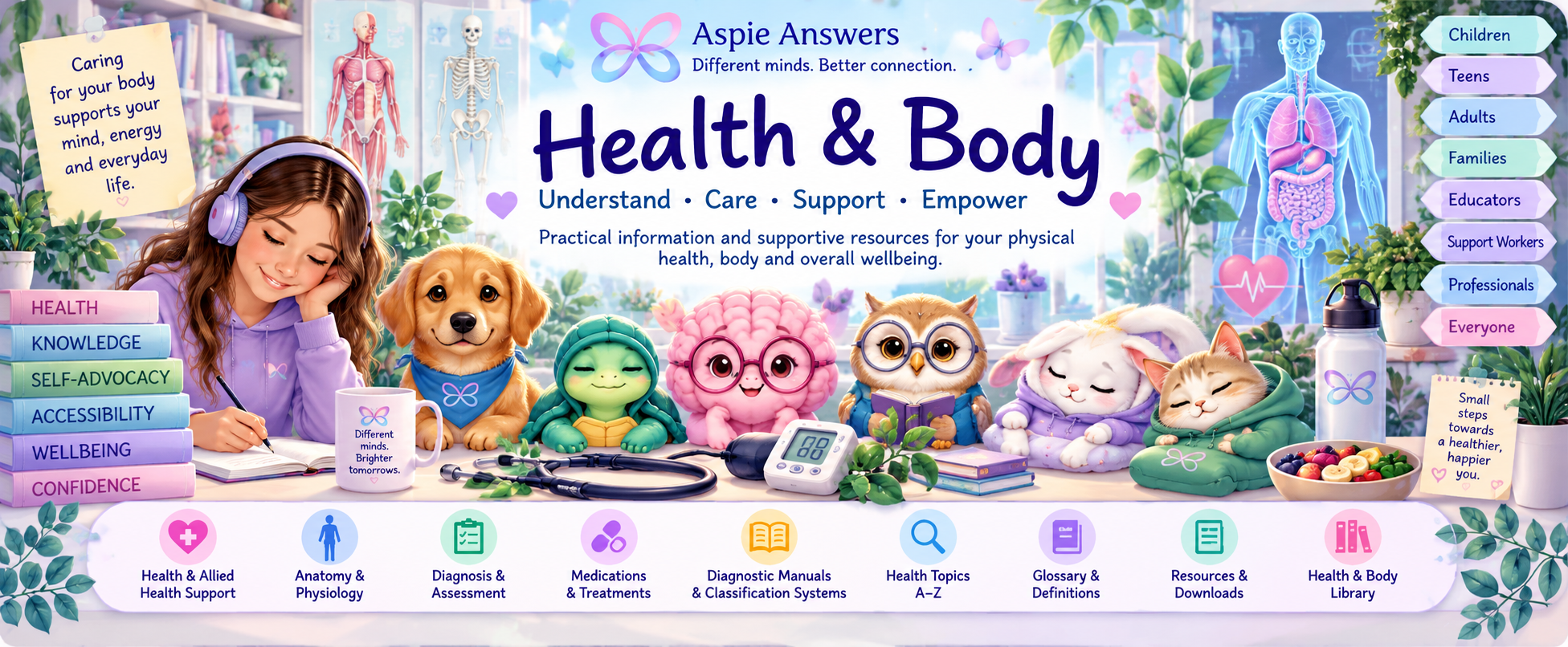
Health & Body
A calm, practical starting point for understanding human physical health, body systems, healthcare, assessment, treatments, allied health, accessibility and everyday support.
Who this page is for
Different people may arrive here for different reasons
For yourself
Understand your body, prepare for healthcare, explore support options and find practical next steps.
For family & whānau
Find clearer explanations, supportive questions and ways to help without taking over.
For support workers & carers
Support appointments, access needs, everyday health routines and person-centred participation.
For professionals
Use this hub as an orientation point into accessibility, communication, healthcare and allied-health support.
What you will find here
Understanding, healthcare, treatments, support and deeper learning
This hub brings together human physical-health information, healthcare pathways, assessment, treatments, allied health, accessibility, practical support and clear routes into deeper learning.
Understanding your body
Health information should make things clearer, not more overwhelming
Physical health can involve body systems, symptoms, appointments, tests, diagnoses, treatments, rehabilitation, daily routines and long-term support. You do not need to understand everything at once.
Learn how the body works
Build clearer understanding of body systems, anatomy, physiology and how different parts work together.
Understand the healthcare journey
Explore appointments, assessment, referrals, diagnoses, treatment planning and follow-up support.
Find practical support
Look at accessibility, communication, preparation, everyday routines and support that makes healthcare more workable.
Main Health & Body pathways
Start with the part of human health you want to understand
These first-level sibling pathways organise the Health & Body family without turning every health topic into a competing doorway. Dedicated sibling pages can do the deeper learning while this main hub stays calm and easy to scan.
Health Navigation & Wellbeing
Understand everyday health, healthcare navigation, appointments, prevention, self-advocacy and practical next steps.
First Aid for Humans
Clear, safety-focused first-aid learning, emergency awareness and guidance about when professional or urgent help is needed.
Anatomy & Physiology
Clearer explanations of body systems, organs, functions and how the human body works.
Diagnosis & Assessment
Assessment pathways, referrals, tests, appointments, results and questions to ask along the way.
Medications & Treatments
General understanding of treatment pathways, medicines, therapies, rehabilitation, monitoring and follow-up care.
Diagnostic Manuals & Classification Systems
Reference information about health classification, diagnostic frameworks and how formal systems organise conditions.
Health & Allied Health Support
Healthcare, therapy, rehabilitation, allied-health roles and practical support around appointments and ongoing care.
Open Health & Allied Health Support →Health & allied-health support
Different professionals support different parts of health, function and participation
The exact mix of professionals depends on the person, the health system and the reason for support. This hub keeps the overview broad, while the dedicated Health & Allied Health Support page can go deeper.
Primary & medical care
GPs, doctors, nurses, specialists and other medical professionals may support assessment, diagnosis, treatment and ongoing care.
Therapy & rehabilitation
Physiotherapy, occupational therapy, speech-language therapy and rehabilitation services can support movement, function, communication and participation.
Nutrition, medicines & practical health
Dietitians, pharmacists and other services may help with nutrition, medication understanding, health routines and practical care.
Sensory & specialist support
Audiology, podiatry, vision-related services and other specialist supports may be part of a wider care pathway.
Dedicated page: use the existing Health & Allied Health Support doorway for healthcare, therapy, assessment and allied-health pathways. Open Health & Allied Health Support →
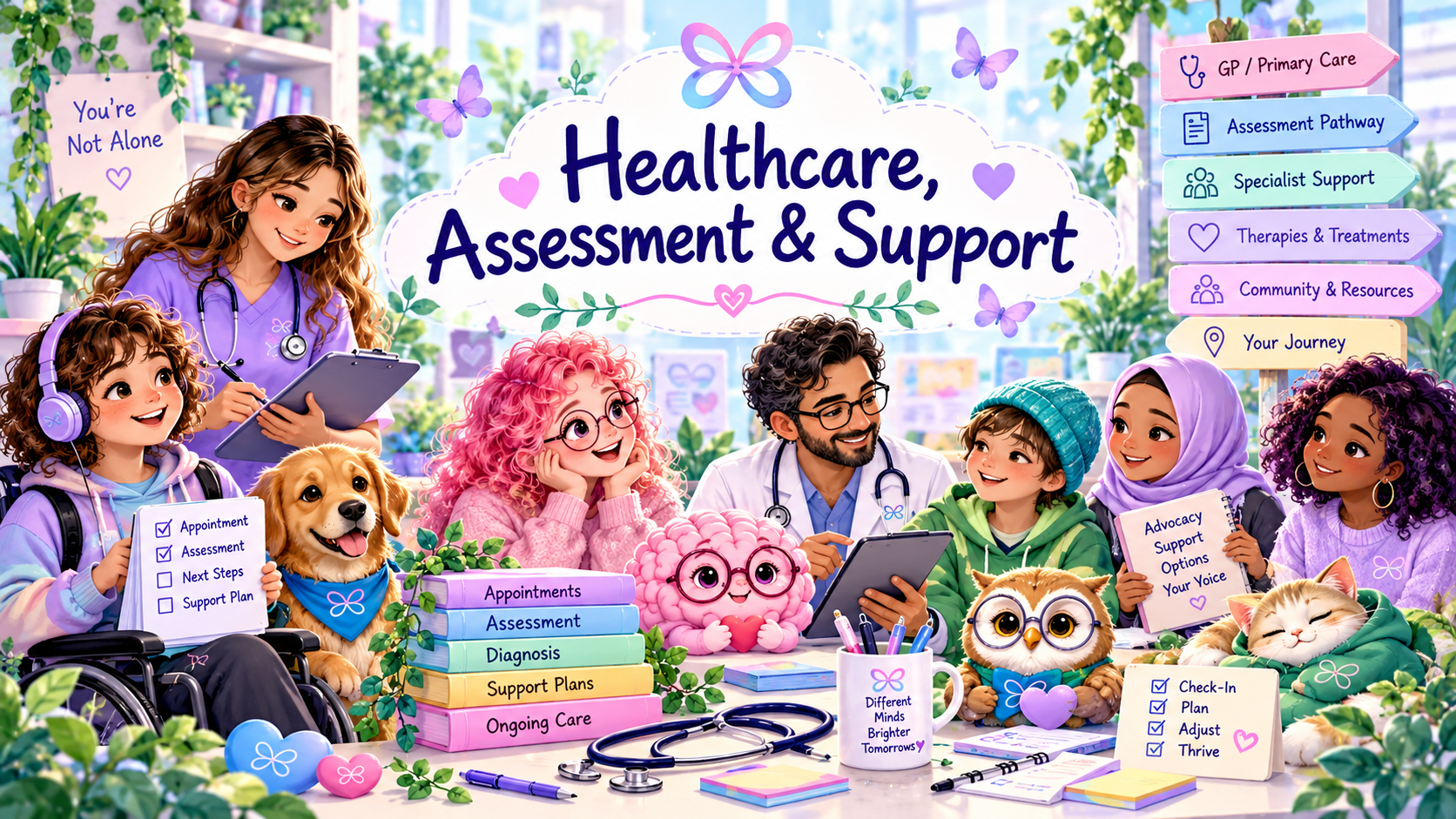
Healthcare, assessment & support
A healthcare pathway can involve several stages
Not every person will need every stage, and pathways vary by country, service and health system.
Preparing for an appointment
Write down concerns, priorities, questions, medication information and any communication or access needs.
Assessment & investigation
Tests, examinations, observations or specialist input may be used to better understand what is happening.
Results & next steps
Ask what the results mean, what options exist, what to monitor and when follow-up is needed.
Ongoing support
Healthcare may include treatment, rehabilitation, self-management, allied health or support with everyday participation.
Common assessment routes
Assessment can involve different tools and different professionals
History & screening
Questions about symptoms, health history, daily impact, family history and screening tools may help identify what needs closer assessment.
Examinations, tests & imaging
Depending on the concern, assessment may include physical examination, blood tests, other laboratory tests or medical imaging.
Specialist assessment
A referral may lead to a specialist or allied-health professional for a more focused assessment or opinion.
Results, second opinions & follow-up
Results may lead to treatment, monitoring, more testing, rehabilitation, a second opinion or planned follow-up.
Appointments can be easier with preparation
- Bring notes or a short symptom timeline.
- Ask for information in a format you can process.
- Take a support person if that helps you communicate or remember information.
- Ask what happens next before you leave.
Your communication needs matter
Some people need extra processing time, written information, clear language, quieter spaces, predictable steps or support explaining sensory and communication needs.
Medications & treatments
Understanding the category can make treatment information easier to navigate
Medicines and treatments can be grouped in different ways. The dedicated Medications & Treatments sibling can eventually go deeper, while this main hub gives a practical overview.
Prescription & over-the-counter
Prescription medicines require an authorised prescriber, while some medicines can be bought over the counter. Access rules vary by country.
Generic & brand names
The same active medicine can sometimes be sold under different brand names. Knowing the generic name can make medication lists clearer.
Medication forms
Medicines may come as tablets, capsules, liquids, creams, inhalers, patches, injections or other forms depending on the treatment.
Broad medication categories
Common groups can include pain relief, anti-inflammatory medicines, antimicrobials, allergy or respiratory medicines, cardiovascular medicines, gastrointestinal medicines, endocrine or metabolic medicines and neurological medicines.
Medication safety & understanding
- Keep an up-to-date medication list where possible.
- Tell healthcare professionals and pharmacists about allergies and other medicines or supplements you use.
- Ask what a medicine is for, how it should be used, and what side effects or warning signs matter.
- Check storage instructions and whether medication reviews are needed.
Treatments are broader than medication
Treatment can also include surgery, rehabilitation, therapy, equipment, lifestyle support, monitoring, education, pacing, recovery plans and other forms of care depending on the person and condition.
Treatments, allied health & everyday support
Support can look different depending on the person and the goal
Therapy & rehabilitation
Support may focus on movement, communication, function, recovery, pain, participation or adapting everyday tasks.
Daily living & practical care
Health support may include routines, equipment, pacing, meal support, personal care or help managing everyday tasks.
Rest, recovery & wellbeing
Sleep, pacing, recovery time, sensory regulation and realistic activity levels can all affect physical wellbeing.

Accessible healthcare
Healthcare works better when access needs are recognised
Disability, neurodivergence, sensory needs, communication differences, fatigue, pain, mobility or cognitive load can all affect how someone experiences healthcare.
Written information
Ask for summaries, instructions, appointment details or next steps in writing when that helps.
Sensory access
Noise, lighting, touch, waiting rooms and unfamiliar environments can affect participation and regulation.
Processing time
Some people need more time to understand questions, make decisions or explain what they are experiencing.
Communication support
Clear language, alternative communication, a support person or advance preparation may make care more accessible.
Across life stages
Health support can change over time
Children
Growth, development, family support, accessible appointments and early health needs.
Teens & young adults
Growing independence, consent, self-advocacy, transitions and learning how to manage healthcare.
Adults
Primary care, chronic health needs, work, routines, appointments and balancing health with daily life.
Transitions & changing needs
Support may shift during life changes, recovery, new diagnoses, disability changes or movement between services.
Resources & deeper learning
Use the wider Aspie Answers system when you are ready
Support & Directories
Move toward organisations, services, directories and broader support pathways.
Open Support & Directories →Resources & Downloads
Browse practical printable and digital tools across the wider resource system.
Browse Resources & Downloads →Everyday Help
Use practical support for routines, planning, forms, organisation and daily living.
Open Everyday Help →Health Topics A–Z
A planned specialist finder for human-health topics, body systems, assessment, treatment and practical healthcare information.
Health Glossary & Definitions
A planned specialist terminology guide for clearer explanations of health, anatomy, assessment, treatment and healthcare language.
A gentle note about health information
Health information can sometimes feel overwhelming, especially when symptoms, tests, unfamiliar language or multiple appointments are involved. It is okay to take information in smaller pieces, write questions down and ask for explanations in a format that works for you.
Information, diagnosis & treatment boundary
Aspie Answers provides general educational and practical information. This page is not a substitute for individual medical advice, diagnosis, treatment or emergency care. Health systems, terminology, eligibility and treatment pathways vary by country and service. For personal health decisions, use an appropriately qualified healthcare professional or local health service.
Questions
A few useful clarifications
Is Health & Body the same as Mental Health?
No. Health & Body is the main human physical-health and healthcare doorway. Mental Health remains its own separate hub, although physical and mental wellbeing can affect one another.
Does this hub replace professional medical advice?
No. It provides educational information and practical support pathways, not personalised diagnosis or treatment.
Does Health & Body include animal care?
No. Animal Care & Husbandry is being developed as its own separate main hub so animal health, care, husbandry, species-specific guides and related resources can have a clear home of their own.
Will this hub include anatomy and body systems?
Yes. Anatomy & Physiology is one of the first-level sibling pathways planned within the Health & Body family.
Will the Medications & Treatments page explain medication categories?
Yes. The planned sibling can go deeper into common medication groups, forms, generic and brand naming, prescription versus over-the-counter medicines, safety, side effects, interactions, reviews and treatment types.
Where can I find practical tools?
Use Resources & Downloads, Everyday Help and Support & Directories for practical tools and wider support pathways.
Understanding your health should feel clearer, more accessible and more manageable
The Health & Body hub is designed to help people understand human physical health, prepare for healthcare, recognise access needs and move toward useful support without having to navigate everything at once.