

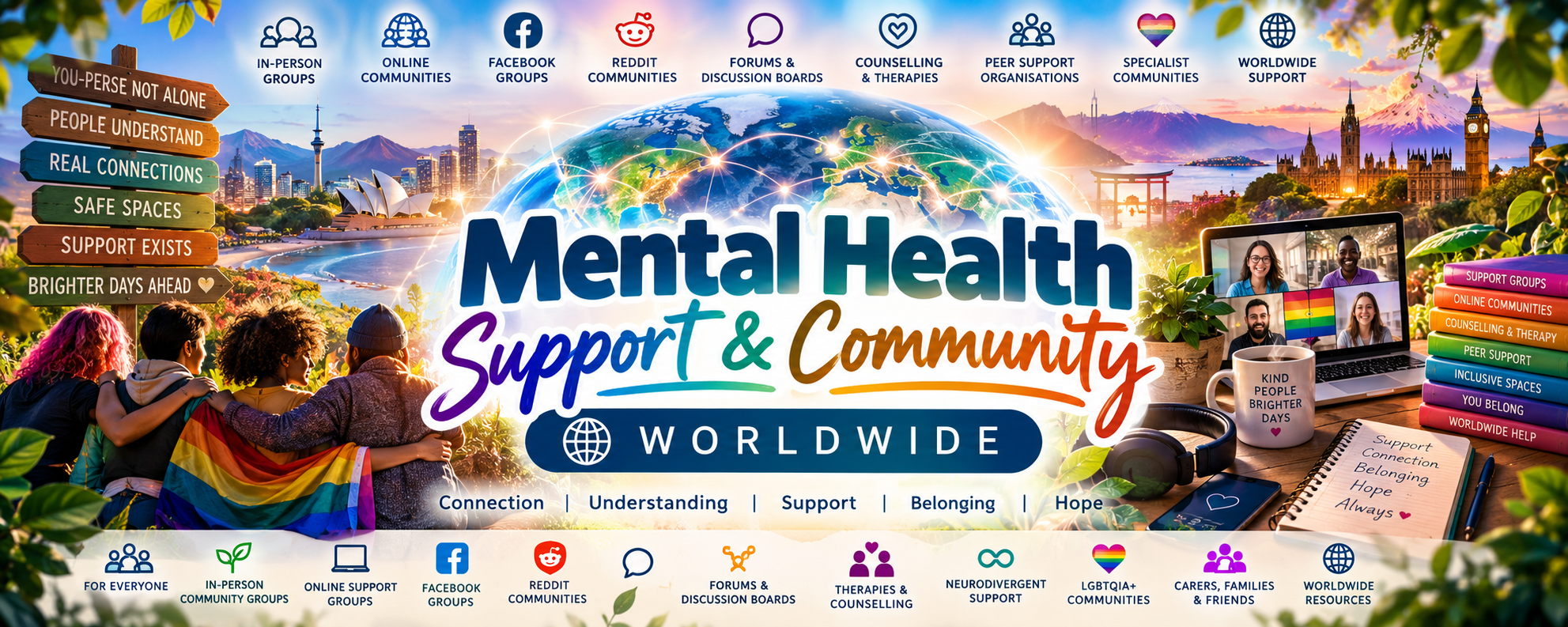
Mental Health Support & Community — Worldwide
Find different ways to connect with support — from counselling, therapy and professional help to peer groups, community organisations, online spaces, forums and identity-specific communities.
On this page
Support can look very different from one person to another
Mental health support is not limited to one service or one type of professional. For some people, counselling or therapy is the best starting point. Others may benefit from peer support, local groups, social connection, community organisations or online spaces where they can hear from people with similar experiences.
Professional support
Counselling, psychotherapy, psychology, psychiatry, community mental-health services and other professional support.
Peer & community support
Local groups, wellbeing programmes, recovery communities, peer-led spaces, social groups and community organisations.
Online connection
Online support groups, virtual meetups, forums, Facebook groups, Reddit communities and other moderated digital spaces.
Choose the kind of connection that feels most useful
There is no single correct route. You can use one option, combine several, or change what you use as your needs change.
Counselling & therapy
One-to-one or group professional support, including in-person and telehealth options.
Explore professional support →In-person groups
Local support groups, community centres, wellbeing programmes, peer groups and social connection.
Explore in-person community →Online communities
Virtual support groups, forums, message boards, Facebook groups, Reddit communities and online meetups.
Explore online support →Specialist communities
Neurodivergent, LGBTQIA+, disability, family/carer, cultural, age-specific and other focused communities.
Explore specialist support →
Counselling, therapies & professional mental health support
Professional support can range from short-term counselling through to longer-term therapy, specialist assessment, medication support or community mental-health care.
Counsellors & therapists
Counselling may help with emotional support, stress, relationships, grief, identity, coping and difficult life experiences. Different practitioners use different approaches.
Psychologists & psychotherapy
Psychologists and psychotherapists may provide structured psychological therapies, assessment, formulation and longer-term therapeutic support, depending on their role and local system.
Psychiatry & medical support
Psychiatrists and other medical professionals may be involved when assessment, medication, complex mental-health needs or specialist medical care are required.
Community mental-health services
Some regions provide multidisciplinary community teams, outreach services, recovery programmes, social support and care coordination.
Telehealth & online therapy
Remote counselling and therapy can improve access when travel, disability, location, sensory needs or scheduling make in-person appointments difficult.
Peer-support workers
Peer workers use lived experience alongside training and service knowledge. Their role is different from clinical therapy, but can be valuable for connection, navigation and recovery support.
Finding a suitable practitioner
It is reasonable to ask about qualifications, registration where relevant, experience, therapeutic approach, fees, accessibility, telehealth, confidentiality and whether the practitioner is neurodivergent-affirming, disability-inclusive, culturally responsive or LGBTQIA+-affirming when that matters to you.
Explore the Professionals pathwayIn-person groups, programmes & local connection
Community support can offer understanding, practical knowledge, companionship and a sense of belonging alongside — or sometimes before — formal professional services.
Local support groups
Regular groups focused on mental health, wellbeing, recovery, particular experiences or shared life circumstances.
Community centres
Local centres may offer social groups, wellbeing activities, information, drop-in support, classes or links to other services.
Peer-led communities
Spaces facilitated by people with lived experience can provide mutual understanding without requiring everyone to explain the basics.
Recovery & wellbeing programmes
Structured community programmes may focus on coping skills, connection, confidence, routine, recovery, education or daily living.
Social & activity groups
Not every helpful group needs to be therapy-focused. Interest groups, walking groups, creative groups and shared activities can reduce isolation.
Community organisations & charities
Non-profits, advocacy organisations and local services may provide groups, information, navigation, education or practical support.

Online groups, forums, Facebook, Reddit & virtual communities
Online spaces can be especially useful when local support is limited, travel is difficult, anonymity feels safer, or you want to connect with people who share a specific experience.
Online support groups
Scheduled video groups, text-based groups, moderated peer spaces and virtual wellbeing programmes.
Facebook groups
Facebook communities can make it easy to find local, condition-specific or identity-specific groups. Check whether the group is private, how it is moderated and what information is visible to others.
Reddit communities
Reddit can provide large lived-experience communities and anonymous discussion. Treat personal posts as peer perspectives rather than verified professional advice.
Forums & message boards
Forums may offer slower-paced discussion, searchable older conversations and long-running communities around mental health, neurodivergence, disability, recovery or specific life experiences.
Virtual meetups & social groups
Online meetups can provide social connection without the sensory, transport or geographic barriers that may come with an in-person event.
Other digital communities
Some communities use chat platforms, private groups, community apps or moderated networks. Privacy and moderation standards vary considerably between platforms.
Online information can be helpful — and it can also be wrong
Personal stories may help you feel understood, but they are not automatically reliable medical, legal or clinical advice. Be cautious with anyone pressuring you to stop treatment, buy a cure, share private information or move quickly into private messages.
Specialist & identity-specific communities
A general mental-health group may not always understand the additional experiences connected with neurodivergence, disability, sexuality, gender, culture, age, caring roles or other parts of life.
LGBTQIA+ communities
Affirming mental-health information, support and community pathways for LGBTQIA+ people.
Explore LGBTQIA+ mental health →Neurodivergent communities
Peer spaces and support that understand autistic, ADHD and other neurodivergent experiences.
Explore Neurodivergence →Disability-inclusive support
Accessibility, participation, rights and support where disability or access needs are part of the picture.
Explore Accessibility & Rights →Families & whānau
Support pathways for parents, families and whānau who are supporting someone or need support themselves.
Explore family pathways →Supporters & carers
Support workers, carers, friends and other people providing practical or emotional support.
Explore Support Workers & Supporters →Neurodiversity & inclusion
Understanding, inclusion, acceptance and participation across different kinds of minds.
Explore Neurodiversity →More specialist community pages may be added later
Aspie Answers will continue auditing existing pages before creating separate specialist community doorways. A new page should only be added when there is a genuine gap rather than duplicating an existing support route.

What can make a community feel safer?
No community can guarantee that every interaction will be positive, but there are useful signs that a group takes safety, boundaries and inclusion seriously.
Expectations about respect, harassment, discrimination and harmful content are easy to find.
There are identifiable moderators or organisers and a way to report problems.
The group explains what is public, private, recorded, searchable or visible to other members.
Different communication styles, identities, cultures and access needs are treated respectfully.
Members are not pressured to disclose personal information, meet privately or accept advice they do not want.
The community is clear about what it can and cannot safely provide during an emergency.
Questions you can ask before joining or booking support
You are allowed to look for a better fit when a service, practitioner or community does not feel right for you.
What kind of support is this?
Professional treatment, peer support, social connection, education, advocacy or a mixture?
Who runs or moderates it?
Qualified practitioners, trained peer workers, volunteers, community members or platform moderators?
What does it cost?
Free, donation-based, publicly funded, insurance-based, subscription, membership or private fee?
How private is it?
Ask what is confidential, what is recorded and what other participants can see.
Is it accessible for me?
Consider sensory needs, communication style, mobility, language, captions, transport, timing and online access.
Does it understand my identity or needs?
Look for affirming and culturally responsive support where this is important to you.
If you need urgent or crisis support
Community groups, forums and peer spaces are not emergency services. If you or someone else may be in immediate danger, needs urgent mental-health help, or cannot stay safe, use the dedicated Crisis Support pathways instead.
Related Aspie Answers pathways
Use these broader routes when you want information, practical tools or a different kind of support.
Mental Health & Wellbeing
Understanding, wellbeing information and mental-health support pathways.
Explore mental health →Everyday Help
Practical support with routines, planning, organisation and daily life.
Explore Everyday Help →Resources & Downloads
Worksheets, guides, planners, printables and practical support resources.
Browse resources →Knowledge & Learning Library
Learn about neurodivergence, mental health, disability, support and related topics.
Open the library →You do not have to find every kind of support at once
Start with the option that feels most manageable today. A small connection, one useful conversation or one supportive community can be a meaningful next step.