
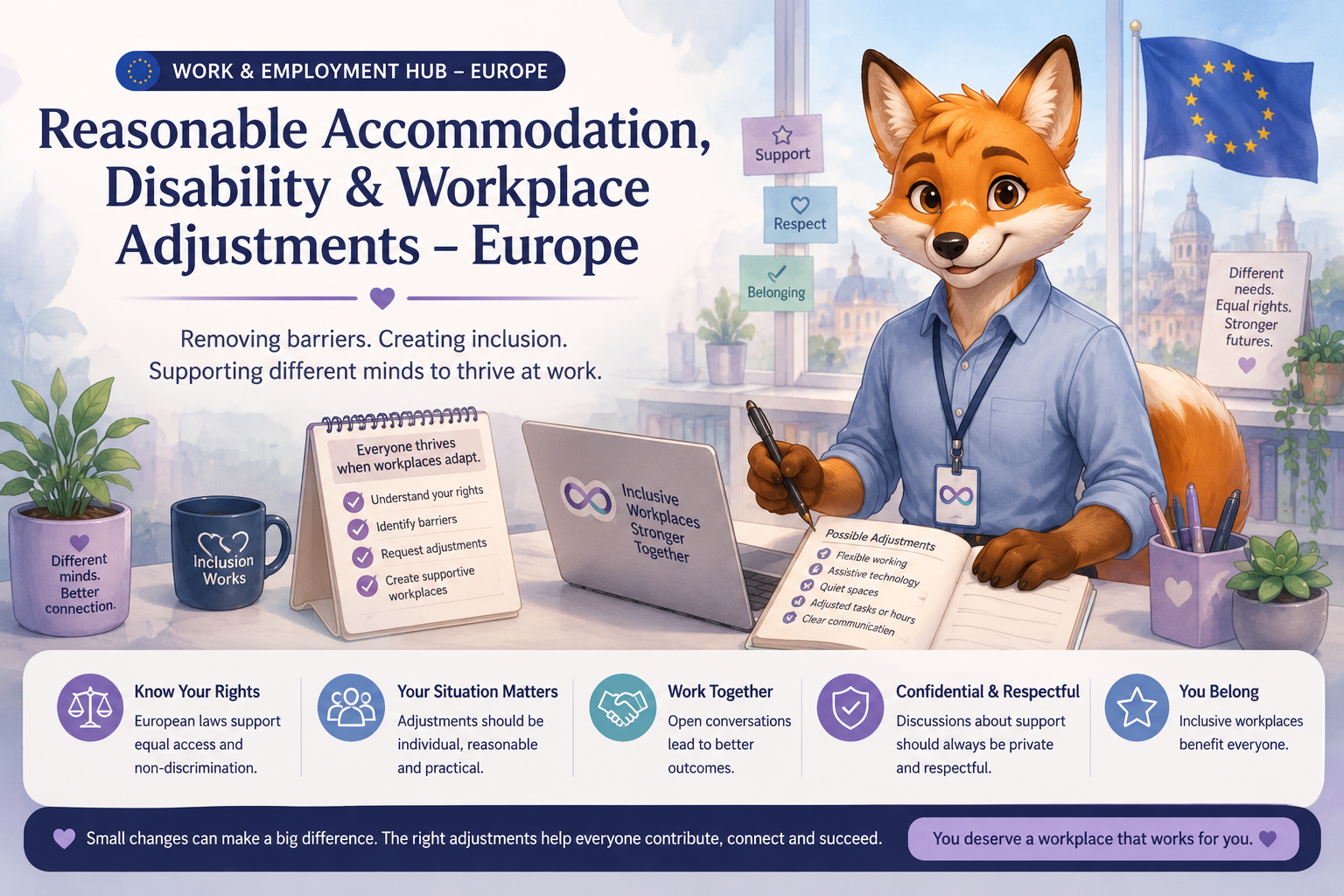
Reasonable accommodation, disability & workplace adjustments
Workplace barriers can affect people in very different ways. An adjustment that is useful for one person may not be useful for another.
This guide explains reasonable accommodation and workplace adjustments in a practical, neurodivergent-friendly way, with examples of changes that may help disabled, autistic, ADHD and other neurodivergent workers participate more fully at work.
Try words such as sensory, communication, hours, remote work, technology, disclosure, confidentiality or request.
Try another word or use the quick-navigation links below.
♿ What is reasonable accommodation?
Reasonable accommodation means making appropriate changes to a job or work environment where those changes are needed to help a disabled person access, perform or progress in employment.
Accessing employment
Adjustments can be relevant during recruitment, interviews, assessments and onboarding as well as after someone begins work.
Doing the job
Changes may help reduce unnecessary barriers while allowing someone to carry out the important parts of their role.
Progressing at work
Accommodation may also be relevant to workplace training, development and advancement.
Individual circumstances
The most appropriate adjustment depends on the person, the barrier, the job and the workplace.
🧩 Identifying workplace barriers
Sometimes the easiest place to begin is by identifying what is making work difficult rather than trying to immediately name an adjustment.
Communication barriers
Verbal-only instructions, unclear expectations, rapid meetings, ambiguous language or insufficient processing time.
Sensory barriers
Noise, lighting, crowded environments, smells, interruptions or unpredictable sensory input.
Executive-function barriers
Prioritising, task switching, working memory, planning, time management or multiple competing demands.
Physical access barriers
Building access, workstation layout, movement, equipment or inaccessible facilities.
Scheduling barriers
Unpredictable shifts, short-notice changes, rigid start times or insufficient transition and recovery time.
Technology barriers
Inaccessible software, unsuitable equipment, visual overload or systems that do not work well with assistive technology.
🛠️ Examples of possible workplace adjustments
These are examples rather than guarantees. What is suitable depends on individual circumstances, the role, national rules and the workplace.
Flexible working arrangements
- Adjusted start or finish times
- Flexible scheduling where appropriate
- Remote or hybrid work where suitable
- Additional transition or recovery time
Communication adjustments
- Written instructions
- Clear priorities and expectations
- Meeting agendas in advance
- Additional processing time
- Written follow-up after important discussions
Sensory adjustments
- Quieter working areas
- Noise-reducing equipment where appropriate
- Lighting changes
- Reduced unnecessary interruptions
- Access to a calmer space
Task & organisation support
- Breaking large tasks into stages
- Written priorities
- Checklists or visual systems
- More predictable workflows
- Regular structured check-ins
Technology & equipment
- Assistive software
- Speech-to-text or text-to-speech tools
- Alternative input equipment
- Ergonomic equipment
- Accessible digital formats
Ways of completing work
- Adjusting how particular tasks are carried out
- Reducing avoidable environmental barriers
- Changing workflow where practical
- Using strengths to support effective working
🧠 Neurodivergent-friendly workplace adjustments
Autistic, ADHD and other neurodivergent workers can experience barriers that are not immediately visible to colleagues or managers.
Autism
Helpful changes might involve sensory environments, predictable communication, clear expectations, reduced ambiguity, preparation for change or alternative ways of communicating.
ADHD
Support might involve clearer priorities, task breakdowns, reminders, reduced distractions, movement opportunities, flexible work methods or structured check-ins.
Dyslexia & processing differences
Alternative formats, assistive technology, additional processing time and accessible written information may reduce barriers.
Hidden disabilities
A disability or support need does not need to be immediately visible for workplace barriers to be significant.
Finn Fox's problem-solving approach
Not sure which adjustment might help? Start with the barrier.
- What part of the situation is difficult?
- When does the difficulty happen?
- What would make that part easier or more accessible?
- Is there a practical change that could reduce the barrier?
- How could you explain that change clearly?
Small changes can sometimes make a big difference.
💬 Requesting a workplace adjustment
The process varies by country and employer, but preparing what you want to communicate can make the conversation easier.
1. Describe the barrier
Explain what is making it difficult to access or carry out part of your work.
2. Explain the impact
Describe how the barrier affects working, communication, concentration, participation or access.
3. Suggest possible solutions
If you already know something that may help, suggest one or more practical options.
4. Discuss alternatives
Another adjustment may sometimes address the same barrier. A collaborative discussion can help identify workable options.
🔐 Disability disclosure & sharing information
Requesting workplace support can involve sharing information about a disability, condition or barrier.
How much information is required, who receives it and what supporting evidence may be requested can depend on national law and workplace procedures.
🛡️ Confidentiality & respectful conversations
- Ask who needs access to information about your adjustment.
- Ask how health or disability information will be stored or handled.
- Keep copies of important requests and responses.
- Record agreed adjustments where appropriate.
- Ask who to contact if an agreed adjustment is not working or has not been implemented.
🚧 If an adjustment request is declined
A declined request does not necessarily mean that there are no other possible solutions or support routes.
Ask for an explanation
Ask why the proposed adjustment cannot be provided.
Explore alternatives
Another adjustment may address the same barrier in a different way.
Keep records
Keep useful copies of requests, responses and agreed next steps.
Seek country-specific support
Equality bodies, employment services, unions, disability organisations or legal services may be able to explain your options.
✅ My workplace-adjustment checklist
- I have identified the main workplace barrier.
- I have thought about what might reduce that barrier.
- I know who I can speak to at work.
- I have written down the main points I want to explain.
- I know whether I want someone to support me in the conversation.
- I have considered asking for important information in writing.
- I will keep copies of requests and responses.
- I know where to look for country-specific guidance if I need it.
🌍 European guidance & country-specific rules
European guidance provides a useful starting point, but the practical process can differ depending on the country where you work.
🇪🇺 European-level framework
EU employment-equality rules include reasonable accommodation for disabled people in employment, subject to the circumstances and proportionality requirements.
🗺️ Country-specific information
National systems can differ in terminology, procedures, support, funding, recognition processes and routes for raising concerns.
A useful approach: understand the broad European principles here, then check the current official information for the country where you work.
🔗 Official help & further information
These official European resources can help you continue from this overview into more detailed guidance.
🇪🇺 European Commission
Read practical guidance and examples about reasonable accommodation at work.
Reasonable Accommodation Guidance ↗⚖️ Your Europe
Find European employment-rights information and guidance about equal treatment at work.
Employment Rights Information ↗🗺️ EURES
Explore employment and disability-support information across participating European countries.
Explore EURES Support ↗For advice about your own situation, consider an appropriate national equality body, labour authority, trade union, disability organisation, advocacy service or qualified legal adviser.