
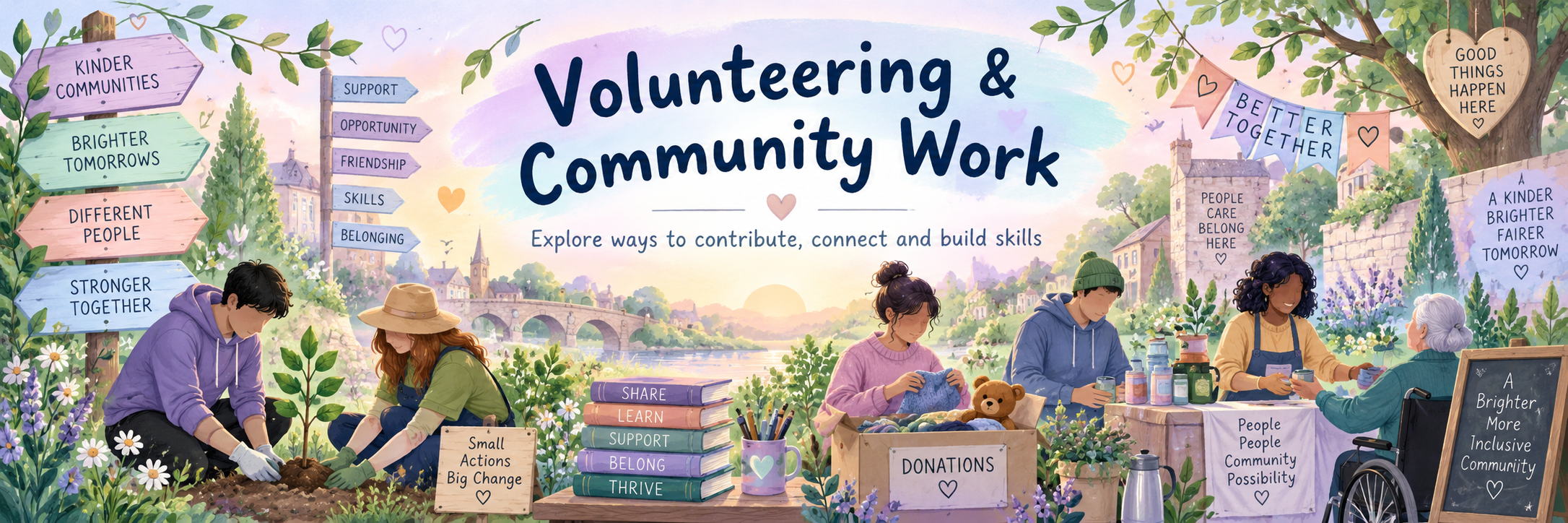
Volunteering and community work can take many forms
Volunteering and community work can offer ways to contribute, connect, build experience, explore interests and develop skills. This section can help you find opportunities that fit your strengths, needs, values, available energy and preferred ways of participating.
Contribute in a way that matters
Support a cause, community, project or organisation that connects with your interests or values.
Build experience and confidence
Learn skills, explore environments and discover what kinds of activities or responsibilities suit you.
Connect with community
Participation can create connection and belonging without requiring everybody to participate in the same way.
There is more than one way to take part
Community participation can look different depending on your interests, capacity, confidence, access needs and stage of life.
🌱 First-time volunteers
People who want to explore volunteering but are unsure where to begin.
🧠 Neurodivergent people
People considering sensory needs, communication, executive function, predictability and social energy.
🔎 Job seekers
People interested in gaining experience, references, confidence or insight into a field of work.
💛 Community-minded people
People wanting to contribute time, knowledge, creativity or practical help to something meaningful.
🌤 People returning to activity
People gradually rebuilding routines, confidence or community participation.
🤝 Families, supporters & professionals
People helping someone explore opportunities, access needs and sustainable participation.

Volunteering can be about much more than work experience
People volunteer for many different reasons. Your reason does not have to look like somebody else's.
🤝 Contributing
Supporting a cause, group, place or community that matters to you.
🌱 Building confidence
Trying manageable responsibilities and recognising what you can do.
📚 Learning
Developing practical knowledge, communication, organisation or specialist skills.
💬 Connection
Meeting people around a shared activity, interest or community.
🔎 Exploring an interest
Learning whether a cause, environment or type of work feels right for you.
⭐ Purpose & meaning
Having an activity or role that feels worthwhile and personally meaningful.
Volunteering does not have to mean one regular weekly role
Different formats can suit different interests, energy levels, schedules and support needs.
📅 Regular volunteering
A predictable weekly or fortnightly role with an organisation or group.
🎪 Event volunteering
Festivals, fundraising events, community days or one-off activities.
💻 Online & remote volunteering
Writing, research, design, administration, digital support or other remote contributions.
🌿 Environmental volunteering
Conservation, gardening, clean-ups, restoration and outdoor community projects.
🐾 Animal-related volunteering
Animal welfare, rescue organisations, shelters or community animal programmes.
🎨 Creative volunteering
Design, photography, writing, crafts, performances or creative community projects.
🧩 Skills-based volunteering
Contributing specialist skills such as technology, administration, accounting or communications.
💛 Peer & community support
Welcoming others, lived-experience contribution or supporting community programmes.
🌟 Informal community contribution
Helping neighbours, local groups or projects without necessarily holding a formal volunteer title.
The cause matters — and so does the environment around the role
A worthwhile organisation may still have a role, schedule or environment that does not work particularly well for you.
Clear expectations can make participation much easier
Neurodivergent volunteers may benefit from many of the same practical supports that can help in workplaces, learning environments and everyday life.
Written instructions
Checklists, written steps or follow-up messages can make tasks easier to understand.
Predictable routines
Knowing where to go, what to do and how long the role lasts can reduce uncertainty.
A clear contact person
Knowing who to ask can stop small uncertainties becoming overwhelming.
Sensory considerations
Quieter areas, breaks, different tasks or reduced sensory demands may sometimes help.
Processing time
Some people benefit from extra time to understand instructions or unexpected changes.
Direct communication
Clear language can be more supportive than relying on unwritten rules or assumptions.
Contribution does not always need a formal volunteer title
Community participation can include informal, creative, local, online and interest-based ways of helping or taking part.
🏘 Local groups
Clubs, neighbourhood initiatives, local projects and community gardens.
💻 Online communities
Moderation, information sharing, digital help or contributing specialist knowledge.
📣 Advocacy & awareness
Sharing lived experience, supporting campaigns or helping community education.
🎨 Helping through interests
Using hobbies, creativity or specialist interests to make a useful contribution.
Volunteering can sometimes help you explore working life
Volunteering can support career exploration and experience, but it should not be treated as a requirement for everybody or used to replace genuine paid employment.
🔎 Explore an industry
Learn whether a field or environment interests you before making a bigger commitment.
⭐ Recognise skills
Notice communication, organisation, teamwork, problem-solving or specialist strengths.
📄 Build experience
Appropriate volunteering may provide experience, examples of your work or references.
Community participation can reveal strengths you may overlook
Skills developed outside paid employment can still be real, useful and transferable.

A few questions can help before you commit
You are allowed to investigate an opportunity before deciding whether it is right for you.

You are allowed to investigate before deciding
Finn Fox supports problem-solving, flexibility and independence. Compare opportunities, ask questions and choose another route if the first option does not fit your needs.
Helping others should not require every bit of energy you have
Sustainable participation means considering your own wellbeing as well as the needs of the organisation or community.
Be clear about your commitment
Agree on realistic hours and responsibilities rather than continually adding more.
Notice your energy
Include travel, sensory load, social interaction and recovery when judging the real demand.
Know who to speak to
You should know who to contact if something feels unclear, difficult or unsafe.
Keep appropriate boundaries
Being helpful does not mean agreeing to every request or responsibility.

Sustainable participation still counts
Toby Turtle reminds us that one manageable hour can be more sustainable than promising five and becoming exhausted. Your contribution does not become less valuable because you protect your energy.
You are allowed to reduce, change or leave a volunteer role
Sometimes expectations change, a role stops fitting or the demands become more than you can manage sustainably.
Reduce the commitment
Ask whether fewer hours or responsibilities would make the role manageable.
Change tasks
Another activity within the same organisation may fit you better.
Take a break
Temporary rest may be appropriate when health, life or energy changes.
Leave respectfully
You can explain that you are no longer able to continue without having to disclose every personal detail.
Community participation is worldwide — the systems around it can differ
Volunteer organisations, safeguarding requirements, background checks, unpaid-work rules and support systems can vary depending on where you live.
🌍 Worldwide foundation
The guidance on role fit, communication, boundaries, accessibility and sustainable participation can be useful wherever you live.
🇳🇿 New Zealand
If you are in New Zealand, check local volunteer centres, organisations and official guidance for opportunities, safeguarding requirements and practical support.
🇦🇺 Australia
Australian volunteer organisations and community networks can provide local information about opportunities, requirements and support.
🌐 Other countries & regions
Look for established local volunteer networks, community organisations and official information relevant to your country or region.
Useful tools for choosing and managing volunteering
Practical worksheets, checklists and reflection tools can make it easier to compare opportunities, prepare for a role, recognise your skills and keep volunteering manageable and sustainable.
Volunteer Opportunity Comparison Sheet
Compare roles, environments, commitments, support and practical requirements.
Questions to Ask Before Volunteering
Useful prompts for finding out what a role, organisation and commitment actually involve.
First-Day Volunteer Planner
Prepare transport, contacts, timing, tasks, breaks and useful questions.
Volunteer Role & Energy Check-In
Notice whether a role continues to feel manageable and sustainable.
Skills Built Through Volunteering
Recognise experience and transferable skills you may otherwise overlook.
Volunteer Experience Record
Record activities, responsibilities, achievements and useful examples for future reference.
Volunteer Boundaries Worksheet
Think about time, availability, responsibilities, communication and what you can realistically offer.
Is This Opportunity Right for Me?
Consider practical, sensory, social, accessibility and energy needs before committing.
Companions for exploring, planning, learning and pacing
Different parts of volunteering can call for different kinds of support. These Companions connect especially naturally with this journey.
Explore opportunities, compare possibilities and change direction when something does not fit.
Protect energy, keep commitments manageable and remember that sustainable participation still counts.
Organise enquiries, schedules, responsibilities and practical next steps.
Notice what you are learning and recognise skills that grow through experience.
Frequently asked questions
A few common questions about volunteering, community participation and finding a role that works for you.
Do I need previous experience to volunteer?
Can neurodivergent people ask for adjustments when volunteering?
Does volunteering help with finding paid work?
What if I can only volunteer occasionally?
What if a volunteer role becomes too much?
Do all volunteering opportunities involve lots of social interaction?
Can online volunteering count as real volunteering?
Can I leave if the organisation is not treating me well?
Where would you like to go next?
Volunteering can connect with career planning, workplace skills, different ways of working and the wider Work & Employment journey.
You do not have to participate like everybody else to make a difference
A meaningful contribution might be regular or occasional, public or behind the scenes, practical or creative, in person or online. What matters is finding a way of participating that is useful, respectful and sustainable for you.