
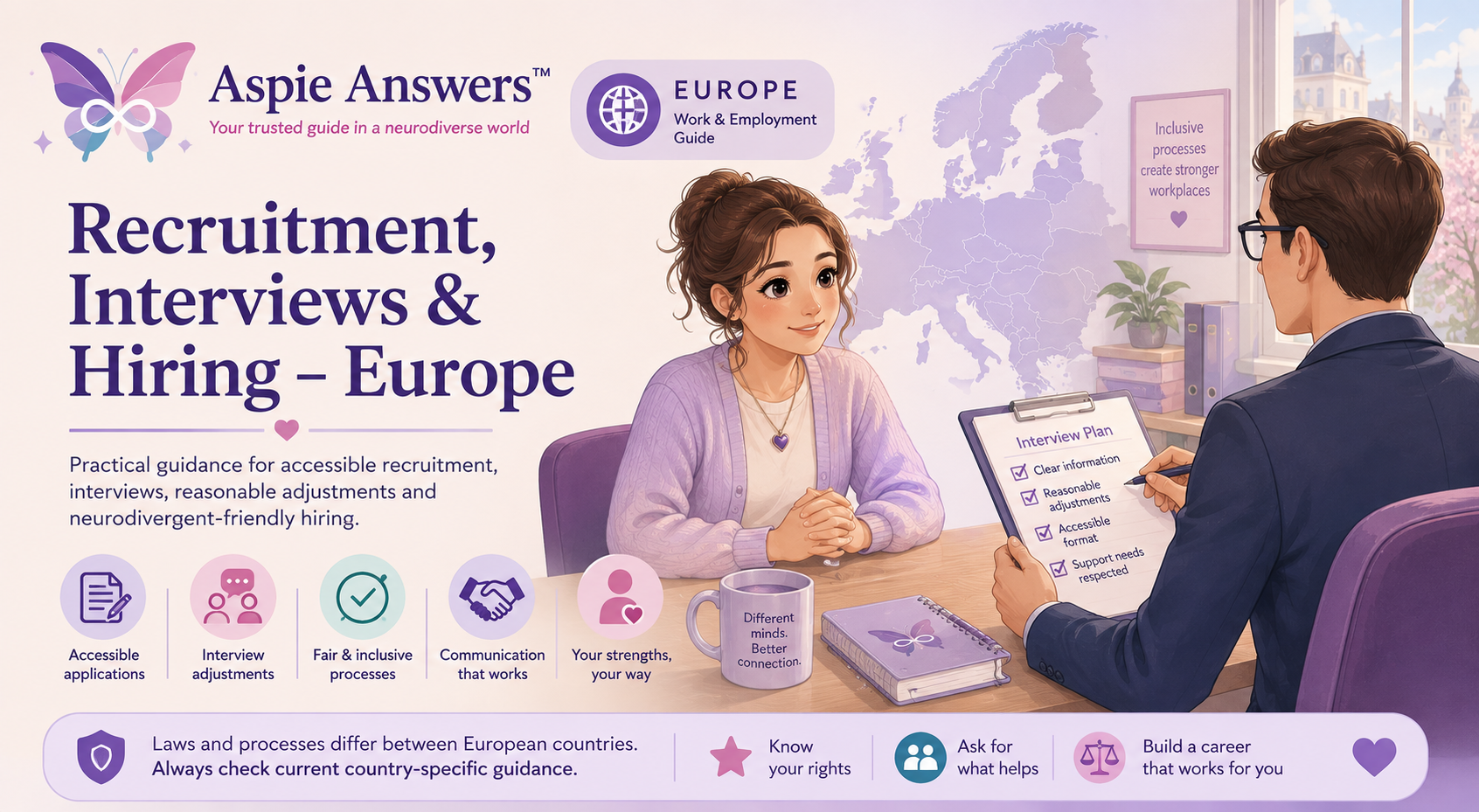
Recruitment can involve much more than simply applying for a job. Application forms, interviews, assessments, communication expectations and unfamiliar environments can all affect how well someone is able to demonstrate their skills.
This guide explores recruitment and hiring across Europe with particular consideration for autistic, ADHD, neurodivergent and disabled applicants. It includes practical ideas for preparing for recruitment, requesting adjustments and navigating different stages of the hiring process.
🧭 Understanding the Recruitment Process
Recruitment processes vary considerably between employers and countries. Some involve only an application and interview, while others may include several stages.
1. Job advertisement
Read the role description carefully and identify essential requirements, preferred skills, location, hours and application instructions.
2. Application
You may be asked for a CV, résumé, cover letter, online application form, portfolio or responses to selection questions.
3. Shortlisting
The employer reviews applications and selects applicants to progress to an interview, assessment or another recruitment stage.
4. Interview or assessment
This could be face-to-face, online, by telephone, with a panel, or combined with practical tasks or assessments.
5. References or checks
Depending on the job, employers may request references or complete relevant employment, qualification or background checks.
6. Job offer
If successful, you may receive an offer followed by information about your contract, conditions, start date and onboarding.
📝 Accessible Job Applications
A good recruitment process should give applicants a reasonable opportunity to understand the role and demonstrate whether they can perform it.
Clear information
Look for a clear job description, essential criteria, application deadline, work location, hours and recruitment stages.
Application format
If an application system creates an accessibility barrier, you may be able to ask whether an alternative accessible format is available.
Focus on evidence
Use examples that show your skills and experience rather than trying to guess the personality an employer expects.
Give yourself time
Where possible, break the application into smaller tasks: research, draft, review, proofread and submit.
💬 Preparing for an Interview
Interviews often test communication under pressure as much as job knowledge. Preparation can reduce uncertainty and help you communicate your experience more clearly.
- Review the job description and essential criteria.
- Prepare examples of situations where you used relevant skills.
- Write down questions you want to ask the employer.
- Check the interview location, travel arrangements or online meeting link.
- Confirm the date, time and expected interview format.
- Prepare documents, notes or portfolio examples where appropriate.
- Allow recovery time before and after the interview if you need it.
♿ Recruitment & Interview Adjustments
Some applicants may need changes to the usual recruitment process so they can participate fairly. The exact rights and terminology depend on the country.
Possible adjustments might include:
🧩 Tests, Tasks & Recruitment Assessments
Some employers use aptitude tests, personality questionnaires, group exercises, presentations, written tasks, technical assessments or work simulations.
If you are invited to an assessment, it can help to ask:
- What type of assessment will be used?
- How long will it take?
- Is it timed?
- What equipment or technology is required?
- Will it be completed individually or in a group?
- What skill is the assessment intended to measure?
- Who should you contact about accessibility or adjustments?
Where an assessment format creates a disability-related barrier, ask the employer or recruitment contact what appropriate alternatives or adjustments may be available.
🌱 Neurodivergence, Disability & Disclosure
Deciding whether to tell an employer about autism, ADHD, another neurodivergent condition or disability can be a personal decision. Legal rules about what employers may ask, what applicants need to disclose and how information must be handled vary between countries.
You may choose to focus on the practical support you need rather than giving extensive personal information.
For example
Instead of explaining every aspect of a diagnosis, an applicant might explain that clear written instructions, additional processing time or a quieter interview environment would help them participate effectively.
📨 After the Interview
Once the interview is finished, give yourself permission to decompress before analysing every answer.
Write brief notes
Record questions you remember, what went well and anything that may help with future interviews.
Follow up appropriately
If the employer provided a decision timeframe, wait until that period has passed before following up unless they told you otherwise.
Ask for feedback
If you are unsuccessful, you may choose to ask whether constructive feedback is available.
Review the offer
If you receive an offer, take time to understand the role, contract, hours, pay, conditions and any agreed workplace support.
⚖️ Fair Recruitment & Your Rights
European countries have their own employment and anti-discrimination frameworks, while European-level rules and principles may also be relevant depending on the country and situation.
If you believe a recruitment process was inaccessible or discriminatory:
- Keep copies of relevant emails, advertisements and application information.
- Write down what happened while the details are still clear.
- Check the employer's recruitment or complaints process.
- Check official disability, equality or employment guidance for your country.
- Seek appropriate advocacy, union, legal or professional support where needed.
✅ Recruitment Preparation Checklist
🌍 Continue through Europe Workplace Guidance
Recruitment is only one part of working life. Continue exploring related Aspie Answers Work & Employment guidance as these pages are developed and connected.
💼 Work & Employment Hub
Return to the main Aspie Answers Work & Employment Hub.
⚖️ Workplace Rights & Employment Guidance
Explore the wider workplace rights and employment guidance collection.
📄 Contracts & Working Conditions — Europe
Understand employment arrangements, contracts and working conditions.
♿ Workplace Adjustments — Europe
Explore reasonable accommodation, disability and workplace adjustments.
💬 Communication & Disclosure — Europe
Explore workplace communication, disclosure and neurodivergence guidance.
🌐 Country-specific guidance matters
Europe includes many different legal systems, recruitment practices and workplace cultures. Always check current official information for the country where the recruitment process takes place.
As the Aspie Answers Europe collection grows, country-specific pathways can be added where they genuinely improve navigation rather than overcrowding the main website menu.