
Accessibility & Rights Glossaries & Definitions
Clear language can make rights, accessibility and support easier to understand. Use this glossary to explore common terms, see what they can mean in everyday life, and move into related Aspie Answers information when you want to learn more.
Start Here
You can use this page when you meet an unfamiliar word, want a simpler explanation, or need to understand how a term connects with accessibility, rights, inclusion, accommodations or self-advocacy.
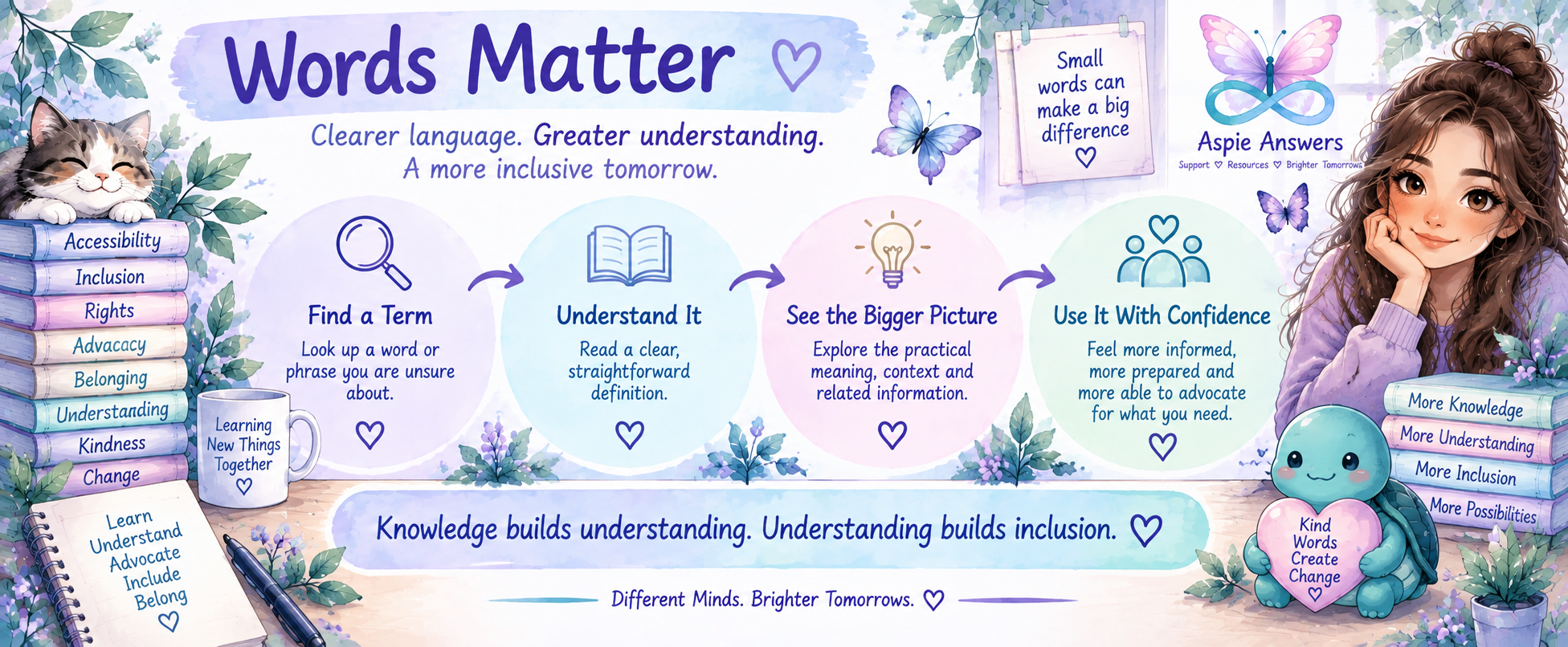
Words Matter
Knowing the words used in accessibility and rights conversations can make information easier to understand and can help you feel more prepared when asking questions, explaining needs or speaking up for yourself or someone else.
Accessibility & Rights A-Z Glossary
Choose a letter below or scroll through the glossary. Letters without a current entry are shown as inactive rather than sending you to an empty section.
A
Accommodation
A change, adjustment or support that helps reduce a barrier so a person can participate more fairly or effectively. Accommodations may relate to communication, timing, environment, equipment, information or how a task is completed.
Related: Reasonable adjustment, Accessibility, BarrierAccessibility
The extent to which environments, information, services, technology and activities can be reached, understood and used by people with different needs and abilities. Good accessibility aims to reduce unnecessary barriers from the beginning.
Related: Universal design, Inclusion, ParticipationAccessible Format
A way of presenting information so it can be used by people with different access needs. Examples can include large print, captions, plain language, Easy Read, audio, Braille or accessible digital documents.
Related: Communication access, Digital accessibilityAdvocacy
Speaking up, taking action or supporting someone to have their needs, rights and views heard. Advocacy can be done by a person for themselves or with help from another person or organisation.
Related: Self-advocacy, Independent advocacyAssistive Technology
Technology, equipment or software that helps a person complete tasks, communicate, access information or participate more independently. Examples can include screen readers, speech-to-text tools and alternative input devices.
Related: Digital accessibility, AccommodationB
Barrier
Something in an environment, system, attitude, process, communication method or design that makes access or participation harder. Barriers can be physical, sensory, digital, communication-based, organisational or attitudinal.
Related: Accessibility, DiscriminationBuilt Environment
The human-made spaces where people live, work, learn and take part in community life, including buildings, entrances, paths, facilities and public spaces. Accessibility in the built environment considers how different people can enter, move through and use those spaces.
Related: Physical accessibility, Universal designC
Captioning
Text that represents spoken words and important sounds in video or live communication. Captions can support Deaf and hard-of-hearing people and can also help people who process information more easily through text.
Related: Communication access, Digital accessibilityCommunication Access
Making communication understandable and usable for people with different communication, language, sensory or processing needs. This can include extra processing time, written information, captions, interpreters, visual supports or alternative communication methods.
Related: Accessible format, AccommodationComplaint
A formal or informal way of raising a concern about a service, decision, treatment, barrier or possible rights issue. Complaint processes differ between organisations, countries and legal systems.
Related: Discrimination, Remedy, AdvocacyConsent
Freely agreeing to something after receiving enough understandable information to make a choice. In accessibility contexts, communication and decision-making support may be important so consent is genuinely informed.
Related: Supported decision-making, Communication accessD
Digital Accessibility
Designing websites, apps, documents and digital services so people with different disabilities and access needs can perceive, understand, navigate and use them.
Related: WCAG, Assistive technology, Accessible formatDisability
A broad term that can describe physical, sensory, intellectual, learning, neurological, mental health or other long-term impairments and access needs. Different laws, communities and individuals may define or understand disability in different ways.
Related: Social model of disability, NeurodiversityDiscrimination
Unfair or unequal treatment connected with a protected characteristic or other legally protected ground. The exact legal definition, tests and remedies depend on the law that applies in a particular place.
Related: Equality, Complaint, Human rightsE
Equal Opportunity
A principle that people should have a fair chance to participate, access services and pursue opportunities without unjustified barriers or discrimination. Fair access may require different supports rather than identical treatment.
Related: Equality, Equity, AccommodationEquality
The principle that people should have equal rights, dignity and protection. In practice, equality does not always mean treating everyone in exactly the same way when different barriers or needs exist.
Related: Equity, Human rights, Equal opportunityEquity
An approach focused on fairness by recognising that people can face different barriers and may need different resources or supports to have a genuinely fair opportunity to participate.
Related: Equality, Accommodation, InclusionH
Human Rights
Fundamental rights and freedoms that protect dignity, equality and participation. Human-rights protections can come from constitutions, legislation, treaties and other legal frameworks, and their exact application varies by jurisdiction.
Related: Equality, Discrimination, RemedyI
Inclusion
Creating environments and communities where people are welcomed, respected and able to participate meaningfully. Inclusion involves more than simply being present; it includes having genuine access, belonging and opportunity.
Related: Participation, Accessibility, BelongingIndependent Advocacy
Advocacy support provided by a person or organisation whose role is to help someone express their views, understand choices or protect their rights without being controlled by the service or authority involved in the issue.
Related: Advocacy, Self-advocacyInformed Choice
Making a decision after receiving enough relevant information in a form that can be understood. Accessible communication and adequate time can be important parts of informed choice.
Related: Consent, Supported decision-makingL
Legal Right
A right recognised and protected by law. Legal rights vary between countries and regions, and the exact wording, coverage, exceptions and enforcement processes depend on the law that applies.
Related: Human rights, Remedy, ComplaintN
Neurodivergent Accessibility
Accessibility that recognises differences in sensory processing, communication, attention, executive functioning, learning, predictability needs and ways of participating. The aim is to reduce unnecessary barriers rather than require everyone to function in one standard way.
Related: Accommodation, Sensory accessibilityNeurodiversity
The idea that human brains and nervous systems naturally vary. Neurodiversity includes many different ways of thinking, learning, communicating and processing information.
Related: Neurodivergent accessibility, InclusionP
Participation
Being able to take part meaningfully in education, work, services, community life, relationships and decision-making. Accessibility supports participation by reducing barriers.
Related: Inclusion, AccessibilityPlain Language
Communication written or spoken in a clear, direct way that makes information easier to understand. Plain language can improve accessibility but is not the same as Easy Read, which uses additional structure and visual support.
Related: Accessible format, Communication accessR
Reasonable Adjustment
A change intended to reduce a disadvantage or barrier for a disabled person. The legal meaning and the factors used to decide what is reasonable differ between jurisdictions, so official local guidance should be checked when the term is used legally.
Related: Accommodation, AccessibilityRemedy
An outcome intended to address a rights violation, unfair treatment or harm. Depending on the system, remedies might include changing a decision, providing access, correcting a process, compensation or another form of resolution.
Related: Complaint, Discrimination, Legal rightS
Self-Advocacy
Understanding and expressing your own needs, preferences, choices and rights. Self-advocacy can include asking questions, requesting support, preparing for meetings and speaking up when something is not accessible.
Related: Advocacy, Informed choiceSensory Accessibility
Reducing avoidable sensory barriers involving sound, lighting, touch, smell, movement, crowding or other sensory input. Sensory accessibility can include quieter spaces, predictable environments and options for different ways of participating.
Related: Neurodivergent accessibility, AccommodationSocial Model of Disability
An approach that focuses on the barriers created by environments, systems and attitudes rather than viewing disability only as a problem located within an individual. It highlights the role of removing barriers and improving access.
Related: Barrier, Accessibility, InclusionSupported Decision-Making
An approach in which a person receives the support they need to understand information, consider options and communicate decisions while keeping their own voice, preferences and choices central.
Related: Informed choice, ConsentU
Universal Design
Designing environments, products, services and information so they can be used by as many people as possible from the outset, rather than relying only on individual fixes after barriers appear.
Related: Accessibility, Built environmentW
WCAG
Web Content Accessibility Guidelines: internationally used guidance for making web content more accessible to people with disabilities. WCAG includes principles and testable success criteria used in many digital-accessibility policies and standards.
Related: Digital accessibility, Assistive technologyFrom Definition to Everyday Meaning
A definition becomes most useful when it helps you recognise a barrier, understand an option or explain what could make participation easier in real life.
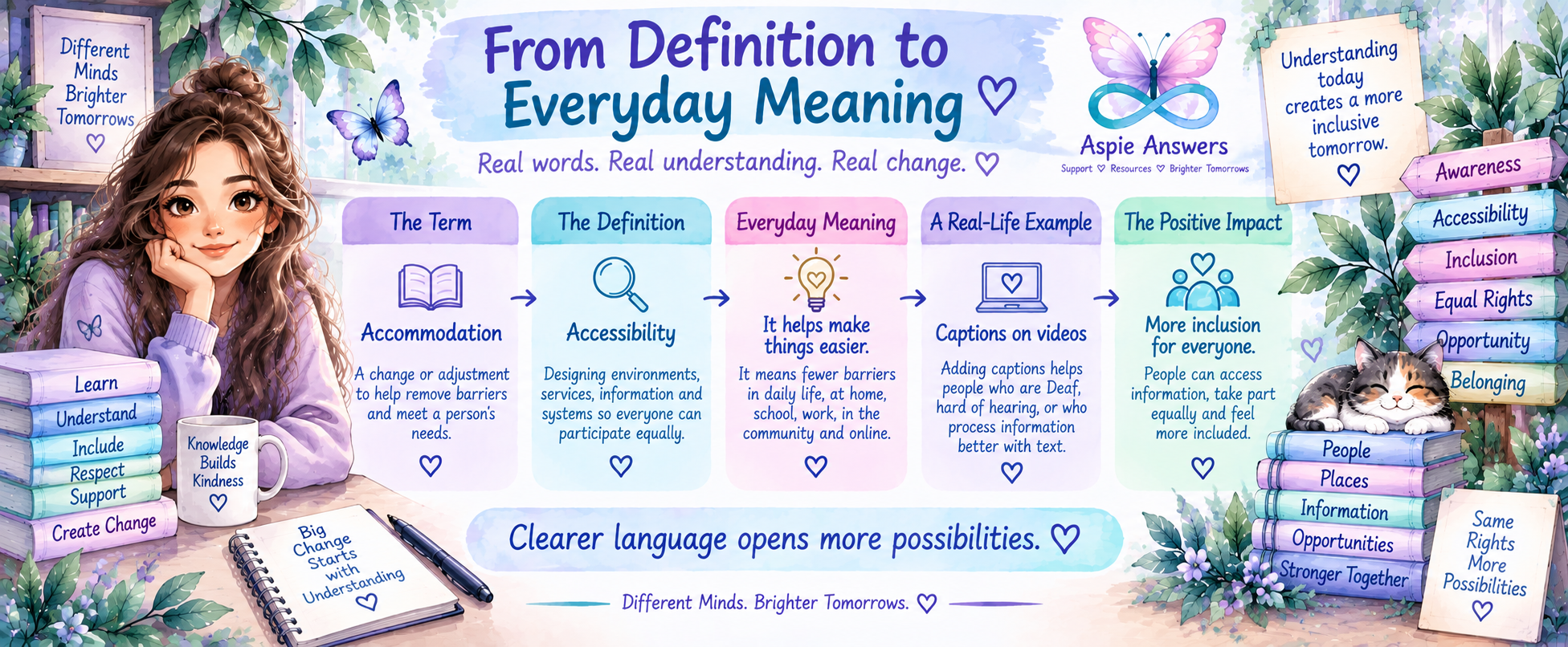
Clearer words can make the next step easier.
You do not need to learn every term at once. Use this glossary when a word appears, follow the related pathway when you need more detail, and return whenever you need a clearer starting point.
Different minds. Brighter tomorrows. 💜