
Work & Employment • Workplace Rights & Employment Guidance • Australia
Australia — Leaving Employment, Redundancy & Workplace Change
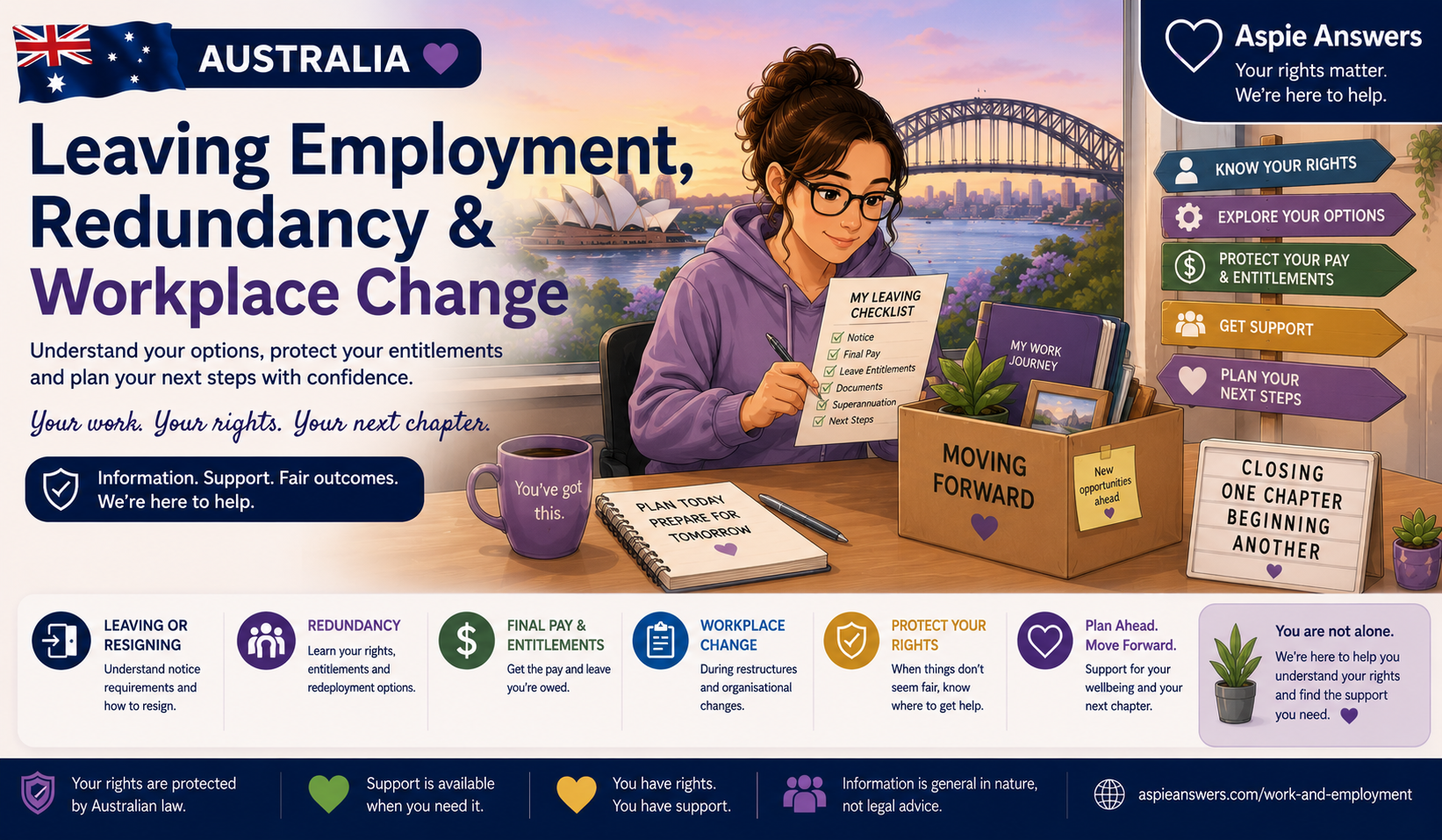
Accessible guidance for navigating resignation, dismissal, redundancy, restructuring, notice, final pay and the practical transition out of a job in Australia.
🌱 Gentle Legal, Financial & Wellbeing Guidance
This page provides general educational and navigation information. It does not replace individual legal, employment, industrial-relations, financial, tax, superannuation or wellbeing advice.
Exact rights can depend on why employment ends, employment type, length of service, award or agreement, contract and individual circumstances. Check current official information when entitlements, eligibility or deadlines matter.
⏳ Some employment claims have short deadlines
If you have been dismissed, made redundant or believe your employment ended unlawfully, check the Fair Work Commission promptly rather than waiting for this page to determine a deadline.
🔎 Search Leaving Employment Guidance
🧭 First: How Is Your Employment Changing?
I Am Choosing to Leave
This is usually resignation. Check any award, agreement or contract notice requirements.
Resignation ↓My Job Is No Longer Required
This may be redundancy. Consultation, redeployment, notice and redundancy pay may need checking.
Redundancy ↓My Employer Is Ending My Employment
This is generally dismissal or termination. Notice, final pay and dispute pathways may apply.
Dismissal ↓My Workplace Is Restructuring
Your role may change even if employment continues. Awards or agreements can contain consultation requirements.
Workplace Change ↓I Am Unsure What Is Happening
Ask for the proposed change, dates and effect on your role in writing where possible, and keep relevant correspondence.
I Feel Pressured to Resign
Constructive dismissal and related issues can be complex. Consider independent advice before acting where possible.
Find Support ↓🔄 Workplace Change, Restructuring & Reorganisation
Workplaces can change because of technology, lower production or sales, mergers, relocation, restructuring or changed ways of working.
Ask What Is Changing
Clarify whether duties, hours, location, reporting lines, pay, status or the existence of the role are affected.
Check the Award or Agreement
Modern awards and enterprise agreements can contain consultation requirements for major workplace change.
Keep the Proposal
Keep lawful copies of consultation documents, proposed structures and your questions or feedback.
📦 Understanding Redundancy
Redundancy generally happens when an employer no longer needs an employee's job to be done by anyone, or in some cases when the employer becomes insolvent or bankrupt.
Genuine Redundancy
For unfair-dismissal purposes, genuine redundancy involves the job no longer being required because of operational changes, applicable consultation requirements being followed, and no reasonable redeployment within the employer or an associated entity.
When Questions Arise
Questions may arise if the job is still required, consultation was not followed, or reasonable redeployment was available. Individual assessment may be needed.
💬 Consultation, Alternatives & Redeployment
Understand the Proposal
Ask what is proposed, why, the likely timing and how your position is affected.
Raise Alternatives
Consultation can provide an opportunity to suggest alternatives or ways to reduce adverse effects.
Consider Redeployment
Whether reasonable redeployment was available can be relevant to genuine redundancy.
Make consultation accessible.
Write questions beforehand, ask for key information in writing, take notes, and ask whether a representative or support person can attend if the process permits.
💵 Redundancy Pay
Eligible employees may receive redundancy pay under the National Employment Standards. Eligibility and amount depend on service and other circumstances, and exclusions can apply.
Not Everyone Qualifies
Employees with less than 12 months' service generally do not receive NES redundancy pay, although notice and other final entitlements may still apply.
Use Current Calculations
Check current Fair Work information and your award or enterprise agreement.
Notice & Redundancy Calculator ↗✉️ Resigning From a Job
Resignation is when an employee decides to end employment and tells the employer.
Put It in Writing
Resignation can be verbal or written, but written notice is best practice. Include the intended final day.
Check Your Notice
An award, enterprise agreement or contract may set notice requirements.
Plan the Notice Period
Clarify whether you will work the period, take approved leave, or whether another arrangement is agreed.
🚪 Dismissal & Termination
Dismissal is when an employer ends an employee's employment. Notice, payment in lieu, final entitlements and dispute pathways may apply.
Keep the Details
Keep written termination information showing the final day, reason given, notice arrangements and final pay.
If You Disagree
Unfair dismissal and general protections have different eligibility rules and can involve short application timeframes.
📅 Notice & Payment in Lieu
Eligible employees being dismissed must receive required notice or payment instead of notice, subject to exceptions. Resigning employees can have separate notice obligations.
Working Notice
Where notice is worked, employment continues during that period and relevant entitlements continue to apply.
Payment in Lieu
Where an employer pays instead of requiring eligible notice to be worked, NES payment in lieu must be paid before or on the day employment ends.
🧾 Final Pay
Outstanding Wages
Check payment for hours worked and applicable penalties and allowances.
Unused Annual Leave
Accrued annual leave owing is generally included, with annual leave loading where applicable.
Other Amounts
Where applicable, final pay can include payment in lieu, redundancy pay and long service leave.
📁 What to Keep Before You Leave
Keep lawful copies of your own important employment records. Do not retain confidential business, client or co-worker information you are not entitled to keep.
Employment Documents
- Contract
- Award/agreement details
- Position description
- Formal variations
- Separation correspondence
Pay & Leave
- Payslips
- Relevant time records
- Leave information
- Final pay statement
- Redundancy calculations
Transition Details
- Final day
- Property to return
- Reference arrangements
- Outstanding questions
🧠 Neurodivergent-Friendly Transition Planning
Create a Timeline
Put notice dates, handover, final day, property return and final-pay checks in one visible place.
Use a Last-Day Checklist
Reduce working-memory demands by writing down practical tasks.
Ask for Written Information
Where appropriate, request key dates and decisions in writing.
Plan Routine Change
Think about sleep, meals, transport, appointments, job-search time and meaningful activities after work ends.
Allow Processing Time
Break decisions into smaller steps where deadlines allow.
Ask About Support
For difficult meetings, ask whether a support person, representative or accessible communication option is available.
🤝 If Something Doesn't Seem Right
Fair Work Ombudsman
Information about notice, redundancy pay, final pay and minimum workplace rights.
Fair Work Ombudsman ↗Fair Work Commission
The national workplace relations tribunal handles eligible dismissal and general-protections matters.
Fair Work Commission ↗Independent Legal Help
For complex or time-sensitive situations, consider a union, community legal centre or employment lawyer as appropriate.
Community Legal Centres Australia ↗📥 Resources & Downloads
Leaving a Job Checklist
From notice through to the final day and final pay.
More resources are coming soon.Redundancy Planner
Organise consultation, redeployment, notice and next steps.
More resources are coming soon.Final Pay Checker
Review wages, annual leave, notice and possible redundancy entitlements.
More resources are coming soon.Workplace Change Planner
Record proposals, questions, consultation feedback and dates.
More resources are coming soon.Last-Day Checklist
Track handover, property return and practical final-day tasks.
More resources are coming soon.Employment Records Checklist
Organise your lawful employment, pay and separation records.
More resources are coming soon.📚 Related Collections
🚪 Leaving Work & Transitions
Resignation, last-day and routine-change tools.
More resources are coming soon.📦 Redundancy & Workplace Change
Consultation, redeployment and restructuring resources.
More resources are coming soon.🧾 Final Pay & Employment Records
Final-pay checks and document-organisation tools.
More resources are coming soon.🔗 Related Aspie Answers Guidance
Australia — Workplace Rights & Employment Guidance
Australia ParentLeaving Employment
Leaving Employment GuideDisclosure at Work
Disclosure GuideBullying, Harassment & Discrimination at Work
International GuideMore Australian Workplace Guidance
Additional country pages will be connected during the final Australian link audit.
More guidance is coming soon.Resources & Downloads
Practical employment-transition resources will be added as the collection grows.
More resources are coming soon.Understand the Change • Keep Your Records • Plan the Next Step
Leaving a workplace can involve rights, practical tasks and a major change in routine at once. Break the transition into manageable steps, check current official information and seek help promptly when a decision or deadline matters.
Aspie Answers gentle guidance: General educational and navigation information only.
↑ Return to the Beginning