
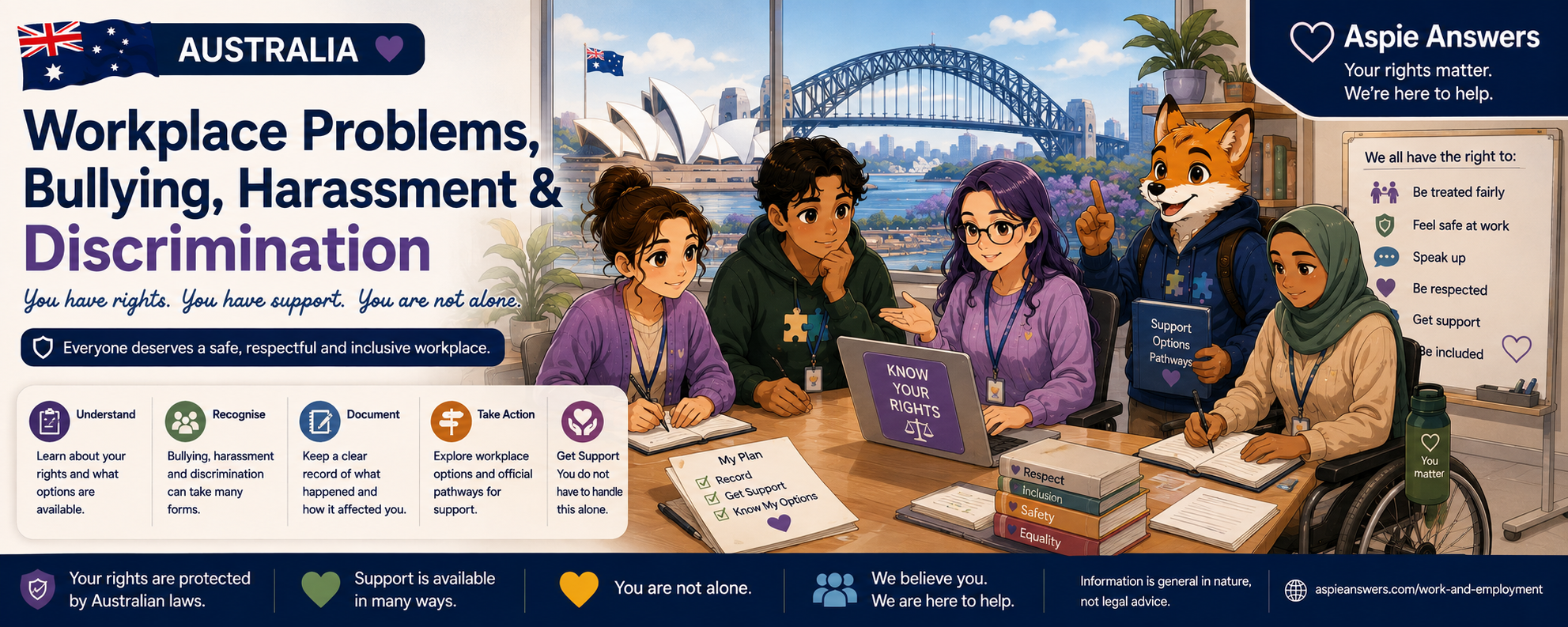
Work & Employment • Workplace Rights & Employment Guidance • Australia
Australia — Workplace Problems, Bullying, Harassment & Discrimination
Practical, accessible guidance for recognising workplace problems, recording what happened, understanding different Australian pathways and finding support when work feels unsafe, unfair or harmful.
🌱 Gentle Legal, Safety & Wellbeing Guidance
This page provides general educational and navigation information. It does not replace individual legal, employment, medical, mental-health, workplace-safety or other professional advice.
Bullying, harassment, sexual harassment, discrimination, adverse action, workplace conflict and unsafe work can overlap, but they are not identical legal concepts. The pathway that applies depends on what happened, who was involved, whether employment is continuing, the jurisdiction and other circumstances.
You do not need to identify the perfect legal term before asking for help. Start by recording what happened and what support or outcome you need.
⚠️ Immediate Safety
If you or someone else is in immediate danger, use the appropriate Australian emergency service. If conduct may be criminal, urgent police or specialist support may also be appropriate. Aspie Answers is not an emergency, legal or investigative service.
🔎 Search Workplace Problems & Rights
🧭 What Kind of Workplace Problem Might This Be?
These categories can overlap. Use them as a navigation aid rather than trying to diagnose the situation yourself.
Repeated Unreasonable Behaviour
This may raise workplace-bullying concerns where behaviour is repeated and creates a risk to health and safety.
Explore Bullying ↓Unwelcome Sexual Conduct
Sexual harassment has its own protections and does not have to be repeated to potentially fall within the legal definition.
Explore Harassment ↓Unfair Treatment Linked to an Attribute
Treatment connected with disability, race, sex, age or another protected attribute may raise discrimination issues.
Explore Discrimination ↓Negative Action Because You Used a Right
Dismissal, disadvantage or another action connected with exercising a workplace right may raise general-protections issues.
Explore Adverse Action ↓Unsafe Work or Psychosocial Risk
Workplace behaviour and work design can also raise work-health-and-safety concerns, including psychosocial hazards.
Health & Safety GuidanceConflict or Poor Communication
Not every difficult interaction is legally bullying or discrimination. It may still be a genuine workplace problem that needs attention, support or clearer communication.
🛡️ Workplace Bullying in Australia
Under the Fair Work framework, workplace bullying involves repeated unreasonable behaviour towards a worker or group of workers that creates a risk to health and safety.
Behaviour Can Include
- Aggressive or intimidating behaviour
- Repeated unreasonable criticism or demands
- Exclusion from work-related activities
- Pressure to behave inappropriately
- Repeated unreasonable conduct affecting health and safety
Look at the Pattern
A single unpleasant incident may still be serious, unsafe, discriminatory, harassing or otherwise inappropriate, but the Fair Work bullying definition requires repeated behaviour.
Record incidents separately so patterns are easier to understand.
📋 Reasonable Management Action
Reasonable management action carried out in a reasonable way is not workplace bullying under the Fair Work definition. Employers can manage performance, give lawful directions and take disciplinary action.
🚫 Harassment & Workplace Sexual Harassment
Workplace sexual harassment is unlawful. Under the Fair Work framework it includes an unwelcome sexual advance, unwelcome request for sexual favours, or other unwelcome sexual conduct where a reasonable person would anticipate the possibility that the person would be offended, humiliated or intimidated.
It Can Be One Incident
Unlike the Fair Work bullying definition, workplace sexual harassment does not need to happen repeatedly.
More Than One Law May Apply
Employment, anti-discrimination/equal-opportunity and work-health-and-safety laws may provide overlapping protections. Some conduct may also potentially involve criminal law.
⚖️ Workplace Discrimination
Australian workplace discrimination protections can apply when adverse action is taken for a prohibited discriminatory reason. Protected attributes under the Fair Work Act include matters such as race, sex, sexual orientation, age, physical or mental disability, family or carer responsibilities, pregnancy, religion, gender identity, intersex status and other listed attributes.
Recruitment
Discrimination protections can be relevant before employment begins, including decisions about hiring and employment terms.
During Employment
Issues may involve treatment, disadvantage, entitlements, job changes, opportunities or other adverse action.
Disability & Neurodivergence
Disability discrimination can intersect with workplace adjustments, disclosure, access and assumptions about capability.
Workplace Adjustments⚖️ Adverse Action & General Protections
The Fair Work Act protects certain workplace rights and protects people from certain unlawful actions. Adverse action can include dismissal, disadvantage in employment, changing a job to a person's detriment, discriminatory treatment and other specified actions depending on who takes the action.
Speaking up can itself involve workplace rights.
If you believe negative treatment happened because you made an enquiry or complaint, exercised an entitlement, participated in lawful workplace activity or because of a protected attribute, consider obtaining advice about general protections.
🧠 Neurodivergent & Disabled Workers
Autistic, ADHD and other neurodivergent workers may face additional barriers when recognising, describing or reporting workplace problems. Disabled workers may also experience problems connected with access needs, assumptions, disclosure or adjustments.
Literal Communication
Indirect comments, unwritten expectations, sarcasm or ambiguous workplace behaviour can make it harder to identify what is happening.
Processing & Recall
Stress can affect memory and communication. Written notes, timelines and copies of messages can reduce the pressure to recall everything verbally.
Accessible Reporting
Ask what accessible communication options are available. Depending on the process, written communication, extra processing time, an advocate or a support person may help.
📝 Record What Happened
Keeping factual records can help you explain the issue, notice patterns and prepare for a workplace or external process.
Incident Notes
- Date and approximate time
- Location or communication channel
- What was said or done
- Who was involved
- Who witnessed it
- How you responded
- What happened afterwards
Documents
- Relevant emails and messages
- Meeting notes
- Policies or procedures
- Letters or formal correspondence
- Relevant rosters or work records
- Copies of complaints and responses
Keep records factual where possible.
You can record how something affected you while separating observations from assumptions about another person's intention. Store records lawfully and securely, and be mindful of workplace confidentiality and privacy obligations.
🏢 Workplace Options — Where Safe & Appropriate
Many workplaces have policies or processes for workplace concerns. Depending on the situation, you might speak with a manager, another manager, HR, a health and safety representative, union representative or another appropriate workplace contact.
Check the Policy
Look for bullying, harassment, discrimination, grievance, complaints, conduct and WHS procedures.
Plan the Conversation
Write down the issue, examples, impact and what you would like to happen next.
Ask About Support
Depending on the process, ask whether a support person, representative, interpreter or accessible communication option is available.
🇦🇺 External & Official Support Pathways
Fair Work Ombudsman
Information and assistance about workplace rights, protections and Fair Work laws.
Fair Work Ombudsman ↗Fair Work Commission
Australia's national workplace relations tribunal. Eligible applications can include stop-bullying, general protections, unfair dismissal and sexual-harassment matters.
Fair Work Commission ↗Australian Human Rights Commission
Federal discrimination and human-rights complaint pathways, including relevant workplace discrimination and harassment matters.
AHRC Complaints ↗WHS Regulators
State, territory and Commonwealth WHS regulators can provide information about workplace safety and psychosocial hazards.
Find WHS Regulator ↗State / Territory Equality Bodies
Local discrimination, equal-opportunity or human-rights bodies may provide another pathway depending on your jurisdiction.
Use the Australian States & Territories directory.Union or Legal Help
A union, community legal centre or employment lawyer may be able to provide advice or representation depending on membership, eligibility and circumstances.
Community Legal Centres Australia ↗⏳ If You Have Been Dismissed or Employment Is Ending
Some Fair Work Commission applications have short statutory time limits. For example, Fair Work guidance currently states that unfair dismissal and dismissal-related general protections applications generally have a 21-day timeframe after dismissal takes effect.
💬 Preparing to Ask for Help
A Simple Opening
“I need help understanding a workplace problem. I have written down what happened and I would like to understand my options and what service or process may apply.”
Questions You Can Ask
- Is this something your service deals with?
- Are there any deadlines?
- What documents should I keep?
- What are my options?
- What happens if I make a formal application or complaint?
- What accessibility support is available?
📥 Resources & Downloads
Workplace Problem — What Do I Do? Checklist
A calm first-step checklist when something at work does not feel right.
More resources are coming soon.Incident Record & Evidence Log
Record dates, behaviour, witnesses, documents, actions and follow-up.
More resources are coming soon.Workplace Problem Timeline
Turn scattered events into a clear chronological record.
More resources are coming soon.Complaint Preparation Worksheet
Organise the problem, examples, impact, desired outcome and supporting records.
More resources are coming soon.Support Person Planning Sheet
Plan what support you need before a meeting, call or complaint process.
More resources are coming soon.Which Australian Service Do I Need?
Match bullying, discrimination, WHS and employment-rights issues to possible support pathways.
More resources are coming soon.📚 Related Collections
🛡️ Workplace Problems & Self-Advocacy
Incident records, meeting preparation, complaint planning and self-advocacy tools.
More resources are coming soon.⚖️ Workplace Rights & Official Support
Service finders, rights checklists, official-source checks and help-seeking tools.
More resources are coming soon.♿ Accessible Workplace Support
Communication preferences, support-person planning, adjustments and neurodivergent-friendly tools.
More resources are coming soon.🔗 Related Aspie Answers Guidance
Australia — Workplace Rights & Employment Guidance
Australia ParentBullying, Harassment & Discrimination at Work
Our broader international guidance.
International GuideWorkplace Issues & Problems
Workplace Issues & ProblemsGetting Help With a Workplace Problem
Getting HelpDisclosure at Work
Disclosure GuideWorkplace Adjustments
Workplace AdjustmentsYou Have Rights • You Have Options • Support Is Available
You do not have to identify every legal term before asking for help. Record what happened, look after your safety, identify the kind of support you need and use current Australian official information when formal rights, complaints or deadlines matter.
Aspie Answers gentle guidance: General educational and navigation information only. Laws, eligibility, jurisdictions, processes and deadlines can change and depend on individual circumstances.
↑ Return to the Beginning