
Work & Employment • Self-Employment & Small Business
Getting Help, Advice & Business Support
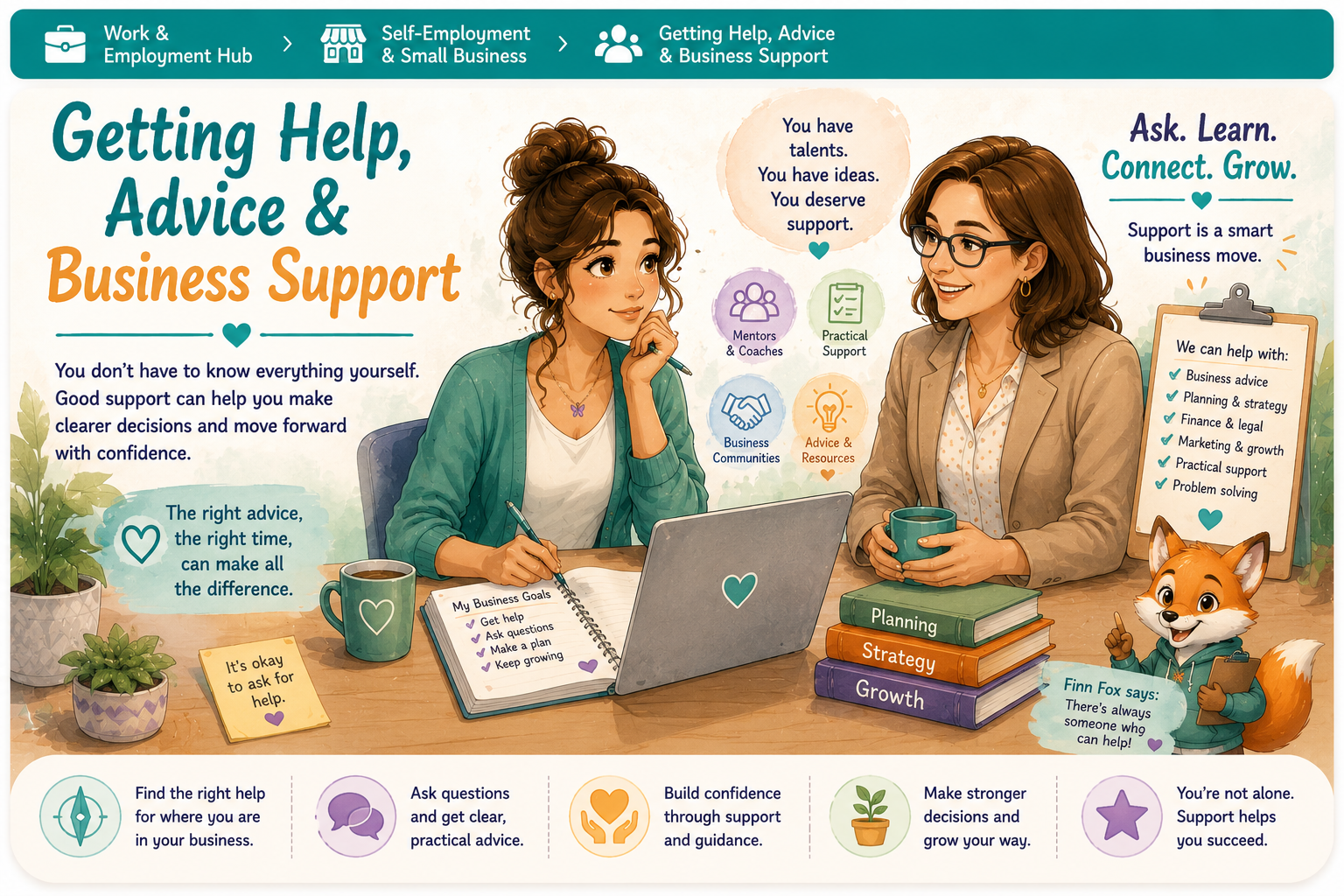
Running a business does not mean doing everything alone. The right advice, practical help, professional expertise or supportive connection can make decisions clearer and reduce the pressure of carrying every question by yourself.
You Do Not Have to Run a Business Alone
Small-business owners often wear many hats, but no one person is expected to be an expert in accounting, marketing, legal matters, technology, customer service, planning and every other area at once.
Getting help can mean asking a quick question, learning from somebody with experience, paying for specialist expertise, joining a useful network, or arranging ongoing practical support.
Finn Fox — Problem Solving
Finn's role fits this page because getting support often starts with identifying the problem, finding reliable options and deciding which next step makes the most sense for your situation.
Different Kinds of Business Support
The most useful support depends on the question you are trying to answer.
Business Mentors & Coaches
Can help you think through goals, decisions, strategy, priorities and the way you want your business to develop.
Accountants & Bookkeepers
Can help with financial records, tax-related responsibilities, accounts, budgeting and understanding the financial side of the business.
Legal & Professional Advice
Useful when you need specialist guidance about contracts, intellectual property, responsibilities, disputes or other areas where professional expertise matters.
Industry & Professional Networks
Can provide sector-specific knowledge, connections, events, training and examples from people working in similar fields.
Peer Support & Business Communities
Other business owners can provide perspective, shared experience and the reassurance that many business challenges are not unique to you.
Administrative & Practical Help
Virtual assistance, contractors, systems, templates or practical support can reduce tasks that repeatedly consume time and energy.
Knowing What Kind of Help I Need
Sometimes the hardest part is not asking for help — it is working out what the actual problem is. Try narrowing the question before searching for a solution.
Asking Questions Without Feeling Embarrassed
It is easy to assume that everybody else already understands business language, systems or processes. In reality, business owners learn constantly and often ask specialists questions that are completely new to them.
Useful Ways to Begin
- “Could you explain what that means in plain language?”
- “What would you recommend I consider before deciding?”
- “Could you give me an example?”
- “What information do you need from me?”
- “What are the main risks or trade-offs?”
Give Yourself Processing Time
You do not always need to make a decision during the conversation. Taking notes and asking to come back to the decision later can help if you need time to process information.
Choosing Advice That Fits My Business
Advice can be useful without being automatically right for you. Different businesses have different goals, budgets, values, customers, capacity and risk levels.
What Is This Advice Based On?
Is it relevant to your industry, business size, location and stage of development?
Does It Fit My Capacity?
A strategy that requires more time, money or energy than you have available may not be sustainable right now.
Does It Fit My Values?
You can choose not to follow an approach that conflicts with how you want to treat customers, work or communicate.
When Advice Conflicts
Two experienced people can sometimes recommend different things. That does not always mean one person is wrong. They may be working from different assumptions, priorities or experiences.
Clarify the Reasoning
Ask why each person recommends that approach and what outcome they are trying to achieve.
Check the Context
Advice that works for a large company may not suit a small home-based business, and advice from another country may not match local responsibilities.
Identify the Decision That Is Yours
Some decisions involve preference and risk tolerance rather than one universal answer.
Get Specialist Advice Where Needed
For legal, tax, financial or other regulated matters, use appropriately qualified professional advice rather than relying only on informal opinions.
Getting Support as a Neurodivergent Business Owner
Helpful business support should work with the way you communicate, process information and make decisions. You are allowed to ask for adjustments that make advice easier to use.
Written Information
Ask for key points, actions or decisions in writing if verbal information is difficult to retain.
Clear Agendas
Knowing what a meeting will cover can make preparation and processing easier.
Processing Time
Ask for time to consider recommendations instead of feeling pressured to decide immediately.
Plain Language
It is reasonable to ask for jargon or complicated processes to be explained clearly.
Examples & Templates
Concrete examples can make abstract advice much easier to understand and apply.
Communication Preferences
Where possible, choose advisers and support people whose communication style works well with yours.
Finding Trusted Support
Before relying on business advice, especially where money, legal responsibilities or important decisions are involved, take some time to understand who is providing it and what their expertise is.
Things I Can Check
- Relevant qualifications, experience or professional membership where appropriate.
- Whether they understand businesses similar to mine.
- What their service includes and what it costs.
- How they communicate and what response times I can expect.
- Whether I feel comfortable asking questions.
Watch for Pressure
Be cautious if somebody promises guaranteed success, pressures you to buy immediately, discourages you from seeking another opinion, or cannot explain clearly what you are paying for.
Preparing for a Business Support Meeting
A little preparation can help you use the time effectively without trying to remember everything during the meeting.
Before the Meeting
- Write down the main issue or decision.
- List the questions you most want answered.
- Gather documents or figures that may be relevant.
- Decide whether you want somebody to attend with you.
- Note any communication or accessibility preferences.
After the Meeting
- Write down the main recommendations.
- Separate urgent actions from things that can wait.
- Clarify anything you are still unsure about.
- Decide what you actually want to do next.
- Book follow-up support only if it will be useful.
My Business Support Map
A support map can help you see where you already have help and where there may still be gaps.
Money & Finance
Who can I ask about bookkeeping, budgeting, tax or financial decisions?
Legal & Responsibilities
Where would I go if I needed qualified advice about contracts, obligations or a dispute?
Planning & Strategy
Who helps me think through priorities, goals and next steps?
Practical Tasks
What can be delegated, automated or supported when my workload is too high?
Industry Knowledge
Who understands the field I work in and can share relevant experience?
Encouragement & Perspective
Who can I talk to when I need perspective rather than technical advice?
Resources & Downloads
As matching tools are completed, this page can connect visitors to practical support-planning resources in the Aspie Answers Resources & Downloads Library.
Library button added after the exact live Resource Library URL is confirmed.