
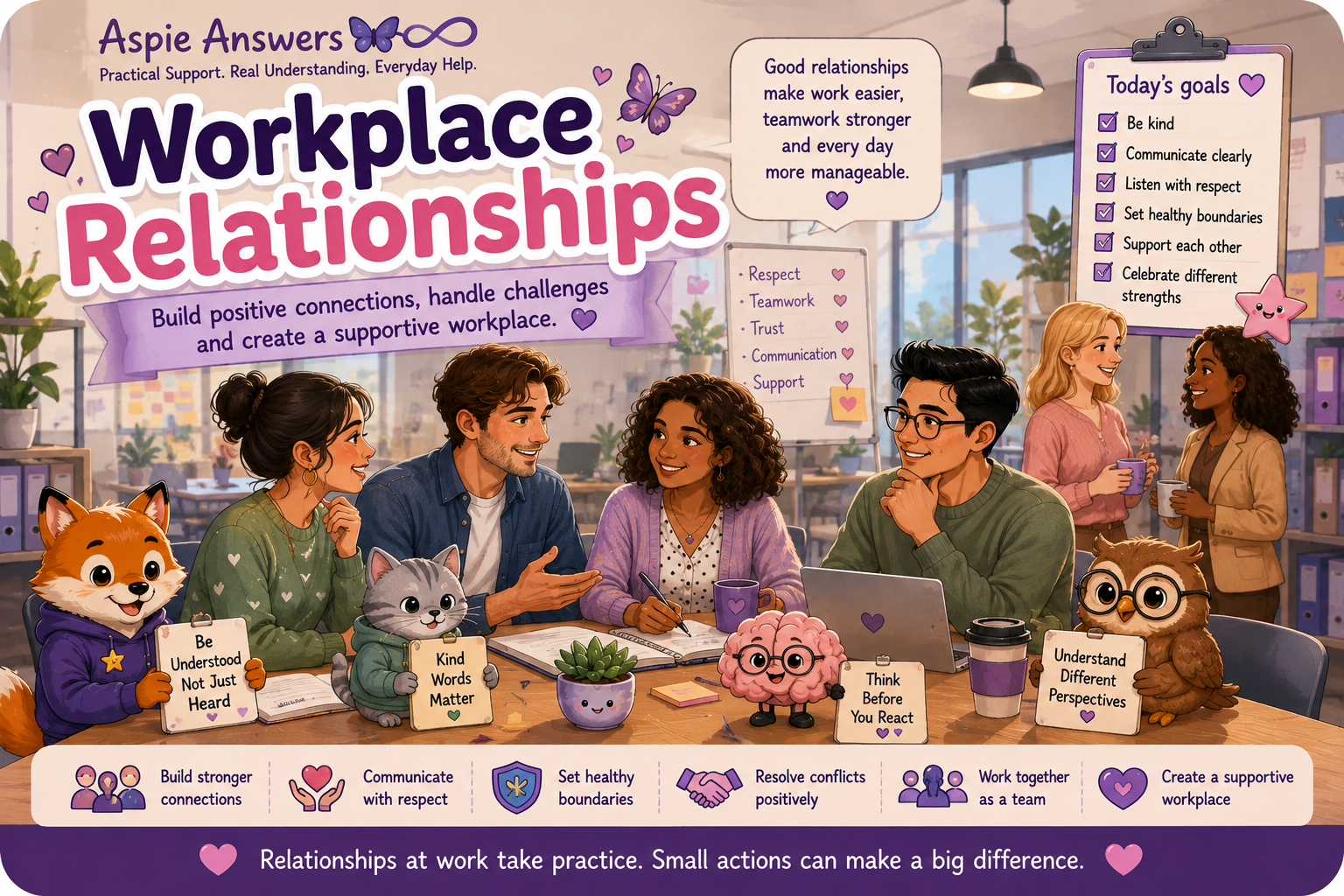
Workplace Relationships
Relationships at work can include colleagues, managers, supervisors, customers, clients and other people you regularly communicate or work alongside.
This page explores practical ways to build respectful connections, understand workplace expectations, manage boundaries and navigate misunderstandings or difficult situations.
Relationships at work can be complicated
Workplace relationships are not always as straightforward as simply being friendly with the people around you. Different workplaces have different cultures, expectations, communication styles and unwritten social rules.
Some people enjoy social workplaces, while others prefer clearer boundaries, quieter environments or more task-focused relationships. Both can be completely valid ways of working.
The goal is not to become the most social person in the room. It is to find practical ways to communicate, cooperate and feel respected while still being yourself.
🌼 A gentle reminder
You do not have to become close friends with everyone you work with. A healthy workplace relationship can simply mean being respectful, communicating clearly, understanding each other's roles and being able to work together safely and effectively.
🧭 What we will explore
You can move through this page in order or choose the area that feels most useful to you.
Different workplace relationships can have different expectations
The way you communicate with a close colleague may be different from the way you communicate with a manager, customer or someone you have only just met. Understanding the role of the relationship can make workplace interactions feel more predictable.
Colleagues and Co-Workers
These are people you work alongside. Some relationships may become friendly, while others may stay mostly task-focused. Respect, communication and cooperation are usually more important than becoming close friends.
Managers and Supervisors
Managers may give instructions, set priorities, provide feedback, approve leave or help resolve workplace concerns. It can be useful to clarify expectations and ask how they prefer updates or questions to be handled.
Team Relationships
Teams may share tasks, deadlines, information and responsibilities. Clear roles can reduce confusion about who is doing what and make collaboration easier.
Customers, Clients and the Public
Some jobs involve regular contact with customers, clients, patients, students or members of the public. These relationships may have clearer professional boundaries and expectations around tone, privacy and service.
Mentors and Support People
A mentor, employment support worker, coach or trusted colleague may help explain workplace expectations, practise conversations or support problem-solving when situations feel difficult.
Remote and Online Relationships
Remote work may involve email, chat, video meetings and shared platforms. Because fewer social cues may be available, written expectations, clear deadlines and regular check-ins can be helpful.
The same person can have more than one role
Workplace relationships are not always simple categories. A colleague may also be a friend, a team leader may also provide mentoring, and a small workplace may have people switching between several responsibilities.
When you are unsure what is expected, it can help to focus on three practical questions:
🌿 Professional does not have to mean distant
You can be warm, kind and genuine while still having boundaries. Professional relationships can include humour, friendship and connection, but you are allowed to decide how much of yourself you share and how social you want your working relationships to be.
Colleagues, managers and teamwork
Working relationships can feel easier when roles, expectations and communication are clear. You do not have to understand every social rule automatically to be a reliable and valued member of a workplace.
Working With Colleagues
Colleagues may have different personalities, communication styles and ways of organising work. Clear task-sharing, respectful communication and predictable check-ins can reduce confusion.
Working With Managers
A manager may set priorities, provide feedback and make decisions about workload. Asking how they prefer updates, questions and concerns to be raised can make communication more predictable.
Working as a Team
Teamwork can involve shared deadlines, handovers and changing responsibilities. Written task lists and clearly agreed roles can help everyone understand what they are responsible for.
What can make teamwork easier?
Teamwork does not require everyone to think or communicate in the same way. A team often works better when expectations are explicit and people can use different strengths.
A supportive manager can make relationships clearer
Helpful management is not about being overly involved. It can simply mean making expectations easier to understand and giving people a reliable way to ask questions.
Useful phrases for everyday teamwork
Simple prepared phrases can make it easier to clarify roles and expectations without needing to improvise.
“Which of these tasks would you like me to focus on first?”
“Can we confirm which part of this project I am responsible for?”
“Would you prefer a quick email update or should I bring this to our next meeting?”
“I am stuck on this part. Could you show me what you would like me to do next?”
“Has the priority changed, or should I continue with the original task first?”
“Would it help if we wrote down who is doing each part?”
Unspoken Rules & Workplace Culture
Every workplace develops its own habits, routines and social expectations. Some are written down, while others are learned by watching what people around you do. When those expectations are not explained clearly, they can be confusing.
What is workplace culture?
Workplace culture is the collection of behaviours, expectations, communication styles and routines that become normal within a workplace. It can affect everything from how people ask questions to whether colleagues eat lunch together, how formal emails are, how meetings work and how people respond when something goes wrong.
Small Talk
Some workplaces expect brief conversations about weekends, weather or everyday life. You do not need to share lots of personal information. A short greeting or simple response can be enough.
Breaks & Lunchrooms
Some teams socialise during breaks while others prefer quiet time. Taking a break alone does not automatically mean you are unfriendly, particularly when downtime helps you reset.
Humour & Banter
Workplace humour can be difficult to interpret because tone and intention are not always obvious. You are allowed to ask what someone means or say when a joke makes you uncomfortable.
Hierarchy
Workplaces may have formal or informal levels of responsibility. Understanding who makes decisions, who approves work and who can help with a concern can make situations easier to navigate.
Social Invitations
There may be birthdays, after-work gatherings, celebrations or team activities. Some may be optional and others work-related. When you are unsure, it is reasonable to ask.
Appearance & Dress
Dress expectations vary greatly between workplaces. A written dress code can help, but workplaces may also have informal expectations that are not clearly explained.
Written rules and unwritten expectations are different
Knowing the difference can help you work out when something should be clearly explained rather than expecting yourself to somehow “just know.”
📘 Written or formal expectations
- Work hours and scheduled breaks
- Health and safety procedures
- Leave and absence processes
- Job responsibilities
- Workplace policies
- Codes of conduct
💭 Unwritten or informal expectations
- How much small talk people usually make
- Whether people eat lunch together
- How quickly messages are normally answered
- How formal conversations tend to be
- How colleagues usually ask one another for help
- How social the team tends to be
🌱 What can I do when I am not sure?
You are allowed to ask about expectations. A short question can often be much easier than spending a long time trying to work out an unwritten rule by yourself.
“Is this optional, or is everyone expected to attend?”
“Do people normally use email or chat for this?”
“Is there a usual time the team takes lunch?”
“Is there a dress code or anything specific I should know?”
🎈 You do not have to attend every social activity
Optional workplace social events can be enjoyable for some people and exhausting for others. It may be possible to attend briefly, choose particular events, or decline optional activities when you need rest or personal time.
🌿 Finding your own level of connection
Some people build close friendships at work. Others prefer friendly but clearly professional relationships. There is room for different levels of connection. What matters is that relationships remain respectful, safe and workable.
Boundaries & Privacy at Work
Workplace relationships can be friendly and supportive without requiring you to share everything about yourself. Boundaries can help protect your time, energy, privacy and sense of safety.
Boundaries help relationships stay clear
A boundary is simply a limit or expectation about what feels acceptable to you. Boundaries can involve time, personal questions, physical space, social contact, messaging, workload or how much of your private life you want to discuss at work.
Time Boundaries
Clarify when you are expected to be available, whether messages need responses outside work hours and when you are entitled to take breaks.
Energy Boundaries
You may need quiet breaks, fewer social activities or time to recover after meetings. Protecting energy can help you stay more sustainable at work.
Personal Information
You can choose how much you share about family, relationships, health, disability, interests or other parts of your personal life, within any relevant workplace requirements.
Physical Boundaries
People have different comfort levels around touch, personal space and crowded environments. It is reasonable to communicate when something makes you uncomfortable.
Conversation Boundaries
You can redirect conversations away from subjects that feel too personal, uncomfortable or unrelated to work.
Digital Boundaries
Work chat, personal phone numbers, social media and after-hours messaging can blur boundaries. It can help to decide what level of contact feels comfortable.
What am I allowed to keep private?
Workplace privacy can depend on your role, workplace policies and local law, but in everyday relationships you generally do not need to answer every personal question simply because a colleague asks.
📱 Social media and coworkers
Some colleagues connect online outside work and others do not. You can keep professional and personal accounts separate, adjust privacy settings or politely decline requests if that feels more comfortable.
🌙 Messages outside work hours
A message arriving after hours does not always mean an immediate response is expected. Where this is unclear, ask your manager what the actual expectation is rather than assuming you must always be available.
Practical phrases for setting boundaries
Boundaries can be communicated respectfully and directly. You can adapt these examples to suit your own voice.
“I prefer to keep that part of my life private.”
“I need to finish this first. Can we talk at 2 p.m.?”
“Thank you for inviting me. I am going to sit this one out.”
“I am more comfortable with a little more space, thank you.”
“I will take a look at that when I am back at work tomorrow.”
“I tend to keep my personal social media separate from work.”
Misunderstandings, Conflict & Repair
Disagreements and misunderstandings can happen in any workplace. A difficult interaction does not always mean a relationship is broken. Sometimes people need clearer information, time to cool down or a chance to repair what went wrong.
Conflict can have many causes
Workplace conflict is not always caused by somebody deliberately trying to be difficult. Miscommunication, unclear roles, stress, different communication styles, competing priorities and incorrect assumptions can all create tension.
Pause Before Responding
If you feel upset, overloaded or angry, you may communicate more clearly after taking time to process what happened.
Clarify What Was Meant
Tone and intention can be misread. Asking what somebody meant can sometimes resolve a misunderstanding before it becomes a larger issue.
Focus on the Specific Issue
Describe the task, behaviour or situation rather than making broad statements about somebody's personality or intentions.
Hear the Other Perspective
Understanding another person's view does not mean you have to agree with it. It can help identify where expectations became different.
Look for a Workable Next Step
Repair often becomes easier when the conversation moves from “who was wrong?” toward “what should happen differently next time?”
Write Things Down if Needed
Notes can help when a situation is complicated, recurring or hard to remember clearly after a stressful interaction.
A simple repair process
Not every disagreement needs a formal process. For smaller misunderstandings, a simple sequence may help.
Helpful language for repairing misunderstandings
These examples can be adapted to your own communication style.
“I think I may have understood that differently. Could we check what you meant?”
“When the instructions changed suddenly, I was unsure which task still had priority.”
“I can see that my message came across differently than I intended. I am sorry for the confusion.”
“Thank you for explaining that. I understand what needs to change next time.”
“I want to respond properly. Could we come back to this later today?”
“Would it help if we confirmed changes in writing from now on?”
📝 When it helps to keep a record
A one-off misunderstanding may not need documentation. But if the same problem keeps happening, notes can help you identify patterns and explain the situation clearly if you need support later.
Trust, Feedback & Stronger Working Relationships
Strong workplace relationships usually develop gradually. Reliability, clear communication, respectful feedback and knowing what to expect from one another can help trust grow over time.
Trust does not have to happen instantly
You may need time and repeated experience before you feel comfortable with a colleague, manager or team. Trust often grows when people are consistent, communicate clearly, respect boundaries and follow through on what they say they will do.
Follow Through
Completing agreed tasks or letting people know early when something changes can help others understand that they can rely on you.
Communicate Clearly
Clear updates, questions and expectations can reduce uncertainty and help working relationships feel more predictable.
Be Consistent
Consistent behaviour can help people know what to expect, especially in workplaces where plans or communication often change quickly.
Listen and Clarify
Listening does not mean silently agreeing. Asking questions can show that you are trying to understand what another person is saying.
Respect Boundaries
Trust is easier to build when people respect privacy, personal space, working hours and clearly communicated limits.
Recognise Contributions
A simple thank-you or acknowledgement of someone's work can help create a more respectful and cooperative relationship.
Feedback can strengthen relationships when it is clear and respectful
Feedback is easier to use when it focuses on a specific task or behaviour rather than making broad judgements about somebody as a person.
🌿 Signs of a healthy working relationship
No relationship is perfect, but these patterns can suggest that a workplace relationship is becoming more dependable and respectful.
Practical phrases for feedback and trust
You can adapt these examples to match your workplace and communication style.
“Could you give me an example of what you would like me to change?”
“Thanks for explaining that clearly. That made it much easier to follow.”
“Can we confirm what good completion looks like for this task?”
“I would like some time to think about that before I respond.”
“That was helpful — thank you for taking the time to show me.”
“I will send you an update by 3 p.m. so you know where things are at.”
🧭 A quick relationship check
If you are unsure how a workplace relationship is going, these questions may help you notice patterns rather than relying on one difficult or unusually good day.
Bullying, Exclusion & When to Seek Support
Not every difficult interaction is bullying, but repeated harmful behaviour, exclusion, intimidation or targeting should not be dismissed as something you simply need to tolerate.
Look for patterns, not just one uncomfortable moment
A disagreement, awkward conversation or occasional mistake can happen in any workplace. Concern becomes more serious when behaviour is repeated, targeted, humiliating, threatening, discriminatory or designed to isolate or undermine someone.
Repeated Targeting
The same person may repeatedly be criticised, mocked, singled out or treated differently from others without a clear work-related reason.
Deliberate Exclusion
Important information, meetings, conversations or opportunities may repeatedly be withheld from someone in ways that affect their work.
Humiliation or Ridicule
Repeated jokes, public criticism, belittling comments or mocking someone's communication, disability, identity or mistakes can be harmful.
Intimidation or Threats
Aggressive behaviour, threats, coercion or attempts to make someone feel afraid can require more formal support.
Spreading Harmful Information
Repeated gossip, rumours or false claims can damage trust and may affect someone's reputation or ability to work safely.
Discrimination or Harassment
Harmful treatment connected to disability, race, gender, age, religion or another protected characteristic may require formal workplace or legal guidance.
Ordinary conflict and repeated harmful behaviour are not the same thing
Looking at the pattern can help you decide whether a situation may need a different kind of response.
🌦️ Ordinary workplace disagreement
- May involve both people disagreeing
- Can usually be discussed or repaired
- Is often linked to a specific situation or task
- Does not usually involve repeated targeting
- Respect can often be restored afterwards
⚠️ Repeated harmful behaviour
- May repeatedly target the same person
- Can involve humiliation, fear or exclusion
- May continue after concerns are raised
- Can interfere with someone's ability to work safely
- May require formal workplace support
📝 Keeping a clear record can help
If a concerning situation is recurring, brief factual notes can help you identify patterns and explain what has been happening if you later need to speak with someone.
🤝 Who might you speak to?
The appropriate person can depend on the workplace and situation. You may not need to approach every option at once.
Practical Workplace Relationship Strategies
Good workplace relationships do not depend on instinct alone. Simple routines, clear expectations and prepared communication tools can make everyday interactions feel more predictable and manageable.
Clarify Roles Early
Knowing who is responsible for what can reduce uncertainty, duplicated work and misunderstandings within a team.
Use Regular Check-Ins
Short scheduled updates can be easier than waiting until something becomes confusing or urgent.
Prepare Important Conversations
Write down your main point, questions and preferred outcome before discussing something difficult or unfamiliar.
Confirm Changes
When roles, deadlines or plans change, a written confirmation can help everyone stay clear about the new expectation.
Protect Boundaries
Clear limits around time, personal information and communication can prevent resentment and make relationships easier to sustain.
Plan Social Recovery
Meetings, teamwork and social interaction can take energy. A quieter break or lower-demand period afterwards may help you recover.
🧰 Build a simple workplace relationship toolkit
You do not need a complicated system. A few reliable tools can make it easier to handle common relationship situations.
🔋 Manage your social energy
Workplace relationships can use mental and emotional energy, even when the interactions are positive. Knowing which situations drain you most can help you plan around them.
Useful phrases for everyday workplace relationships
A few familiar phrases can reduce the pressure of having to find the right words in the moment.
“Could we confirm what each of us is responsible for?”
“Is now a good time for a quick update, or would later suit better?”
“I see this differently. Can we go through the options together?”
“I would rather keep that part of my life private.”
“I think we may have misunderstood each other. Can we reset?”
“Thank you — that explanation was really helpful.”
✅ Quick Workplace Relationship Checklist
You can use this as a simple reflection tool rather than a test you have to pass.
Extra support for navigating workplace relationships
Some situations are easier when you have a familiar framework, worksheet, checklist or companion to help you slow things down and think through the next step.
Finn Fox
Finn can support problem-solving, difficult conversations, misunderstandings, thinking through options and finding practical next steps when a workplace relationship feels confusing.
Toby Turtle
Toby can support pacing, social energy, recovery, sensory needs and recognising when repeated workplace interactions are taking too much out of you.
Scout
Scout can offer emotional reassurance around confidence, belonging, friendship, difficult feelings and recovering after challenging social experiences.
📚 Workplace Relationship Resources
These resources can be added to the Work & Employment library as the collection grows. Existing resources should always be checked before creating duplicates.
Workplace Relationship Reflection Sheet
Reflect on communication, trust, boundaries, role clarity and whether a relationship feels mostly predictable and respectful.
Planned resourceDifficult Conversation Planner
Prepare the main issue, examples, questions, boundaries and preferred outcome before an important conversation.
Planned resourceWorkplace Boundary Checklist
Explore time, privacy, digital contact, social expectations and personal boundaries in the workplace.
Planned resourceWorkplace Incident Record
Keep factual notes about recurring workplace concerns, including dates, people involved, what happened and any follow-up.
Planned resourceTeam Roles & Responsibilities Sheet
Clarify who is responsible for different tasks, handovers, decisions and shared deadlines.
Planned resourceSocial Energy at Work Tracker
Notice which workplace interactions use the most energy and what kinds of breaks or recovery strategies help afterwards.
Planned resource🧰 Match the tool to the situation
You do not need every resource. Start with the situation that is creating the most difficulty right now.
Try a roles and responsibilities sheet.
Use a conversation planner first.
Use a boundary checklist.
Keep factual incident notes.
Track social energy and recovery.
Use a relationship reflection sheet.
Questions about workplace relationships
Workplace relationships can raise lots of questions, especially when expectations are unclear or different people communicate in different ways. These answers offer a practical starting point.
👥 Do I need to be friends with my coworkers?
No. A healthy workplace relationship can simply be respectful, cooperative and professional.
Some coworkers become friends while others remain mostly task-focused. Both can be completely valid.
☕ What if I do not enjoy workplace small talk?
You do not have to become highly social to be a good colleague. Short greetings, simple responses and respectful communication may be enough.
You can also use breaks for quiet recovery if social interaction takes a lot of energy.
💬 What if I do not understand what a coworker means?
Asking directly can often be easier than trying to guess.
You might say, “I am not sure I understood that the way you meant it. Could you explain what you would like me to do?”
🛡️ Is it okay to keep parts of my personal life private?
Yes. Friendly workplace relationships do not require you to share everything about your life.
You can decide how much you want to discuss about family, relationships, health, social media and other personal topics, within any relevant workplace requirements.
🌦️ What if I have a disagreement with a coworker?
Disagreement does not automatically mean a relationship has failed.
It may help to pause, clarify what happened, focus on the specific issue and agree on what should happen differently next time.
📝 When should I keep notes about a workplace problem?
Keeping brief factual notes can be useful when a problem is recurring, difficult to remember clearly, or may later need support from a manager, HR, union or advocate.
Include dates, what happened, who was involved and any follow-up.
⚠️ How do I know if something may be bullying rather than ordinary conflict?
Ordinary conflict may involve disagreement between people and can often be discussed or repaired.
Repeated targeting, intimidation, humiliation, deliberate exclusion or harmful behaviour that continues after concerns are raised may need a more formal response.
🤝 Who can I ask for help if a workplace relationship becomes difficult?
Depending on the workplace and situation, support might come from a manager, another supervisor, Human Resources, a union representative, employment support worker, advocate or appropriate external service.
You can also ask someone you trust to help you prepare what you want to say before raising a concern.
🔋 What if workplace relationships use too much of my energy?
Social interaction, meetings and conflict can all use significant mental and emotional energy.
Quiet breaks, fewer optional social activities, more written communication and planned recovery time may help make working relationships more sustainable.
🌱 Can workplace relationships improve over time?
Yes. Trust often develops gradually through consistency, clearer communication, repaired misunderstandings and knowing what to expect from one another.
You do not need instant closeness for a relationship to become dependable and respectful.
Related Workplace Success Pathways
Workplace relationships are only one part of working life. Explore another area when you are ready, whether you need help communicating, building confidence, managing everyday work or understanding workplace support.
Workplace Communication
Explore clearer conversations, asking questions, written communication, meetings, communication preferences and ways to reduce misunderstandings at work.
Explore workplace communicationWorkplace Success
Find practical support for settling into work, routines, expectations, organisation, confidence and making working life more sustainable.
Explore workplace successWorkplace Confidence
Build confidence around asking for help, speaking up, learning new tasks, handling mistakes and recognising your strengths at work.
Build workplace confidenceWorkplace Adjustments & Support
Explore ways workplace environments, communication, routines, sensory demands and task expectations may be made more accessible.
Explore workplace supportWorkplace Rights & Guidance
Find guidance around workplace concerns, fair treatment, discrimination, employment support and knowing where to seek further advice.
Explore workplace guidanceSeeking Work & Career Planning
Explore job searching, identifying strengths, career direction, preparing applications and finding work that may better suit your needs and goals.
Explore career planning🧭 Not sure where to go next?
Start with what is creating the biggest challenge right now. You do not need to work through the Work & Employment Hub in a particular order.
Explore Workplace Communication.
Explore Workplace Success.
Explore Workplace Confidence.
Explore Workplace Adjustments & Support.
Explore Workplace Rights & Guidance.
Explore Seeking Work & Career Planning.
Return to the Work & Employment Hub
Explore the wider collection of Aspie Answers workplace guidance, practical tools, employment pathways and neurodivergent-friendly support.
Healthy workplace relationships do not require you to become someone else.
Strong working relationships can grow through clearer communication, respectful boundaries, dependable behaviour and practical ways to repair misunderstandings. The goal is not social perfection — it is creating relationships that feel safe, workable and sustainable.
Notice what is happening
Is the challenge about communication, unclear expectations, boundaries, conflict, trust or something more serious?
Choose one practical response
Ask a question, clarify a role, prepare a conversation, set a boundary or use one of the practical relationship tools.
Seek support when needed
Some situations can be repaired informally. Others may need a manager, advocate, HR, union or another appropriate support.
Aspie Answers provides general information and practical support. Workplace policies, employment rights and legal processes vary by location and situation. Where appropriate, seek advice from a suitable employment, legal, advocacy, union or workplace support service.