
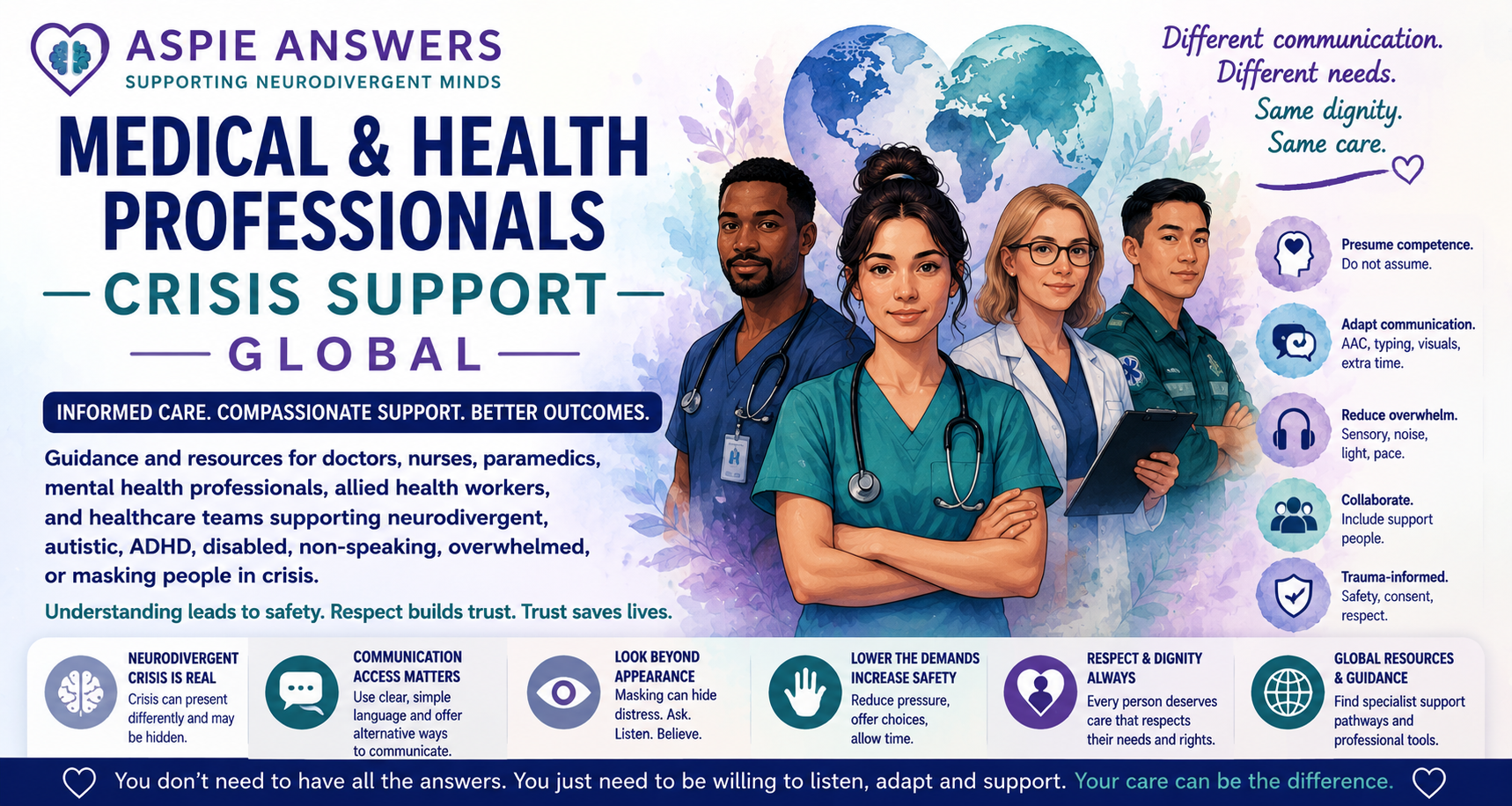
Medical & Health Professionals Crisis Support – Global
A practical support page for doctors, nurses, paramedics, emergency teams, mental health clinicians, allied health workers, hospital staff, crisis teams, and healthcare professionals supporting neurodivergent, autistic, ADHD, disabled, non-speaking, overwhelmed, masking, or sensory-sensitive people in crisis.
If there is immediate danger
If a person is in immediate danger, medically unsafe, at risk of serious harm, missing, or unable to stay safe, follow your local emergency, safeguarding, clinical, or crisis response protocols immediately.
- Emergency risk: use local emergency pathways.
- Medical risk: assess urgently and escalate appropriately.
- Safeguarding risk: follow local safeguarding procedures.
- Communication barriers: adapt communication immediately.
Gentle content note
This page mentions crisis, suicide risk, self-harm risk, distress, shutdowns, meltdowns, burnout, trauma, and medical escalation. It is designed as supportive signposting and does not replace clinical judgement, local policy, or emergency protocols.
Professional reminder
Neurodivergent crisis may not always look like expected crisis presentation. A person may appear calm, articulate, quiet, compliant, angry, frozen, shut down, or “fine” while risk is still high.
Respect builds safety
Adapted communication, sensory-aware care, consent, dignity, and trauma-informed support can reduce escalation and help people access support more safely.
Quick professional pathways
Use these pathways to quickly adapt support when a person’s crisis presentation may be affected by neurodivergence, disability, sensory overload, masking, trauma, or communication barriers.
Immediate risk or medical emergency
Follow emergency, clinical, safeguarding, or crisis protocols. If communication is limited, adapt support while still prioritising safety.
Open emergency numbersCommunication barriers
Offer text, writing, AAC, visual choices, plain language, support people, or extra processing time rather than relying only on speech.
Open communication accessSensory or overload presentation
Reduce noise, light, crowding, questions, pace, and unnecessary touch. Lowering sensory demand can improve safety and cooperation.
Open sensory supportSearch & filter professional support topics
Use this section to quickly find the professional support pathway that fits the situation.
Risk may be hidden
A person may appear calm, articulate, compliant, or “fine” while still experiencing serious risk, overload, or unsafe thoughts.
Communication access
Use AAC, typing, writing, visuals, plain language, yes/no options, support people, and extra processing time.
Open communication accessSensory-aware care
Waiting rooms, bright lights, alarms, touch, multiple staff, and fast questions can worsen distress or shutdown.
Open sensory supportTrauma-informed practice
Explain what is happening, ask before touch where possible, offer choices, preserve dignity, and avoid unnecessary force or shame.
Open trauma-informed supportMasking and hidden distress
Do not judge risk only by appearance. Masking can hide panic, suicidality, shutdown, burnout, or collapse.
Open masking supportFind support by location
Use the location hub for emergency numbers, crisis pathways, and country or region support pages.
Open location hubHow neurodivergent crisis may present
Neurodivergent crisis can look different depending on the person, setting, communication access, masking, sensory load, trauma history, health needs, and trust in services.
Quiet or frozen
The person may shut down, stop speaking, avoid eye contact, or seem detached.
Agitated or distressed
The person may pace, cry, yell, flee, stim, repeat words, or appear defensive.
Calm but unsafe
Masking may make distress look smaller than it is. Ask clearly and gently about safety.
Communication changes
Speech, processing, memory, decision-making, and emotional regulation may become harder.
Helpful clinical reminder
“This person may need crisis support adapted around sensory load, communication access, trauma history, and processing time.”
Adapt support to reduce distress and improve safety
Small adjustments can make a big difference during crisis, especially when someone is overwhelmed, non-speaking, masking, or sensory overloaded.
Reduce sensory load
- Offer a quieter space if safe.
- Reduce lights, noise, crowding, and interruptions.
- Limit the number of people speaking.
- Allow headphones, sunglasses, comfort items, or stimming when safe.
Lower communication pressure
- Use one question at a time.
- Offer written, typed, AAC, or visual options.
- Allow extra processing time.
- Do not assume silence means refusal or lack of understanding.
Protect dignity and consent
- Explain what will happen before doing it.
- Ask before touch where possible.
- Use respectful language.
- Include support people when appropriate and consented to.
Communication access in medical and crisis settings
Communication access is part of safe care. It helps reduce misunderstanding, escalation, missed risk, and traumatic service experiences.
Ask access questions
- “How do you communicate best right now?”
- “Would writing or typing help?”
- “Do you need extra time?”
- “Do you want a support person included?”
Use plain language
- Short sentences.
- One instruction at a time.
- Concrete wording.
- Check understanding without blame.
Respect AAC and tools
- Do not remove communication tools.
- Wait for responses.
- Respond to typed or symbol-based communication.
- Presume competence.
Professional pathways by country / region
Medical and crisis systems vary by country. Use local policy, emergency protocols, safeguarding processes, and clinical judgement first. This section is a broad signposting reminder only.
New Zealand
In an emergency, use 111. For mental health support, 1737 can be called or texted within New Zealand. Follow local DHB/Te Whatu Ora, crisis team, and safeguarding pathways where relevant.
Australia
In an emergency, use 000. Follow local state/territory health, emergency, mental health crisis, and safeguarding pathways.
United States
In an emergency, use 911. The 988 Lifeline may support mental health crisis pathways. Follow local clinical, emergency, disability access, and safeguarding protocols.
Canada
In an emergency, use 911. Follow provincial or territorial healthcare, mental health crisis, emergency, and safeguarding pathways.
United Kingdom
In an emergency, use 999 or 112. Follow NHS, local crisis team, safeguarding, mental health liaison, and accessibility policies where relevant.
Ireland
In an emergency, use 112 or 999. Follow local emergency, HSE, crisis, safeguarding, and accessibility pathways.
Europe
In many European countries, 112 is the emergency number. Use local health system, crisis response, safeguarding, and disability access processes.
International / worldwide
Use the Crisis Support by Location hub to locate country, region, and emergency pathways where available.
Open location hubWhen access needs are unclear
Ask directly, offer options, reduce sensory load, use plain language, and include trusted support people where appropriate.
Where to go next
This page connects into the wider Aspie Answers crisis support structure.
Neurodivergent Crisis Support
Return to the main neurodivergent crisis support doorway.
Open ND crisis supportCommunication Access Crisis Support
For AAC, text, writing, Easy Read, plain language, support people, and non-phone options.
Open communication accessNon-Speaking / Low-Speaking Support
For people who use AAC, typing, gestures, symbols, support people, or unreliable speech.
Open non-speaking supportTrauma-Informed Neurodivergent Support
For calmer, safer, consent-aware, dignity-focused support.
Open trauma-informed supportMasking, Overload & Crisis Support
For hidden distress, masking, burnout, shutdown, and risk that may not be visible.
Open masking supportCommunity Workers & Navigators
For support workers, advocates, peer workers, navigators, and community helpers.
Open community worker support