
Work & Employment • Workplace Rights & Employment Guidance
Employment Rights
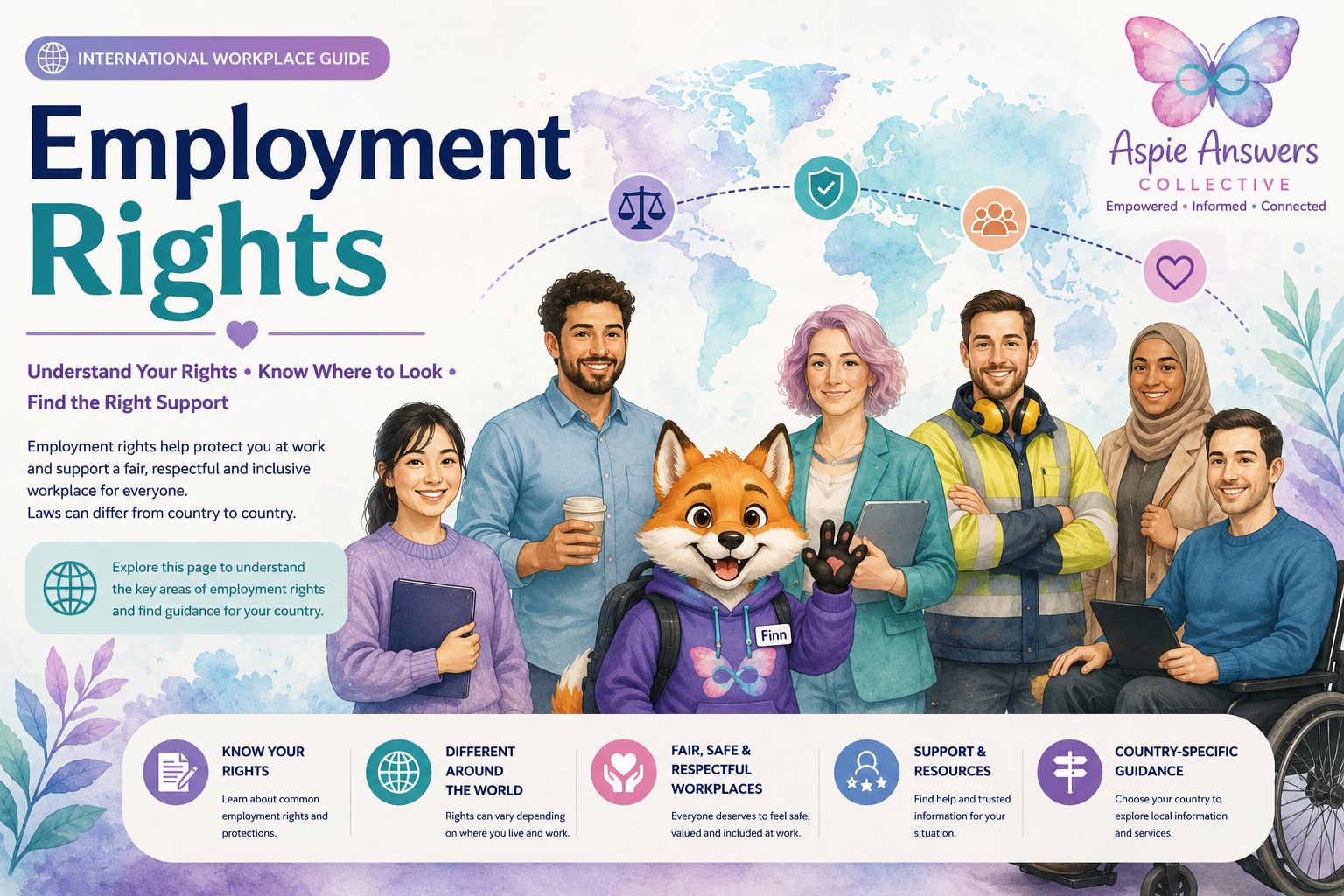
Understand common workplace rights and protections, learn why they differ around the world, and find the official guidance that applies where you live and work.
🌱 A Gentle Information & Legal Guidance Note
Aspie Answers provides general educational information to help people understand employment-rights topics and find appropriate support pathways. This page is not individual legal, employment, financial, medical or other professional advice.
Employment rights differ by country, state, province or territory and can depend on employment status, industry, agreement and individual circumstances. Laws, minimum standards, definitions, complaint processes and time limits can also change.
Start with the topic that matters to you, choose the correct country or jurisdiction, and use current official information when a decision may affect your employment or legal rights.
🔎 Find Workplace Rights & Support
Search Aspie Answers for employment rights, agreements, pay, leave, workplace adjustments, health and safety, workplace problems and other Work & Employment guidance.
What Are Employment Rights?
Employment rights are legal or contractual protections and entitlements connected with work. Depending on where you live and your employment status, they can affect pay, hours, leave, workplace safety, discrimination, dismissal, representation, privacy and many other parts of working life.
You do not need to learn employment law all at once.
Start with the issue that matters to you, work out which country or jurisdiction applies, then use current official information for the details.
Common Areas of Employment Rights
The exact law differs around the world, but these are common areas worth knowing about.
📄 Agreements & Terms
Written terms, contracts or employment agreements can explain duties, conditions, hours, pay and other expectations.
💰 Pay & Working Time
Minimum pay, overtime, deductions, records, breaks and working-time protections can depend on local law and employment status.
🌴 Leave & Holidays
Annual leave, public holidays, sick leave, family leave and other entitlements vary widely between jurisdictions.
🦺 Health & Safety
Workplaces generally have safety responsibilities, but the legal framework and regulator depend on location.
⚖️ Fair Treatment
Discrimination, harassment, retaliation and other workplace protections may be covered by employment, equality or human-rights law.
♿ Accessibility & Adjustments
Disability-related workplace rights and adjustment duties differ internationally and may depend on the person's circumstances.
🤝 Voice & Representation
Union activity, collective bargaining, workplace representation and consultation rights differ by legal system.
🚪 Ending Employment
Notice, dismissal, redundancy, final pay and challenge rights are highly country-specific.
Employment Status Can Change Which Rights Apply
Words such as employee, worker, contractor, casual, temporary, fixed-term or self-employed can have legal meanings that differ between countries. The label used by a workplace is not always the only factor that determines legal status.
Why Status Matters
- Minimum pay or wage protections
- Leave and holiday entitlements
- Working-time rules
- Dismissal or termination protections
- Tax and social-insurance responsibilities
- Access to particular dispute or representation processes
Do Not Rely Only on the Label
Some legal systems look at the actual working relationship, not simply what the contract calls it. If your status is unclear, check current official guidance for your jurisdiction before relying on a particular entitlement.
Rights & Responsibilities Work Together
Workers / Employees
- Understand the terms that apply to your work.
- Follow lawful and reasonable workplace requirements where applicable.
- Use safety procedures and raise concerns appropriately.
- Communicate questions or problems when you need clarification.
Employers
- Meet applicable minimum employment standards.
- Provide a safe and lawful workplace.
- Keep required records and provide information where the law requires it.
- Address workplace concerns through fair and appropriate processes.
The exact responsibilities vary by country and type of work. This section is a general educational overview rather than a legal checklist.
Neurodivergence, Disability & Employment Rights
Disability and neurodivergence can intersect with recruitment, workplace adjustments, communication, discrimination, privacy, leave, health and safety, performance processes and return-to-work planning.
Workplace Adjustments
Explore practical workplace changes and the questions worth considering when support or accessibility barriers arise.
Workplace AdjustmentsDisclosure at Work
Explore privacy, choice and communicating disability, neurodivergence, health circumstances or support needs.
Disclosure at WorkIf Something at Work Doesn't Feel Right
You may be unsure whether an issue is a misunderstanding, workplace policy problem, legal-rights issue, discrimination, bullying, pay problem, safety concern or something else. You do not need the perfect label before you begin documenting what happened and checking reliable information.
Workplace Issues & Problems
Use our practical problem-solving doorway to identify the issue, record useful facts and consider the next step.
Workplace Issues & ProblemsGetting Help With a Workplace Problem
Find workplace, representative, official and country-specific support pathways when you need more help.
Find Workplace HelpLeaving Employment
If employment may be ending — by resignation, redundancy, dismissal or another route — understand the transition and check local rules before making important decisions.
Leaving Employment🇳🇿 New Zealand Starting Point
New Zealand has minimum employment rights and obligations that apply to employees and employers. The dedicated Aspie Answers New Zealand sibling page should carry the fuller NZ-specific explanation, while this international parent remains the global doorway.
Employment Rights — New Zealand
Continue to the Aspie Answers NZ sibling for country-specific rights, official guidance and local pathways.
Employment Rights — New ZealandEmployment New Zealand
Official government information about minimum rights, employment standards, agreements, pay, leave and resolving workplace problems.
Official NZ Employment Guidance ↗🌏 Choose Your Country or Regional Pathway
This international page is the starting point. Dedicated country siblings can explain local employment systems in more detail, while regional pathways help visitors find the correct national authority.
🇳🇿 New Zealand
Dedicated NZ employment-rights guidance and official pathways.
Employment Rights — New Zealand🇦🇺 Australia
Australia's Fair Work system includes minimum conditions and general workplace protections for people covered by the national system.
Official Australian Guidance ↗Aspie Answers country sibling developing
🌊 Oceania & Pacific Islands
Regional doorway for Pacific countries and territories. Each country uses its own employment and labour system.
Regional pathway developing🇬🇧 United Kingdom
Employment status affects which statutory rights apply. Acas provides impartial workplace-rights guidance for workers and employers in Great Britain.
Official UK Guidance ↗Aspie Answers country sibling developing
🇪🇺 Europe & EU
European frameworks can provide minimum protections while individual countries retain their own employment laws and processes.
EU Rights at Work ↗Regional pathway developing
🇺🇸 United States
Federal worker protections are spread across different laws and agencies, and state law can add important rights.
U.S. Worker Rights ↗Aspie Answers country sibling developing
🇨🇦 Canada
Canada has federal, provincial and territorial employment standards. The correct system depends on the workplace and jurisdiction.
Canada Federal Standards ↗Aspie Answers country sibling developing
🌎 North America
Additional country and regional pathways beyond the dedicated USA and Canada guides.
Regional pathway developing🌎 Latin America & Caribbean
Country-specific labour, employment, equality and workplace-rights pathways across Latin America and the Caribbean.
Regional pathway developing🌏 Asia
Country-specific employment and labour-rights pathways across Asia.
Regional pathway developing🌍 Africa
Country-specific employment, labour, equality and workplace-rights pathways across African jurisdictions.
Regional pathway developing🌍 Other Countries & Territories
If your location is not yet listed, use your government's official employment or labour authority for current information.
More pathways coming📥 Practical Tools & Resources
Practical resources are being developed to help visitors identify the right employment topic, organise questions and find authoritative information.
Know My Rights Checklist
Identify the employment topic, country, documents and official information you need to check.
More resources are coming soon.Employment Rights Questions Sheet
Write down questions about pay, leave, safety, agreements, treatment or ending employment.
More resources are coming soon.Find My Official Authority
A simple country or jurisdiction worksheet for locating the correct regulator, employment service or equality body.
More resources are coming soon.Employment Status Check-In
Record how your work is described and identify which official status guidance you need to check.
More resources are coming soon.My Workplace Rights Notes
Keep important rights information, questions, official links and follow-up in one place.
More resources are coming soon.Rights & Support Pathway Planner
Map the issue, country, workplace contact, support person and official authority that may be relevant.
More resources are coming soon.📚 Related Work & Employment Collections
Collections will bring connected guides and practical tools together so visitors can follow a clearer employment-rights pathway.
🛡 Workplace Rights Collection
Employment rights, agreements, pay, leave, workplace problems, official-help pathways and practical tools.
More resources are coming soon.🌱 Workplace Confidence Collection
Asking questions, understanding documents, preparing conversations and self-advocacy support.
More resources are coming soon.🌈 Neurodivergent Workplace Success Collection
Accessibility, adjustments, communication, sensory support and workplace-rights guidance.
More resources are coming soon.Know the Topic. Know the Location. Find the Right Information.
Employment rights can feel complicated because the answer often depends on both what happened and where you work. Start with the topic, choose the right country pathway and use current official information for decisions that affect your employment.
Aspie Answers provides general educational information and does not replace individual legal, employment, financial, medical or other professional advice.
↑ Return to the Beginning