🚶 Resignation
You decide to leave your job and give the notice required by the rules that apply to you.

Work & Employment • Workplace Rights & Employment Guidance
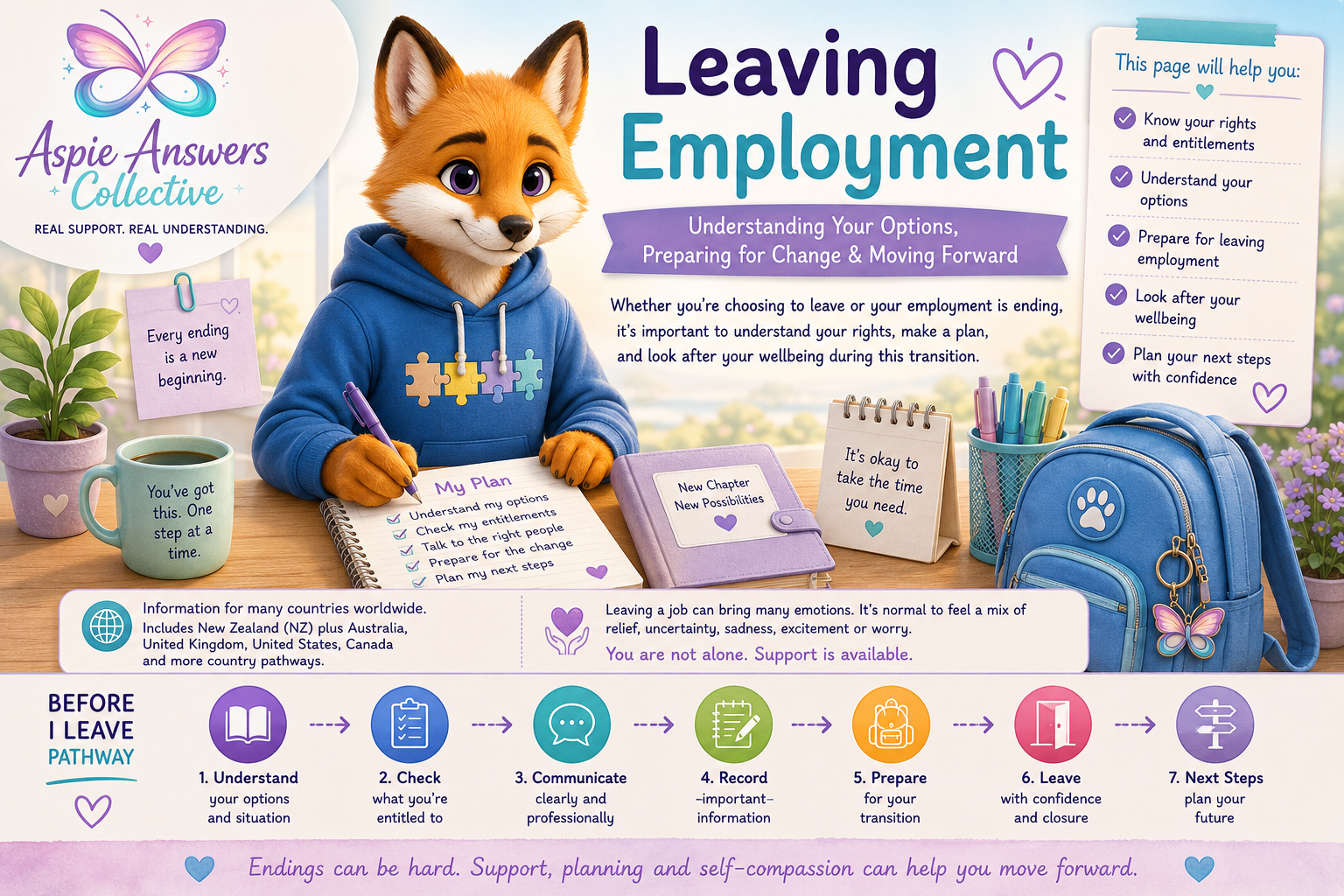
Understanding your options, preparing for change and moving forward — whether you are choosing to leave, facing redundancy, being dismissed, or reaching the end of another employment arrangement.
Aspie Answers provides general educational information and practical support pathways. This page does not replace individual legal, financial, employment, medical or mental-health advice.
Notice, final pay, redundancy, dismissal, grievance, termination and other leaving-work rules differ between countries and can also depend on employment type, contract terms and individual circumstances. Check current official guidance for the place where you work before relying on legal or entitlement information.
If you are leaving because work has become unsafe, discriminatory, harmful or overwhelming, consider getting appropriate advice or support before making a major decision where circumstances allow.
Search Aspie Answers for workplace rights, leaving-work guidance, resources, adjustments and related employment support.
Employment can provide income, routine, familiar people, a place to go, responsibilities, identity and structure. When it ends, even a change you wanted can bring relief, uncertainty, sadness, excitement, worry or several feelings at once.
You do not need to have your whole future worked out before your last day. Focus first on understanding what is happening, protecting important information, completing what needs to be completed and preparing for your next step.
You decide to leave your job and give the notice required by the rules that apply to you.
Your role may end or change because the employer no longer requires the job in its current form or the organisation changes.
An employer ends the employment relationship. Fair process, notice and challenge rights depend on the country and circumstances.
A fixed-term arrangement may finish, a business may close, retirement may occur, or another agreed employment ending may apply.
Know why employment is ending and what options may apply.
Review your agreement, notice, leave and possible entitlements.
Confirm important conversations and dates clearly.
Keep appropriate copies of information you are entitled to retain.
Plan handover, property, finances, routine and transition.
Complete the final practical steps and close out your employment.
Give yourself room to adjust and plan what comes next.
A notice period is the time between notice being given and employment ending. The amount required can depend on your country, employment agreement, award, collective agreement, length of service, employment type and who is ending the employment.
Do not assume every employee or every country has the same notice requirement. Check the documents and law that apply to your employment.
You may continue working normally, complete a handover or have agreed changes to duties. Leave during notice can also have specific rules.
Payment instead of notice, agreement to shorten notice, or other arrangements may be possible depending on the circumstances and jurisdiction.
Your final pay may look different from an ordinary pay. Depending on where you work and your circumstances, it can include wages still owing, leave-related payments, notice payments, redundancy entitlements or other contractual amounts.
Record key tasks, deadlines, contacts and project information needed by the person or team taking over.
Return equipment, keys, access cards, devices, uniforms, documents or other employer property as required.
Expect workplace accounts and system access to be changed or closed. Remove personal information only where you are permitted to do so and do not take confidential workplace material.
Before leaving, think about what legitimate information you may need later. Depending on your workplace and country, this could include employment dates, role details, a reference or referee, final-pay documents, tax information, training records or evidence of qualifications you personally earned.
Redundancy is different from simply resigning. Consultation, selection processes, notice, redeployment possibilities and redundancy pay vary significantly by country and employment arrangement.
Why is the role changing? What process applies? Are alternative roles available? What are the proposed dates? What notice and payments apply? What information can I receive in writing?
If your role may be made redundant, use current official employment guidance for your jurisdiction rather than relying only on general internet information.
If your employer is ending your employment, the process and your rights depend on the reason, local employment law and your employment circumstances. There may be rules covering fair process, notice, final pay, discrimination, retaliation, misconduct, performance, probation or unfair dismissal.
Where appropriate, ask for the reason, effective date, relevant documentation, final-pay information and the process for raising concerns or challenging the decision. If formal rights may be involved, get jurisdiction-specific advice promptly.
Sometimes a person wants to leave because of bullying, discrimination, unresolved conflict, health impacts, unmet adjustments, workload, safety concerns or another serious workplace problem.
Use our problem-solving guide to record what happened, consider outcomes and find support pathways.
Workplace Issues & ProblemsIf barriers at work relate to disability, neurodivergence or health, consider whether workplace adjustments or another support pathway may be relevant before making a final decision.
Workplace AdjustmentsLeaving a job can change your routine, finances, social contact, energy demands and sense of certainty. Try to plan for the transition as well as the paperwork.
Think about wake times, meals, movement, appointments, job-search time, rest and activities that give your week some shape.
Relief and sadness can exist together. You do not need to feel only one way about leaving.
If the previous job was exhausting or harmful, you may need some recovery time before deciding what comes next, where your circumstances allow.
This is general wellbeing guidance rather than mental-health treatment. If your wellbeing is significantly affected, appropriate professional or local support may also be useful.
Aspie Answers keeps the practical guidance international while separating country-specific legal information. As dedicated sibling pages are completed, these pathways can become deeper country-specific guides.
Employment New Zealand provides official guidance on resignation, notice, final pay, redundancy, dismissal and employment problems.
NZ: Resignation ↗NZ: Final Pay ↗Fair Work Ombudsman provides official information about resignation, notice, final pay, redundancy and dismissal under the national workplace-relations system.
Australia: Ending Employment ↗Acas provides guidance on resignation, notice and final pay. Contractual and statutory rules can both matter.
UK: Acas Final Pay ↗Federal and state rules can differ significantly. Wage, discrimination, leave, notice and termination issues may involve different agencies and laws.
Dedicated US pathway developingEmployment standards and termination rules may be federal, provincial or territorial depending on the workplace and jurisdiction.
Dedicated Canada pathway developingEuropean countries have distinct employment laws even where EU-level rules or principles are relevant.
Country pathways developingCountry-specific employment pathways across Asia and the wider Pacific should be treated individually rather than as one legal system.
Regional pathway developingAdditional country and regional pathways beyond the dedicated United States and Canada guides.
More pathways comingCountry-specific leaving-employment and labour-law pathways across South America.
Regional pathway developingAdditional country and regional pathways can be added as the international Work & Employment library grows.
More regions comingGive yourself time to process the transition where your circumstances allow.
What did the role teach you about your strengths, needs, preferences and boundaries?
Update your CV, references, work examples and job-search information when you are ready.
Your next step might be another job, study, volunteering, self-employment, recovery time or something else entirely.
Practical resources are being developed to make leaving employment easier to plan, understand and manage.
A start-to-finish checklist covering notice, final pay, records, property and next steps.
More resources are coming soon.Plan timing, notice, communication, finances and the final day.
More resources are coming soon.Record expected payments, deductions and questions to check.
More resources are coming soon.Organise tasks, deadlines, contacts and information before leaving.
More resources are coming soon.A simple structure for asking an appropriate person for a reference.
More resources are coming soon.Plan routine, wellbeing, finances and the first few weeks after employment ends.
More resources are coming soon.Collections bring related guides and practical tools together around a particular stage of the employment journey.
Resignation, final pay, handover, transition and next-step resources.
Collection developingRights, agreements, workplace problems, safety and support pathways.
Collection developingCommunication, decision-making, self-advocacy and preparing for difficult conversations.
Collection developingUnderstand difficult workplace situations and possible next steps.
Workplace Issues & ProblemsExplore the wider foundation of employment rights and official guidance.
Employment RightsUnderstand employment terms, agreements and questions to check before you accept work.
Employment Agreements & ContractsExplore accessibility, practical changes and support at work.
Workplace AdjustmentsThink through decisions about sharing disability, neurodivergence or support needs.
Disclosure at WorkFind guidance for unfair, discriminatory or harmful workplace situations.
Explore This TopicUnderstand what is happening, check what applies to you, keep the information you need, prepare for the transition and give yourself room to work out what comes next.
Aspie Answers gentle guidance: Leaving work can involve legal, financial, practical and emotional decisions. Use current official information for your location and appropriate professional support where individual advice is needed.
↑ Return to the Beginning