
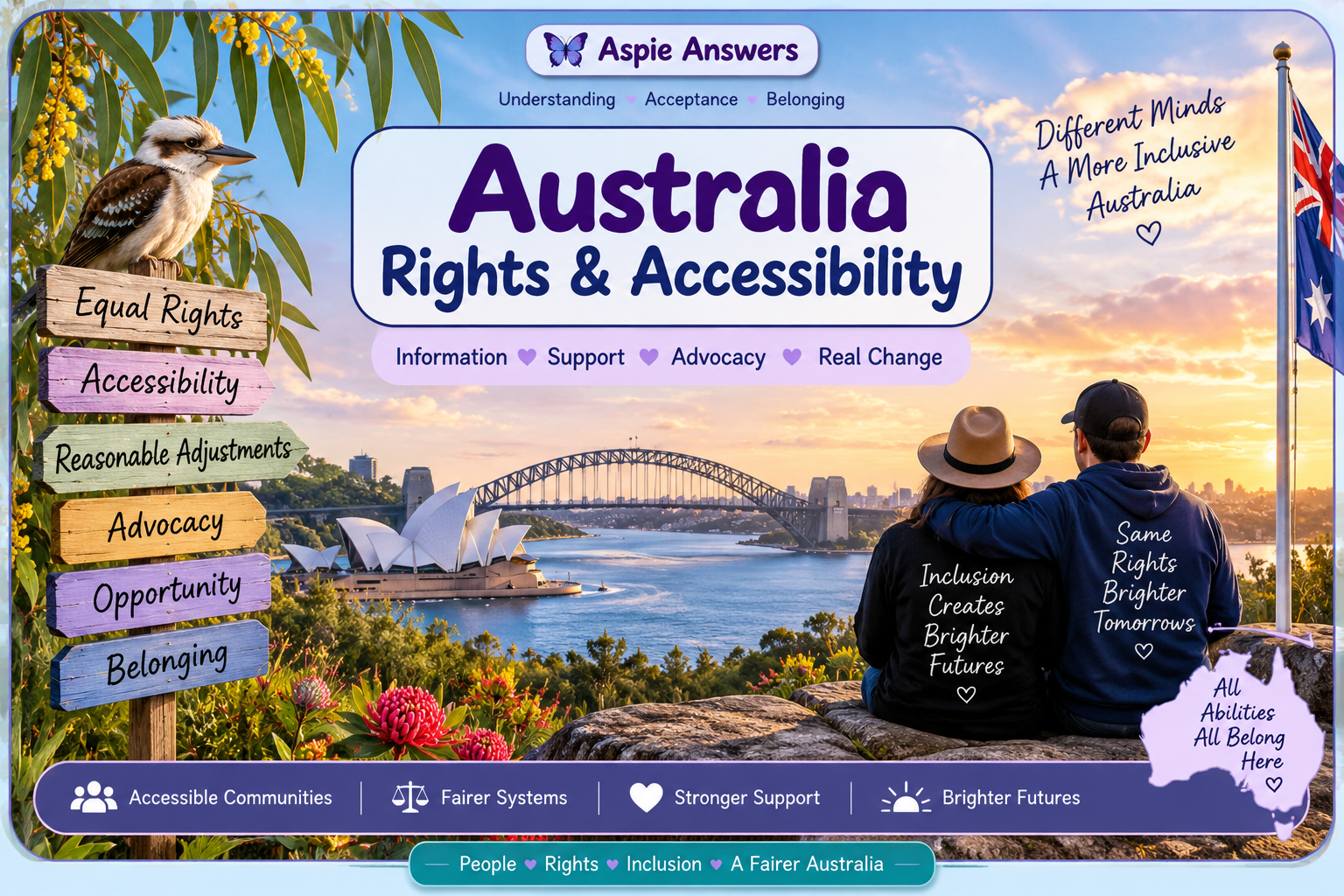
Australia Rights & Accessibility
Understanding disability rights can make it easier to recognise barriers, ask for reasonable adjustments, find support, participate more fully and know where to turn when something is not working. This page brings together key Australian disability-rights, accessibility, advocacy and complaint pathways in one easier-to-follow place.
💜 A Gentle Information Notice
This page provides general educational information and navigation support. It is not legal advice and does not determine individual eligibility, legal rights or the outcome of a complaint. Australian laws, programmes, government responsibilities and complaint processes can change, and some pathways differ between states and territories. Use the linked official Australian sources for current guidance relevant to your circumstances.
🌿 Understanding Disability Rights in Australia
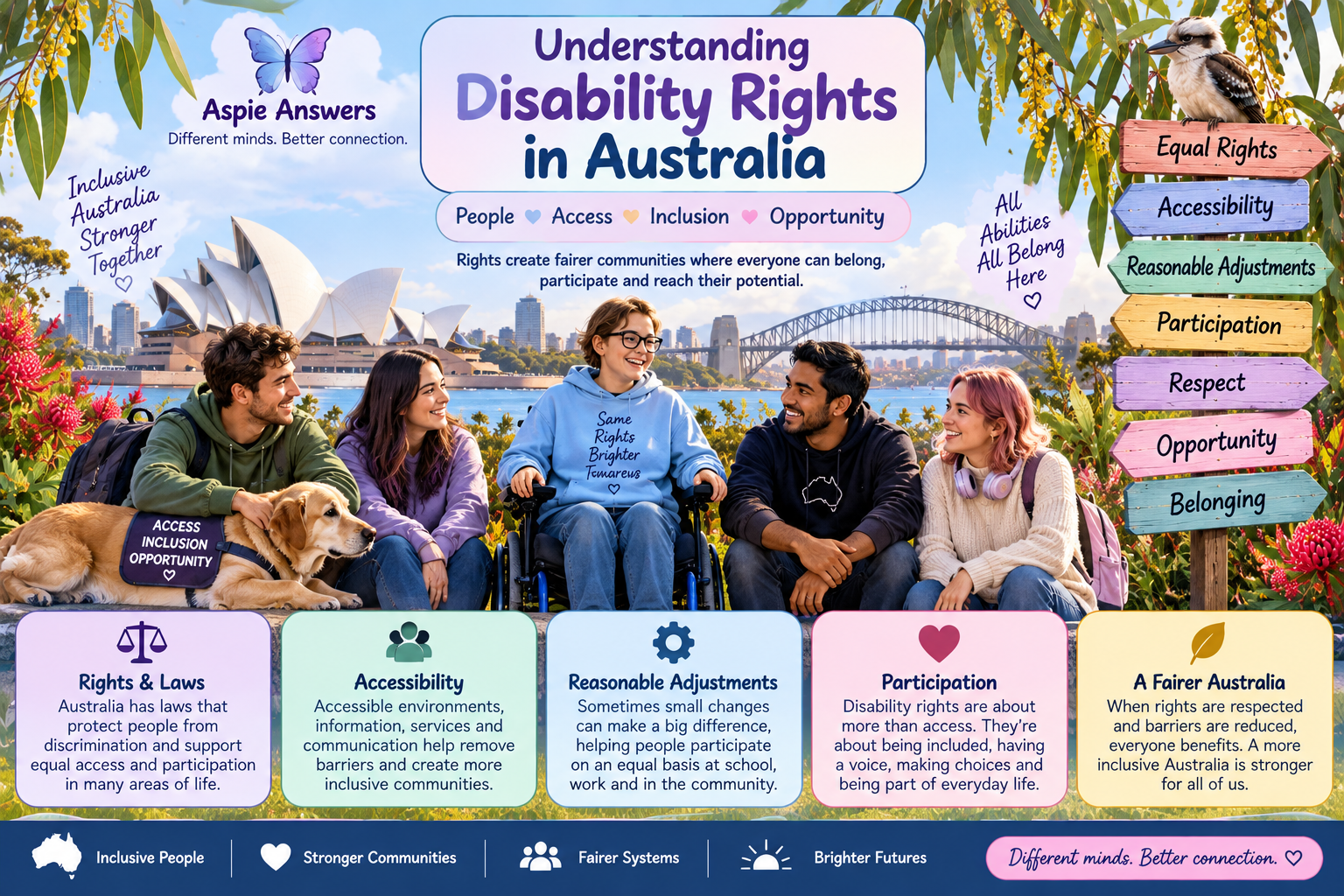
Disability rights are about being able to participate, make choices, access services and opportunities, communicate your needs and be treated fairly and with dignity.
Equal rights
Australian disability discrimination law protects people with disability against unlawful discrimination in areas of public life.
Removing barriers
Accessibility can involve physical spaces, communication, information, sensory environments, technology, procedures and attitudes.
Participation
Inclusion is not only about being present. It is also about having meaningful opportunities to participate, contribute and belong.
🧭 Australia’s Disability Rights Framework
Different laws, standards, strategies and government responsibilities can apply depending on where a barrier occurs and what kind of support or resolution is needed.
Disability Discrimination Act 1992
The Disability Discrimination Act is a major Commonwealth anti-discrimination law covering disability discrimination in areas including employment, education, access to premises and provision of goods, services and facilities.
Australia’s Disability Strategy 2021–2031
Australia’s national disability strategy provides a framework shared by Australian, state, territory and local governments for improving inclusion and outcomes for people with disability.
State and territory laws
Australia also has state and territory anti-discrimination, equal-opportunity, complaints and service systems. The correct pathway may therefore depend on where you live and what happened.
International disability rights
Australia is a party to the United Nations Convention on the Rights of Persons with Disabilities, which provides an international human-rights framework for disability inclusion and participation.
♿ Accessibility Across Everyday Life
Access needs can look very different from person to person. Some barriers are visible; many others are not.
Buildings & public spaces
Physical access can include entrances, pathways, toilets, seating, signage, lighting, navigation and the ability to use facilities safely and independently.
Communication access
Some people may need Auslan, AAC, visual information, plain language, Easy Read, written communication, extra processing time or a support person.
Neurodivergent access
Predictability, sensory adjustments, reduced noise, alternative communication, clear instructions, breaks and flexibility may all support neurodivergent accessibility.
Digital accessibility
Websites, apps, online forms, documents, videos and digital communication can create barriers when information is difficult to perceive, understand, navigate or operate.
Community participation
Access can affect transport, recreation, events, appointments, shopping, community services and participation in social and civic life.
Information access
Accessible information can include alternative formats, captions, readable layouts, clear instructions, accessible documents and more than one way to communicate.
🛠️ Reasonable Adjustments & Accommodations
Sometimes equal access requires changing a usual process, environment or way of doing something so a person with disability can participate more fairly.
Change the environment
This might include physical access changes, lighting, seating, quieter spaces, reduced sensory load or accessible equipment.
Change communication
Written instructions, accessible formats, Auslan, visual information, alternative ways to respond and additional processing time may help.
Change the process
Flexibility around timing, interviews, tasks, assessments, breaks, work methods or participation may reduce unnecessary barriers.
Explore Aspie Answers: Reasonable Adjustments & Accommodations →
🎓 Education, Employment & Opportunity
Two areas where accessibility and reasonable adjustments are especially important are education and employment.
Education & learning
The Disability Standards for Education clarify obligations under the Disability Discrimination Act and aim to ensure students with disability can access and participate in education on the same basis as students without disability.
Employment & workplace adjustments
Workplace adjustments may include changes to the work area, equipment, communication, work methods, tasks or working arrangements. JobAccess provides Australian guidance for people with disability and employers.
🤝 Support, Advocacy & Community
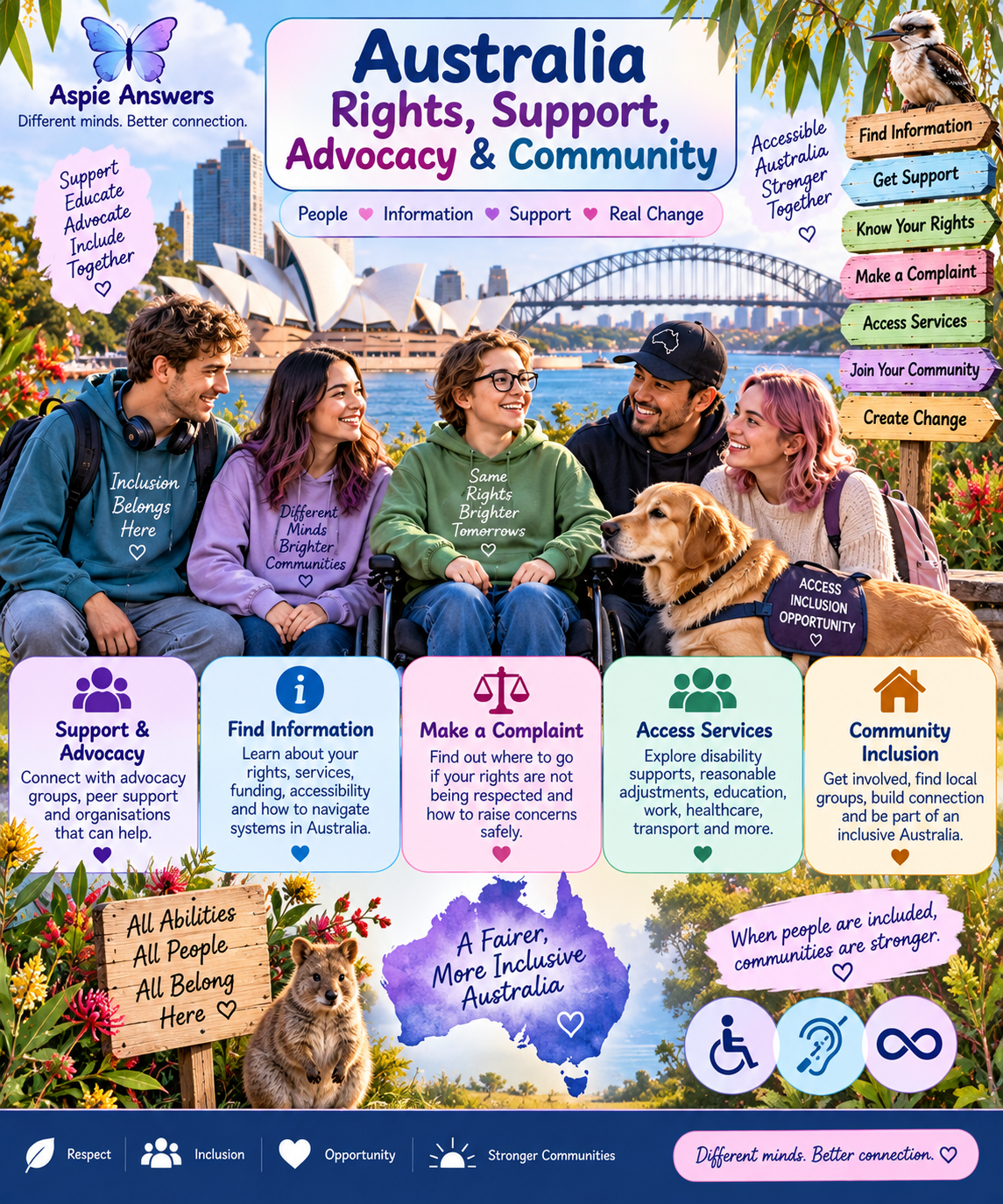
You do not always need to navigate a complicated system alone. Support can come from people you trust, disability organisations, advocates, community services and official information pathways.
Disability Gateway
Disability Gateway helps people find disability information, services and support across areas of everyday life.
Disability advocacy
Advocacy organisations can help people understand options, have their say, protect their rights and navigate difficult situations. Available organisations differ across states and territories.
Trusted support people
A family member, friend, advocate, interpreter or other trusted support person may help with appointments, communication, preparing questions and keeping track of information.
🌏 Culture, Identity & Belonging
Accessible support should recognise that disability does not exist separately from culture, identity, family, language, community and lived experience.
Aboriginal & Torres Strait Islander people
Culturally safe disability information and support should recognise connection to Country, family, community and cultural identity rather than assuming one service approach suits everybody.
Culturally & linguistically diverse communities
Language, migration experience, family roles, cultural understandings of disability and access to interpreters can all influence how someone experiences a service.
Individual language preferences
People may use different language for disability and identity. Where possible, listen to and respect the terminology the person chooses for themselves.
📣 Complaints, Advocacy & Finding Help
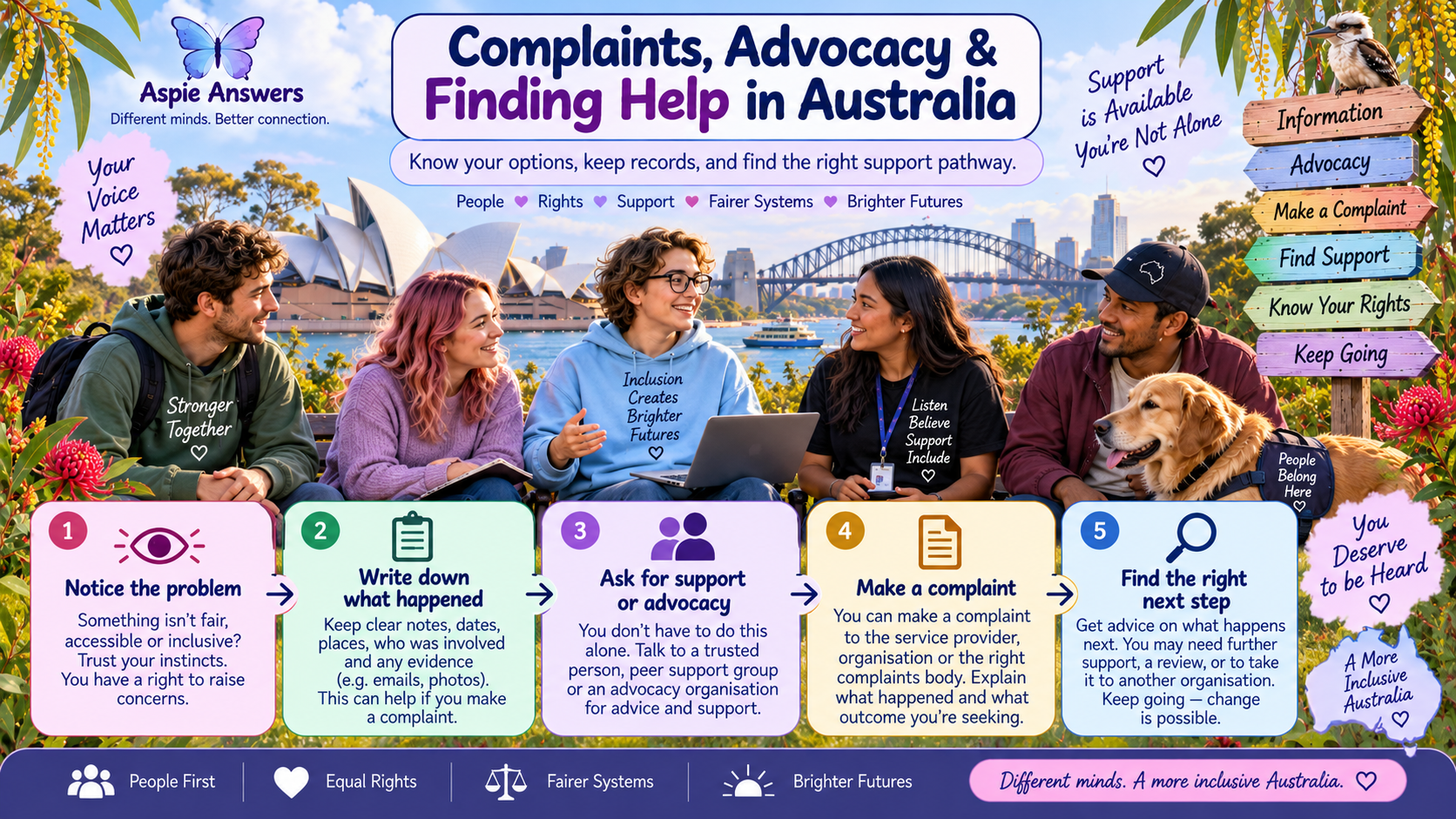
Australia does not have one single complaint organisation for every disability-related problem. The correct pathway depends on what happened, who was involved and whether the issue is national, state or territory based.
Australian Human Rights Commission
The Commission can receive complaints about disability discrimination covered by federal anti-discrimination law. Its complaint process is free.
Human Rights Commission complaints ↗NDIS Quality & Safeguards Commission
Concerns about the quality or safety of NDIS supports, providers or workers can be raised with the NDIS Commission.
NDIS Commission complaints ↗Commonwealth Ombudsman
The Commonwealth Ombudsman can consider complaints about many Australian Government agencies and some other organisations within its jurisdiction.
Commonwealth Ombudsman ↗State & territory pathways
Anti-discrimination commissions, ombudsmen, health complaint bodies, tenancy services and other complaint organisations vary between Australian states and territories.
Find advocacy in your state or territory ↗Explore Aspie Answers: Discrimination, Complaints & Problems →
✨ Where Do I Start?
You do not need to understand the entire Australian disability system before taking the first step. Start with the particular barrier or problem affecting you now.
Name the barrier
What is preventing access, participation or fair treatment?
Work out what would help
An adjustment, information, support, communication access or a decision reviewed?
Keep useful information
Save relevant letters, messages, dates, notes and decisions.
Ask for support
A trusted person or advocate can help if navigating it alone feels difficult.
Find the right pathway
Match the organisation to the type of issue and your state or territory where relevant.

🔗 Trusted Australian Starting Points
These official Australian sources are useful places to check current rights, services, adjustments and complaint information.
Australian Human Rights Commission
Federal disability discrimination information and human-rights complaint pathways.
Visit disability discrimination information ↗Australia’s Disability Strategy
National framework for disability inclusion across Australian governments.
Visit Department of Social Services ↗Disability Gateway
Information about disability services, support and advocacy across Australia.
Visit Disability Gateway ↗JobAccess
Australian disability-employment information, workplace adjustments and employment support.
Visit JobAccess ↗Department of Education
Disability Standards for Education and related information for students, families and education providers.
Disability Standards for Education ↗NDIS Quality & Safeguards Commission
Information and complaints relating to the quality and safety of NDIS supports and services.
Visit NDIS Commission complaints ↗