
North America Rights & Accessibility
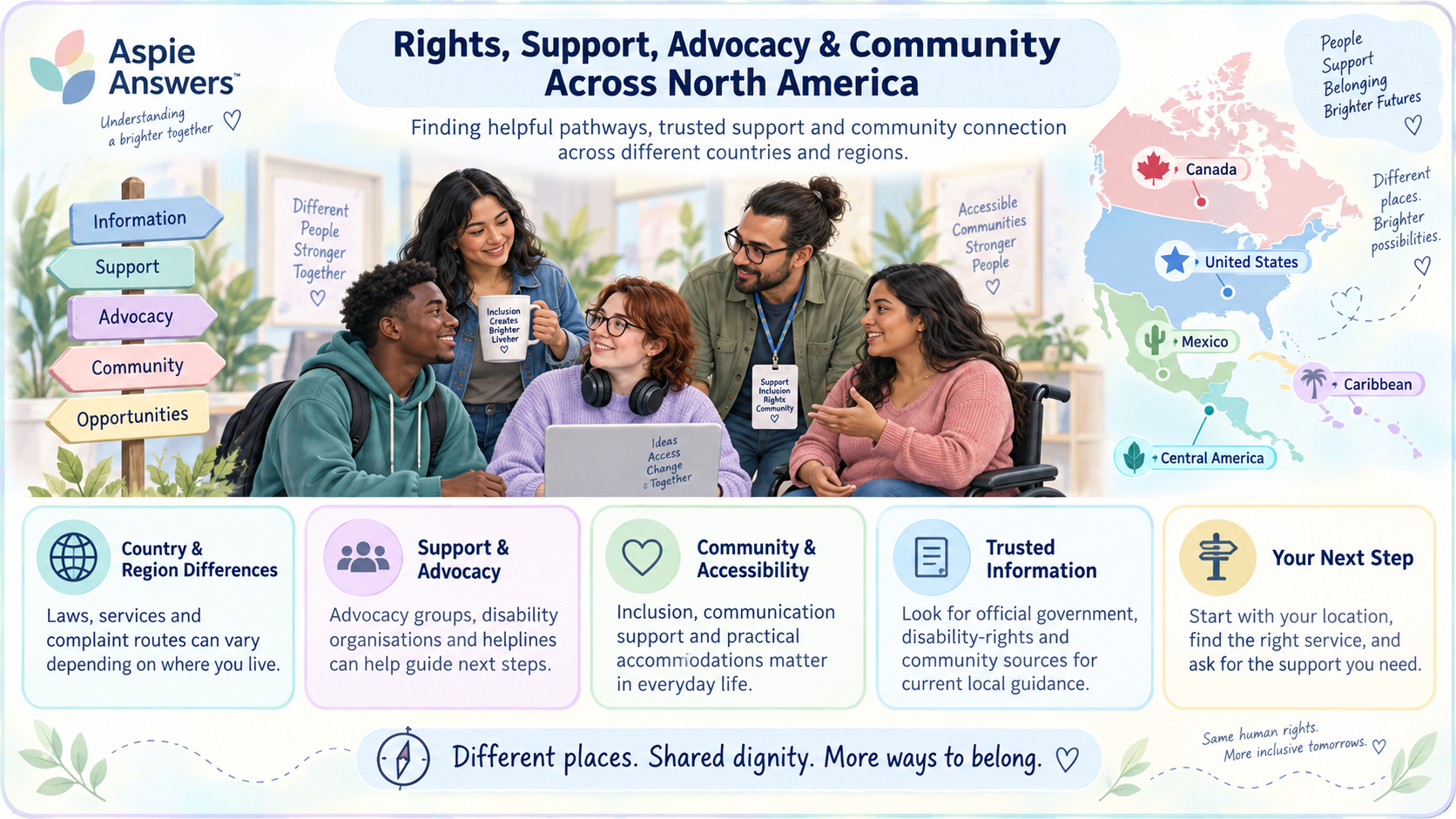
Disability rights and accessibility look different across Canada, the United States, Mexico, Central America and the Caribbean. Laws, reasonable accommodation requirements, services and complaint routes can also differ between provinces, territories, states and local jurisdictions. This page helps you understand the regional picture and find a more appropriate local starting point.
💜 A Gentle Information Notice
Aspie Answers provides general educational and navigation information. This page is not legal advice and does not determine individual legal rights, eligibility or complaint outcomes. Disability laws, accessibility requirements, government responsibilities, services and complaint processes can change and may differ between countries, states, provinces, territories and local jurisdictions. Always check current official information for your particular location and circumstances.
🌿 Understanding Disability Rights Across North America
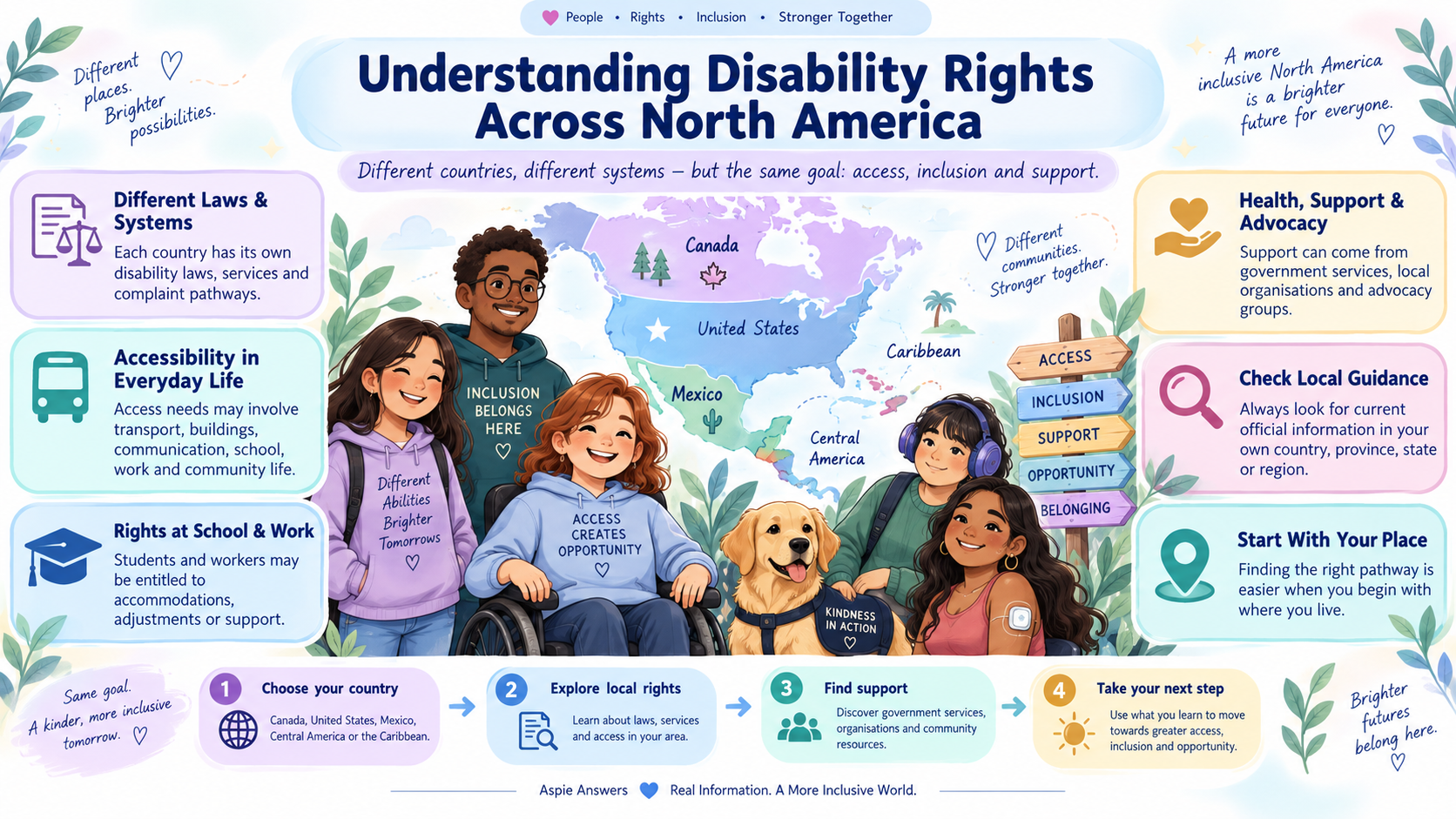
North America does not have one disability-rights system. The first useful question is usually: where is the person, organisation or problem located?
Different laws
Each country has its own disability, human-rights, accessibility and anti-discrimination framework. State, provincial, territorial or local law may also apply.
Different access systems
Accessibility requirements can affect buildings, transportation, communication, digital services, education, employment, healthcare and public services.
Different support pathways
Human-rights bodies, government departments, disability organisations, advocates and complaint agencies have different roles in different places.
🧭 International & Regional Rights Frameworks
International and regional frameworks help explain disability-rights principles, but they do not replace the national or local law that applies to an individual situation.
UN Convention on the Rights of Persons with Disabilities
The CRPD is an international human-rights framework covering equality, accessibility, independent living, education, health, employment, information and participation.
Treaty status and domestic implementation differ, so check the current status for the country involved.
Inter-American disability-rights framework
The Organization of American States has an Inter-American Convention aimed at preventing and eliminating discrimination against persons with disabilities.
It applies according to each country's treaty status, so it should not be treated as a single law covering everyone in North America.
🗺️ Start With Your Place
Aspie Answers uses a broad North American discovery pathway here to help visitors navigate. This is a practical website grouping rather than a statement that every country or subregion shares the same legal system.
🇨🇦 Canada
The Accessible Canada Act focuses on identifying, removing and preventing accessibility barriers within areas of federal jurisdiction. Provincial and territorial accessibility and human-rights laws may also be relevant.
Accessible Canada Act information ↗🇺🇸 United States
The Americans with Disabilities Act is a major federal civil-rights law covering disability discrimination in areas including employment, state and local government services and places open to the public.
Explore ADA.gov ↗🇲🇽 Mexico
Mexico's disability-rights framework includes the General Law for the Inclusion of Persons with Disabilities. CONADIS promotes disability rights, inclusion and participation.
View the current federal disability law ↗🌎 Central America
Rights, disability legislation, government agencies and complaints systems vary by country. Begin with current national sources, local disabled people's organisations and relevant regional human-rights information.
🏝️ Caribbean
Caribbean jurisdictions have different constitutional, disability, equality and service systems. Check the individual country or territory rather than relying on a single regional rule.
♿ Accessibility Across Everyday Life
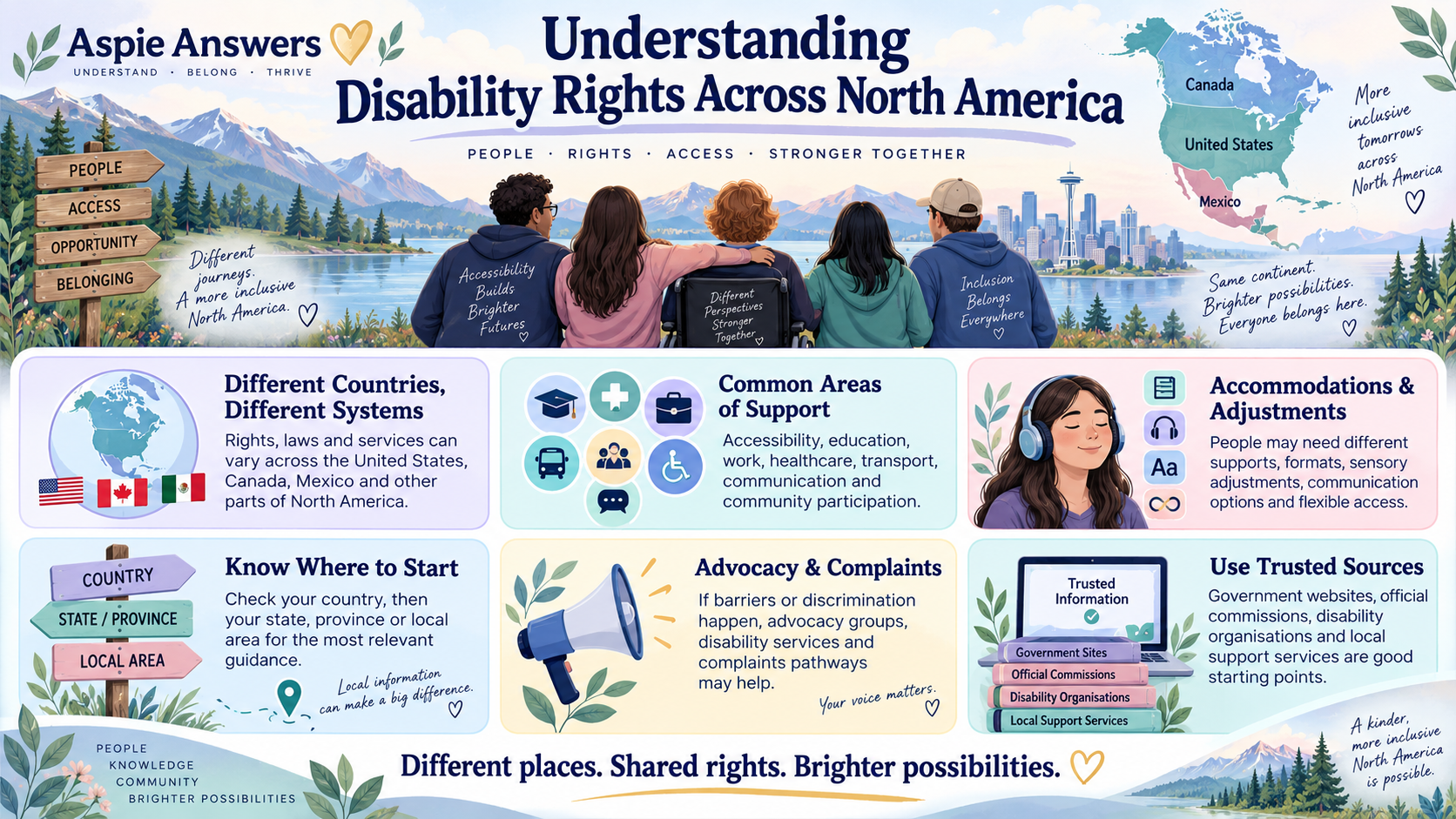
Accessibility is much broader than physical access. Barriers can affect the way someone learns, works, communicates, travels, receives healthcare, uses technology or participates in community life.
Buildings & public services
Entrances, pathways, toilets, signage, service counters, waiting areas and the design of public services can affect whether someone can participate.
Communication access
Sign languages, AAC, interpreters, captions, plain language, Easy Read, written communication and extra processing time may all support access.
Neurodivergent accessibility
Predictability, sensory adjustments, clearer instructions, alternative communication, quieter environments, breaks and flexibility may reduce barriers.
Digital access
Websites, online forms, documents, apps and videos can create barriers when information is difficult to perceive, navigate, understand or operate.
Transport
Accessible transport may involve vehicles, stations, booking systems, communication, boarding assistance and usable travel information.
Community life
Recreation, shops, events, housing, public meetings, appointments and community services can all be part of meaningful accessibility.
🛠️ Adjustments, Accommodations & Removing Barriers
The terminology and legal tests differ between jurisdictions, but the practical idea is often similar: changing an environment, process or method may help provide fairer access.
Change the environment
Physical access, seating, lighting, quieter spaces, sensory changes and accessible equipment may help.
Change communication
Written instructions, interpreters, captions, accessible formats, AAC or alternative ways to respond may reduce communication barriers.
Change the process
Timing, breaks, work arrangements, interviews, assessment methods or other procedures may sometimes be adjusted to improve access.
🎓💼 Rights in Work, Education, Healthcare & Community
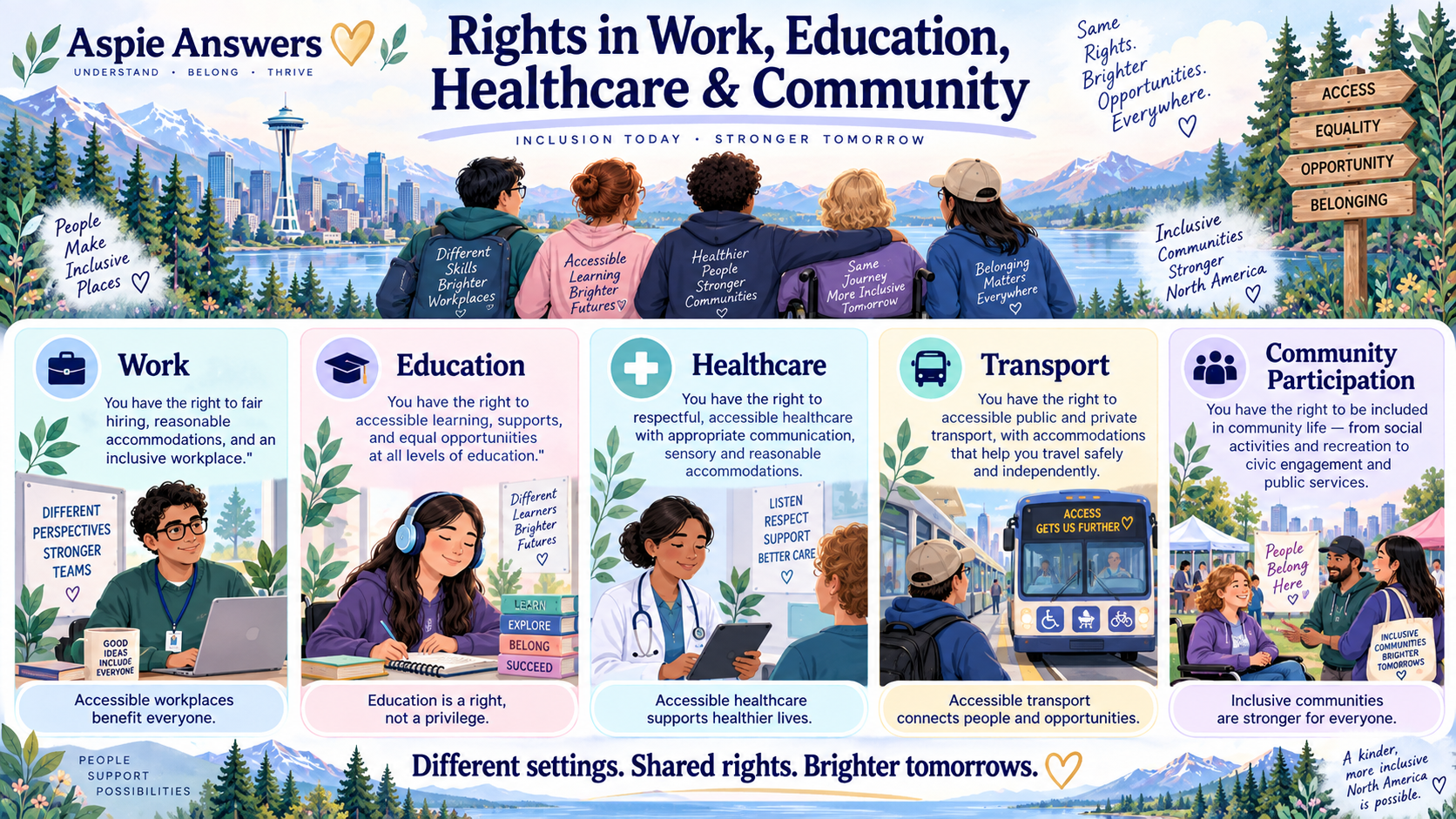
Rights and access needs can follow someone across many settings, but the responsible organisation and legal pathway may change each time.
Employment
Recruitment, workplace accessibility, disability discrimination, accommodation and complaint systems differ by jurisdiction.
Education
Disability support, inclusive education, accommodations, assessments and complaint pathways may differ between school systems and education levels.
Healthcare
Accessible healthcare may involve communication, physical access, sensory support, interpreters, informed decision-making and respectful care.
Transport
Different transport providers and government bodies may be responsible for air, rail, road, marine or local public transport access.
Public services
Government services, voting, courts, community programmes and local services may have their own accessibility requirements and complaint pathways.
Community participation
Recreation, culture, public events and civic life become more inclusive when information, environments and participation options are accessible.
🤝 Rights, Support, Advocacy & Community
You do not always have to understand or navigate a disability-rights system alone. Local advocacy and disability organisations can be especially useful when national systems are complicated.
Find trustworthy information
Begin with official government, human-rights, disability or regulator information for the particular country and jurisdiction.
Find an advocate
Advocates may help explain options, prepare information, communicate concerns or identify the appropriate organisation to contact.
Use community knowledge
Disabled people's organisations, neurodivergent groups, community organisations and peer networks can help people understand local systems.
📣 Complaints, Advocacy & Finding Help
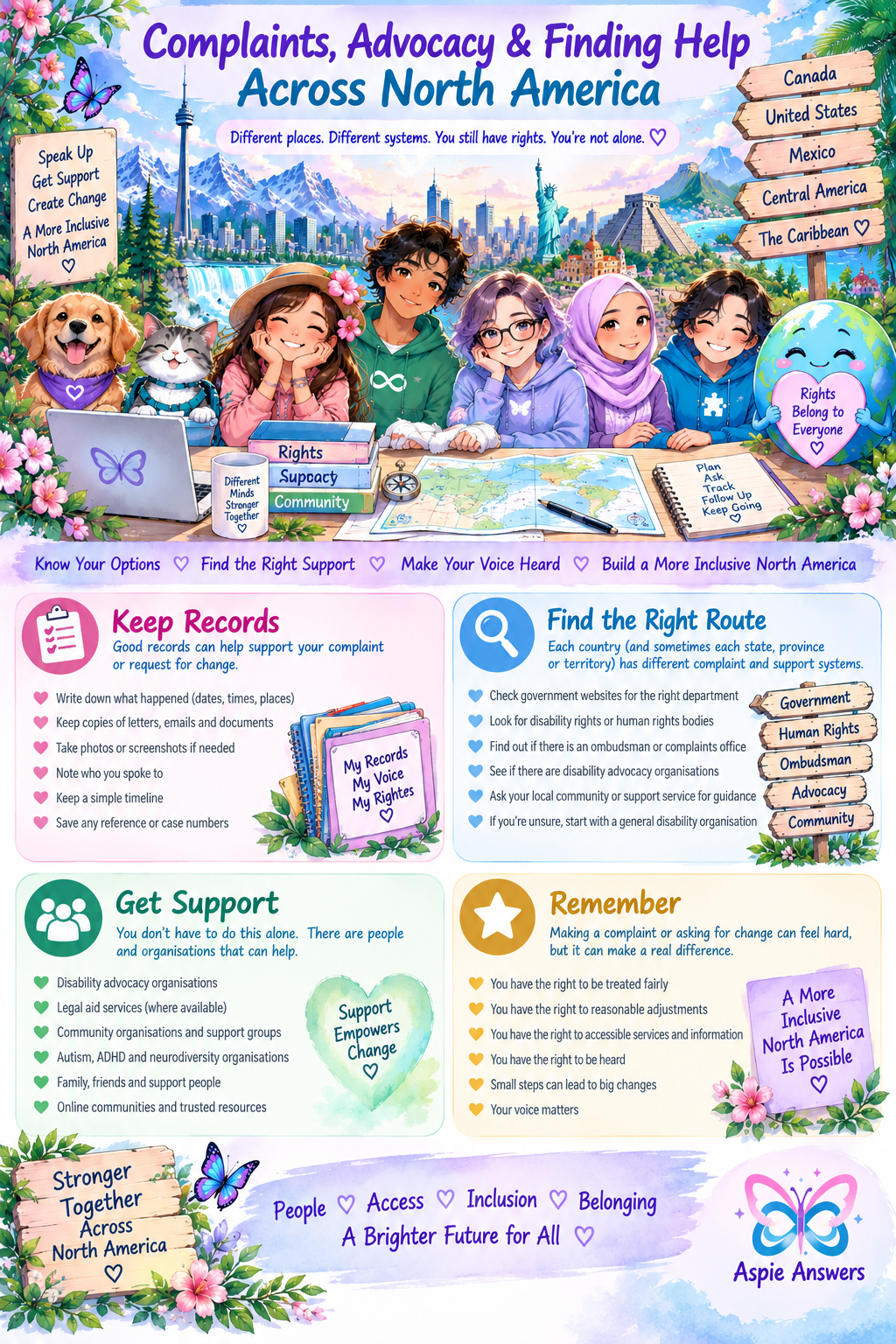
Finding the right complaint pathway is often easier once you know both the type of problem and the jurisdiction involved.
🇺🇸 United States — ADA complaints
The appropriate federal agency depends on the issue. ADA.gov directs employment concerns to the EEOC, air-travel concerns to the Department of Transportation, housing matters to HUD, and many other ADA complaints to the Department of Justice.
ADA complaint guidance ↗🇨🇦 Canada — human-rights & accessibility complaints
The Canadian Human Rights Commission deals with complaints within federal jurisdiction and can help visitors identify whether a different provincial or territorial pathway is appropriate.
Canadian Human Rights Commission ↗🇲🇽 Mexico — disability information
CONADIS coordinates and promotes federal disability inclusion policy and disability rights information. Other complaint or legal pathways may depend on the particular issue and location.
Visit CONADIS ↗Central America & Caribbean
Begin with the national government, national human-rights institution, disability organisation, ombudsman or equivalent body for the country or territory. Regional OAS information may provide additional context.
✨ Where Do I Start?
You do not have to map an entire legal system first. Start with the one problem or barrier affecting you now.
Find the location
Which country, state, province, territory or local area does the issue belong to?
Name the barrier
Is it discrimination, access, education, work, healthcare, transport or another problem?
Check official guidance
Look for the current law, agency or service responsible.
Get support
A trusted person, advocate or disability organisation may help you navigate the next step.
Take one next step
Ask a question, request an accommodation, contact an organisation or begin a complaint.
🔗 Trusted Starting Points
Use these as starting points, then follow the relevant country, state, province, territory or issue-specific pathway.
United States — ADA.gov
U.S. Department of Justice information about the Americans with Disabilities Act, accessibility and complaint pathways.
Visit ADA.gov ↗Canada — Accessible Canada
Government of Canada information about the Accessible Canada Act and federal accessibility.
Explore Accessible Canada ↗Canada — Human Rights Commission
Information about federal discrimination and accessibility complaints and finding the correct jurisdiction.
Canadian Human Rights Commission ↗Mexico — CONADIS
Mexican government disability-rights, inclusion and participation information.
Visit CONADIS ↗Mexico — Federal Disability Law
Current text and amendment history for the General Law for the Inclusion of Persons with Disabilities.
View the law ↗Organization of American States
Regional information about the Inter-American disability-discrimination convention and its framework.
Explore OAS disability-rights information ↗