
Mental Health Topics & Conditions
Explore broad mental-health topics, conditions and related experiences through clear, accessible learning pathways. Start with the area that feels most relevant to you and follow the links that help you understand more.
🦉 Learning With Olive Owl & Twinkle Owl
Olive Owl and Twinkle Owl continue to guide the Mental Health Education family.
Olive helps break complex information into clearer pieces. Twinkle reminds us that questions, uncertainty, repetition and changing direction are all valid parts of learning.
A Gentle Information Notice
This page provides general mental-health education and lived-experience-informed learning. It can help explain concepts, experiences and terminology, but it cannot diagnose a condition.
Similar symptoms can have different causes, and a person's wider context matters. If something raises concerns about your wellbeing, you may choose to discuss it with an appropriately qualified health or mental-health professional.
💜 Some Topics May Feel Heavier
This page can lead into subjects such as trauma, abuse, grief, eating-related concerns, distress, difficult relationships and other challenging experiences.
These topics are included for education, not to pressure anyone into reading material they are not ready for. Skip sections, take breaks and return another time whenever you need to.
You can explore information simply because you are curious, supporting someone else or trying to make sense of an experience.
✨ What This Page Covers
Use this page to explore broad mental-health topic areas, understand where experiences may overlap and choose what you would like to learn about next.

Start With a Topic
Choose a broad area such as mood, anxiety, trauma, sleep or relationships.
Start With an Experience
You may only know that something feels difficult, unfamiliar or different. That is enough to begin exploring.
Use the A–Z
If you already know the term or condition you want, the A–Z provides a faster route.
Mental Health Topics A–Z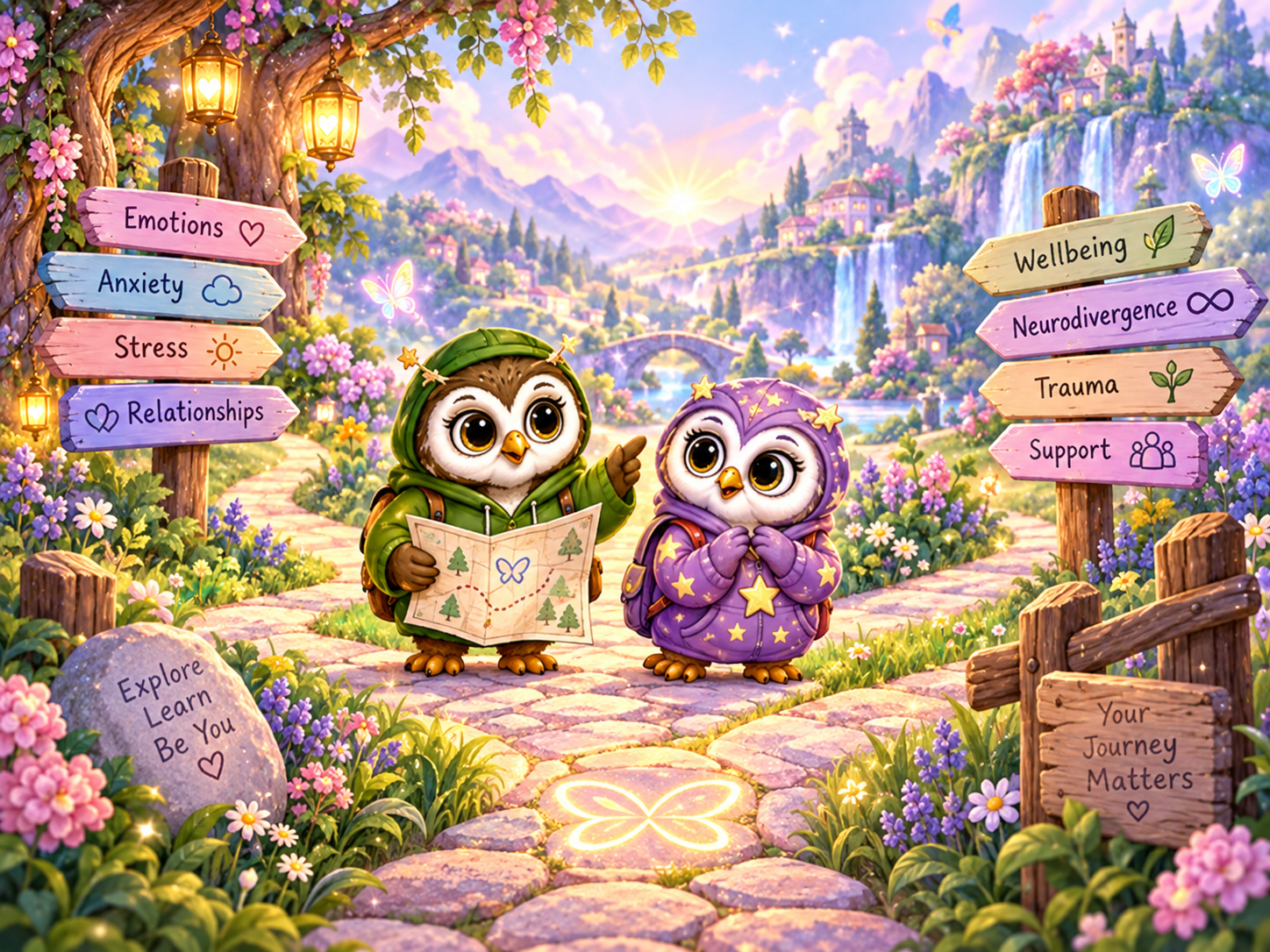
Low Mood & Depression
Explore low mood, loss of interest, motivation, energy and the ways depression can affect everyday life.
Emotional Overwhelm
Learn about intense emotions, emotional exhaustion and feeling unable to manage everything at once.
Self-Esteem & Self-Worth
Explore how self-beliefs, experiences, relationships and environments can affect how people see themselves.
Grief & Loss
Grief can follow many kinds of loss and may affect emotions, sleep, concentration, identity and everyday functioning.
Motivation & Energy
Changes in motivation and energy can have many causes and do not automatically point to one condition.
Emotional Regulation
Learn how people notice, understand and respond to emotions in different ways.
Anxiety & Worry
Explore worry, apprehension, physical tension, uncertainty and avoidance.
Panic
Learn about sudden intense fear and the physical sensations that may accompany panic.
Stress
Understand how ongoing demands may affect the mind, body, emotions and capacity.
Fears & Phobias
Explore intense fear responses connected with particular situations, objects or experiences.
Obsessions & Compulsions
Learn about recurring unwanted thoughts and repetitive behaviours or mental actions without assuming that every habit is OCD.
Burnout & Overload
Explore exhaustion, prolonged demands, reduced capacity and the importance of recovery and accessibility.
You can skip it and continue to the next section if that feels better today.
Trauma
Learn how overwhelming or threatening experiences can affect emotions, memory, safety, relationships and the body.
Abuse & Coercion
Educational information about abuse will remain clearly connected to appropriate safety and specialist-support pathways.
Difficult Relationships
Relationships can affect wellbeing through connection, conflict, safety, loss, control, rejection or isolation.
Grief & Bereavement
Grief is individual and can affect many areas of everyday life.
Recovery & Safety
Recovery may involve support, safety, boundaries, time, adaptation and rebuilding trust or capacity.
Specialist Support Matters
Some experiences need pathways beyond general mental-health education. Aspie Answers will keep those routes visible rather than duplicating specialist services.
Intrusive Thoughts
Unwanted thoughts can occur for many reasons and do not automatically reflect a person's wishes, values or intentions.
Dissociation
Learn about experiences of disconnection from surroundings, memory, identity or a sense of being fully present.
Changes in Perception
Some mental-health experiences may affect how a person interprets or experiences the world around them.
Psychosis-Related Experiences
Educational information can explain terminology and experiences while avoiding assumptions about any individual person.
Confusion & Concentration
Stress, sleep, physical health, medication, trauma and many other factors can affect concentration and clarity.
Context Matters
Similar experiences can arise for different reasons, which is why individual assessment may matter.
Eating and body-related difficulties can involve mental health, physical health, sensory experiences, neurodivergence, culture, accessibility and many other factors.
Eating Difficulties
Explore challenges around eating without assuming one cause or diagnosis.
Body Image
Learn how beliefs, social messages, identity and experiences may influence relationships with the body.
Sensory & Neurodivergent Factors
Texture, smell, routine, interoception and sensory needs may also affect eating.
Sleep
Sleep can affect mood, concentration, stress tolerance and everyday capacity.
Fatigue & Low Energy
Low energy may have mental, physical, environmental or lifestyle contributors.
Daily Functioning
Mental-health difficulties can affect routines, work, study, self-care, household tasks and social participation.
Relationships
Connection, conflict, communication, loneliness and belonging can all affect wellbeing.
Identity & Self-Understanding
Mental wellbeing may interact with identity, self-knowledge and how people understand their experiences.
Life Changes
Moving, study, employment, caregiving, relationships, ageing and other transitions may bring both stress and opportunity.
Loneliness & Belonging
Feeling disconnected or excluded can affect mental wellbeing.
Confidence & Self-Advocacy
Understanding needs and communicating them can support wellbeing and access.
Social & Environmental Factors
Housing, finances, discrimination, accessibility, community and safety can influence mental health too.

Neurodivergence is not the same thing as mental illness, but the two can interact.
Sensory Load
Sensory environments may influence stress, exhaustion and regulation.
Masking
Continually hiding or suppressing natural ways of being can require significant energy.
Executive-Function Demands
Planning, initiation, memory and task switching can influence everyday stress and functioning.
Neurodivergent Burnout
Burnout may involve prolonged exhaustion and reduced capacity after sustained demands.
Accessibility
Reducing barriers and recognising needs can be an important part of supporting wellbeing.
Co-Occurring Mental-Health Needs
Neurodivergent people can also experience mental-health conditions and deserve support that understands both.
Many experiences can appear across more than one condition — or arise from physical health, trauma, sleep, neurodivergence, medication, stress or life circumstances.
Similar Symptoms, Different Causes
One symptom alone rarely tells the whole story.
Diagnosis Has a Context
Assessment may consider patterns, duration, impact, history and other possible explanations.
Education Can Support Questions
Learning can help people recognise what they want to ask about without turning general information into self-diagnosis.
Mental Health Is Not a Moral Failing
Mental-health difficulties are not proof that someone is weak, lazy, difficult or not trying.
One Story Is Not Every Story
People with the same diagnosis can have different experiences, strengths and support needs.
Check the Source
Reliable mental-health learning benefits from trustworthy, current sources and clear separation between evidence, professional guidance and personal experience.
If you already know the term, condition or experience you want to learn about, the Mental Health Topics A–Z gives you a direct alphabetical route.
Browse Topics A–Z
Find mental-health topics alphabetically.
Mental Health Topics A–Z →Mental Health Glossary
Use the glossary when you need a quick explanation of an unfamiliar word or phrase.
Mental Health GlossaryStart With the Foundations
If the terminology feels overwhelming, return to the broad foundational concepts first.
Mental Health FoundationsNext in this learning sequence
Continue directly into the Mental Health Topics A–Z to explore the topic collection alphabetically.
Continue to Mental Health Topics A–Z →Mental Health Education
Stay in this hub when your main goal is learning and understanding.
Education HubMental Health Support
Move to practical tools, worksheets, coping strategies and everyday support.
Mental Health SupportCrisis Support
Use the dedicated Crisis Support area for urgent or emergency pathways.
Crisis SupportIf something is affecting your wellbeing or everyday life, it is valid to seek help, information or support earlier.
💜 You Can Explore One Topic at a Time
Mental health is broad, and no single page can explain every person's experience. This page is here to help you find a starting point and choose where you want to learn next.
You can follow one pathway, change direction, use the A–Z or return to the Foundations whenever you need to.
Explore • Understand • Reflect • Grow
↑ Back to the Beginning