
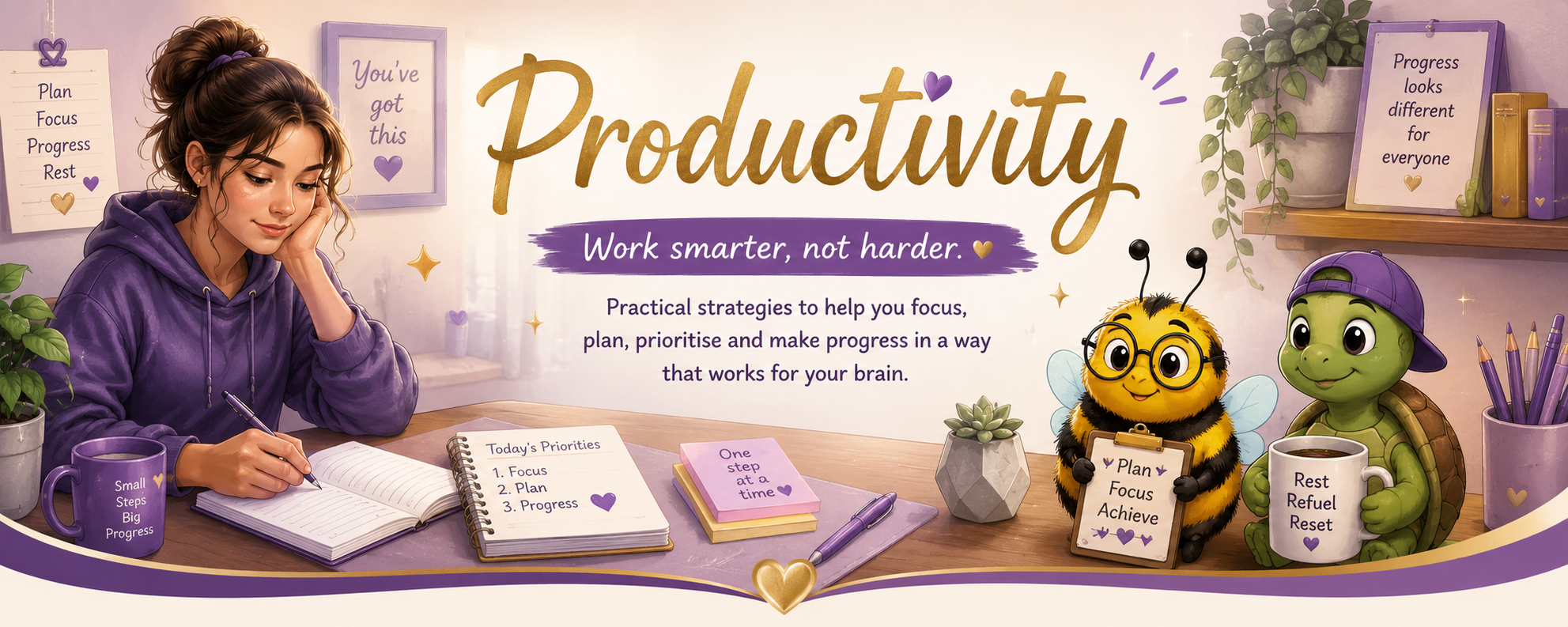
Productivity is not about doing everything, working constantly or ignoring your need for rest.
It is about choosing meaningful priorities, reducing barriers, finding a realistic next step and making progress in a way that works for your brain and energy.
Rest is productive. Slow progress still counts. Different brains need different systems, and doing less—but doing it sustainably— can be a successful and healthy choice.
Choose one task small enough to begin now. Starting with one clear action often creates more momentum than trying to plan the whole day at once.
You do not need to read or use everything at once. Start with the section that best matches the difficulty you are experiencing today.
Begin with Getting Started and Breaking Tasks Into Steps.
Visit Choosing Priorities and select one main task for today.
Explore Focus and Distractions, then try one environmental adjustment.
Use Time and Energy Planning to choose a lighter or shorter task.
Go to Rest and Burnout Prevention and choose a stopping point.
Use the Quick Productivity Reset to decide what matters now.
Search this page or choose a topic below.
Productivity is personal. It may look different from one day, person or situation to the next.
Completing one meaningful task can be enough for today.
Starting is progress, even when the task is not finished yet.
Getting clearer information can prevent wasted time and stress.
Preparing a clear next step can make the next day easier.
Rest can protect your energy and improve future focus.
Changing the environment can reduce the effort needed to focus.
Task initiation can be difficult even when the task matters and you genuinely want to complete it.
Replace “finish the assignment” with “open the document” or “read the first instruction”.
Try five or ten minutes, then decide whether to continue or pause.
Work beside someone, join a quiet online session or ask a person to check in with you.
Collect the tools, information and files you need before beginning.
Use a familiar song, drink, lamp or routine to signal the beginning.
The first attempt can be rough, incomplete or imperfect.
Not every task has the same urgency, importance or impact.
| Priority Level | What It Means | Examples |
|---|---|---|
| Must Do | Time-sensitive or linked to safety, essential needs or a firm deadline. | Medication, urgent work, an assignment due today. |
| Should Do | Important, but may be moved if your energy or circumstances change. | Preparing tomorrow’s materials, replying to a non-urgent email. |
| Could Do | Helpful or desirable, but not essential today. | Reorganising files, optional reading or future planning. |
| Can Wait | A task that does not need your attention right now. | Low-impact admin, cosmetic organisation or a future idea. |
Try choosing one main priority and one or two smaller supporting tasks rather than expecting every task to be completed today.
Focus often improves when the environment asks less of your brain.
Silence unnecessary alerts or place your phone out of reach.
Remove unrelated items while keeping needed tools visible.
Try headphones, white noise, instrumental music or quiet.
Use lighting that feels comfortable rather than overly bright or dim.
Work for a planned period, then pause before your attention drops sharply.
A library, quiet room or different seat may provide a useful reset.
A task often becomes more manageable when it moves through a small, visible process.
Get the task out of your head and into a trusted place.
Work out what the task is actually asking.
Turn the task into smaller actions.
Complete the smallest useful first step.
Check progress, adjust and recognise what you completed.
A task may fit into your calendar but still be unrealistic for your available energy.
Include time to stop, travel, prepare and switch between tasks.
Use higher-energy periods for demanding work where possible.
Prepare simple admin, sorting or review tasks for difficult days.
Many tasks take longer once setup, breaks and interruptions are included.
Leave unplanned space for delays, recovery and unexpected needs.
After demanding work, schedule a lower-demand period where possible.
Motivation is not always available before a task begins. Sometimes it appears after the first step.
Check boxes, move cards or mark completed stages.
Pair effort with a favourite drink, song, stretch or break.
Remind yourself why the task matters or what it makes possible.
Combine a less enjoyable task with music, company or another support.
One simple success may create enough momentum for the next task.
Notice what was completed instead of immediately replacing it with more work.
Sustainable productivity includes stopping points, recovery and realistic limits.
Take breaks before exhaustion rather than only after it.
Decide in advance what will count as enough for the session.
Watch for irritability, shutdown, pain, confusion or loss of focus.
Spread demanding work across more than one day where possible.
Not everything needs to be carried into the same day.
Your worth is not measured by how much you produce.
Stopping before exhaustion can help you return tomorrow. Rest is not something you must earn after completing everything.
Workplace productivity improves when expectations, priorities and communication are clear.
Ask which task should be completed first when several arrive together.
Use email or notes to reduce memory pressure and confusion.
Protect periods for concentrated work where your role allows it.
Regular updates can prevent tasks drifting in the wrong direction.
Use task boards, written processes and visible reminders.
Clear instructions or reduced interruptions may support better work.
Study productivity is not just the amount of time spent working. It is also how clearly the work is planned and understood.
Replace “study biology” with a clear chapter, question or task.
Separate planning, research, drafting, editing and submission.
Choose session lengths that match your attention and energy.
Short repeated reviews may be more useful than one long session.
Keep notes, files and current tasks in predictable locations.
Plan food, water, movement and rest around demanding study periods.
Use these questions when your day feels scattered, overloaded or stuck.
Different companions can support different parts of productivity. Their larger character pages can be connected later through the future Companion Hub.
Helps with getting started, routines, small steps, checklists and celebrating progress.
Helps with working memory, task breakdown, planning, focus and executive function.
Helps with pacing, breaks, energy management and avoiding burnout.
These printable ideas can later be developed and linked through the Work & Study Resources & Downloads page.
Plan one priority, smaller tasks, breaks and realistic stopping points.
Banked ResourceSort tasks into must do, should do, could do and can wait.
Banked ResourceTurn a large or unclear task into small visible actions.
Banked ResourcePlan a focus goal, time block, environment and recovery break.
Banked ResourceNotice repeated distractions and identify practical adjustments.
Banked ResourceMatch demanding and lighter tasks to changing energy levels.
Banked ResourceChoose a priority, reduce overload and identify the next step.
Banked ResourceReflect on completed tasks, barriers, supports and next priorities.
Banked ResourceProductivity resources may later be offered in several matching editions while the core information remains practical and supportive.
Clean, practical productivity planners and worksheets for adults, students and support settings.
Matching versions featuring Busy Bee, Buzzy Brain, Toby Turtle or another relevant companion.
Future visual versions featuring kawaii details, companion scenes or semi-realistic people.
Continue through the Work & Study section using the related pages below.
Simple answers to common questions about productivity, focus, energy and neurodivergent-friendly support.
Productivity can mean completing one priority, beginning a difficult task, asking for support, reducing a barrier or protecting enough energy to continue another day.
Reduce the task to one physical action, such as opening a document, collecting the materials or writing the first heading. A timer, body double or written first step may also help.
Consider safety, deadlines, consequences and current energy. Choose one must-do task before adding lower-priority work.
Yes. Planned breaks can protect concentration, reduce mistakes, support regulation and lower the risk of burnout.
Energy-based planning means matching tasks to the mental, physical and emotional energy available rather than relying only on the clock.
Use realistic limits, transition time, recovery periods, fewer daily priorities and clear stopping points. Sustainable progress matters more than maximum output.
No. One calendar, one task list and one clear next step may be enough. A simple system you regularly use is usually more helpful than a complex system you cannot maintain.
Adjusting a plan is not failure. Review what changed, recognise what you did accomplish and choose a realistic next step.
Ask when instructions are unclear, the workload is unrealistic, a barrier keeps repeating or practical adjustments could help you work or study more successfully.
Productivity is not a measure of your worth. Progress can mean finishing one priority, asking for help, adjusting the plan or taking the break that allows you to continue another day.