
Aspie Answers · Neurodiversity · Learning · Inclusion
Neurodiversity Topics A–Z
Browse a growing A–Z guide to neurodiversity, autism, ADHD, AuDHD, learning differences, sensory processing, communication, executive function, identity, accessibility, wellbeing, support and everyday neurodivergent experiences. You can search, filter or move directly to a letter without leaving this page.
Gentle notice
Some topics touch anxiety, burnout, meltdown, shutdown or other experiences that can feel personal or difficult. You can hide sensitive topics at any time. Use what is helpful, leave what is not, and return when you are ready.
Language and understanding continue to evolve
Neurodiversity-related language varies across people, communities, countries and professional settings. Some terms are community language, some are clinical, and some are debated. This page provides clear starting points and links rather than insisting that every person use the same words.


Find a neurodiversity topic
Jump to a letter
A
Acceptance
Respecting neurodivergent people as they are while supporting access, wellbeing and individual needs.
Learn more →Access needs
The practical supports, changes or conditions that help a person participate more comfortably and fairly.
Learn more →Accommodations / Adjustments
Changes to environments, communication, schedules or expectations that reduce barriers.
Learn more →ADHD
A neurodevelopmental condition that can affect attention, activity, impulse control, motivation, emotions, working memory and executive function.
Learn more →Advocacy
Speaking up or taking action so needs, rights, perspectives and access barriers are heard and addressed.
Learn more →Anxiety in neurodivergent people
Anxiety can occur alongside neurodivergence and may be influenced by sensory load, uncertainty, masking, past experiences or everyday demands.
Learn more →Autism
A lifelong neurodevelopmental difference involving patterns of communication, sensory processing, interests, routines and ways of experiencing the world.
Learn more →Autistic burnout
A state of profound exhaustion and reduced capacity associated with prolonged demands, masking, stress or mismatch between needs and environment.
Learn more →AuDHD
A community term commonly used by people who are both autistic and ADHD.
Learn more →B
Belonging
Feeling accepted, respected and able to participate without having to hide important parts of yourself.
Learn more →Body signals / Interoception
Awareness of internal body signals such as hunger, thirst, temperature, heartbeat or needing the bathroom.
Learn more →Burnout
Deep exhaustion and reduced capacity after prolonged stress or demands; the pattern can differ between autistic burnout and other forms of burnout.
Learn more →C
Camouflaging / Masking
Consciously or unconsciously hiding, suppressing or changing traits to fit expectations or avoid negative reactions.
Learn more →Co-occurring conditions
Conditions that exist alongside neurodivergence, such as anxiety, depression, epilepsy, sleep problems or chronic health conditions.
Learn more →Communication differences
Different ways of understanding, expressing and exchanging information, including speech, writing, AAC, gesture and other communication methods.
Learn more →Community
People, groups and spaces where neurodivergent people can connect, share experiences and belong.
Learn more →Co-regulation
Using safe connection, support or shared strategies with another person to help regulation, calm or recovery.
Learn more →D
Demand avoidance
Difficulty responding to demands, expectations or loss of autonomy; the reasons and patterns can vary between individuals.
Learn more →Diagnosis
A formal clinical identification based on recognised criteria, history and assessment; diagnosis can provide understanding, validation or access to support.
Learn more →Disability
A broad term that can describe impairments or conditions interacting with barriers in society and the environment.
Learn more →Dyscalculia
A learning difference that can affect understanding and working with numbers, quantities or mathematical concepts.
Learn more →Dysgraphia
A term used for significant difficulties with written expression or handwriting-related skills; definitions and diagnostic use vary by country.
Learn more →Dyslexia
A specific learning difference that commonly affects accurate or fluent word reading, spelling and decoding.
Learn more →Dyspraxia / DCD
Developmental Coordination Disorder affects motor coordination and the learning or performance of movement-based tasks.
Learn more →E
Education inclusion
Designing learning so neurodivergent students can access, participate and progress without unnecessary barriers.
Learn more →Emotional regulation
Processes involved in noticing, understanding and responding to emotions; regulation can look different across people and situations.
Learn more →Energy management
Planning activity, rest and recovery around available energy rather than assuming capacity is constant.
Learn more →Executive dysfunction
Difficulty with starting, planning, organising, switching, remembering or completing tasks despite understanding what needs to be done.
Learn more →Executive function
Mental processes involved in planning, organising, remembering steps, managing time, shifting attention and regulating actions.
Learn more →F
Fatigue
Physical, cognitive, emotional or sensory exhaustion that can reduce capacity for everyday tasks and participation.
Learn more →Focus
Attention can be variable, interest-based, effortful or intense; different environments and supports can change how focus works.
Learn more →Friendship
Neurodivergent friendships may involve different communication patterns, shared interests, energy needs and expectations.
Learn more →G
Giftedness / Twice-exceptionality
Some people are both gifted and disabled or neurodivergent; strengths and support needs can exist together.
Learn more →H
Hyperfocus
A period of intense attention on an activity or interest that can make switching or noticing other needs difficult.
Learn more →Hypersensitivity
Heightened sensitivity to sensory input such as sound, light, touch, smell, taste or movement.
Learn more →Hyposensitivity
Reduced awareness or response to certain sensory input, sometimes leading a person to seek stronger input.
Learn more →I
Identity
How someone understands and describes who they are, including whether neurodivergence is an important part of their identity.
Learn more →Inclusive design
Designing spaces, systems, information and services for a wide range of people from the beginning.
Learn more →Inclusion
Actively reducing barriers so people can participate, contribute and belong.
Learn more →Interoception
The sensory system involved in noticing signals from inside the body.
Learn more →Intersectionality
How different identities and social factors can overlap and shape experiences of advantage, disadvantage, access or discrimination.
Learn more →J
Job accommodations
Changes that reduce workplace barriers, such as communication adjustments, sensory changes, flexible scheduling or task supports.
Learn more →K
Knowledge through lived experience
Understanding gained from personally living with neurodivergence, disability, support systems or access barriers.
Learn more →L
Late diagnosis
Receiving a diagnosis later in adolescence or adulthood, sometimes after years of misunderstanding, masking or unmet needs.
Learn more →Learning differences
Differences in how a person takes in, processes, remembers or expresses information.
Learn more →Lived experience
Knowledge, insight and perspective gained by personally experiencing neurodivergence and its everyday impacts.
Learn more →Low-stim environments
Spaces designed to reduce sensory load, visual clutter, noise, movement or other stimulation.
Learn more →M
Masking
Changing or suppressing traits or behaviours to appear more typical or avoid negative judgement.
Learn more →Meltdown
An intense involuntary response to overwhelm or overload that can involve loss of usual coping or communication capacity.
Learn more →Mental health
Emotional, psychological and social wellbeing, including how a person feels, copes, relates and functions.
Learn more →Monotropism
A theory describing a tendency toward concentrated attention on a smaller number of interests or demands at a time; often discussed in relation to autism.
Learn more →N
Neurodivergence
A broad concept describing brains or nervous systems that differ from dominant or typical patterns.
Learn more →Neurodivergent
An adjective commonly used for a person whose brain or nervous system differs from dominant or typical patterns.
Learn more →Neurodiversity
The natural variation in human brains and nervous systems across the population.
Learn more →Neuroaffirming
An approach that respects neurodivergent ways of thinking, communicating and regulating while supporting real needs.
Learn more →Non-speaking communication
Communication without spoken language, including AAC, typing, gesture, symbols and other methods.
Learn more →O
Overload
When sensory, emotional, cognitive or environmental demands exceed a person’s current capacity to process them comfortably.
Learn more →Overwhelm
Feeling that demands, information, emotions or tasks have become too much to manage at that moment.
Learn more →P
Pacing
Balancing activity, demands and recovery to help reduce exhaustion and support sustainable participation.
Learn more →Participation
Being able to take part meaningfully in work, learning, services, relationships or community life.
Learn more →Pathological Demand Avoidance / PDA terminology
A contested term used by some clinicians and communities to describe an extreme or persistent demand-avoidant profile; recognition and terminology vary by country and service.
Learn more →Peer support
Support from people who share relevant lived experience or identity.
Learn more →Processing time
Extra time needed to understand information, organise a response or shift between tasks or ideas.
Learn more →Proprioception
The sense that helps the brain understand body position, movement and force.
Learn more →Q
Quality of life
A broad measure of wellbeing across health, autonomy, relationships, safety, participation and everyday living.
Learn more →R
Reasonable adjustments
Changes made to reduce disability-related barriers in work, education or services; legal wording varies by country.
Learn more →Recovery time
Time and reduced demands that may be needed after sensory, social, cognitive or emotional exertion.
Learn more →Routines
Predictable sequences or patterns that can support organisation, regulation, memory and a sense of control.
Learn more →S
School accommodations
Changes that help learners access teaching, assessment, communication, sensory environments and participation.
Learn more →Self-advocacy
Communicating your own needs, preferences, rights and choices, with or without support.
Learn more →Sensory overload
Distress or reduced functioning when sensory input becomes more intense or numerous than a person can comfortably process.
Learn more →Sensory processing
How the nervous system receives, organises and responds to sensory information.
Learn more →Sensory seeking
Actively looking for stronger sensory input such as movement, pressure, sound, texture or visual stimulation.
Learn more →Shutdown
A reduced-response state that can occur during overload or exhaustion and may involve less speech, movement or interaction.
Learn more →Special interests
Deep, focused interests that can bring joy, knowledge, regulation, identity, skill and connection.
Learn more →Stimming
Repetitive movements, sounds, words or actions that may support regulation, expression, focus or sensory needs.
Learn more →Strengths-based support
Support that recognises abilities and interests while still taking real barriers and support needs seriously.
Learn more →T
Task initiation
The executive-function process involved in beginning a task, even when the person understands what to do.
Learn more →Time blindness
A community term for difficulty sensing, estimating or managing the passage of time.
Learn more →Transitions
Moving between activities, places, expectations or states; transitions can require extra preparation or recovery.
Learn more →Tourette syndrome
A neurodevelopmental condition characterised by multiple motor tics and at least one vocal tic over time.
Learn more →Twice-exceptional / 2e
A term commonly used for people who are both gifted and disabled, neurodivergent or otherwise eligible for learning support.
Learn more →U
Universal design
Designing environments, services and information so they work for as many people as possible from the start.
Learn more →Unmasking
Reducing the need to hide or suppress neurodivergent traits in safer, more accepting contexts.
Learn more →V
Visual supports
Pictures, symbols, schedules, written steps or other visual information that can support understanding, memory and predictability.
Learn more →Vocational support
Support related to employment, training, workplace access, job preparation and sustainable participation.
Learn more →W
Wellbeing
A broad sense of physical, emotional, social and everyday wellness.
Learn more →Working memory
The ability to hold and use information briefly while completing a task or following steps.
Learn more →Workplace inclusion
Practices that help neurodivergent people participate fairly at work through accessible recruitment, communication, adjustments and culture.
Learn more →X
No entries under this letter yet.
Y
Young neurodivergent people
Children and teenagers may need age-appropriate support that respects development, identity, communication, autonomy and family context.
Learn more →Z
Zones of comfort / sensory safety
A non-clinical way to think about environments, routines and supports that help a person feel regulated enough to participate.
Learn more →
Autism, ADHD & AuDHD
Different profiles
Autism and ADHD are distinct neurodevelopmental conditions, but they can coexist and interact in individual ways.
AuDHD experiences
People who are both autistic and ADHD may experience apparently competing needs around routine, novelty, focus, stimulation and energy.
Late identification
Some people reach adulthood before their neurodivergence is recognised, particularly when masking or compensating has hidden support needs.
Strengths and disability
Capability and disability can coexist. Recognising strengths should not be used to minimise genuine barriers or support needs.
Co-occurring conditions
Mental health, sleep, chronic illness, epilepsy, learning differences and other conditions may be relevant to a person’s overall support.
No single presentation
People with the same diagnosis can have very different sensory, communication, executive-function, social and everyday experiences.
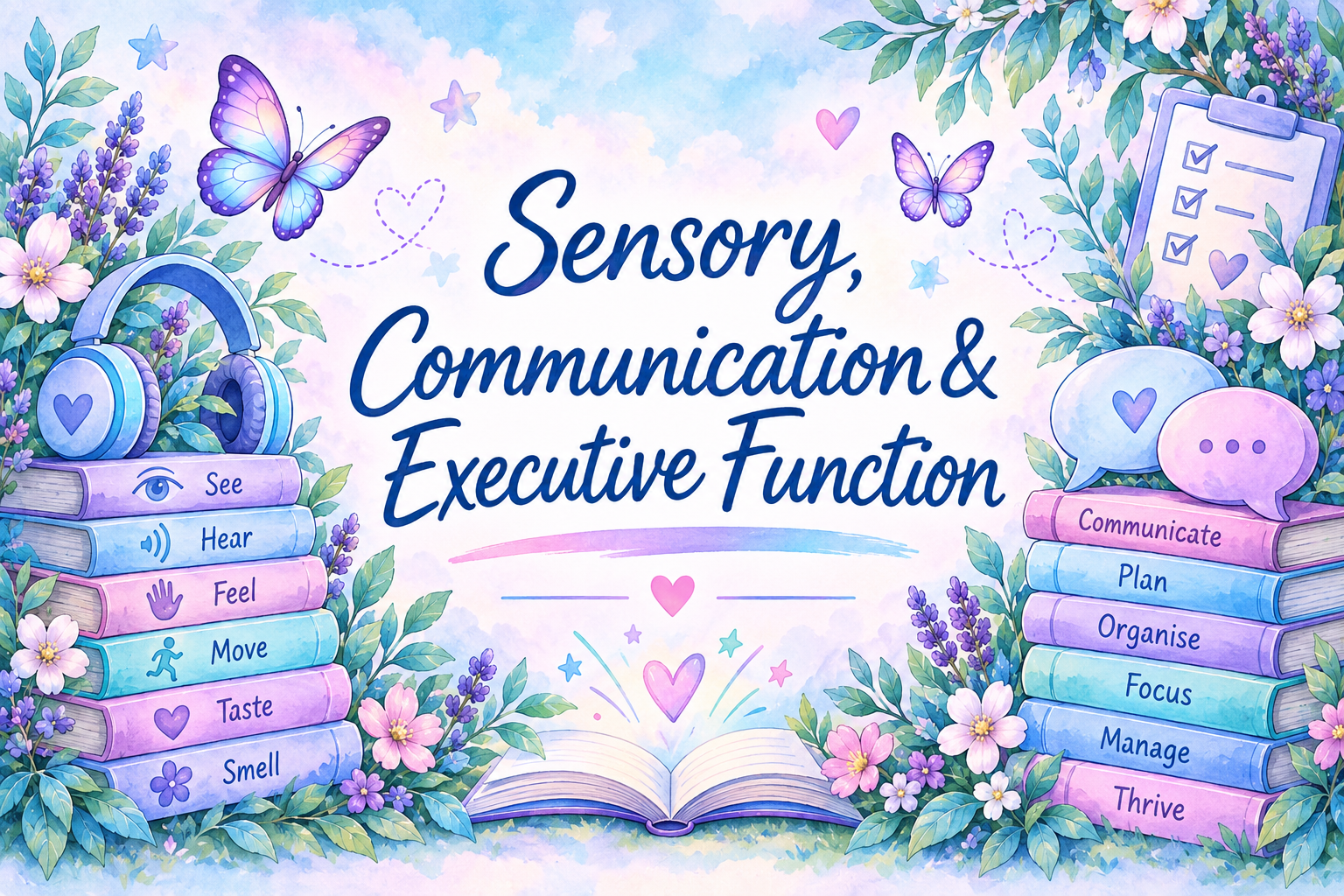
Everyday processing, communication & executive function
Sensory systems
Neurodivergence can affect how sound, light, touch, movement, smell, taste and internal body signals are noticed and processed.
Communication access
Written communication, AAC, direct language, processing time and reduced social pressure can make communication more accessible.
Executive function
Planning, switching, remembering, starting, organising and estimating time can require supports even when the person understands the task.
Regulation
Movement, sensory input, routines, interests, rest and predictable communication can all contribute to regulation.
Overload
High sensory, cognitive, emotional or social demand can reduce capacity and increase the need for space, recovery and fewer demands.
Different tools for different people
No single planner, sensory tool, therapy, routine or strategy will suit every neurodivergent person.
Learning, identity & belonging
Different ways of learning
People may learn best through visuals, repetition, movement, written instructions, practical experience, special interests or other combinations.
Identity matters
For some people neurodivergence is an important part of identity; others prefer to focus on a diagnosis or use different language.
Belonging matters too
Neurodivergent people should not have to perform a more typical version of themselves to deserve inclusion and connection.
Education access
Predictability, sensory support, flexible communication and appropriate adjustments can reduce barriers to learning.
Lived experience
People directly affected by neurodivergence should have meaningful input into information, services, policies and resources.
Community & peer connection
Meeting others with similar experiences can provide understanding, language, practical ideas and a stronger sense of belonging.
Continue exploring Aspie Answers
Different minds deserve more than one pathway
This A–Z is designed as a starting point. Neurodiversity is broad, lived experience is individual, and useful support depends on context. Follow the links that fit what you need and leave the rest for another day.