
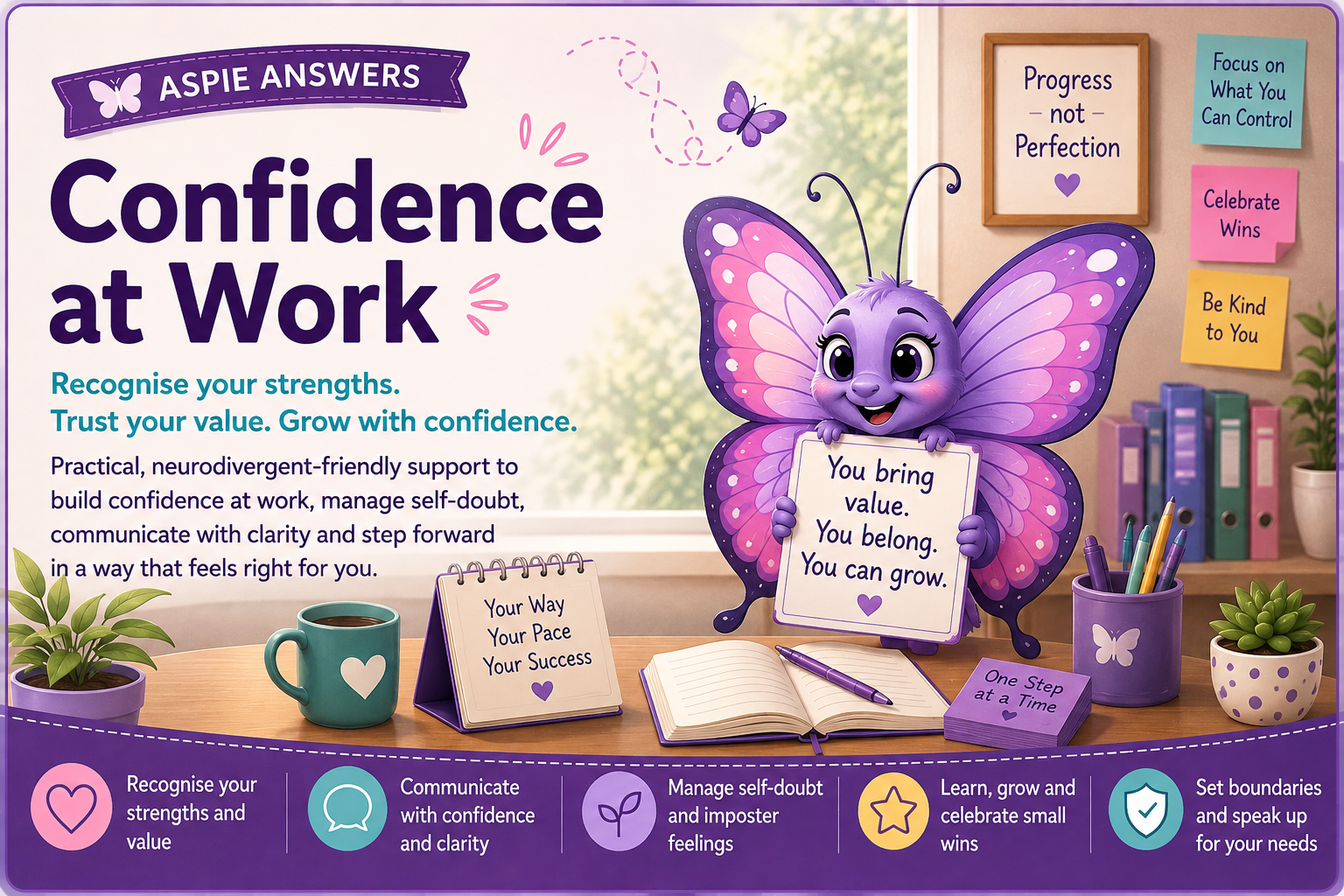
Confidence at Work
Workplace confidence is not about becoming the loudest person in the room or pretending that everything feels easy. It can grow through understanding your strengths, recognising your value, learning what supports you and building trust in your ability to handle workplace situations in your own way.
Confidence Can Grow — It Doesn't Have to Arrive All at Once
Confidence often develops through experience, support, preparation, self-understanding and small moments of progress. You can feel unsure about something and still take a meaningful next step. You can need accommodations or clarification and still be capable. And you can make mistakes without those mistakes defining your worth at work.
💡 Confidence does not mean pretending you have no needs
For neurodivergent people especially, workplace confidence should not require hiding differences, masking every difficulty or forcing yourself through situations that are genuinely inaccessible. Confidence can also mean understanding what helps you work well, communicating your needs, setting boundaries and recognising when support is appropriate.
What We'll Explore Together
Confidence can be affected by many different parts of working life. This page breaks those areas into smaller, more manageable pieces.
Recognising Your Strengths
Notice the skills, qualities, experience and ways of thinking you already bring to your workplace.
Communicating with Confidence
Build confidence with questions, clarification, ideas, conversations and everyday workplace communication.
Managing Self-Doubt
Notice comparison, imposter feelings and the inner voice that may underestimate what you can do.
Learning from Small Wins
Use progress, practice and completed challenges as evidence that your confidence can develop over time.
Speaking Up for Your Needs
Explore boundaries, support and ways of communicating what helps you work effectively.
Growing in Your Own Way
Build workplace confidence without needing to copy somebody else's personality, communication style or definition of success.
What Does Workplace Confidence Really Mean?
Confidence at work is not one fixed personality trait. It can be a growing sense of trust in your skills, judgement, contribution and ability to handle situations — including situations where you are still learning.
Confidence Is More About Self-Trust Than Certainty
You do not need to know every answer, perform perfectly or feel fearless to have workplace confidence. Confidence can mean trusting yourself enough to contribute, ask questions, make decisions, learn from feedback and take the next appropriate step even when some uncertainty remains.
Confidence Can Show Up in Many Ways
Some forms of confidence are obvious. Others are quieter and may be easy to overlook.
Asking a Question
Seeking clarification when something is unclear instead of feeling that you should already know.
Sharing an Idea
Contributing a suggestion or perspective without needing absolute certainty that everyone will agree.
Saying “I'm Still Learning”
Recognising that developing a skill does not mean you are incapable or do not belong in your role.
Setting a Boundary
Communicating what is realistic, what support you need or when something needs clarification.
Recovering from a Mistake
Treating a mistake as something to understand and respond to rather than proof that you cannot do the job.
Owning Your Strengths
Being able to recognise what you contribute without immediately minimising or dismissing it.
🌿 Confidence Doesn't Have to Look “Confident”
Workplace culture sometimes treats confidence as being highly social, quick to answer or comfortable taking centre stage. Those behaviours are only some possible ways confidence may appear.
Confidence does not require…
- Being the loudest person in a meeting.
- Always answering immediately.
- Never feeling nervous.
- Knowing everything already.
- Agreeing with everyone.
- Hiding every support need.
- Changing your whole personality to fit in.
Confidence can include…
- Taking processing time before responding.
- Preparing your thoughts before a meeting.
- Contributing through writing when that works better.
- Asking for clear information.
- Recognising when you know something well.
- Requesting appropriate support.
- Being thoughtful, quiet and still confident.
Different Parts of Workplace Confidence
You may feel confident in one part of your job and uncertain in another. That is completely possible — confidence is not all-or-nothing.
Task Confidence
Trust in your ability to complete particular tasks or use your knowledge and skills.
Communication Confidence
Feeling increasingly able to ask, explain, clarify, contribute and participate in workplace conversations.
Social Confidence
Navigating colleagues, meetings, teamwork or workplace relationships in ways that feel manageable.
Self-Advocacy Confidence
Communicating needs, boundaries, concerns or adjustments when something is affecting your ability to work well.
Learning Confidence
Trusting that not knowing something yet is part of learning rather than evidence that you cannot succeed.
Contribution Confidence
Recognising that your work, perspective, knowledge and way of thinking can bring genuine value.
♾️ Workplace Confidence & Neurodivergence
Confidence can be affected by the environment around a person as well as by their own skills. Neurodivergent workers may have experienced misunderstanding, correction, exclusion or pressure to communicate and behave in ways that do not come naturally.
🦋 Confidence Can Grow Through Experience
You do not have to manufacture confidence from nowhere. It can develop gradually as you collect evidence that you can learn, contribute and handle more situations.
Take one manageable step.
Notice what happened and what helped.
Give yourself credit for progress and effort.
Use that experience when the next challenge arrives.
✏️ A Quick Confidence Check-In
You do not need to answer everything now. These questions simply help you notice where confidence already exists and where you may want more support.
Where Confidence Can Get Knocked
Workplace confidence does not develop in isolation. Criticism, misunderstanding, mistakes, rejection, comparison and difficult work environments can all influence how safe it feels to trust yourself.
💜 Low confidence is not always evidence of low ability
Sometimes confidence has been shaped by what happened around you. Repeatedly being corrected, misunderstood, excluded or expected to work in ways that do not suit you can make even capable people begin questioning themselves.
Criticism
Harsh, vague or repeated criticism can make it harder to separate one piece of feedback from your overall view of yourself.
Misunderstandings
Being frequently misunderstood may lead to overthinking communication or becoming less willing to contribute.
Mistakes
A mistake can feel much bigger when your inner response becomes “I can't do this” rather than “something went wrong here.”
Rejection
Missing out on a role, promotion, opportunity or idea can affect confidence even when many factors contributed to the outcome.
Comparison
Comparing your processing speed, social style or career progress with someone else's can hide the strengths you bring differently.
Difficult Workplaces
Poor communication, bullying, exclusion, unclear expectations or an inaccessible environment can gradually reduce confidence.
🧠 Past Experiences Can Follow You Into New Workplaces
A new workplace may be different, but earlier experiences can still influence what your brain expects to happen next.
🔄 Notice the Story That Can Form After a Setback
A difficult experience can sometimes grow into a much larger conclusion about your ability. Separating the event from the story around it can make the situation easier to examine.
A mistake, criticism, misunderstanding or rejection occurs.
“I always get things wrong” or “I'm not good enough.”
You become less willing to try, ask, speak or take a risk.
Ask what actually happened and what the experience really proves.
🚩 Sometimes the environment is part of the problem
- Instructions are consistently unclear.
- Feedback is vague or delivered harshly.
- You are expected to guess unwritten rules.
- Sensory barriers reduce your functioning.
- Bullying or exclusion affects your sense of safety.
- You receive little support while expectations remain high.
🌱 A more balanced reframe might be…
- “I may need clearer information.”
- “This feedback is about one part of my work.”
- “A difficult environment can affect performance.”
- “I can learn from this without attacking myself.”
- “Support needs do not cancel out my strengths.”
- “One workplace does not define every workplace.”
🌿 A Confidence Reset After a Knock
When something shakes your confidence, these questions can help bring the situation back into proportion.
Recognising Your Strengths at Work
Confidence becomes harder to build when you only notice what is difficult. A more balanced picture includes the skills, qualities, experience, values and ways of thinking you already bring to your work.
⭐ Strengths do not have to be extraordinary to count
Reliability, persistence, careful thinking, creativity, honesty, organisation, curiosity, problem solving and noticing details can all be valuable workplace strengths. Things that feel ordinary to you may still be important parts of what others rely on.
Thinking Strengths
Problem solving, analysis, pattern recognition, creativity, memory or seeing possibilities other people may miss.
Practical Skills
Technical knowledge, organisation, writing, systems, planning, hands-on skills or experience built through practice.
People Strengths
Listening, loyalty, fairness, patience, empathy, honesty or supporting others in ways that feel natural to you.
Attention Strengths
Spotting errors, noticing details, identifying inconsistencies or focusing deeply on work that matters to you.
Learning Strengths
Curiosity, persistence, specialist interests, willingness to practise or developing expertise over time.
Character Strengths
Integrity, commitment, courage, responsibility, consistency or caring about doing work well.
🌿 Your Strengths Are More Than Your Job Description
Formal skills matter, but confidence can also grow from recognising the less obvious qualities you bring to how you work.
🔎 Look for Evidence of Your Strengths
Confidence becomes more grounded when strengths are connected to real examples rather than relying only on positive statements.
👀 Notice What Other People Already See
Sometimes other people recognise strengths that we have become too used to noticing in ourselves.
Listen for repeated feedback
If different people repeatedly describe you as thorough, creative, dependable or helpful, that is useful evidence.
Notice what people trust you with
Responsibility can reveal strengths that may otherwise feel invisible because you use them every day.
Save positive feedback
Keep emails, comments or notes that remind you of work you have done well when confidence is lower.
Ask someone you trust
A supportive colleague, manager or mentor may notice strengths you have difficulty naming yourself.
♾️ Neurodivergent Strengths Can Look Different
There is no single set of “neurodivergent strengths,” and not every person will relate to the same qualities. The aim is to notice your own genuine strengths rather than fit another stereotype.
📝 Build Your Workplace Strengths Inventory
Try collecting evidence instead of relying on memory alone — especially because confidence can make positive examples harder to remember.
Self-Doubt, Comparison & Imposter Feelings
You can have skills, experience and evidence that you are doing well while still feeling uncertain about yourself. Confidence is not always an accurate reflection of competence.
💭 Feeling unsure does not automatically mean you are unprepared
Self-doubt often becomes convincing because it sounds like a fact: “Everyone else knows what they're doing,” “I only got lucky,” or “Soon people will realise I'm not good enough.” Instead of automatically believing those thoughts, it can help to pause and compare them with the evidence you actually have.
Self-Doubt
Questioning your judgement, abilities or decisions even when there is evidence that you are capable.
Comparison
Measuring yourself against someone else's strengths, pace, confidence, communication style or career path.
Imposter Feelings
Feeling that your success does not really belong to you or worrying that others may eventually discover you are less capable than they think.
🔍 Notice Common Confidence-Thinning Thoughts
The aim is not to police every thought. It is simply to recognise when one interpretation is being treated as the whole story.
⚖️ Be Careful What You Are Comparing
Comparison becomes especially unfair when you compare somebody else's visible strengths with the parts of yourself you feel most uncertain about.
The comparison trap
- Their confidence vs. your anxiety.
- Their speed vs. your processing style.
- Their social ease vs. your communication differences.
- Their experience vs. your learning stage.
- Their visible success vs. your private struggles.
- Their career path vs. your completely different circumstances.
A more balanced comparison
- Compare your progress with where you started.
- Notice what has become easier with practice.
- Recognise the conditions that help you work well.
- Look at your whole strength profile.
- Remember that different people contribute differently.
- Use others for inspiration without using them as a verdict on you.
🎭 When Success Doesn't Feel Like It Belongs to You
Imposter feelings can make genuine achievements feel accidental, temporary or undeserved.
An achievement quickly becomes “not a big deal” once you are the one who achieved it.
External factors receive all the credit while your own effort disappears from the story.
You worry that others have somehow overestimated your competence.
Each achievement creates a new requirement before you allow yourself to feel capable.
What you do not know becomes much more visible than everything you already know.
Competence becomes defined as never needing help, clarification or another attempt.
♾️ Neurodivergence Can Add Another Layer
Workplace self-doubt may be shaped by years of receiving messages that your natural way of communicating, concentrating, organising or responding is somehow the “wrong” way.
🌱 Try a More Balanced Response
A useful reframe does not have to be unrealistically positive. It only needs to make room for evidence that self-doubt may be leaving out.
📂 Create a Confidence Evidence Bank
When self-doubt is high, positive evidence can become surprisingly hard to remember. Keeping some of it somewhere accessible gives you something concrete to revisit.
✏️ Check the Thought Before You Believe It
When self-doubt shows up, these questions can help you examine what is happening without demanding that you immediately feel confident.
Confidence with Communication
Confident workplace communication does not require being quick, extroverted or comfortable speaking in every situation. It can mean understanding how you communicate best and having practical ways to ask, clarify, contribute and respond.
💬 Confidence is not the same as speaking without hesitation
You can pause before answering, prepare notes, ask for clarification or communicate something in writing and still be communicating confidently. The goal is not to perform confidence — it is to make communication clear enough for you and the people around you.
Asking Questions
Clarifying what you need to know instead of assuming that asking means you should already have known the answer.
Sharing Ideas
Contributing a thought, suggestion or perspective without requiring complete certainty that it will be accepted.
Taking Processing Time
Giving yourself enough time to think rather than treating an immediate response as the only valid response.
Using Written Communication
Email, notes or written follow-up may help you communicate more clearly when spoken information moves too quickly.
Clarifying Meaning
Checking what somebody means can prevent uncertainty from turning into unnecessary self-doubt.
Repairing Misunderstandings
A communication mismatch does not mean the relationship or your credibility is permanently damaged.
🧠 Processing Time Is Not Lack of Confidence
Some people think best while speaking. Others need time to organise information before responding. Both can contribute valuable ideas.
👥 Build Confidence in Meetings
Meeting confidence can grow through preparation and small participation rather than expecting yourself to suddenly become the most vocal person in the room.
💬 Useful Confidence-Building Communication Phrases
Prepared wording can reduce the pressure of finding the perfect sentence while already processing the situation.
🔄 A Misunderstanding Doesn't Have to Become a Confidence Crisis
Communication between two people can go wrong for many reasons. Try treating a misunderstanding as something to clarify before treating it as evidence that you are bad at communicating.
📝 Written Communication Can Be a Strength
Confidence does not require choosing spoken communication when another format allows you to communicate more clearly.
Useful when you need time to organise information or create a record of what was discussed.
Prepared Notes
Bring prompts into conversations or meetings so you do not have to hold everything in working memory.
Follow-Up Messages
Add or clarify information after you have had time to process.
Written Instructions
Ask for key information in a format you can revisit instead of relying only on memory.
🌱 Build Communication Confidence in Small Steps
You do not need to jump straight into the most difficult communication situation. Confidence often grows more steadily through repeatable practice.
Decide what you want to communicate.
Use one manageable communication step.
Notice what worked and what was difficult.
Carry the useful learning into the next situation.
✏️ My Communication Confidence Check
These prompts can help you work out where confidence already exists and where another support might help.
Confidence with New Tasks & Change
New tasks, unfamiliar systems and workplace changes can temporarily make confidence drop — even when you are very capable. Confidence can grow by giving yourself enough information, support, practice and time to turn something unfamiliar into something known.
🌱 Being new at something is not the same as being bad at it
The first attempt often contains more uncertainty, more questions and more mental effort than later attempts. Instead of judging yourself by how easy something feels immediately, notice what changes as you learn the task.
Unclear Instructions
Confidence can drop quickly when you are expected to begin without enough information about what success looks like.
Too Much Information at Once
Learning several new steps, systems or expectations together can create overload even when each part is manageable separately.
Unexpected Change
A sudden change in routine, role, process or priority may need more adjustment time than other people realise.
Being Watched While Learning
Demonstrating a new task under observation can add another layer of pressure to something already unfamiliar.
Pressure to Learn Quickly
Needing repetition or practice does not mean you cannot learn the task.
Expecting Instant Mastery
Confidence suffers when the standard for a first attempt is the same as the standard for an experienced one.
🧩 Break New Tasks Into Learnable Steps
Confidence often improves when an unfamiliar task becomes a sequence of smaller things you can understand, practise and repeat.
Clarify what the task is and what the finished result should look like.
Turn the task into smaller steps, stages or checkpoints.
Repeat the parts that need more familiarity or confidence.
Notice what is becoming easier instead of only what still feels new.
🛠️ Asking for Training Is a Workplace Skill
Confidence does not mean pretending to understand something you have not yet been shown. Asking for enough information can help you learn more accurately and become independent more quickly.
🔄 When the Workplace Changes Around You
Confidence may temporarily dip when routines or expectations change. Giving yourself a transition process can make change feel more predictable.
🌱 Let a First Attempt Be a First Attempt
New-task confidence becomes harder to build when the first try is treated as a final test of ability.
🚩 High-pressure thinking
- “I should understand this immediately.”
- “If I need help, I'm failing.”
- “Everyone else learned faster.”
- “One mistake proves I'm not suited to this.”
- “I have to remember everything first time.”
- “If I'm nervous, I must not be ready.”
🌿 Learning-focused thinking
- “This is unfamiliar, so extra effort makes sense.”
- “Questions are part of learning.”
- “I can use written supports while this becomes familiar.”
- “A mistake can show me which part needs clarification.”
- “Repetition can build confidence.”
- “I do not need to feel comfortable before I begin learning.”
💬 Useful Phrases for New Tasks & Change
Having a few phrases ready can make it easier to ask for what you need without having to find the wording under pressure.
⭐ Collect Evidence That You Can Learn New Things
When something feels unfamiliar, it can help to remember that many things you now do confidently were once new too.
Mistakes, Feedback & Learning
Mistakes and feedback can shake confidence, especially when you care deeply about doing your work well. The goal is not to become unaffected by them — it is to learn how to separate useful information from harsh conclusions about your overall ability or worth.
💜 A mistake is an event — not your whole workplace identity
Something can genuinely need correcting without proving that you are bad at your job. Confidence grows when you can look at what happened, repair what needs repairing, learn something useful and then allow yourself to move forward.
Fear of Getting It Wrong
Worry about mistakes can make starting, deciding or finishing work much harder than the task itself.
Replaying the Situation
You may mentally revisit what happened long after the practical issue has already been addressed.
Turning Feedback Into Identity
“This part needs changing” can quickly become “I'm not good enough” if confidence is already low.
Perfection Pressure
Expecting zero mistakes can make ordinary learning feel like failure.
Vague Feedback
General comments can be difficult to act on because you may not know exactly what needs to change.
Avoiding New Challenges
After a confidence knock, avoiding unfamiliar work can feel safer even though it also limits new confidence-building evidence.
🔄 Pause → Understand → Repair → Learn
A simple process can stop one mistake from expanding into a much bigger judgement about yourself.
Give the emotional reaction a little time to settle before deciding what the mistake means.
Identify what actually happened and which part needs attention.
Correct the practical issue, clarify information or communicate with the appropriate person.
Decide what would help next time without turning the lesson into self-punishment.
💬 Make Feedback More Useful
Feedback is easier to use when it is clear enough to turn into an action. You are allowed to ask questions when a comment is too vague.
🚩 Harsh self-judgement may sound like…
- “I always mess everything up.”
- “They must think I'm incompetent.”
- “I shouldn't have needed feedback.”
- “If I were good at this, I would never make mistakes.”
- “I can't trust myself anymore.”
- “I should avoid doing this again.”
🌱 Learning-focused thinking may sound like…
- “Something went wrong, and I can identify what.”
- “Feedback can help me improve one part of the work.”
- “Competent people still need information and correction.”
- “I can change the process without attacking myself.”
- “One mistake does not erase everything I do well.”
- “I can use this experience next time.”
💬 Useful Feedback & Repair Phrases
Prepared wording can make it easier to respond when emotions or processing demands are already high.
🌿 After a Confidence-Knocking Mistake
Once the practical issue has been handled, confidence may still need time to catch up.
Write down what you want to remember so your brain does not need to keep replaying the whole event.
Include what you handled well, not only what went wrong.
A later successful attempt can become new evidence that the mistake was not permanent.
Do not force yourself to guess the missing information a second time.
Correction and accountability can happen without humiliation or harshness.
The way you respond to a mistake can itself become evidence of workplace confidence.
✏️ My Feedback & Learning Check
These questions can help you keep useful learning separate from unnecessary damage to confidence.
Boundaries, Needs & Speaking Up
Workplace confidence can include knowing when to ask, clarify, set a limit or explain what helps you work well. Speaking up does not mean you have to become confrontational — it can simply mean making important information visible.
🛡️ Having needs does not cancel out competence
You can be capable and still need clear instructions, sensory support, processing time, realistic deadlines, written information or another workplace adjustment. Confidence can mean recognising that support helps you use your abilities rather than pretending you do not need it.
Clarifying Expectations
Ask what is expected when instructions, priorities or responsibilities are unclear.
Setting Limits
Communicate when time, workload or availability has reached a realistic limit.
Explaining Support Needs
Describe practical barriers and what may help reduce them.
Raising Concerns
Speak about a problem before it becomes much larger or harder to resolve.
Asking for Time
Request enough processing or preparation time when an immediate response would make communication less accurate.
Using Workplace Support
Confidence can also mean recognising when a situation needs help from somebody else.
🌿 Workplace Boundaries Can Be Practical
Boundaries are not only about saying “no.” They can make expectations clearer and reduce the uncertainty that often damages confidence.
♾️ Reframe Needs as Useful Information
The way you describe your needs to yourself can affect how confident you feel communicating them to somebody else.
💬 A Simple Way to Speak Up
When a conversation feels difficult, break it into four parts rather than trying to explain everything at once.
Explain the specific situation or barrier.
Say how it is affecting the work or your ability to complete it.
Suggest a practical change, clarification or support.
Make sure the next step or agreement is clear.
🗣️ Useful Self-Advocacy Phrases
Prepared wording can make difficult workplace conversations much easier to start.
🤝 Speaking Up Can Include Asking Someone Else to Stand With You
Self-advocacy does not mean you always have to manage the conversation completely alone.
For priorities, workload, role expectations or practical day-to-day support.
For workplace processes, adjustments, policies or more formal support.
Someone may be able to attend, help prepare or support a difficult discussion.
Some concerns may be easier to explain clearly in writing first.
A supportive colleague may help you check your understanding or prepare.
Depending on the situation, another appropriate adviser or support may also help.
✏️ My Speaking-Up Confidence Check
You do not need to become comfortable with every difficult conversation at once. Start by noticing what would make one conversation easier.
Building Confidence Through Small Wins
Confidence does not always arrive before you act. Often it grows after you collect enough experiences that show you can try, learn, recover, contribute and handle more than self-doubt predicted.
🌱 Small wins are not small when they change what you believe is possible
Asking one question, speaking once in a meeting, completing a new task or setting one boundary may not look dramatic from the outside. But each can become evidence that helps your brain approach the next situation with a little more trust.
You Asked
You asked a question, requested clarification or spoke when you might previously have stayed silent.
You Completed
You finished something that once felt unfamiliar, difficult or easy to avoid.
You Learned
A task, system, conversation or process became easier because you kept practising.
You Spoke Up
You explained a need, set a boundary or made a workplace barrier more visible.
You Recovered
Something went wrong and you responded, repaired or tried again rather than giving up completely.
You Contributed
Your idea, work, support, perspective or skill added something useful.
🪜 Build a Confidence Ladder
Instead of jumping straight from “this scares me” to “I should be able to do this confidently,” create smaller steps between the two.
Watch, learn or gather information about the situation.
Write notes, practise wording or break the task into steps.
Take one manageable version of the challenge.
Let familiarity reduce some of the uncertainty.
Move to the next level when the previous one feels more manageable.
⭐ What Counts as a Confidence Win?
Wins do not need to involve perfect outcomes. Sometimes the confidence growth is in how you approached the situation.
📈 Track Progress So It Doesn't Disappear
When confidence is low, the brain can remember every difficult moment and quickly forget the evidence that things are changing.
🎉 Let Yourself Notice Progress
Celebration does not need to be loud or public. The important part is allowing progress to register instead of immediately moving the goalpost.
Say or write what you actually accomplished.
Add it to your confidence evidence bank for lower-confidence days.
Avoid automatically explaining your contribution away.
Compare the experience with how the same situation felt earlier.
A favourite break, activity or simple acknowledgement can mark the moment.
Use this experience as evidence when the next challenge appears.
🦋 Try a One-Week Confidence Challenge
Choose only one or two small actions. The goal is to gather evidence, not create another performance target.
✏️ My Small-Wins Reflection
Confidence growth can be easy to miss when you are looking only for a dramatic change.
Create Your Personal Confidence Plan
Confidence is easier to build when you know what strengthens it, what knocks it, what support helps and which small steps are realistic for you. Your plan does not need to make you fearless — it simply gives you something practical to return to when confidence changes.
🦋 Build a plan around your real workplace experience
Your confidence plan should reflect your strengths, communication style, learning needs, workplace environment and previous experiences. What helps somebody else may not be the thing that helps you — and that is okay.
My Strengths
Record the skills, qualities, experience and perspectives you already bring to work.
My Confidence Knocks
Notice which situations, thoughts or past experiences make you doubt yourself most.
My Communication Supports
Identify whether preparation, scripts, writing, clarification or processing time help you communicate confidently.
My Learning Supports
Note how you learn new tasks best — demonstration, written steps, repetition, practice or another method.
My Boundaries & Needs
Record what helps you work well and where clearer limits or support may be useful.
My Small Wins
Keep evidence of situations you handled, skills you developed and steps you took even when you felt unsure.
📝 My Workplace Confidence Plan
These prompts can become a future printable worksheet, journal page or confidence planning resource.
🚦 Match Your Strategy to Your Confidence Level
Confidence changes. You may need different support on a steady day than on a day when self-doubt is already loud.
🟢 Confidence Feels Steady
You feel reasonably able to participate, make decisions and use your skills.
- Keep using your normal supports.
- Notice and save positive evidence.
- Try manageable stretch opportunities.
- Keep recognising your strengths.
🟡 Confidence Feels Shaky
Self-doubt is louder and unfamiliar situations may feel more difficult.
- Increase preparation.
- Use scripts or written notes.
- Return to your evidence bank.
- Choose smaller confidence steps.
- Reduce unnecessary comparison.
🔴 Confidence Has Taken a Knock
A mistake, difficult interaction or workplace experience may have significantly affected self-trust.
- Separate the event from your whole identity.
- Clarify what actually happened.
- Use trusted support.
- Review environmental factors.
- Rebuild with smaller, safer evidence.
🤝 Build a Confidence Support Network
Confidence does not have to be built alone. Different people may support different parts of your workplace growth.
🔄 Review Your Confidence Plan as You Grow
The situations that challenge you now may not be the same ones that challenge you later. Let the plan change as you gain experience.
Companion Support for Confidence at Work
Workplace confidence can involve growth, reassurance, problem solving and learning how to trust your own contribution. Each companion supports a different part of that journey.
Flutter Butterfly V1 Artwork
Add the approved WordPress image URL here when ready.
🦋 Flutter Butterfly
Flutter Butterfly supports growth, change and new beginnings. On this page, Flutter helps remind us that confidence does not have to appear fully formed — it can develop through practice, self-understanding, small wins and experiences that gradually build self-trust.
Flutter also fits the parts of workplace confidence that involve trying something new, adjusting after a setback, recognising progress and allowing yourself to become more comfortable with your own strengths over time.
You do not have to become somebody else in order to grow. Confidence can develop while you remain authentically yourself.
Flutter Is Supported by Scout & Finn Fox
Confidence is not only about growth. Sometimes we also need reassurance when self-doubt is loud and practical problem solving when we do not know what to try next.
Scout V1 Artwork
Add the approved WordPress image URL here when ready.
🐶 Scout
Emotional Reassurance • Feelings • SupportScout supports the emotional side of confidence — especially when a mistake, difficult interaction, rejection or self-doubt makes one workplace moment feel much bigger than it really is.
Finn Fox V1 Artwork
Add the approved WordPress image URL here when ready.
🦊 Finn Fox
Problem Solving • Learning • Finding a Way ForwardFinn Fox helps when confidence gets stuck on “I don't know what to do.” His role is to slow the problem down, look for useful information, explore options and find the next practical step.
🌿 Three Companions — Three Parts of Confidence
Different confidence moments may call for different kinds of support.
💜 Which Companion Might Help Right Now?
Your confidence needs can change depending on what is happening around you.
Confidence at Work Resources & FAQs
Confidence is not something you have to remember how to build from scratch every time it dips. Keep a few practical tools, reminders and questions nearby so you have something useful to return to when work feels uncertain.
🧰 Build a confidence toolkit that works for you
You may not need every strategy on this page. Choose the tools that fit your workplace, communication style, strengths and support needs. A useful toolkit is one you can actually reach for when confidence is wobbling.
⚡ Your Quick Confidence Toolkit
Six simple tools can cover many of the confidence situations explored throughout this page.
Evidence Bank
Save achievements, positive feedback, completed challenges and reminders of things you have learned.
Communication Scripts
Keep useful phrases for meetings, clarification, boundaries, feedback and asking for support.
Preparation Notes
Write down key points before conversations, meetings or unfamiliar workplace situations.
Confidence Ladder
Break intimidating situations into smaller steps instead of expecting yourself to make one enormous leap.
Boundary Reminders
Keep track of the limits, conditions and supports that help you work sustainably.
Small-Wins Log
Record the ordinary moments that show confidence, learning, self-advocacy and resilience are growing.
🔄 A 4-Step Confidence Reset
When confidence suddenly drops, you do not have to solve your whole career. Start with the situation in front of you.
What happened that made my confidence drop?
What are the facts, and what is self-doubt adding?
What information, person, script or adjustment would help?
What is the smallest useful action I can take next?
📚 Confidence Resources to Build Around This Page
These are natural companion resources that can eventually sit alongside the Confidence at Work page in the Aspie Answers resource collection.
Identify skills, qualities, knowledge, achievements and transferable strengths.
A printable place to collect positive feedback, accomplishments and evidence of growth.
Turn a difficult workplace situation into smaller, manageable confidence-building steps.
Prepare what you want to say, what outcome you need and which points matter most.
Identify workload, communication, sensory, time and role boundaries that support sustainable work.
Capture the gradual progress that can otherwise be forgotten during low-confidence periods.
Separate assumptions, predictions and harsh self-judgements from the evidence you actually have.
Bring strengths, challenges, supports, boundaries and next steps together in one reusable plan.
🤝 When Self-Help Isn't the Whole Answer
Sometimes low confidence is connected to a workplace barrier rather than something you simply need to think your way out of. Support can be part of the solution.
If uncertainty is the problem, clearer instructions or priorities may help more than trying harder to feel confident.
Consider whether communication, sensory conditions, workload, training or another workplace factor is contributing.
A manager, trusted colleague, workplace support person or other appropriate support may help you find a way forward.
❓ Confidence at Work — Frequently Asked Questions
Some confidence questions come up again and again. Click a question below to open the answer.
What if I don't feel confident even though I know I can do my job?
Ability and confidence are not the same thing. You can have strong skills while still experiencing self-doubt, uncertainty or anxiety. Instead of waiting for the feeling of confidence to arrive, look at evidence from what you have already learned, completed and handled.
Does asking questions make me look less capable?
Asking a useful question can prevent errors, clarify expectations and help you work more independently. Confidence does not require pretending to understand information you have not been given.
What if I need more time to process things at work?
Processing time can be part of how you produce a thoughtful and accurate response. Where possible, use preparation, written information, notes or a request for reasonable thinking time rather than assuming an immediate answer is always the best answer.
How do I rebuild confidence after making a mistake?
Separate the mistake from your overall ability. Identify what happened, repair what needs repairing, record what you learned and give yourself another opportunity to use that learning. A successful later attempt can become important new evidence.
What if feedback makes me doubt everything I do?
Try to turn feedback into something specific. Ask which part needs changing, what the expected result looks like and what is already working. Feedback about one task or skill does not automatically describe your whole performance.
What if everyone else seems more confident than me?
You can usually see another person's outward behaviour, but not the uncertainty, preparation or self-doubt behind it. Compare yourself with your own earlier experiences where possible rather than using somebody else's visible confidence as your measurement.
Can I be confident and still need workplace support?
Yes. Confidence can include understanding what helps you work well and communicating those needs clearly. Using effective support does not erase your skills or contribution.
What if my workplace itself is damaging my confidence?
Look beyond self-confidence alone. Unclear expectations, repeated criticism, lack of training, unsuitable communication, unrealistic workloads or other workplace barriers may contribute. Depending on the situation, documenting concerns and seeking appropriate workplace support may be useful.
Do I have to become more outgoing to be confident at work?
No. Workplace confidence can be quiet. It may look like preparing carefully, communicating clearly, doing reliable work, asking a useful question, sharing an idea in writing or knowing when to speak up about something important.
What if my confidence changes from day to day?
That can happen. Energy, workload, stress, environment, recent experiences and uncertainty can all affect how confident you feel. Your skills do not necessarily disappear because your access to confidence feels different on a particular day.
💜 Keep These Reminders Nearby
Continue Your Workplace Confidence Journey
Confidence grows differently for different people. You may want to strengthen communication, improve workplace wellbeing, work on stress, build better systems or simply keep collecting evidence that your own way of working has value.
Explore More Workplace Success Support
Choose the area that best matches what would make work feel clearer, safer, more manageable or more sustainable for you.
Workplace Communication
Explore clarification, meetings, written communication, processing time and practical ways to make workplace conversations easier.
Explore CommunicationWorkplace Wellbeing
Explore energy, boundaries, sensory needs, recovery and creating a healthier relationship with work.
Explore Workplace WellbeingManaging Stress at Work
Recognise stress triggers, respond earlier and build practical ways to manage workplace pressure.
Explore Managing StressBurnout Prevention at Work
Explore pacing, capacity, sensory load, recovery, boundaries and practical burnout prevention.
Explore Burnout PreventionWorkplace Productivity
Build practical ways to organise priorities, reduce friction and make progress without relying only on pressure.
Explore ProductivityExecutive Function at Work
Explore support for starting, planning, organising, remembering, switching and focusing at work.
Explore Executive Function🌱 Keep Building Confidence One Step at a Time
You do not need to finish this page feeling completely confident. A more useful outcome may be knowing what you can return to next time self-doubt shows up.
Return to the strengths and evidence you already have.
Choose a manageable next step rather than one enormous leap.
Preparation, adjustments, people and tools can all support confidence.
Let new experiences gradually become new evidence about what you can do.
💼 Return to the Work & Employment Hub
The wider Work & Employment Hub brings together workplace success, job preparation, communication support, employment resources and neurodivergent-friendly guidance across the working journey.
💜 Your Confidence Team Is Still With You
Different moments may need different kinds of support. Keep the companion message that fits what you are facing now.
Growth does not require becoming somebody else. Keep building from where you are.
A difficult feeling does not have to decide what you believe about yourself next.
When confidence feels stuck, shrink the problem and find one practical next step.