
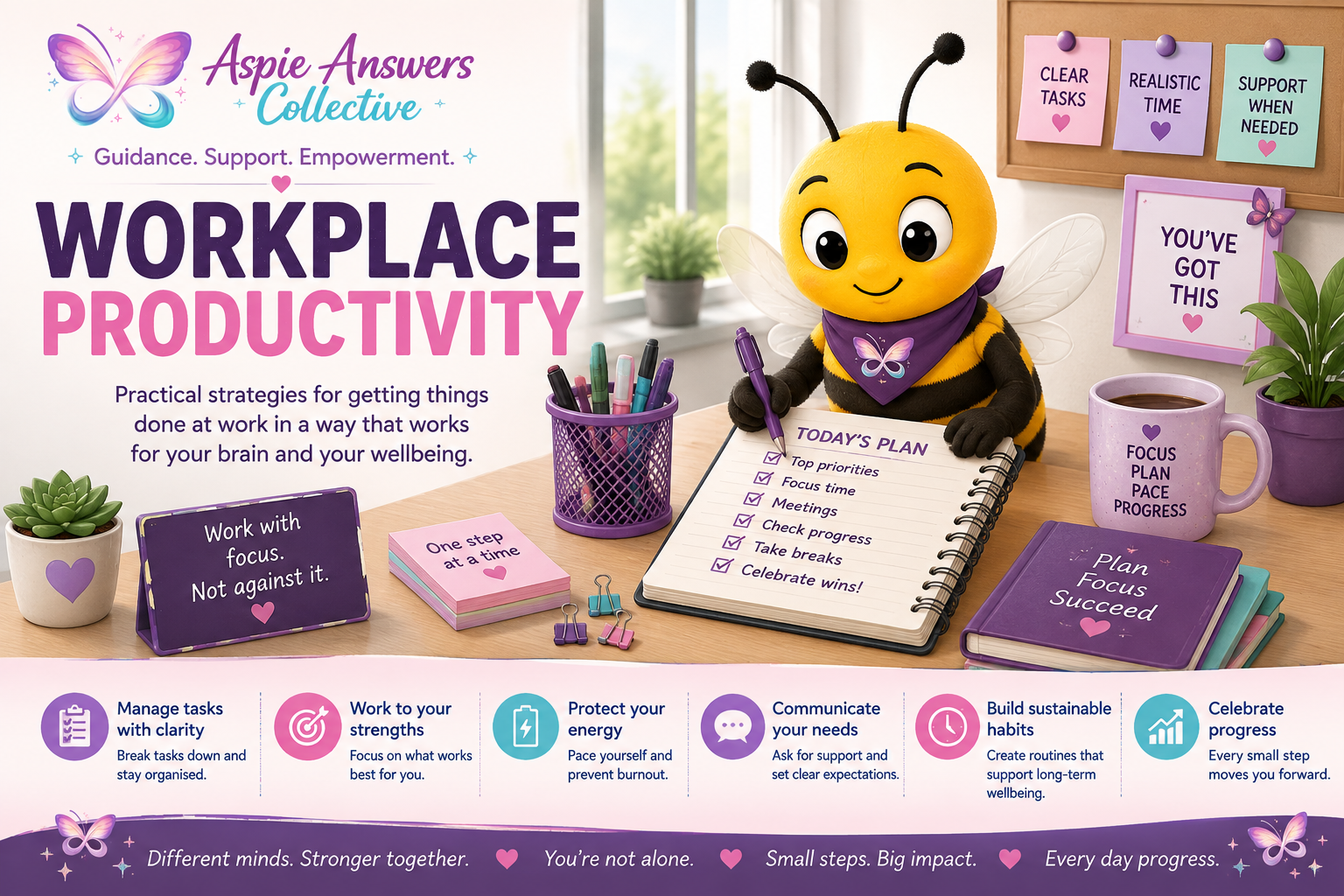
Workplace Productivity
Productivity at work is not simply about completing as much as possible. It is about understanding what needs to be done, identifying realistic priorities and finding practical ways to complete work while protecting your energy and wellbeing.
For neurodivergent people, productivity may improve when work is clearer, more visible, better structured and supported in ways that work with your brain rather than against it.
What is making work harder today?
You do not have to improve every part of your workday at once. Begin with the area creating the most pressure and choose one manageable change to try.
I am struggling to get started
Reduce the task to one visible first action, clarify what “finished” looks like and make the starting point easier to see.
Everything feels equally important
Identify what is urgent, what has consequences, what affects other people and what can realistically wait.
I cannot sustain the pace
Look at workload, interruptions, sensory demands, breaks, recovery time and whether expectations need to be clarified.
What Workplace Productivity Can Actually Look Like
Productivity is often described as how much work someone completes. But a healthy workplace needs a broader picture. Sustainable productivity is about making meaningful progress while having the clarity, tools, time and support needed to do your work well.
Productivity is more than being busy
A full calendar, overflowing task list or constantly rushing between responsibilities does not necessarily mean a workday is productive. Productivity can also mean choosing the right task, completing important work carefully, communicating when something is unclear, taking necessary breaks and recognising when priorities need to change.
Knowing What Matters
Understanding priorities helps direct limited time and attention towards work that genuinely needs to happen.
Being Able to Begin
A task needs a clear starting point. Making the first action visible can reduce the effort needed to move from thinking about work to beginning it.
Making Work Manageable
Large or unclear responsibilities can become easier to approach when expectations, stages and next actions are made visible.
Protecting Focus
Reducing unnecessary interruptions and sensory demands can make it easier to stay connected with the task you are trying to complete.
Managing Your Energy
Work requires mental, emotional and physical energy. Sustainable productivity includes recognising when recovery and pacing are needed.
Making Useful Progress
Progress does not have to mean finishing everything. Completing the next meaningful step can still move important work forward.
🚫 Productivity does not have to mean…
- Working as quickly as possible all day.
- Saying yes to every request.
- Completing every task immediately.
- Skipping breaks to get more done.
- Hiding when instructions or priorities are unclear.
- Measuring your value by how much you produce.
🌿 Sustainable productivity can mean…
- Knowing which work deserves your attention first.
- Having realistic expectations for the time available.
- Using tools and systems that reduce unnecessary mental load.
- Protecting enough energy to continue working sustainably.
- Asking for clarification or support when it is needed.
- Recognising progress instead of expecting perfection.
💭 A useful question to ask
Instead of asking, “How can I force myself to do more?”, it may be more useful to ask what would make the work clearer, easier to begin or more sustainable.
Starting Tasks & Getting Into Motion
Sometimes the hardest part of a workplace task is not doing the work — it is getting started. Making the beginning smaller, clearer and more visible can reduce the effort needed to move into action.
🌸 Difficulty starting does not mean you are not trying
A task may be important and you may genuinely want to complete it, while still finding it difficult to begin. Unclear expectations, competing priorities, overwhelm, interruptions, low energy or not knowing the first action can all make starting harder.
What Might Be Getting in the Way?
Before pushing yourself harder, it can help to identify what is making the starting point difficult.
The Task Is Unclear
You know something needs doing, but the expected outcome or next action has not been clearly defined.
It Feels Too Big
A project may contain so many steps that your brain sees one enormous responsibility instead of several manageable actions.
Everything Feels Important
When several tasks appear equally urgent, deciding which one deserves attention first can become a task of its own.
The Standard Feels Too High
Worrying about mistakes or trying to find the perfect approach can make beginning feel risky.
Your Attention Is Being Pulled
Messages, noise, conversations, notifications and other tasks can make it difficult to settle into one activity.
Your Energy Is Low
Stress, fatigue, sensory overload or a demanding day can increase the effort required to initiate work.
👣 Find the Smallest Useful First Step
Instead of trying to mentally complete the whole task before you begin, identify one visible action that gets the work moving.
Name the Task
Write down what actually needs to be completed.
Define “Done”
Identify what the finished result needs to look like.
Break It Down
Separate the task into smaller actions or stages.
Begin One Action
Focus only on the first useful step rather than the entire project.
🧩 Turning a Big Task Into a Starting Point
🛠️ Tools That May Make Starting Easier
Different tasks may need different starting supports.
Write the First Step Down
Make the next action visible instead of keeping the whole task in your head.
Use a Short Starting Block
Commit to beginning for a manageable period rather than expecting yourself to finish everything at once.
Use a Checklist or Template
Reusable steps can reduce the amount of planning required for familiar or repeated workplace tasks.
Clarify the Expectation
Ask what outcome is needed, which part matters most or when the task is genuinely required.
Create a Starting Routine
A familiar sequence — open the file, check priorities, gather materials and begin — can create a predictable entry into work.
Use External Support
A brief check-in, written instruction or agreed deadline may help create enough structure to begin.
💜 When “doing it properly” makes starting harder
Sometimes beginning is delayed because the first attempt feels as though it needs to be perfect. Where appropriate, try separating starting from finishing. A rough outline, first draft, initial calculation or basic structure can be improved later. The first version does not always need to be the final version.
🌱 You only need somewhere to begin
You do not need to feel completely ready, motivated or certain before taking the first step. Sometimes a clear and manageable starting point is enough to create the momentum for whatever comes next.
Priorities & Managing Your Workload
Workplace productivity becomes much harder when everything appears equally urgent. A clear priority system can help you decide what needs attention now, what should happen next and what can safely wait.
⭐ A long task list is not the same as a priority list
Your task list may contain everything you could possibly do, while your priority list should help you identify the small number of actions that genuinely deserve attention first.
Needs Attention Now
Work that has immediate consequences if it is delayed.
- Urgent deadlines
- Safety or compliance issues
- Customer or client needs
- Tasks blocking someone else
- Time-sensitive problems
Important Next
Meaningful work that matters but does not require immediate action.
- Upcoming deadlines
- Preparation for meetings
- Important project stages
- Follow-up tasks
- Planned routine work
Can Wait or Be Reviewed
Work that may be useful but does not currently need your attention.
- Optional improvements
- Lower-impact tasks
- Ideas for later
- Non-urgent tidying
- Work that may be rescheduled
💭 Questions That Can Help You Prioritise
When several tasks compete for attention, these questions may make the order easier to see.
📚 Managing a Busy Workload
Productivity is easier when work is visible, expectations are clear and there is a realistic plan for what can actually fit into the day.
Capture New Tasks
Record new requests in one trusted place instead of trying to keep everything in working memory.
Match Tasks to Time
Check whether the day actually contains enough time for the work you are planning.
Break Projects Into Stages
Large pieces of work become easier to manage when progress can be seen in smaller steps.
Review Priorities
Priorities can change during the day. Recheck them when new work, deadlines or unexpected problems appear.
Clarify New Requests
A new request does not automatically mean every existing task is now less important. Ask where it fits.
Close Completed Tasks
Mark finished work clearly so your task system shows what remains rather than everything you have already done.
🚩 Signs the workload may be too much
- Important deadlines regularly compete with one another.
- You cannot identify what should be done first.
- New work arrives faster than existing work can be completed.
- Breaks are repeatedly sacrificed to keep up.
- You are constantly switching tasks without finishing them.
- Essential work is being missed despite sustained effort.
🌿 Practical responses may include
- Ask for priorities to be clarified.
- Discuss which deadlines can move.
- Identify work that can be delegated or paused.
- Request written confirmation of priorities.
- Explain where current workload exceeds available time.
- Ask for practical workplace support where appropriate.
💬 When you need help deciding what comes first
It can be helpful to make the workload visible rather than simply saying that you are busy. Showing the tasks, deadlines and competing expectations can make it easier to have a practical conversation.
🌱 Prioritising is also deciding what not to do right now
A realistic workday has limits. Choosing one task first does not mean the other tasks do not matter — it simply gives your attention somewhere useful to go.
Focus, Interruptions & Protecting Attention
Knowing what to work on is only part of productivity. Workplaces can contain conversations, messages, meetings, noise, notifications and unexpected requests that repeatedly pull attention away from the task you are trying to complete.
🧠 Refocusing uses energy too
An interruption may only last a few moments, but returning to the original task can take additional mental effort. Protecting attention where possible can reduce unnecessary switching and make focused work easier to sustain.
What May Be Pulling Your Attention?
Identifying the source of interruptions can help you choose a support that actually matches the problem.
Conversations
Nearby discussions, questions from colleagues or frequent informal interruptions may repeatedly break concentration.
Notifications
Email, chat messages, phone alerts and application notifications can continually compete for attention.
Sensory Distractions
Noise, lighting, movement, smells or uncomfortable surroundings may use attention that would otherwise be available for work.
New Requests
Unexpected tasks can make it difficult to decide whether to stop current work or continue with the existing priority.
Competing Thoughts
Remembering another responsibility while working can create pressure to switch tasks before the current one is finished.
Fragmented Time
A day filled with short meetings or small gaps may leave too little uninterrupted time for work requiring deeper concentration.
🌿 Ways to Protect Your Focus
The aim is not to remove every interruption. It is to reduce avoidable distractions and make it easier to return to your work.
Create Focus Blocks
Where your role allows it, reserve a defined period for one important task rather than switching continuously.
Reduce Optional Alerts
Silence non-essential notifications during focused work and check them at planned times where practical.
Capture Other Thoughts
Write down a new task or reminder so you do not need to act on it immediately just to avoid forgetting it.
Adjust Your Environment
If appropriate for your workplace, consider quieter spaces, headphones, different seating or other sensory supports.
Keep Your Current Task Visible
A written task, checklist or open project note can help you remember where your attention needs to return.
Use Clear Focus Signals
Where workplace culture allows, a status message, calendar block or agreed signal can show that you are concentrating.
🔄 When You Are Interrupted
A simple return process can reduce the effort of figuring out where you were every time your attention is pulled away.
Pause
Notice that your current task is being interrupted.
Mark Your Place
Write down what you were doing or what needs to happen next.
Handle the Interruption
Respond now if necessary, or capture it for later if it can wait.
Return
Use your note or visible next step to reconnect with the task.
⏳ A Simple Focus Block
Focus blocks do not need to be long. The useful length depends on the task, your role, your environment and your available energy.
💬 When interruptions are affecting your work
If interruptions are making important work difficult to complete, discussing the impact may help identify a practical solution. Focus time does not necessarily mean being unavailable all day — it may mean agreeing on reasonable periods when concentrated work can happen.
🌱 Lost Your Focus? Try a Small Reset
💜 Focus does not need to be perfect
Attention naturally shifts. A useful productivity system does not expect uninterrupted concentration all day — it helps make distractions easier to manage and gives you a clearer path back when your attention moves elsewhere.
Time, Deadlines & Realistic Scheduling
Workplace productivity depends on more than knowing what needs to be done. The work also needs to fit within the time available, alongside meetings, interruptions, transitions, unexpected requests and normal human needs such as breaks.
⏳ A deadline tells you when work is needed — not how long it will take
A task that appears to take one hour may also require preparation, finding information, asking questions, waiting for responses, checking the finished work and switching attention from another activity. Realistic planning includes these hidden parts of the task.
Too Many Deadlines
Several tasks may be technically possible on their own but become unrealistic when their deadlines overlap.
Underestimating Tasks
Planning only for the main task can leave too little time for setup, checking, interruptions and follow-up.
Task Switching
Moving repeatedly between unrelated activities can use time and attention even when every individual switch appears brief.
Waiting on Other People
Your progress may depend on information, approval, feedback or work from somebody else.
Transitions & Travel
Moving between meetings, locations or different types of work also needs time.
Energy Changes
The same task may take different amounts of time depending on fatigue, stress, sensory load and available concentration.
🌿 Build a More Realistic Workday
A useful schedule leaves enough room for the work itself and for the things that happen around the work.
Estimate Generously
When unsure, allow more time than the ideal uninterrupted version of the task appears to need.
Add Transition Time
Leave space to stop one activity, move, prepare and mentally reconnect with the next one.
Schedule the Important Work
Where possible, give important tasks an actual place in the day rather than hoping spare time will appear.
Leave Some Open Space
A completely full schedule has little room for unexpected work, delays or recovery.
Include Breaks
Breaks are part of the workday, not leftover time that only happens if everything else goes perfectly.
Review the Plan
If the day changes, update the plan rather than continuing to measure yourself against a schedule that no longer exists.
📌 Before Accepting or Planning a Deadline
These questions can help make the real amount of work easier to see.
🧠 Estimate the Whole Task, Not Just the Main Action
A realistic estimate may include several smaller pieces of time.
💬 When a Deadline Looks Unrealistic
Raising a timing issue early may create more options than waiting until the deadline is already missed. Where appropriate, explain the competing work and ask which priority should change.
🚩 If You Keep Ending Up in Last-Minute Rushes
Repeated deadline pressure may be a sign that something in the system needs changing rather than evidence that you simply need to work faster.
📅 Need more help with time itself?
This section focuses on workplace productivity. For a broader guide to time blocking, routines, reminders, transitions and visual time supports, continue to the dedicated Aspie Answers Time Management page.
Explore Time Management🌱 A realistic plan should fit a real workday
Planning every available minute can look efficient on paper while becoming impossible in practice. Useful scheduling includes the task, the transitions around it, the unexpected things that happen and enough recovery to keep going.
Energy, Pacing & Sustainable Productivity
Productivity is easier to sustain when work is planned around more than available time. Concentration, social interaction, sensory demands, decision-making and stress can all use energy throughout the workday.
🌿 Your capacity may change across the day
Being able to complete a task at one time does not always mean the same task will require the same amount of effort later. Energy, attention and sensory capacity can change, especially after meetings, demanding conversations, prolonged concentration or repeated interruptions.
Concentrated Thinking
Complex decisions, problem-solving, learning and detailed work can require sustained mental effort.
Social Interaction
Meetings, customer contact, teamwork and interpreting workplace communication may use significant social energy.
Sensory Load
Noise, lighting, movement, smells, clothing, temperature and busy environments may steadily reduce available capacity.
Frequent Switching
Moving repeatedly between tasks, people or priorities can use more energy than completing similar work in fewer blocks.
Stress & Uncertainty
Unclear expectations, conflict or worrying about mistakes can leave less energy available for the work itself.
Transitions
Commuting, changing locations, preparing for meetings and shifting between different environments can add to the day's demands.
🔍 Match the Task to the Energy Available
Where your role allows some flexibility, different tasks may fit different levels of concentration and capacity.
🔋 Higher Energy
Useful for demanding work requiring greater concentration.
- Problem-solving
- Important writing
- Complex calculations
- Learning new processes
- Detailed project work
🌤️ Moderate Energy
May suit familiar work requiring steady but manageable attention.
- Routine tasks
- Emails and follow-ups
- Standard administration
- Updating records
- Regular project work
🪫 Lower Energy
Simpler or familiar tasks may be easier when capacity is reduced.
- Basic filing
- Simple checking
- Preparing materials
- Updating a task list
- Closing completed work
🐢 Practical Pacing Strategies
Pacing means using your capacity in a way that makes continued work more sustainable rather than repeatedly reaching exhaustion.
Use Manageable Work Blocks
Break demanding work into periods that better match your attention and available energy.
Take Breaks Before Empty
A short break before exhaustion may be more restorative than waiting until concentration has completely collapsed.
Mix Task Demands
Where possible, avoid placing every high-demand task together without any lower-demand work or recovery between them.
Notice Meeting Load
Several meetings may leave less capacity for focused work than an apparently open calendar suggests.
Protect Recovery Time
After a demanding task or interaction, a lower-demand period may make it easier to continue the day.
Review What Drains You
Notice which tasks or environments consistently require more recovery than expected.
🚩 Signs your pace may not be sustainable
- You regularly work through breaks to keep up.
- Concentration drops sharply before the workday ends.
- Small requests begin to feel disproportionately difficult.
- You need increasing recovery after ordinary workdays.
- Mistakes increase as fatigue builds.
- You are using evenings or weekends just to recover enough to return.
🌱 Things worth reviewing
- Workload and competing deadlines
- Break frequency and quality
- Sensory or environmental demands
- Meeting and social load
- Task switching and interruptions
- Whether workplace adjustments or support may help
☕ A Break Does Not Have to Mean Doing Nothing
A useful break changes the type of demand placed on your brain or body. The most helpful break will depend on what has been using your energy.
💬 When the current pace is affecting your work
If workload or workplace demands are repeatedly causing exhaustion, it may help to explain the practical impact rather than waiting until you are completely depleted.
💜 Sustainable productivity includes tomorrow
A workday is not truly sustainable if completing today's tasks leaves you unable to function tomorrow. Progress, pacing and recovery can all be part of doing your work well.
Communication, Expectations & Asking for Support
Productivity becomes easier when you know what is expected, what the priorities are and where to ask questions. Clear workplace communication can reduce uncertainty, prevent duplicated effort and make tasks easier to complete.
🧠 Sometimes the barrier is not the task — it is the information around it
If instructions are vague, priorities change without warning or important information is scattered across different conversations, additional mental effort is needed just to work out what you are supposed to do. Clearer communication can reduce that load.
Vague Instructions
“Sort this out” or “do this when you can” may not provide enough information about the required outcome, priority or deadline.
Changing Priorities
New requests can make it unclear whether existing work should stop, continue or move to a different deadline.
Verbal-Only Information
Detailed verbal instructions may be difficult to hold in working memory while completing the task.
Scattered Requests
Tasks arriving through email, chat, meetings and conversations can make the real workload difficult to see.
Unclear Standards
Not knowing what counts as “good enough” can lead to unnecessary checking, overworking or uncertainty.
Unclear Deadlines
Phrases such as “soon” or “when possible” may make it difficult to understand where a task fits among other responsibilities.
🌿 Make Expectations Easier to See
You may not need more motivation. Sometimes you simply need clearer information about what is required.
Clarify the Outcome
Ask what the finished task should contain or what result is expected.
Clarify the Priority
Ask how the task fits alongside the work you are already doing.
Clarify the Deadline
Replace vague timing with a specific date or time where possible.
Confirm Important Details
A brief written summary may help everyone remember what was agreed.
Define “Done”
Knowing when enough has been completed can reduce unnecessary extra work.
Check Understanding
Restating the task in your own words can help identify misunderstandings before the work begins.
💬 Practical Workplace Phrases
Prepared wording can make it easier to ask for the information you need without having to find the right words in the moment.
🔄 When Priorities Change During the Day
Changing priorities are sometimes unavoidable. The important part is making the new order visible rather than expecting yourself to keep every previous deadline unchanged.
🤝 When a Productivity Barrier Needs Workplace Support
Some difficulties can be addressed with personal systems. Others may need changes to information, workflow, environment or workplace support.
Written Instructions
Key tasks, processes or changes may be easier to follow when they are also available in writing.
Clear Priorities
Agreed priority lists or regular check-ins may reduce uncertainty when several tasks compete for attention.
Reduced Interruptions
Protected work periods or changes to notification expectations may support tasks requiring concentration.
Clear Processes
Checklists, templates or documented workflows can reduce the need to reconstruct repeated tasks each time.
Environmental Support
Sensory or workspace adjustments may reduce demands that are interfering with productive work.
Predictable Check-Ins
Regular planned opportunities to ask questions may be easier than relying on informal or unpredictable conversations.
💬 Describe the barrier and the practical support
When asking for help, it can be useful to explain what is happening, how it affects your work and what practical change may help.
🌿 Written information may help with…
- Remembering multi-step instructions
- Tracking changing priorities
- Confirming deadlines
- Reviewing expectations independently
- Reducing misunderstanding
- Returning to a task after interruption
⚠️ But avoid creating another overload
- Too many separate task systems can become confusing.
- Important information can still be lost across multiple channels.
- Long written instructions may need headings or smaller steps.
- A system only helps when people actually use it consistently.
- Written support should simplify the work, not create extra administration.
💬 Need deeper workplace communication support?
This section focuses on communication as part of productivity. For broader support with workplace conversations, communication styles, meetings, misunderstandings and communication preferences, explore the dedicated Workplace Communication page.
Explore Workplace Communication💜 Asking for clarity is part of productive work
Clarifying a deadline, checking a priority or asking how a task should be completed is not wasted time. Clear information can prevent hours of unnecessary work, uncertainty or correction later.
Meetings, Collaboration & Team Productivity
Workplace productivity is rarely completely individual. Meetings, shared projects, handovers and teamwork can help work move forward — but unclear roles or too many interruptions can also make productive work harder.
🤝 Team productivity works best when responsibility is visible
Shared work becomes easier when everyone knows what has been decided, who owns each task, what the deadline is and what needs to happen next. Good collaboration should reduce confusion rather than create more of it.
Too Many Meetings
A calendar full of meetings may leave very little uninterrupted time to complete the work discussed during those meetings.
Unclear Purpose
Meetings without a clear purpose or agenda may use time without producing useful decisions or next actions.
Unclear Ownership
Tasks can be delayed when everybody assumes somebody else is responsible for completing them.
Repeated Handovers
Work moving between several people may lose information or require repeated explanation.
Scattered Decisions
Important decisions made across meetings, messages and conversations can become difficult to track.
Social Energy
Collaboration can require significant attention and social energy, leaving less capacity for focused work afterwards.
📋 Make Meetings More Useful
A productive meeting should help people understand, decide, plan or solve something — and leave everyone clearer about what happens next.
Know the Purpose
Understanding why the meeting is happening makes it easier to prepare and follow the discussion.
Use an Agenda
A simple list of topics can help keep discussion structured and reduce uncertainty about what will be covered.
Respect Time
Starting, finishing and keeping discussion reasonably focused can protect everyone's workday.
Finish With Actions
Confirm decisions, owners and deadlines before the meeting ends.
🧭 Before, During & After a Meeting
A little structure around meetings can reduce the amount of information you need to hold in your head.
Before
- Read the agenda if one is available.
- Write down questions or updates you need to raise.
- Gather any information you may need.
- Know whether you are expected to decide, discuss or simply listen.
During
- Take brief notes where helpful.
- Ask for clarification when needed.
- Record tasks assigned to you.
- Check deadlines or priorities before leaving the topic.
After
- Move your actions into your task system.
- Review anything you need to follow up.
- Clarify uncertain decisions early.
- Allow transition time before demanding focused work where possible.
🤝 Make Shared Work Visible
Team productivity often improves when responsibility and progress can be seen without repeatedly asking everyone for an update.
👤 Role Clarity Reduces Duplicated Work
When responsibilities overlap, people may both complete the same work or each assume the other person is handling it.
🔄 A Clear Handover Can Save Time Later
When work passes from one person to another, a short structured handover can reduce repeated questions and missing information.
Avoid making the next person reconstruct the history.
Make the remaining actions visible.
Identify missing information, approval or dependencies.
Confirm when the next action is required.
🔋 Collaboration can use energy
- Back-to-back meetings
- Long group discussions
- Rapid verbal information
- Unexpected questions
- Reading social cues
- Switching immediately from meetings into focused work
🌿 Supports may include
- Agendas provided in advance
- Written actions after meetings
- Shorter or more focused meetings
- Breaks between demanding meetings
- Opportunities to contribute in writing
- Protected work time following meeting-heavy periods
💬 Useful Team Productivity Phrases
Clear questions can prevent small uncertainties becoming larger productivity problems later.
🤝 Need more help navigating workplace relationships?
This section focuses on collaboration as part of productivity. For deeper support with teamwork, boundaries, trust, misunderstandings, difficult relationships and workplace social expectations, explore the dedicated Workplace Relationships page.
Explore Workplace Relationships🌱 Good teamwork should make the work clearer
Collaboration does not need to mean constant meetings or continuous availability. Shared work is often most productive when communication has a purpose, responsibilities are visible and everyone has enough uninterrupted time to complete their part.
Meetings, Collaboration & Team Productivity
Workplace productivity is rarely completely individual. Meetings, shared projects, handovers and teamwork can help work move forward — but unclear roles or too many interruptions can also make productive work harder.
🤝 Team productivity works best when responsibility is visible
Shared work becomes easier when everyone knows what has been decided, who owns each task, what the deadline is and what needs to happen next. Good collaboration should reduce confusion rather than create more of it.
Too Many Meetings
A calendar full of meetings may leave very little uninterrupted time to complete the work discussed during those meetings.
Unclear Purpose
Meetings without a clear purpose or agenda may use time without producing useful decisions or next actions.
Unclear Ownership
Tasks can be delayed when everybody assumes somebody else is responsible for completing them.
Repeated Handovers
Work moving between several people may lose information or require repeated explanation.
Scattered Decisions
Important decisions made across meetings, messages and conversations can become difficult to track.
Social Energy
Collaboration can require significant attention and social energy, leaving less capacity for focused work afterwards.
📋 Make Meetings More Useful
A productive meeting should help people understand, decide, plan or solve something — and leave everyone clearer about what happens next.
Know the Purpose
Understanding why the meeting is happening makes it easier to prepare and follow the discussion.
Use an Agenda
A simple list of topics can help keep discussion structured and reduce uncertainty about what will be covered.
Respect Time
Starting, finishing and keeping discussion reasonably focused can protect everyone's workday.
Finish With Actions
Confirm decisions, owners and deadlines before the meeting ends.
🧭 Before, During & After a Meeting
A little structure around meetings can reduce the amount of information you need to hold in your head.
Before
- Read the agenda if one is available.
- Write down questions or updates you need to raise.
- Gather any information you may need.
- Know whether you are expected to decide, discuss or simply listen.
During
- Take brief notes where helpful.
- Ask for clarification when needed.
- Record tasks assigned to you.
- Check deadlines or priorities before leaving the topic.
After
- Move your actions into your task system.
- Review anything you need to follow up.
- Clarify uncertain decisions early.
- Allow transition time before demanding focused work where possible.
🤝 Make Shared Work Visible
Team productivity often improves when responsibility and progress can be seen without repeatedly asking everyone for an update.
👤 Role Clarity Reduces Duplicated Work
When responsibilities overlap, people may both complete the same work or each assume the other person is handling it.
🔄 A Clear Handover Can Save Time Later
When work passes from one person to another, a short structured handover can reduce repeated questions and missing information.
Avoid making the next person reconstruct the history.
Make the remaining actions visible.
Identify missing information, approval or dependencies.
Confirm when the next action is required.
🔋 Collaboration can use energy
- Back-to-back meetings
- Long group discussions
- Rapid verbal information
- Unexpected questions
- Reading social cues
- Switching immediately from meetings into focused work
🌿 Supports may include
- Agendas provided in advance
- Written actions after meetings
- Shorter or more focused meetings
- Breaks between demanding meetings
- Opportunities to contribute in writing
- Protected work time following meeting-heavy periods
💬 Useful Team Productivity Phrases
Clear questions can prevent small uncertainties becoming larger productivity problems later.
🤝 Need more help navigating workplace relationships?
This section focuses on collaboration as part of productivity. For deeper support with teamwork, boundaries, trust, misunderstandings, difficult relationships and workplace social expectations, explore the dedicated Workplace Relationships page.
Explore Workplace Relationships🌱 Good teamwork should make the work clearer
Collaboration does not need to mean constant meetings or continuous availability. Shared work is often most productive when communication has a purpose, responsibilities are visible and everyone has enough uninterrupted time to complete their part.
Workplace Productivity Questions
Productivity can look different from person to person. Here are some answers to common questions about working productively while supporting your brain, energy and wellbeing.
🌱 What does being productive at work actually mean?
Productivity is not about being busy every minute of the day. It is about making useful progress on the work that matters while using your time, attention and energy in a sustainable way.
🧠 Why can productivity be harder for neurodivergent people?
Executive function, attention, working memory, task initiation, sensory processing, transitions and energy regulation can all affect how work gets started and completed.
This does not mean someone is incapable of productive work. The right systems, environment and workplace supports can make a significant difference.
🚦 What can I do when I cannot get started?
Try making the first action very small and visible. Instead of writing “finish report”, your first step might be “open the report” or “write the first heading”.
Checklists, timers, written instructions, body doubling and clear starting cues may also help reduce the effort needed to begin.
⭐ How do I know which task to work on first?
Look at deadlines, importance, consequences and whether another person is waiting for your work. It can help to separate tasks into Needs Attention Now, Important Next and Can Wait or Be Reviewed.
⏰ What if I regularly underestimate how long work takes?
Record how long familiar tasks actually take for a while. Real examples can help you build more realistic estimates than relying only on an internal sense of time.
Adding transition time, breaks and a little flexibility can also make your schedule more realistic.
🎯 How can I manage distractions while working?
Reduce unnecessary notifications, make your current task visible, use defined focus periods and consider sensory supports such as headphones where appropriate.
Keeping a “later” list can also give distracting thoughts and new tasks somewhere to go without needing to act on them immediately.
☕ Do breaks reduce productivity?
Not necessarily. Planned breaks can support concentration, regulation and energy, particularly during demanding or highly focused work.
Sustainable productivity includes recovery rather than waiting until exhaustion forces you to stop.
🤝 Can I ask for workplace support with productivity?
Workplace supports might include clearer written instructions, defined priorities, advance notice of changes, regular check-ins, quieter working arrangements, task breakdowns or agreed systems for managing work.
Useful support should reduce unnecessary barriers while helping you do your work effectively.
💜 What if my productivity changes from day to day?
Capacity can change with sleep, stress, sensory load, health, workload, interruptions and energy. A flexible system can help you adjust your expectations and priorities when your available capacity changes.
🌼 Do I need to use every productivity strategy?
No. Productivity systems should work for you rather than becoming another job to maintain. Experiment with different strategies, keep what genuinely helps and change or remove what does not.
You do not have to do everything at once. Choose what matters, find your next manageable step and build from there.
Continue Your Work & Employment Journey
Workplace productivity connects with communication, organisation, executive function, relationships and broader workplace success. Continue with the area that best matches what is making work difficult right now.
Workplace Success
These pages belong together within the Workplace Success pathway and provide deeper support for the different parts of working effectively and sustainably.
Workplace Success
Return to the main Workplace Success pathway and explore the wider collection of practical workplace guidance.
Explore Workplace SuccessWorkplace Communication
Build clearer communication around instructions, questions, meetings, feedback, boundaries and asking for help.
Explore CommunicationWorkplace Relationships
Explore teamwork, trust, professional boundaries, misunderstandings and navigating relationships with colleagues and managers.
Explore RelationshipsExecutive Function at Work
Explore workplace strategies for task initiation, working memory, planning, priorities, focus, switching and organisation.
Explore Executive FunctionWorkplace Organisation
Build systems for workplace tasks, digital files, paperwork, equipment, information and everyday organisation.
Explore OrganisationTime Management
Explore broader support with time blocking, reminders, routines, transitions, scheduling and making time easier to see.
Explore Time Management💼 Explore the Wider Work & Employment Hub
Workplace Success is only one part of the wider Aspie Answers Work & Employment collection. The full hub can also connect visitors with job preparation, interviews, workplace wellbeing, employment support and other practical work-related guidance as those pathways are completed.