
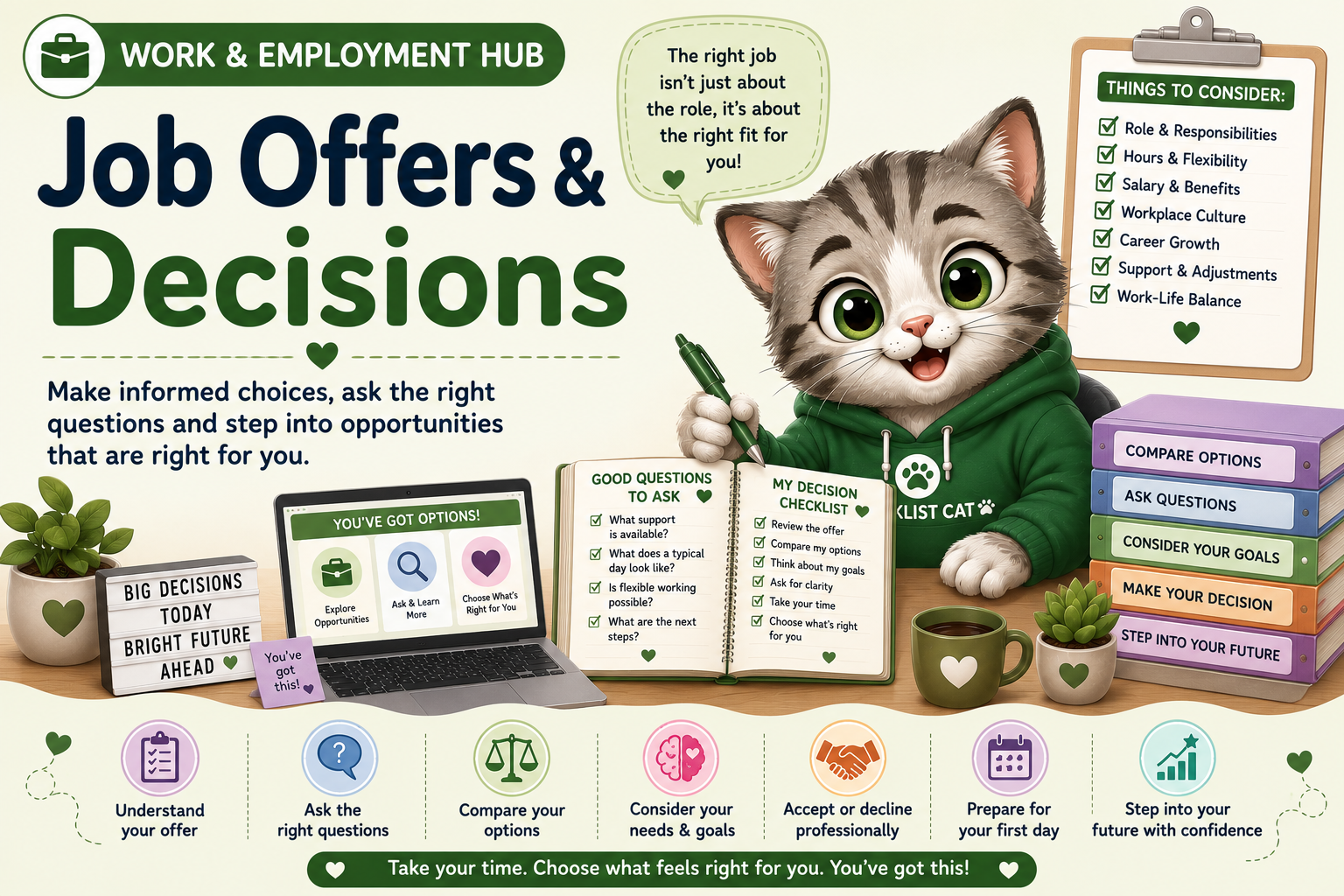
Job Offers & Decisions
Receiving a job offer can feel exciting, relieving, confusing or overwhelming. This page helps you slow the decision down, understand what is being offered and choose the option that best supports your needs, goals and working life.
Try words such as salary, hours, sensory, flexibility, adjustments, compare, accept, decline or first day.
Showing all guide sections.
Read the offer, employment agreement and any supporting information carefully. If something is unclear, write down your questions before responding.
Role & Responsibilities
Check the job title, main duties, reporting line and the outcomes you will be expected to deliver.
Hours & Schedule
Confirm normal hours, shift patterns, break arrangements, overtime expectations and any flexible-working options.
Pay & Benefits
Review the pay rate or salary, payment frequency, leave, benefits, allowances and any review arrangements.
Employment Type
Check whether the position is permanent, fixed-term, casual, part-time, full-time, temporary or contract-based.
Location & Travel
Consider the workplace location, commute, parking, public transport, travel requirements and remote-work expectations.
Start & Review Details
Confirm the proposed start date, induction, training, probation or trial arrangements, and performance review process.

Your Strengths
Does the work use skills you enjoy, value or want to develop?
Your Energy
Can the hours, commute and workload be sustained alongside the rest of your life?
Your Environment
Consider noise, lighting, interruptions, shared spaces, uniforms and physical demands.
Your Communication Needs
Think about instructions, meetings, feedback, phone use, customer contact and team expectations.
Your Goals
Will this role support your financial, learning, independence or career goals?
Your Wellbeing
Ask whether the role feels manageable with the right support, rather than only whether you could force yourself through it.

If you have more than one opportunity, a written comparison can make the decision feel less tangled. Give each factor the weight that matters to you rather than assuming pay is the only important measure.
| Factor | Option A | Option B | What Matters Most to Me? |
|---|---|---|---|
| Role and tasks | |||
| Hours and flexibility | |||
| Pay and benefits | |||
| Commute or remote work | |||
| Workplace environment | |||
| Support and adjustments | |||
| Learning and career growth | |||
| Work-life balance |
Predictability
Ask how schedules, priorities and changes are communicated. Clear expectations can reduce uncertainty.
Sensory Environment
Consider sound, light, temperature, smells, movement, clothing and opportunities for breaks.
Executive Functioning
Think about task-switching, deadlines, interruptions, written instructions and organisational systems.
Communication
Ask whether feedback can be clear, specific and written down when needed.
Adjustments
Identify practical changes that could help you access the role and perform consistently.
Recovery Time
Include commuting, masking, social demands and after-work recovery when judging sustainability.

Checklist Cat
Turn one big decision into a few visible steps so you can see what has already been checked and what still needs attention.

Finn Fox
Look at more than one possible path. A good decision may involve asking a question, negotiating something, accepting, or deciding this role is not the right fit.

Accepting
Thank the employer, clearly confirm that you accept, restate the agreed role and start date, and keep a copy of the written confirmation.
Asking or Negotiating
Be specific and respectful. Explain the change or clarification you are requesting and give the employer time to respond.
Declining
Reply promptly, thank the employer for the opportunity and state clearly that you will not be accepting the offer.
Simple Acceptance Example
Thank you for offering me the position of [job title]. I am pleased to accept the offer and confirm my start date as [date]. Please let me know if there is anything I should complete or bring before my first day.
Simple Decline Example
Thank you very much for offering me the position of [job title]. After careful consideration, I have decided not to accept the offer. I appreciate the time you and the team spent speaking with me and wish you all the best.
You only need a few immediate details at this stage: your start date and time, where to go or how to log in, who to report to, and anything you need to bring. The fuller transition into routines, induction, workplace expectations and settling in belongs on the dedicated Starting a New Job page.
Do I need to accept a job offer immediately?
No. Ask when the employer needs your decision and use the available time to review the details and ask questions.
Can I ask for the offer in writing?
Yes. Written information can make the terms easier to review and gives you an accurate record of what has been offered.
Can I ask questions after receiving an offer?
Yes. It is sensible to clarify the role, hours, support, start date or other important details before accepting.
What if the role does not feel right?
You can decline. A job offer is an opportunity to consider, not an obligation to accept.
What if I need workplace adjustments?
You can think through what support may help, when you want to discuss it and who the appropriate workplace contact may be.