
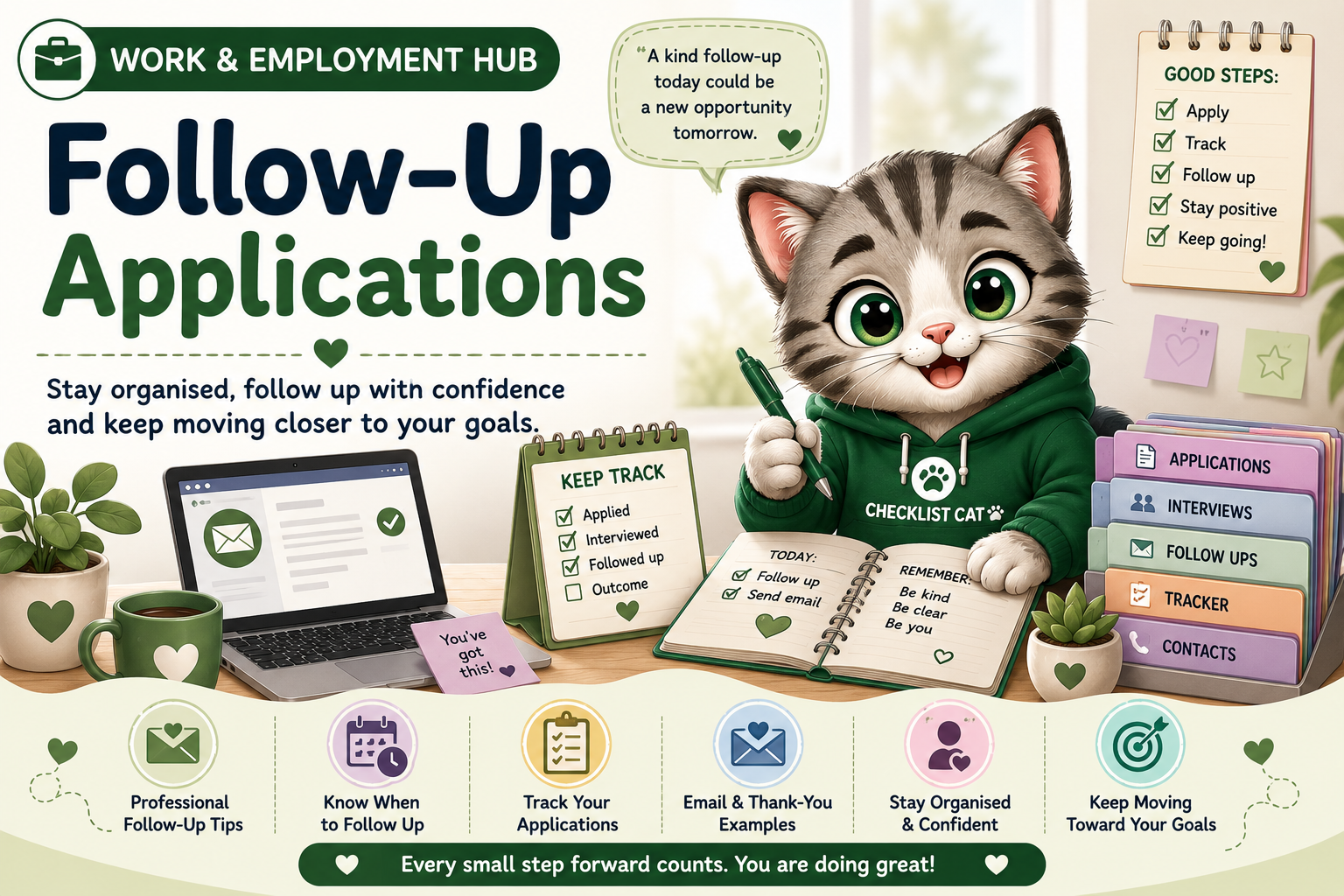
Follow-Up Applications
Once you have submitted an application, there can be a lot of waiting and uncertainty. This guide helps you decide when a follow-up may be appropriate, what to say, how to track applications and how to keep one unanswered application from taking over your whole job search.
Try words such as closing date, email, phone, tracker, no reply, waiting or interview.
Showing all guide sections.
Confirm Your Interest
A brief message can show that you remain interested in the opportunity.
Clarify the Timeline
You may learn whether recruitment is still underway or when applicants can expect an update.
Support Organisation
Follow-up dates help you keep track of applications instead of relying on memory alone.

Record the Application
Save the job title, employer, closing date, contact details and a copy of what you submitted.
Wait for the Stated Timeframe
Follow any instructions from the employer. If no timeframe is given, allow a reasonable period after the closing date.
Send One Polite Message
Confirm your interest and ask whether there is an update on the recruitment process.
Record the Outcome
Add the reply, next action and any new date to your tracker.

Simple Application Follow-Up
Subject: Follow-up: [Job title] application
Kia ora [Name],
I am following up regarding my application for the [job title] position, submitted on [date]. I remain very interested in the opportunity and wondered whether there is an update on the recruitment timeline.
Thank you for your time.
Kind regards,
[Your name]
[Phone number]
Prepare a Short Script
Write down your name, the role, application date and the one question you want to ask.
Choose a Quiet Place
Reduce background noise and keep your notes, calendar and job details nearby.
Be Ready for Voicemail
Prepare one sentence explaining why you called and leave clear contact details.
Use Email if It Works Better
Email is a professional option and may suit you better if you need extra processing time.
Simple Phone Script
“Kia ora, my name is [name]. I applied for the [job title] role on [date]. I am calling to ask whether there is an update on the recruitment timeline. Thank you.”
| Record | What to Include |
|---|---|
| Job details | Employer, job title, location and advertisement link. |
| Important dates | Application date, closing date and expected response date. |
| Contact details | Recruiter or hiring manager name, email and telephone number. |
| Follow-up action | Date contacted, method used, message sent and response. |
| Next step | Interview, another follow-up, outcome or closure. |

Checklist Cat
Keep one clear tracker and tick off each follow-up step rather than relying on scattered notes.

Calendar Cat
Add follow-up dates to your calendar so your brain does not have to keep checking whether today is the day.

Delays Happen
Recruitment teams may receive many applications, experience delays or change hiring plans.
Set a Stopping Point
Choose when you will mark the application as inactive or closed in your tracker.
Continue Applying
Try not to pause your whole job search while waiting for one employer.
Protect Your Wellbeing
Reduce repeated checking and use supportive routines when uncertainty becomes draining.
Post-interview follow-up has its own set of tasks: recovery, recording what happened, thank-you messages, waiting for a decision, asking for feedback and deciding what comes next. We now keep that guidance together on the dedicated After the Interview page rather than repeating it here.
How long should I wait before following up?
Use any timeline provided by the employer. If none is given, wait until after the closing date and allow a reasonable period for applications to be reviewed.
How many times should I follow up?
One clear follow-up is usually a sensible starting point. Consider another only if the employer gives a new date or specifically invites further contact.
Should I telephone or email?
Follow the employer's preferred method when one is given. Email is often easier to document and gives both people time to respond.
What if I never hear back?
Record the application as inactive or closed after your chosen stopping point, continue applying elsewhere and avoid treating silence as a judgement of your ability.
What if I have already interviewed?
Use the dedicated After the Interview page for post-interview recovery, thank-you messages, decision waiting, feedback and next steps.