Glossary & Definitions
A plain-language guide to words connected with life stages, families, neurodivergence, disability, identity, culture, community, education, work, support and access.
Immediate Safety & Crisis Support
This glossary is educational information, not emergency support. If you or someone else may be in immediate danger, use the Crisis Support area for urgent help.
Important Information
Language changes across communities, cultures and countries. Some people prefer different words for themselves. These definitions offer a respectful starting point, not a rule for how every person must describe their identity or experience.
Inside This Page You Will Find
Plain-language definitions
Short explanations designed to make unfamiliar words easier to understand.
Audience & life-stage terms
Words connected with age, family, caring roles, study, work and life transitions.
Identity, culture & access
Terms about belonging, disability, neurodivergence, culture, identity and inclusion.
Support & participation
Words connected with access, accommodations, communication, caring, community and support.
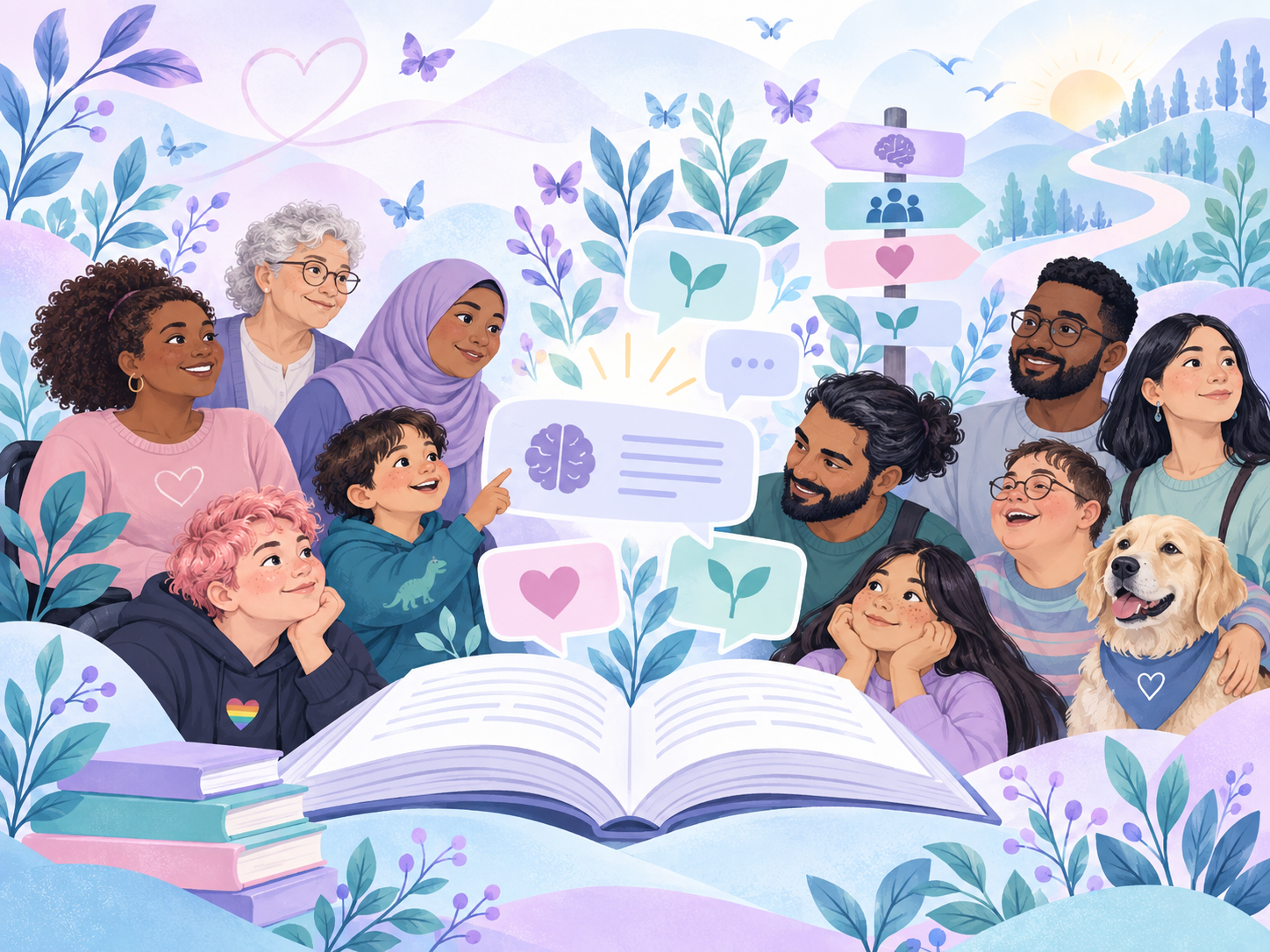
Understanding People, Experiences & Support
Mental health is shaped by more than symptoms or diagnoses. Age, disability, identity, culture, family, housing, money, education, work, communication and access to support can all affect how a person experiences wellbeing and how easy it is to get help.
This glossary focuses on those wider life and audience terms. Detailed clinical terminology belongs in the main Mental Health Glossary or specialist glossaries, so this page does not try to duplicate every mental-health definition.
A terms
AAC Communication
Augmentative and Alternative Communication. Methods that support or replace speech, including communication boards, symbols, signs and speech-generating devices.
Accessibility Access
Designing information, spaces, services and systems so disabled people and people with different access needs can use them as independently as possible.
Accommodation / Adjustment Access
A change to an environment, task, communication method or expectation that reduces an unnecessary barrier for a person.
Ageism Life stages
Stereotyping, prejudice or discrimination based on age. It can affect young people as well as older adults.
Ally / Allyship Belonging
A person or practice that supports people from a group they are not part of, ideally by listening, learning and acting respectfully rather than speaking over that group.
AuDHD Neurodivergence
An informal community term often used by people who are both autistic and have ADHD. It is not a separate formal diagnosis.
Autonomy Rights & choice
A person’s ability and right to make choices about their own life, body, support and decisions, with assistance if they want it.
B terms
Barriers to Access Access
Obstacles that make information, services or support harder to reach. Barriers may be financial, physical, cultural, sensory, communication-based, geographic or administrative.
Belonging Community
The feeling of being accepted, valued and able to participate as yourself within a relationship, group, culture, workplace, school or community.
Burnout Life circumstances
Deep exhaustion and reduced capacity that can follow prolonged stress or demands. Different forms, including work-related and autistic burnout, may have different features and support needs.
C terms
Carer / Caregiver Caring roles
A person who provides practical, emotional or personal support to someone else. Some carers are family or friends; others are paid workers.
Chosen Family Relationships
People someone intentionally regards as family, whether or not they are biologically or legally related. The term is especially important in some Rainbow/LGBTQIA+ communities.
Community Care Community
People supporting one another through shared relationships, practical help, connection, advocacy or collective responsibility.
Cultural Humility Culture
An ongoing approach of learning, self-reflection and respect when working across cultures, including awareness that no professional can fully “master” another person’s culture.
Cultural Safety Culture
Support or care experienced as respectful and safe by the person receiving it, including attention to culture, identity, power and discrimination.
D terms
Disability Disability
A broad term covering physical, sensory, intellectual, learning, neurological, mental-health and other impairments or conditions, especially where barriers restrict participation.
Disclosure Identity & access
Choosing to share personal information such as a disability, diagnosis, identity or support need. People may disclose in different ways and in different settings.
Discrimination Rights & inclusion
Unfair or harmful treatment linked to a person’s identity, disability, age, culture, ethnicity, gender, sexuality, religion or another protected or marginalised characteristic.
E terms
Easy Read Accessible information
An accessible information format that uses clear language, short sections, supportive images and generous spacing to make content easier to understand.
Educator Education
A person who teaches or supports learning, including teachers, lecturers, tutors, trainers and other education professionals.
Equity Inclusion
A fairness approach that recognises people may need different resources, adjustments or support to have a meaningful opportunity to participate.
F terms
Family / Whānau Relationships
People connected through family, kinship or close supportive relationships. In Aotearoa New Zealand, whānau can carry wider meanings of family and collective connection.
Faith / Spiritual Community Culture & community
A community connected through shared religious, spiritual or belief traditions. For some people it can be an important source of identity, meaning and support.
Financial Stress Life circumstances
Stress linked to money, debt, income, employment, housing costs or difficulty meeting everyday needs.
G terms
Gender-Diverse Identity
An umbrella description for people whose gender identity or expression differs from traditional or binary expectations. People may prefer more specific words for themselves.
Gender Identity Identity
A person’s internal sense of their gender. It may or may not match the sex they were assigned at birth.
H terms
Hauora Aotearoa context
A Māori concept of health and wellbeing that can include physical, mental and emotional, social/family and spiritual dimensions, understood in an interconnected way.
Hidden / Non-Apparent Disability Disability
A disability or health-related need that may not be immediately visible to other people.
Housing Insecurity Life circumstances
Unstable, unsafe, unaffordable or uncertain housing, including the risk of losing accommodation.
I terms
Identity-First Language Language
Language that places an identity before “person”, such as “autistic person” or “disabled person”. Some communities strongly prefer it; individual preferences still matter.
Inclusion Belonging
Creating environments where people can participate, contribute and belong without being expected to hide important parts of themselves.
Intersectionality Identity & systems
A way of understanding how different parts of identity and social position can overlap, shaping experiences of advantage, discrimination, access and belonging.
J terms
Jargon Communication
Specialist or technical language used within a profession or community. Jargon can become an access barrier when it is not explained clearly.
K terms
Kinship Support Family & community
Support provided through extended family, whānau or other culturally meaningful kinship networks.
L terms
Late Diagnosis Life stages
Receiving a diagnosis later than is typical or expected, sometimes after years of unexplained experiences, masking or unmet support needs.
Lived Experience Experience
Knowledge gained through personally living with a condition, identity, disability, life circumstance or support system.
Low-Cost Support Access
Support offered at reduced cost, on a sliding scale, through subsidies or through community and charitable services.
M terms
Masking Neurodivergence
Consciously or unconsciously hiding, suppressing or changing natural behaviours to meet social expectations or avoid negative reactions.
Migrant Migration
A person who moves from one place or country to another, temporarily or permanently, for reasons such as work, family, education or safety.
Minority Stress Identity & wellbeing
Additional stress linked to stigma, discrimination, exclusion or the need to navigate environments that marginalise a person’s identity or community.
N terms
Neurodivergence Neurodivergence
A term for ways of thinking, processing or experiencing the world that differ from what is considered neurologically typical.
Neurodivergent Neurodivergence
An adjective describing a person whose neurological development or functioning differs from dominant expectations.
Neurodiversity Neurodiversity
The natural variation in human brains and nervous systems. The term can also refer to a wider framework that values neurological difference as part of human diversity.
Non-Speaking Communication
A description used by some people who do not use speech, or use very little speech, to communicate. Non-speaking does not mean a person has nothing to communicate.
O terms
Older Adult Life stages
A broad term for people in later life. The age at which services or research use this label varies by country, culture and context.
Online Support Support
Support accessed through digital platforms, such as telehealth, moderated communities, online peer groups, helplines, chat or video appointments.
P terms
Pasifika Culture
An umbrella term commonly used in Aotearoa New Zealand for people and communities with heritage from Pacific nations. People may prefer their specific cultural identity.
Peer Support Support
Support provided by people with shared or similar lived experience. Peer support is different from professional therapy, although both may be useful.
Person-First Language Language
Language that places “person” before a condition or disability, such as “person with a disability”. Preferences vary between individuals and communities.
Professional Support Support
Support provided by someone working in a professional role, such as a counsellor, psychologist, therapist, social worker or other qualified practitioner. Titles and regulation differ by country.
Q terms
Questioning Identity
A term some people use while exploring or thinking about their sexual orientation, gender identity or another part of identity.
R terms
Rainbow / LGBTQIA+ Identity & community
Umbrella terms for diverse sexual orientations, gender identities and sex characteristics. Different communities and individuals may use different words.
Reasonable Accommodation Access
An adjustment intended to remove a disability-related barrier where it is reasonable and practical in the relevant setting. Legal wording differs between countries.
Refugee Migration
A person who has been forced to leave their country because of serious threats to safety or persecution and meets relevant legal criteria for refugee protection.
Rural / Remote Access Access
The challenges and solutions involved in accessing support outside major population centres, including travel, service shortages, connectivity and telehealth.
S terms
Sensory Accessibility Access
Reducing unnecessary sensory barriers such as intense noise, lighting, smells, crowding or unpredictable sensory input.
Support Group Community support
A group where people connect around shared experiences or needs. Some are peer-led and some professionally facilitated. A support group is not automatically the same as group therapy.
Support Worker Support roles
A paid worker who provides practical, community, disability, mental-health or daily-living support according to their role and the person’s needs.
Supported Decision-Making Rights & choice
An approach that helps a person understand choices and communicate decisions while keeping the person at the centre of decision-making.
T terms
Telehealth Support access
Health or support services delivered remotely through phone, video or other secure digital communication.
Transition Life stages
A period of change between settings, roles or life stages, such as changing schools, beginning work, leaving home, becoming a parent or entering retirement.
Trauma-Informed Support approach
An approach that recognises trauma can affect people in different ways and aims to increase safety, choice, trust, collaboration and control.
U terms
Universal Design Accessibility
Designing environments, information or services to work for as many people as possible from the beginning, rather than relying only on later individual fixes.
Unemployment Life circumstances
Being without paid employment while available for or seeking work. Unemployment can affect income, routine, identity, connection and wellbeing in different ways.
V terms
Validation Support
Acknowledging that someone’s feelings, perspective or experience makes sense in context, without necessarily agreeing with every interpretation or action.
W terms
Whānau Aotearoa context
A Māori term commonly translated as family, while often carrying wider meanings of kinship, collective connection, belonging and shared responsibility.
Workplace Wellbeing Work
The conditions, relationships, supports and practices that influence wellbeing at work, including workload, safety, inclusion, flexibility and access needs.
X terms
Xenophobia Discrimination
Fear, hostility, prejudice or discrimination directed toward people perceived as foreign, from another country or outside a dominant cultural group.
Y terms
Young Adult Life stages
A broad life-stage term for people moving from adolescence into adulthood. Exact age ranges vary between services, research and countries.
Young Person Life stages
A broad term for children, teenagers or youth. The exact age range depends on context, law, service criteria and culture.
Z terms
Zero-Cost Support Access
Support that does not charge the person using it. Availability, eligibility and what is included can vary widely between services and countries.
Language, Identity & Context
No glossary can capture every person’s preferred language. A respectful approach is to listen to how people describe themselves and avoid assuming one term fits everyone.
- Preferences vary: for example, some people prefer identity-first language while others prefer person-first language.
- Community language evolves: especially around disability, neurodivergence, culture, gender and sexuality.
- Country matters: professional titles, service systems and legal definitions are not identical worldwide.
- Context matters: a word may have a clinical, legal, cultural or community meaning depending on where it is used.
- Self-description matters: when possible, follow the person’s own words for their identity and experience.