
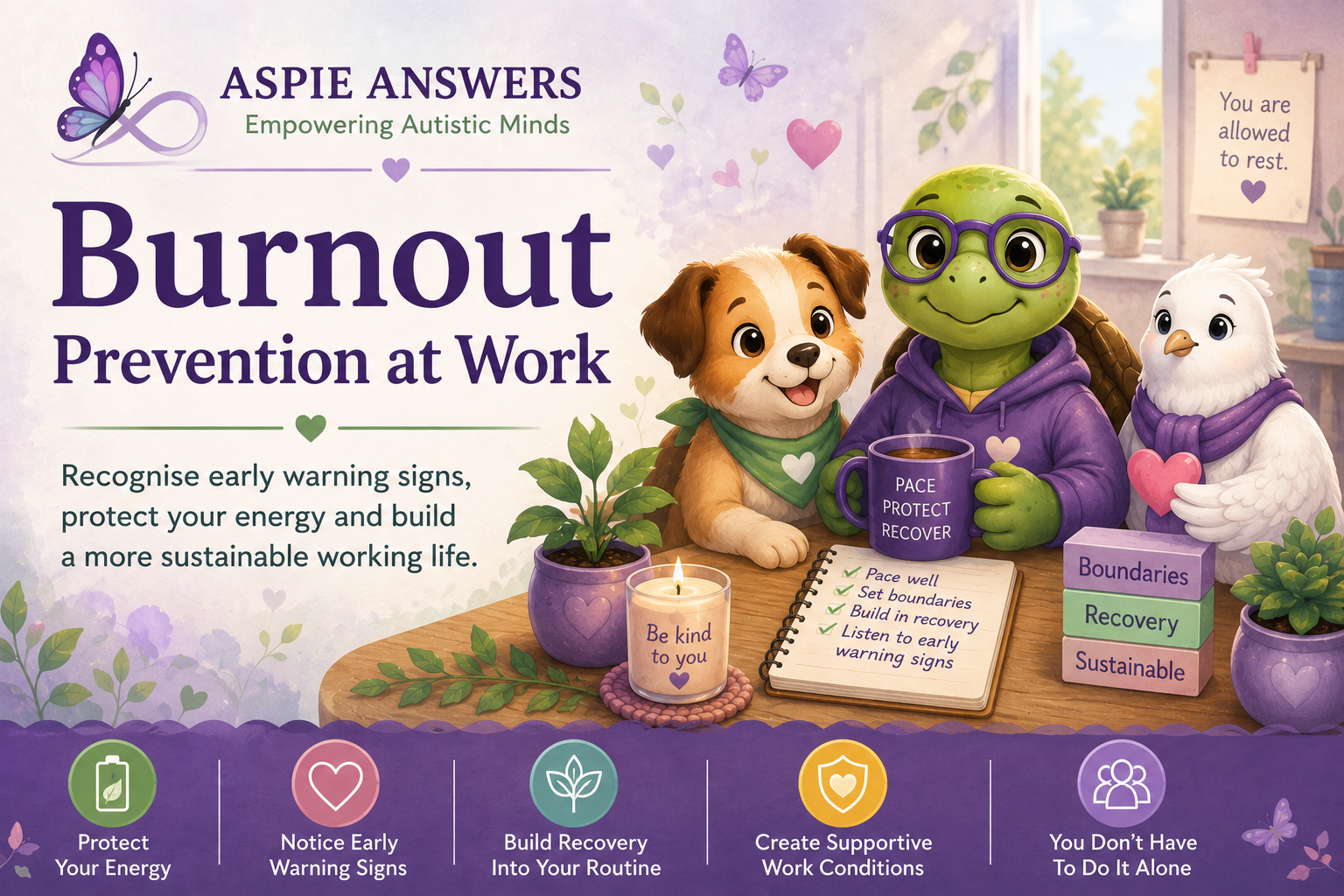
Burnout Prevention at Work
Burnout rarely begins with one dramatic moment. It can build gradually when demands, stress, sensory load, responsibilities and recovery stay out of balance for too long.
Burnout prevention is about noticing those patterns earlier and making changes before exhaustion becomes the normal way of getting through the working week.
For neurodivergent people, prevention may also mean recognising hidden demands such as masking, sensory processing, executive function, communication, unexpected change and the amount of recovery needed after the workday.
This page will help you notice early warning signs, understand what may increase burnout risk, protect your energy, pace demands more sustainably and identify when the workplace itself may need to change.
🌿 Start With the Pattern, Not the Blame
If work is repeatedly leaving you exhausted, the most useful question may not be “Why can't I cope better?” Instead, look at what the current pattern is asking from you and whether enough recovery and support exist around those demands.
What Is Workplace Burnout?
Burnout can develop when work demands repeatedly use more mental, emotional or physical capacity than you have enough opportunity to restore.
Burnout is more than simply feeling tired
A difficult day, demanding project or busy week can leave anyone exhausted. Burnout-like patterns become more concerning when the exhaustion continues, recovery becomes less effective and ordinary work begins to require increasingly more effort.
You may also notice changes in concentration, motivation, sensory tolerance, communication, emotional regulation or your ability to manage everyday life outside work.
Prevention means paying attention to these changes before pushing through becomes the only strategy left.
🔄 How Burnout Can Build Over Time
It is often the repeated cycle — rather than one individual stressor — that creates the greatest strain.
Workload, change, sensory or social demands begin using more capacity.
More energy is needed just to maintain the same level of functioning.
Breaks, evenings or weekends no longer replace what work is using.
Normal work starts feeling harder because there is less available capacity left.
🧩 Burnout Can Affect More Than Energy
The effects may show up across several parts of working and everyday life.
Energy
Persistent tiredness, feeling depleted earlier in the day or needing much more recovery than usual.
Thinking
Concentration, memory, decision-making, planning or task initiation may become harder.
Sensory Tolerance
Noise, lighting, movement or other sensory input may feel more intense and difficult to filter.
Emotional Regulation
Anxiety, frustration, irritability, shutdown or overwhelm may happen more easily.
Communication
Finding words, processing conversations or responding quickly may require more effort.
Life Outside Work
Household tasks, relationships, interests or everyday activities may receive less energy because work has used so much.
🌤️ A temporary demanding period may…
- Have a clear reason or end point.
- Improve once the workload settles.
- Respond reasonably well to normal rest.
- Leave you tired without continuously reducing functioning.
- Allow your usual capacity to return afterwards.
🚩 A concerning pattern may…
- Continue week after week.
- Require increasing effort just to keep up.
- Leave you unable to recover properly.
- Reduce concentration, tolerance or everyday functioning.
- Keep returning because the underlying demands have not changed.
🐢 Toby's Early Sustainability Check
You do not need to decide whether something “counts” as burnout before paying attention to the pattern.
Stress vs Burnout — What's the Difference?
Stress and burnout can overlap, but they are not always the same experience. Looking at how long the pressure lasts, how well you recover and whether your functioning is changing can help you understand the pattern.
🌿 Think pattern, not perfect label
You do not need to diagnose yourself before taking action. If work is repeatedly leaving you depleted and normal recovery is no longer enough, that is already useful information that the current balance deserves attention.
Workplace Stress
Stress often appears when demands increase or something feels difficult, uncertain or urgent.
- You may feel tense, rushed or overloaded.
- There may be a clear trigger or busy period.
- Rest often helps once the pressure settles.
- Your usual capacity tends to return.
- You can often identify what created the stress.
Burnout-Like Pattern
Burnout-like patterns can develop when stress and demand continue for too long without enough recovery or meaningful change.
- Exhaustion may remain even after normal rest.
- Concentration and everyday functioning may reduce.
- Sensory and social tolerance may become lower.
- Recovery may take much longer than it used to.
- The same work pattern may keep recreating the problem.
🔍 Compare the Pattern
These differences are not strict rules, but they can help you notice when ordinary stress may be becoming something more persistent.
🐢 Burnout Prevention Happens Before the Final Stage
Think of burnout risk as a gradual movement rather than an on/off switch.
Work uses energy, but recovery keeps pace.
Pressure is increasing and more recovery is needed.
Normal rest is no longer restoring your usual capacity.
Functioning, energy or wellbeing may be significantly affected.
💭 Questions That Matter More Than the Label
If you are unsure whether you are “stressed enough” to change something, these questions may be more useful.
Early Warning Signs of Burnout
Burnout prevention becomes much easier when you know what your own early changes look like. The signs may appear in your energy, thinking, sensory tolerance, emotions, communication or recovery before the situation feels severe.
🔍 Your early signs may be quieter than you expect
Burnout does not always begin with being unable to work. It may start with needing longer to recover, finding ordinary tasks more effortful, becoming less tolerant of noise or having less capacity left for life outside work.
Energy Drops Earlier
You may begin running out of energy earlier in the day or start the workday with less capacity than usual.
Thinking Takes More Effort
Planning, remembering, decision-making or starting tasks may require more mental effort than before.
Sensory Tolerance Changes
Sounds, lights, movement, smells or physical discomfort may become harder to filter or tolerate.
Communication Gets Harder
Finding words, processing conversations, joining meetings or replying quickly may begin to use much more energy.
Emotions Feel Closer to the Surface
Irritability, anxiety, frustration, shutdown or overwhelm may happen more easily than usual.
Recovery Takes Longer
Evenings, weekends or normal breaks may no longer restore your usual level of energy.
📝 Identify Your Personal Warning Signs
Different people notice different changes first. Your own pattern is more useful than trying to match somebody else's exactly.
🟡 Earlier signs may include…
- Needing more quiet after work.
- Feeling drained sooner in the day.
- Small interruptions becoming more frustrating.
- More difficulty switching tasks.
- Putting off activities outside work because energy is low.
- Depending on weekends mainly for recovery.
🔴 If the pattern keeps building…
- Normal work may become significantly harder to complete.
- Recovery may stop restoring your usual capacity.
- Sensory and social demands may feel much more intense.
- Communication or decision-making may become much harder.
- Daily life outside work may become increasingly difficult.
- You may feel as though you are running on empty most of the time.
🌿 What Can You Do When You Notice the Signs Early?
Prevention often works best when the response happens before exhaustion becomes severe.
Review the Current Demands
Ask what has changed in workload, deadlines, responsibilities or expectations.
Protect Recovery Earlier
Increase breaks, quiet time or recovery before your energy reaches its lowest point.
Reduce Hidden Load
Look at sensory, social, communication or interruption demands that may be quietly using extra capacity.
Adjust the Pace
Avoid treating every day as a maximum-output day when your capacity is already dropping.
Strengthen Boundaries
Review availability, workload, breaks and how much work is following you into recovery time.
Ask for Support Earlier
A smaller conversation now may be easier than waiting until the situation becomes much harder to manage.
🐢 Toby Turtle's “Something Has Changed” Check
If you notice that your normal working pattern suddenly costs more energy, Toby suggests checking these areas before assuming you simply need to try harder.
What Can Increase Burnout Risk at Work?
Burnout risk is not only about how well someone manages stress. Workload, environment, expectations, communication, recovery and hidden demands can all influence whether work remains sustainable.
🐢 Burnout prevention includes looking at the conditions around the work
If someone is continually using more capacity than they can restore, adding another coping strategy may not solve the underlying problem. Sometimes the demands, environment, pace or expectations need attention too.
Chronic Workload Pressure
Too many tasks, unrealistic deadlines or constantly increasing responsibilities can leave little opportunity to recover between demands.
Constant Urgency
When everything feels urgent, the nervous system may spend too much of the workday responding to pressure rather than working at a sustainable pace.
Ongoing Sensory Load
Noise, lighting, movement, smells, temperature or crowded environments can continuously use energy even when the work itself is manageable.
Frequent Interruptions
Repeated messages, questions, meetings and task switching can increase cognitive load and make it harder to complete focused work.
Unclear Expectations
Vague instructions, changing priorities or uncertainty about what is expected can create ongoing mental and emotional pressure.
Masking & Monitoring Yourself
Continually monitoring communication, behaviour, expression or sensory responses in order to fit workplace expectations can require substantial energy.
Weak Work–Life Boundaries
Working late, checking messages during recovery time or feeling permanently available can reduce opportunities to properly switch off.
Too Little Recovery
Skipped breaks, inadequate downtime or repeatedly pushing through exhaustion can allow recovery needs to accumulate.
Lack of Appropriate Support
Burnout risk may increase when someone repeatedly encounters barriers but does not have enough practical, communication or workplace support.
🧠 Remember the Hidden Workload
Two people doing the same visible task may be using very different amounts of energy because some workplace demands are not obvious from the outside.
⚖️ Burnout Risk Often Comes Down to Balance
High demands are more difficult to sustain when the things that protect capacity are missing.
📈 When Demands Keep Growing
- More tasks are added without anything being removed.
- Deadlines remain tight for long periods.
- Interruptions and task switching stay high.
- Sensory or social demands remain intense.
- Expectations are unclear or continually changing.
- Extra effort becomes the normal way of keeping up.
🌿 Protective Conditions May Include
- Realistic workload and clear priorities.
- Predictable expectations where possible.
- Protected breaks and recovery time.
- Appropriate sensory adjustments.
- Clear communication and practical support.
- Enough flexibility to respond when capacity changes.
🧩 It May Be the Combination That Matters
One individual demand may be manageable. Several demands happening together can create a very different energy cost.
🐢 Toby Turtle's Burnout Risk Review
Instead of asking only whether you are coping, Toby encourages you to look at what your work is repeatedly asking from you.
Neurodivergent Burnout in the Workplace
Neurodivergent workers may be managing the visible job alongside sensory, executive-function, communication, social and masking demands that use additional energy throughout the day.
🧠 Looking capable does not always mean the work is sustainable
Someone may meet deadlines, attend meetings and appear composed while using a very large amount of energy to manage the environment, interpret expectations, switch tasks, regulate sensory input and hide signs of overload.
Masking
Monitoring behaviour, facial expression, tone, eye contact or natural regulation needs can create an additional layer of effort throughout the workday.
Sensory Processing
Filtering noise, movement, lighting, smells or physical discomfort can steadily use capacity in the background.
Executive Function
Planning, prioritising, remembering instructions, task initiation and switching may require constant conscious effort.
Communication Processing
Rapid conversations, vague instructions, implied meaning and pressure to respond immediately can increase cognitive load.
Transitions & Change
Unexpected schedule changes, interruptions and switching contexts may require additional adjustment and recovery.
Social Demand
Meetings, teamwork, customers, workplace small talk and navigating unwritten social expectations may use significant energy.
🎭 The Cost of Looking “Fine”
Masking can make support needs less visible because the effort happens internally rather than appearing as an obvious workplace difficulty.
🔍 What People See vs What It May Be Costing
Burnout prevention works better when the hidden effort is included in the picture.
👀 What Others May See
- You arrive at work and complete your tasks.
- You participate in meetings.
- You respond politely to colleagues or customers.
- You meet deadlines most of the time.
- You appear calm during the workday.
- You keep going when plans change.
🔋 What It May Be Costing
- Significant preparation before work.
- Continuous sensory filtering.
- High executive-function effort.
- Masking distress or confusion.
- Little energy remaining after work.
- Long periods of recovery before doing anything else.
🌿 Reduce the Hidden Energy Cost Where Possible
Neurodivergent burnout prevention does not mean removing every challenge. It means avoiding unnecessary energy use where practical supports could make the same work more sustainable.
Move Information Into Writing
Written priorities, instructions and follow-up notes may reduce working-memory and communication demands.
Reduce Sensory Barriers
Quieter spaces, appropriate sensory supports or environmental changes may reduce background energy use.
Increase Predictability
Advance notice, visible routines and clear expectations may reduce the effort required to prepare for uncertainty.
Allow Regulation & Recovery
Short quiet, movement or sensory breaks may help prevent the nervous system from carrying uninterrupted load all day.
Reduce Communication Pressure
Allow processing time, clarification and different communication formats where appropriate.
Reduce Unnecessary Masking
Safer, more accepting workplace conditions may reduce the energy spent constantly monitoring and hiding natural differences.
💭 Ask What Happens After the Workday
Sometimes the clearest sign of an unsustainable work pattern appears after someone leaves the workplace.
Energy, Capacity & Pacing
Burnout prevention becomes easier when you stop treating energy as unlimited. Capacity can change from day to day, and sustainable pacing means adjusting effort to the resources you actually have available.
🐢 Pacing isn't about always going slowly
Pacing means recognising when you have capacity to push a little harder, when you need a steadier rhythm, and when protecting recovery matters more than squeezing in one more task.
Energy Is Finite
Mental, sensory, emotional and physical demands all draw from available capacity, even when they are not visible to other people.
Capacity Changes
Sleep, health, sensory load, stress, life demands and the previous workday can all affect how much capacity is available today.
Pace Matters
Working at maximum intensity all day may create more output temporarily, but it can also increase the recovery cost afterwards.
Breaks Protect Capacity
Planned pauses may help prevent the nervous system from carrying uninterrupted demand until energy is already gone.
Recovery Has a Cost Too
A workday may technically fit into eight hours while still requiring several more hours of recovery afterwards.
Life Needs Energy Too
Sustainable work should ideally leave some capacity for everyday life, relationships, interests and basic recovery outside work.
🔋 Think of Your Capacity as an Energy Budget
Not every task costs the same amount of energy, and the cost can change depending on the environment or the day.
🌿 Toby's Pace → Pause → Check → Adjust Method
Instead of waiting until the end of the day to discover that you have used too much energy, try checking capacity while the day is still happening.
Start at a level you can realistically maintain.
Use short recovery points before your capacity is empty.
Notice energy, sensory load, concentration and stress.
Change pace, priorities or support when your capacity changes.
🚦 Match the Day to Your Available Capacity
The same workload may not be equally sustainable every day.
🟢 Higher-Capacity Day
You have more usable energy and your normal supports are working well.
- Use focused work periods.
- Complete higher-demand tasks where appropriate.
- Still protect breaks.
- Avoid spending tomorrow's energy today.
🟡 Medium-Capacity Day
You can work, but demands may need more deliberate management.
- Keep priorities narrow.
- Use more structure and written supports.
- Reduce avoidable interruptions.
- Build in additional recovery points.
🔴 Lower-Capacity Day
Energy or tolerance is already reduced and normal work may cost much more.
- Focus on essential priorities.
- Reduce unnecessary sensory or social demands.
- Ask for practical support if needed.
- Protect recovery rather than pushing for maximum output.
🚩 The Push → Crash Cycle
- Use maximum energy while capacity is available.
- Skip breaks to get more done.
- Ignore early warning signs.
- Reach exhaustion or overload.
- Need significant recovery afterwards.
- Return and repeat the same pattern.
🌿 A More Sustainable Rhythm
- Use effort according to the task and available capacity.
- Pause before reaching empty.
- Alternate higher and lower demand where possible.
- Protect sensory and mental recovery.
- Adjust workload when capacity drops.
- Leave some energy for life outside work.
🐢 Toby Turtle's Midday Capacity Check
A short check during the day may help you make small changes before exhaustion decides the rest of the day for you.
Sensory Load & the Workplace Environment
A workplace can use energy before you even begin the actual task. Noise, lighting, movement, temperature, interruptions and physical surroundings may all contribute to cumulative strain across the day.
🎧 Sensory load can quietly reduce the capacity available for work
If part of your attention is continuously being used to filter background noise, tolerate uncomfortable lighting or manage a busy environment, less capacity may remain for concentration, communication, planning and recovery.
Noise
Conversations, phones, machinery, music, alarms and background sound can make sustained concentration much more demanding.
Lighting
Bright, flickering or visually intense lighting may create discomfort, fatigue or additional sensory strain.
Movement & Visual Activity
Open-plan spaces, people walking past and visually busy environments can repeatedly pull attention away from the task.
Temperature & Comfort
Heat, cold, uncomfortable seating, clothing requirements or physical discomfort can steadily use energy in the background.
Interruptions
Questions, messages, people approaching and sudden changes can turn the environment into a constant task-switching demand.
Smells & Other Sensory Input
Perfume, food, cleaning products and other environmental sensations may contribute to cumulative overload.
🧠 What Sensory Load Can Cost
Environmental demands can affect more than comfort. They may change how much capacity is available for the rest of the workday.
🌿 Practical Ways to Reduce Environmental Strain
Not every workplace can remove every sensory demand, but reducing even one repeated source of strain can protect capacity.
Use Appropriate Sound Support
Where suitable for the role, noise reduction or quieter spaces may help reduce background processing.
Review Lighting
Alternative lighting, screen settings or workspace positioning may reduce visual discomfort.
Create Quieter Work Periods
Some focused tasks may be easier in a lower-interruption environment or at a quieter time of day.
Use Sensory Recovery Breaks
Short periods of quiet, movement or reduced stimulation may help stop sensory strain from building continuously.
Improve Physical Comfort
Seating, temperature, posture and other physical factors can affect how much energy remains available.
Reduce Avoidable Interruptions
Protected focus periods, clearer communication channels or fewer unnecessary notifications may help.
🚦 Notice Your Sensory Load Before It Reaches Overload
A simple low–medium–high check can help you decide when the environment needs adjusting.
🟢 Lower Sensory Load
The environment is noticeable but manageable.
- Concentration is reasonably stable.
- Normal supports are enough.
- Recovery needs feel typical.
🟡 Sensory Load Building
Input is beginning to use more attention and energy.
- Noise or light is harder to ignore.
- Interruptions feel more disruptive.
- Thinking or communication may slow down.
- A sensory reset may help.
🔴 High Sensory Load
The environment is using a significant amount of available capacity.
- Normal input may feel overwhelming.
- Communication and decisions may become harder.
- Stress or shutdown signals may increase.
- Reducing stimulation may need priority.
🚩 Signs the environment may be draining too much capacity
- You need silence immediately after work.
- Normal workplace sounds increasingly feel unbearable.
- Interruptions make it much harder to restart tasks.
- Your concentration drops sharply in busy environments.
- You become increasingly tense or irritable as the day continues.
- High-sensory days require much longer recovery afterwards.
🌱 Possible responses
- Reduce one repeated sensory demand where possible.
- Use quieter periods for high-focus work.
- Protect sensory breaks before overload.
- Review lighting, seating or workspace position.
- Reduce unnecessary interruptions.
- Discuss practical workplace adjustments if barriers continue.
🐢 Toby Turtle's Environment Check
Before assuming your energy problem is only about workload, Toby suggests checking how much capacity the environment itself is using.
Boundaries, Workload & Sustainable Expectations
Burnout risk can increase when workload grows without clear limits, priorities remain uncertain or work repeatedly takes over the time and energy needed for recovery.
🛡️ Being capable does not mean having unlimited capacity
You may be skilled, reliable and willing to help while still needing realistic limits around workload, deadlines, availability and recovery. Sustainable expectations make it easier to use your strengths without repeatedly draining the capacity needed to keep using them.
Clear Priorities
Knowing what genuinely needs attention first reduces the pressure of treating every task as equally urgent.
Realistic Deadlines
Time expectations should reflect the actual work involved rather than requiring constant rushing or unpaid catch-up.
Visible Workload
Making all current tasks visible can show when new work is being added to a schedule that is already full.
Protected Breaks
Breaks are part of maintaining capacity, not simply spare time to remove whenever workload increases.
Availability Limits
Expectations around email, messages, calls and interruptions can affect whether your attention ever gets a chance to reset.
Recovery Boundaries
When work repeatedly follows you home, the time available for recovery can become too small to restore what the day has used.
🔍 Is the Workload Actually Fitting?
Sometimes burnout prevention begins with checking whether the work expected can realistically fit into the time and capacity available.
🌿 Boundaries That Can Protect Against Burnout
Healthy workplace boundaries are often practical agreements about what, when and how much — rather than simply saying “no.”
🚩 An unsustainable pattern may look like…
- Every request becomes another priority.
- Deadlines stay tight even when workload grows.
- Breaks are consistently sacrificed.
- Work regularly continues beyond agreed hours.
- You feel permanently available.
- Recovery time is used mainly to prepare for more work.
🌱 A healthier pattern may include…
- Clear decisions about what matters most.
- Deadlines that reflect available time.
- Protected focus and recovery periods.
- New work being balanced against existing work.
- Clearer expectations around availability.
- Enough separation between work and recovery.
💬 Useful Boundary & Workload Phrases
Having prepared wording can make it easier to raise concerns before the workload becomes overwhelming.
🐢 Toby Turtle's “Does It Fit?” Check
Before pushing harder, Toby suggests checking whether the expectation actually fits the resources available.
Recovery Before You Reach Empty
Burnout prevention works better when recovery happens throughout the pattern — not only after your energy has already disappeared. Small recovery points can help protect capacity before a full crash becomes the only way to stop.
🐢 Toby says: recovery should happen before the tank is empty
Rest is often less effective when it only begins after prolonged overload. Building recovery into the workday, the transition home and the wider week may help prevent exhaustion from continually accumulating.
Micro-Recovery
Short pauses during the day can reduce uninterrupted cognitive, sensory or social demand.
Sensory Recovery
Quiet, lower light, movement or reduced stimulation may help when the workplace environment has been demanding.
Mental Recovery
Time without decisions, task switching or information processing can give an overloaded brain a chance to settle.
Social Recovery
Lower-demand time after meetings, customers or intensive interaction may help restore social capacity.
After-Work Recovery
A deliberate transition out of work can help reduce the sense that the working day never really ended.
Weekly Recovery
The week may need lower-demand periods rather than using every available day at maximum intensity.
🌿 Think in a Work → Pause → Recover → Return Rhythm
Sustainable recovery is often easier when it is part of the normal work pattern rather than an emergency response.
Use focused effort while capacity is available.
Stop before attention and energy are completely depleted.
Reduce demand enough for the nervous system to settle.
Continue when there is enough usable capacity again.
☕ Small Recovery Moments During the Workday
Recovery does not always need a long break. Brief changes in demand can still interrupt the build-up of strain.
🏡 Create an End-of-Work Recovery Transition
A predictable closing routine can help your brain recognise that work has ended and recovery time is beginning.
📝 Close the Open Loops
Write down unfinished tasks and tomorrow's starting point instead of carrying them around in your head all evening.
🔕 Reduce Incoming Work
Where appropriate, close work systems and reduce unnecessary work notifications during recovery time.
🌿 Choose a Transition Cue
A walk, shower, change of clothes, quiet time, music or another routine can help create separation from the workday.
🎧 Meet Sensory Needs
High-sensory workdays may need lower light, less conversation or additional quiet afterwards.
💚 Lower Immediate Demands
If possible, avoid scheduling every after-work hour with more high demand when your capacity is already low.
🔋 Notice What Restores You
Recovery is personal. Pay attention to what genuinely leaves you with more capacity rather than what only fills the time.
🚩 Waiting for the crash may look like…
- Skipping breaks while energy is available.
- Continuing until concentration collapses.
- Ignoring increasing sensory overload.
- Using evenings only to recover from work.
- Spending weekends becoming functional enough to return.
- Starting the next week already partly depleted.
🌱 Preventive recovery may look like…
- Using breaks before exhaustion.
- Alternating demanding and lower-demand work.
- Reducing sensory load as it begins building.
- Protecting a transition out of the workday.
- Leaving some lower-demand space in the week.
- Adjusting the workload when recovery is falling behind.
📅 Check the Recovery Pattern Across the Week
Burnout prevention is not only about how you feel at 5pm. Look at whether your energy is gradually recovering or steadily disappearing as the week continues.
🐢 Toby Turtle's Recovery Check
Toby encourages you to look at whether your recovery is actually replacing the energy work is using.
Create Your Burnout Prevention Plan
A simple plan can help you notice changes earlier, remember what protects your capacity and decide what needs to happen when work starts becoming less sustainable.
🐢 Make the plan while you still have enough energy to use it
When exhaustion is already severe, planning, decision-making and asking for support can become much harder. Writing down your warning signs, supports and next steps in advance gives you something concrete to return to.
My Warning Signs
Record the first changes you notice in energy, thinking, sensory tolerance, communication or recovery.
My Capacity Pattern
Notice what high-, medium- and low-capacity workdays look like for you.
My Hidden Energy Costs
Identify sensory, social, masking, communication or executive-function demands that quietly increase the cost of work.
My Recovery Supports
List what helps during work, after work and across the wider week.
My Boundaries
Define what needs protecting around workload, availability, breaks, deadlines and recovery time.
My Support Pathway
Know who you can approach when personal strategies are no longer enough.
📝 My Burnout Prevention Plan
These prompts can become a future worksheet, printable or personal note.
🚦 Build a Green → Amber → Red Prevention Plan
A simple traffic-light system can help you connect warning signs with action rather than waiting until capacity has already collapsed.
🟢 Green — Sustainable
Work is demanding, but recovery is keeping pace.
- Keep normal breaks and routines.
- Use sensory and executive-function supports.
- Protect your existing boundaries.
- Notice changes early.
🟠 Amber — Capacity Is Dropping
Recovery is taking longer or normal work is costing more.
- Reduce avoidable demands.
- Narrow priorities.
- Increase recovery.
- Reduce sensory or social load.
- Raise concerns before the pattern worsens.
🔴 Red — Current Pattern Is Not Sustainable
Capacity may be significantly reduced and normal strategies may no longer be enough.
- Prioritise immediate wellbeing and essential demands.
- Use appropriate workplace support.
- Review workload, environment and expectations.
- Consider appropriate leave or health support where needed.
- Avoid returning unchanged to the same unsustainable pattern.
🤝 Decide Your Support Pathway Before You Need It
Burnout prevention can be easier when you already know who handles different types of workplace support.
🔄 Review the Plan — Don't Just Repeat It
A prevention plan should change when the job, environment or your capacity changes.
Companion Support for Burnout Prevention
Burnout prevention involves more than one kind of support. Toby Turtle leads with pacing, energy and recovery, while Scout and Hope the Dove support the emotional and compassionate side of protecting wellbeing.
Toby Turtle V1 Artwork
Add the approved WordPress image URL here when ready.
🐢 Toby Turtle
Toby Turtle's specialist role is pacing, wellbeing, sensory needs and burnout prevention. He helps make energy and recovery part of the plan instead of something considered only after exhaustion.
On this page, Toby encourages you to notice changes earlier, match your pace to available capacity, protect recovery and question work patterns that continually leave you running on empty.
Sustainable progress is not about going as fast as possible. It is about finding a pace that gives you a better chance of still having usable capacity tomorrow.
Toby Is Supported by Scout & Hope the Dove
Energy and pacing matter, but burnout prevention also needs emotional support, self-compassion and permission to ask for help.
Scout V1 Artwork
Add the approved WordPress image URL here when ready.
🐶 Scout
Emotional Reassurance • Friendship • RegulationScout helps when burnout risk brings worry, overwhelm, discouragement or the feeling that you should be handling everything alone. Scout's support is about recognising emotions and reaching out before things become too much.
Hope the Dove V1 Artwork
Add the approved WordPress image URL here when ready.
🕊️ Hope the Dove
Peace • Calm • Compassion • KindnessHope helps challenge the pressure to judge yourself for needing rest, boundaries or support. Her role is to bring more compassion into the way you respond when your capacity changes.
🌿 Three Companions — Three Parts of Prevention
Each companion helps you look at burnout prevention from a different angle.
💜 Which Companion Might Help Today?
You may need different support depending on what part of the burnout pattern is showing up.
Burnout Prevention Resources & FAQs
Practical tools can make energy, warning signs, workload and recovery easier to see. You can use them to notice patterns earlier and prepare workplace conversations before burnout risk becomes more difficult to manage.
Burnout Early Warning Signs Tracker
Record changes in energy, concentration, sensory tolerance, communication and recovery.
Planned / Check Resource BankWorkplace Energy & Capacity Tracker
Notice high-, medium- and low-capacity days and what seems to affect available energy.
Planned / Check Resource BankPacing Planner
Balance higher-demand work, lower-demand tasks, breaks and recovery across the day or week.
Planned / Check Resource BankSensory Load Review
Identify environmental demands and practical changes that may reduce hidden energy use.
Planned / Check Resource BankWorkplace Boundary Check
Review workload, deadlines, availability, breaks and the amount of work entering recovery time.
Planned / Check Resource BankRecovery Planning Worksheet
Map micro-recovery, end-of-work decompression and wider weekly recovery.
Planned / Check Resource BankGreen–Amber–Red Burnout Prevention Plan
Match changing capacity levels with practical actions before the pattern becomes unsustainable.
Planned / Check Resource BankBurnout Prevention Conversation Planner
Prepare how to explain changing capacity, workplace barriers and support that may help.
Planned / Check Resource BankMy Burnout Prevention Plan
Bring warning signs, pacing, sensory support, recovery, boundaries and support contacts together in one place.
Planned / Check Resource Bank📚 Explore More Aspie Answers Resources
As these burnout prevention tools are developed, they can connect into the wider Work & Employment and Aspie Answers resource collections.
❓ Burnout Prevention FAQs
These answers cover some common questions about preventing burnout at work.
🐢 Do I need to already be burned out before changing something?
No. Prevention is about noticing changes while you still have more options available.
If recovery is taking longer, your capacity is dropping or the same workplace barriers keep draining you, those are useful reasons to review the pattern.
🔋 Why does my capacity change from day to day?
Capacity can be affected by sleep, sensory load, health, stress, social demands, executive-function load, life outside work and what happened the previous day.
Sustainable pacing allows for that variation instead of expecting identical output every day.
🎭 Can masking contribute to burnout risk?
It can add significant hidden effort for some neurodivergent people. Monitoring behaviour, communication and natural regulation needs can use energy even when nobody else can see that effort.
🎧 Can the workplace environment affect burnout?
Yes. Noise, lighting, movement, interruptions, physical discomfort and other sensory demands may repeatedly reduce the capacity available for work and recovery.
☕ Should I wait until I'm exhausted before resting?
Preventive recovery usually works better when breaks and lower-demand periods happen before your capacity is completely gone.
🛡️ Are workplace boundaries part of burnout prevention?
They can be. Boundaries around workload, deadlines, availability, breaks and recovery time can help prevent demands from continually expanding beyond available capacity.
🏡 What if my weekends are mostly spent recovering from work?
That pattern may be worth reviewing, particularly if weekends no longer restore enough capacity and each new week begins with less energy than the previous one.
🤝 When should I ask for workplace support?
You do not need to wait for the situation to become severe. Repeated workload, sensory, communication or recovery problems may be easier to address when they are raised earlier.
💜 What if my usual burnout prevention strategies stop helping?
That can be a sign that the underlying demands need a larger review. More coping strategies cannot always compensate for an unsustainable workload, environment or working pattern.
Continue Your Workplace Success Journey
Burnout prevention connects with stress management, wellbeing, productivity, executive function, sensory needs and the wider question of what makes work sustainable for you.
Explore More Workplace Success Support
Continue with the area that best matches what is affecting your work, energy or wellbeing right now.
Managing Stress at Work
Recognise workplace stress triggers, manage pressure in the moment and build a practical personal stress plan.
Explore Managing StressWorkplace Wellbeing
Explore energy, sensory needs, boundaries, emotional wellbeing and creating a healthier relationship with work.
Explore Workplace WellbeingWorkplace Productivity
Build practical systems for priorities, focus and progress without relying on constant urgency or pressure.
Explore ProductivityExecutive Function at Work
Explore support for planning, task initiation, working memory, organisation, switching and focus.
Explore Executive FunctionTime Management
Explore time awareness, schedules, transitions, reminders and ways to make the working day easier to see and manage.
Explore Time ManagementWorkplace Communication
Explore instructions, clarification, workplace conversations, processing time and asking for practical support.
Explore Communication💼 Return to the Work & Employment Hub
The wider Work & Employment Hub brings together workplace success, job preparation, interviews, employment support, practical resources and neurodivergent-friendly guidance across the working journey.