
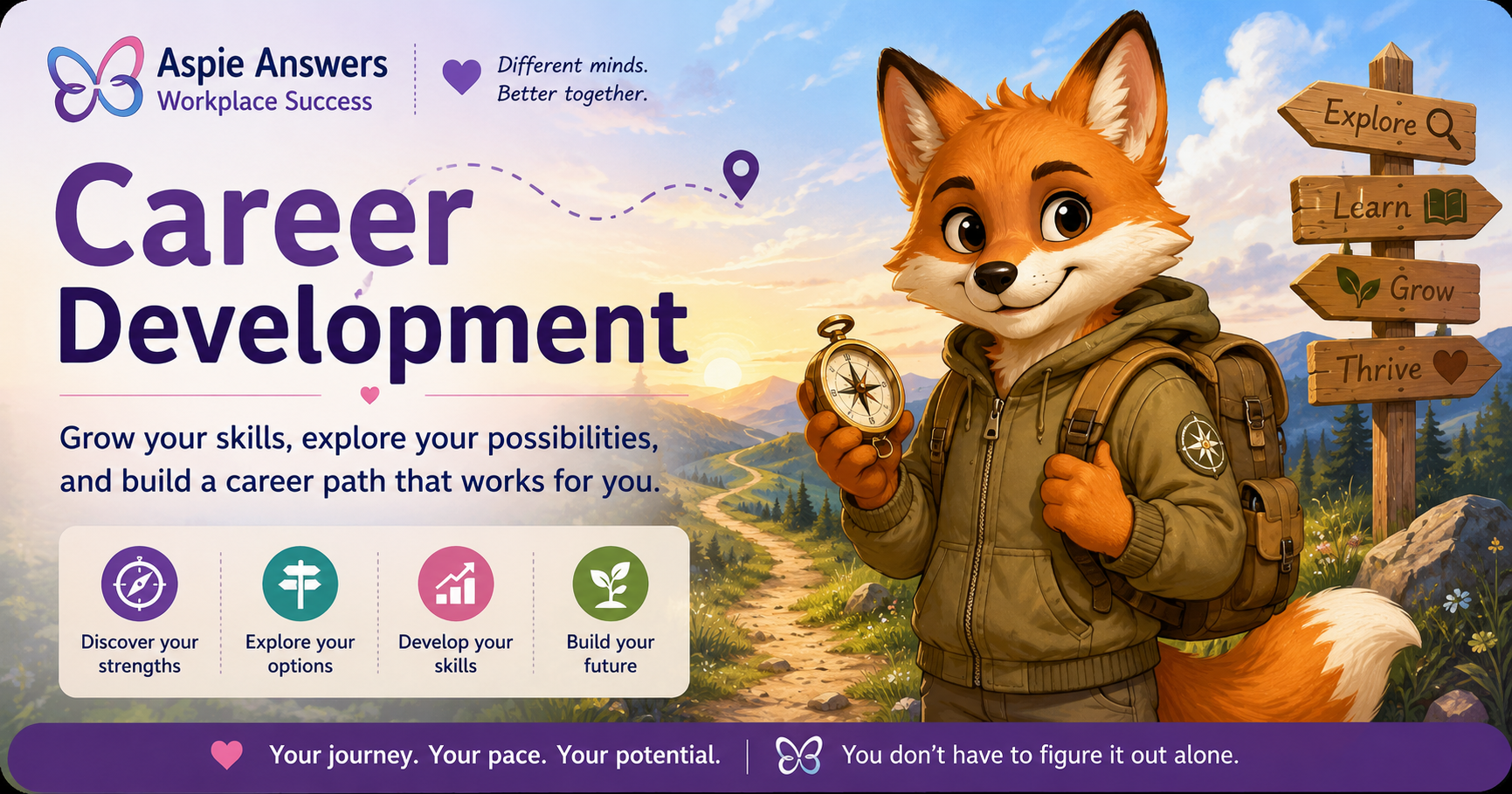
Career Development
Career development is about more than promotions or climbing a traditional career ladder. It can mean discovering your strengths, building new skills, finding work that fits you better, exploring a different direction or creating a working life that feels more sustainable and meaningful.
Your Career Path Does Not Have to Look Like Anyone Else's
There is no single correct route through working life. Some people move upwards, some move sideways, some change industries, some develop deeper expertise in one area, and others build a mix of paid work, self-employment, study or different roles over time. The useful question is not “Am I following the normal path?” but “Does this direction work for me?”
🌿 Career development should support your life — not consume it
Growth does not always mean taking on more responsibility, longer hours or greater pressure. Development can also mean improving confidence, strengthening a skill, finding better workplace conditions, learning to advocate for your needs or choosing a role that gives you more balance.
What We'll Explore Together
Career development becomes easier to approach when the journey is broken into smaller decisions and practical next steps.
Discover Your Strengths
Identify skills, experience, interests, qualities and ways of thinking that may shape your career direction.
Explore Your Options
Consider roles, pathways and possibilities without assuming there is only one correct career destination.
Develop Your Skills
Look at training, learning, mentoring, experience and practical ways to build capability over time.
Set Career Goals
Turn broad hopes into smaller, clearer goals and next steps that feel realistic.
Navigate Change
Explore career changes, setbacks, new roles and moments when the direction you once chose no longer fits.
Build a Future That Fits
Think about success in ways that include wellbeing, sustainability, values, interests and the kind of life you want around work.
What Does Career Development Really Mean?
Career development is the ongoing process of understanding yourself, building skills, exploring opportunities and making decisions about how you want work to fit into your life.
Career Development Is a Direction — Not One Fixed Destination
Your working life may include several roles, industries, learning periods, pauses, changes of direction or different definitions of success. Career development is about making informed choices as your interests, strengths, needs and circumstances change.
Career Development Can Look Like Many Things
Progress does not have to mean climbing a traditional ladder.
Moving Into More Responsibility
Taking on a new position, leadership opportunity or greater responsibility when that direction genuinely fits you.
Moving Sideways
Changing teams, specialisms or roles at a similar level to find work that better matches your strengths or interests.
Building Expertise
Developing deeper knowledge or specialist skills without needing to become a manager.
Changing Direction
Moving into another field, role or way of working when your current path no longer fits.
Developing Confidence & Independence
Becoming more comfortable with communication, decisions, new tasks or advocating for what helps you work well.
Creating Better Balance
Choosing work that supports wellbeing, sustainability and the life you want outside your job.
🌿 Redefine What Career Success Means
Career success is personal. A path that looks impressive from the outside may not be successful if it leaves no room for health, identity, relationships or life outside work.
Success does not have to mean…
- Constantly moving upward.
- Managing other people.
- Working longer and longer hours.
- Staying in one field forever.
- Following somebody else's timeline.
- Sacrificing wellbeing for status.
Success might mean…
- Work that uses your strengths.
- More financial security.
- Learning something you care about.
- Better workplace conditions.
- Greater independence.
- A sustainable level of responsibility.
- Enough energy for life outside work.
🗺️ Career Paths Are Often Less Straight Than They Look
Many careers develop through a mixture of learning, opportunities, experiments, setbacks and unexpected changes.
Learning & Training
Formal study, short courses, certificates, workplace training or self-directed learning may open different options.
Experience
Projects, volunteering, temporary responsibilities and hands-on practice can build transferable evidence.
People & Support
Mentors, managers, colleagues and professional connections may help you discover opportunities you had not considered.
Exploration
Researching roles, talking with people and trying smaller experiences can help you decide what actually fits.
Change & Redirection
Discovering that one path is not right can still provide useful information for choosing another.
Strength-Led Growth
Sometimes the next direction appears by noticing the tasks and problems you naturally do well.
♾️ Neurodivergent Career Development May Need a Wider Lens
Career decisions can be influenced by more than interests and skills. Sensory environments, communication demands, executive-function load, flexibility, predictability, energy and support may all affect whether a role is genuinely sustainable.
✏️ A Quick Career Direction Check-In
You do not need final answers. These questions simply help you notice what matters as you begin exploring your direction.
Identifying Your Strengths & Transferable Skills
Career development does not always mean starting from zero. Skills, knowledge and experience from previous jobs, volunteering, study, hobbies, caring roles and everyday life can often transfer into new opportunities.
⭐ You may already have more career evidence than you realise
When people think about career skills, they often focus only on formal job titles or qualifications. But the way you solve problems, organise information, support people, learn systems, manage responsibilities and create things can also become useful evidence for a different role.
Thinking Skills
Analysis, problem solving, pattern recognition, research, memory, creativity or making sense of complex information.
Communication Skills
Writing, explaining, listening, presenting information, customer support, teaching or communicating clearly with others.
Organisation Skills
Planning, coordinating, scheduling, documenting, tracking details or building useful systems.
Practical & Technical Skills
Equipment, software, tools, processes, hands-on knowledge or specialist technical experience.
People & Support Skills
Listening, mentoring, helping, teamwork, patience, advocacy or supporting people through difficult situations.
Personal Strengths
Reliability, persistence, honesty, curiosity, attention to detail, adaptability or commitment to doing work well.
🔄 What Makes a Skill “Transferable”?
A transferable skill is something useful in more than one role, workplace or industry.
🧭 Translate Experience Into Career Language
Sometimes the skill is already there — it simply needs describing in a way that makes its wider value visible.
→ Planning, coordination, scheduling, communication and problem solving.
→ Content management, digital skills, troubleshooting, planning, communication and self-directed learning.
→ Responsibility, communication, advocacy, organisation, patience and responding to changing needs.
→ Research, deep knowledge, persistence, attention to detail and independent learning.
→ Troubleshooting, analysis, initiative, decision-making and practical problem solving.
→ Adaptability, resilience, communication, self-management and decision-making under pressure.
🔍 Look for Evidence — Not Just Labels
A stronger strengths picture comes from connecting each skill with something you have actually done.
♾️ Neurodivergent Strengths Are Individual
Avoid replacing one stereotype with another. Not every neurodivergent person has the same strengths, and the same trait may be useful in one environment and difficult in another.
You may notice errors, patterns or information that other people miss.
Strong interests may develop into specialist expertise or valuable subject knowledge.
A different way of processing information may produce useful questions, ideas or solutions.
Certain tasks or interests may support sustained concentration and high-quality work.
Strong values around honesty, consistency or fairness can influence how you approach work.
Some people naturally notice how systems fit together or where a process could work better.
✏️ Build Your Transferable Skills Inventory
This becomes particularly useful later when researching roles, updating a CV, preparing applications or considering a career change.
Exploring Interests, Roles & Career Possibilities
You do not need to know the perfect job title before you begin exploring. Interests, strengths, preferred tasks and working conditions can provide clues that point toward several possible career directions.
🧭 Exploration is not the same as making a commitment
Researching a role, talking with someone about their work or trying a short course does not mean you have chosen that career forever. Exploration gives you information. Sometimes discovering what you do not want is just as useful as finding something that excites you.
Your Interests
What subjects, activities, problems or ideas naturally hold your attention or curiosity?
Your Strengths
Which skills and ways of thinking would you like more opportunities to use?
Your Preferred Tasks
Do you enjoy making, analysing, organising, researching, helping, writing, building, designing or solving?
Your Best Environment
Think about noise, pace, structure, social contact, location and predictability as well as the work itself.
Your Values
What do you want your work to contribute to your life, community or sense of purpose?
Your Sustainable Capacity
Consider not only whether you could perform a role, but whether its overall demands could work for you long term.
🔍 Look for Career Clues in Everyday Life
Possible directions sometimes appear in the things you already choose, notice or enjoy outside formal career planning.
🗺️ Research the Reality of a Role
A job title alone rarely tells you what daily work actually feels like. Look beyond the headline before deciding whether something may fit.
🧩 Look at Role Fit From More Than One Angle
A role can sound interesting but still be difficult in practice if the way the work is organised clashes with your needs.
Strength Fit
Does the role use skills or qualities you already have or want to develop?
Interest Fit
Is enough of the everyday work genuinely interesting to sustain motivation?
Environment Fit
Are the sensory, social and physical conditions manageable?
Cognitive Fit
How much task switching, ambiguity, working memory or rapid decision-making is involved?
Lifestyle Fit
Do the hours, commute, flexibility and recovery demands work with the rest of your life?
Values Fit
Does the work connect with things you care about or at least avoid regularly conflicting with them?
🦊 Create a Finn Fox Possibility Map
Instead of forcing yourself to pick one career immediately, build a small map of possibilities and investigate them one at a time.
Write down three to five roles or directions that make you curious.
Find out what the everyday reality of each option involves.
Look at strengths, interests, needs, training and sustainability.
Choose one or two options worth testing in a little more depth.
🌱 Test an Idea Before Making a Big Change
Where possible, smaller experiments can provide much better information than imagining an entire career from a distance.
✏️ My Career Possibility Check-In
You are exploring, not signing a lifelong contract. Curiosity is enough to begin.
Setting Career Goals & Choosing Your Next Step
A career goal does not need to map the next ten years. Sometimes the most useful goal is simply the next piece of information, skill, experience or conversation that will help you make a better decision.
🎯 Goals should create direction — not trap you in a plan
Your interests, health, opportunities, responsibilities and priorities may change. A useful career goal gives you something to work toward while still leaving room to adjust when you learn more.
Exploration Goal
Learn more about a role, industry or career direction before deciding whether to pursue it.
Learning Goal
Build a skill, qualification, certificate or area of knowledge that may open future options.
Experience Goal
Gain practical evidence through a project, volunteering, temporary responsibility or workplace opportunity.
Confidence Goal
Develop greater confidence with communication, interviews, networking, leadership or another career skill.
Progression Goal
Prepare for a promotion, specialist role, different responsibility or another opportunity within your field.
Change Goal
Prepare for a move into a different role, industry, working pattern or career direction.
🧭 Direction → Goal → Step → Review
Keep the process simple enough that you can actually use it.
What do you want to explore, improve or move toward?
What useful outcome would move you closer?
What is the smallest practical action that creates progress?
What did you learn, and does the direction still fit?
⏳ Use Flexible Time Horizons
Career planning can include different timeframes without pretending you can predict everything that will happen.
👣 Choose a Next Step That Gives You Something Useful
A good next step either creates progress or gives you better information about what to do after it.
Does it give me information?
Research, conversations and small experiments can reduce uncertainty.
Does it build a useful skill?
Even if the career direction changes, the skill may still transfer.
Does it create evidence?
A project, achievement or experience can strengthen future applications.
Is it sustainable?
A next step should fit your available time, energy and resources.
Is it specific enough?
“Work on my career” is difficult to start. “Research three courses” gives you something concrete.
Can I review afterwards?
Build in a point where you can decide whether to continue, adjust or stop.
🧱 Plan for Barriers Without Assuming the Goal Is Impossible
If a goal keeps getting stuck, the problem may be the size of the step, missing information or a practical barrier rather than lack of motivation.
📝 Turn Broad Career Wishes Into Practical Goals
You do not need perfect wording. The important part is making the next action visible.
Try: “This month I will research three roles that use more of my strengths.”
Try: “I will identify one skill that appears repeatedly in roles I am interested in.”
Try: “I will find out what skills and evidence are expected for the next-level role.”
Try: “I will compare two possible fields before deciding whether either deserves deeper exploration.”
Try: “I will practise explaining my transferable skills before my next application.”
Try: “I will make one low-pressure professional connection this month.”
✏️ My Next-Step Career Check
You do not need to solve the whole journey today. Work out what would make the next decision easier.
Skills, Learning & Professional Development
Career development often includes learning, but that does not always mean enrolling in another long qualification. Skills can grow through courses, projects, mentoring, workplace experience, practice and self-directed learning.
📚 Learn for a reason — not because you feel you should collect qualifications
Training is most useful when it connects with a real direction, skill gap or opportunity. Before investing time, money and energy, ask what the learning will help you do and whether there is a smaller route to the same outcome.
Formal Study
Degrees, diplomas, certificates or recognised qualifications may be useful when a field genuinely requires them.
Short Courses
Online or in-person courses can build a targeted skill without the time commitment of a large qualification.
Hands-On Practice
Projects and practical experience can turn knowledge into evidence that you can actually use the skill.
Mentoring
A mentor can help you understand the unwritten parts of a field and identify useful development opportunities.
Workplace Learning
New tasks, project work, shadowing, internal training and temporary responsibilities can all build useful experience.
Self-Directed Learning
Books, tutorials, practice, specialist communities and independent research can build significant expertise too.
🧭 Find the Skill Gap Before Choosing the Course
Start with what the career direction actually needs, then choose the learning route that fits.
Review roles or opportunities you are interested in.
Which skills do you already have and which ones appear repeatedly?
Choose the gap most likely to improve your options.
Pick the most suitable and sustainable way to build it.
♾️ Learn in Ways That Work With Your Brain
Professional development does not have to use one standard learning style. The format can make a major difference to how accessible the learning is.
🌱 Professional Development Can Be Bigger Than Courses
Development includes any experience that improves your ability, confidence, knowledge or future options.
📂 Build Evidence as You Learn
A skill becomes easier to use in career conversations when you can show how you have applied it.
Certificates & Training Records
Save completed course evidence where it is easy to find later.
Projects
Keep examples of work that demonstrate the skill in practice.
Positive Feedback
Save relevant comments from managers, customers, colleagues or others.
Learning Notes
Record what you learned, what you can now do and what you want to practise next.
Achievements
Keep specific examples of improvements, problems solved or milestones reached.
Transferable Examples
Note how the skill could apply outside the situation where you first learned it.
🔍 Before You Commit to Training
A quick check can prevent expensive, exhausting or unnecessary learning commitments.
✏️ My Professional Development Plan
Keep the plan small enough to use and specific enough to know what comes next.
Asking for Opportunities, Mentoring & Career Conversations
Career opportunities are not always advertised or offered automatically. Sometimes development begins by letting the right person know what you want to learn, asking about possibilities or finding someone who can help you understand the path ahead.
💬 You do not have to wait for someone to guess your career goals
Managers, colleagues and mentors may not know that you want more responsibility, specialist experience, training or a different career direction unless you tell them. A career conversation can simply make your interests visible and help you gather useful information.
Ask About Training
Find out whether workplace learning, courses or development support are available.
Ask for Project Experience
A project can let you practise a new skill without immediately changing roles.
Ask to Shadow
Observing somebody else's work may help you understand whether a role or responsibility fits.
Find a Mentor
Learn from someone who understands the field, role or career challenge you are exploring.
Ask for Development Feedback
Find out which strengths are already visible and what would help you become ready for another opportunity.
Ask About Career Paths
Learn how people normally move into the kind of role you are interested in.
🧭 Prepare a Career Conversation in Four Steps
You do not need to improvise an entire career plan in the meeting. Prepare the main points you want the other person to understand.
Explain what you are interested in exploring or developing.
Mention relevant strengths, experience or progress you already have.
Ask what opportunities, skills or next steps they would suggest.
Finish with one practical action or piece of information to follow up.
💬 Useful Career Conversation Phrases
Prepared wording can make it easier to start conversations that otherwise feel vague or intimidating.
🤝 What Can a Mentor Help With?
Mentoring does not have to be a formal programme. Sometimes it is simply a trusted person who can help you understand a field and think through decisions.
♾️ Networking Does Not Have to Mean Working a Crowded Room
Professional connection can happen in many ways. Choose methods that are useful and manageable rather than forcing yourself into a style that makes the actual career goal harder.
Networking does not have to be…
- Large events full of strangers.
- Constant small talk.
- Trying to impress everyone.
- Collecting as many contacts as possible.
- Being highly extroverted.
- Talking about yourself without a clear purpose.
Professional connection can be…
- One useful conversation.
- Emailing someone with a specific question.
- Joining a structured online group.
- Attending an interest-based professional event.
- Staying in touch with a former colleague.
- Asking someone how they entered their field.
🌱 Make Opportunity Requests Specific
“I want to develop” can be difficult for another person to act on. Specific requests create clearer possibilities.
✏️ Prepare My Next Career Conversation
Write down the answers beforehand if that makes the conversation easier.
Career Barriers, Setbacks & When Things Don't Go to Plan
Careers rarely unfold without interruptions, rejection, difficult workplaces or unexpected changes. A setback can affect confidence without becoming proof that the whole direction is wrong.
🌧️ A blocked path is information — not automatically the end of the journey
Sometimes the next step genuinely needs changing. Sometimes the barrier is practical, temporary or environmental. Before abandoning an entire career direction, it can help to work out what actually stopped progress.
Job Rejection
Not getting one role may reflect competition, timing, fit or another factor rather than your entire career potential.
Missing Skills or Qualifications
A gap may become a development plan rather than a permanent barrier.
Financial Barriers
Training costs, lower starting pay or limited resources can affect the pace and route of career development.
Energy & Capacity
A career goal may need a slower pace, different structure or more sustainable pathway.
Poor Workplace Fit
Struggling in one environment does not automatically mean the entire occupation is wrong for you.
Changing Priorities
Sometimes your values, interests or circumstances change and the old goal genuinely stops fitting.
🧭 Pause → Understand → Adjust → Continue
When something goes wrong, try understanding the barrier before deciding what it means about your future.
Give disappointment or frustration some room before making a major decision.
Identify the actual barrier rather than turning it into a judgement about yourself.
Change the step, support, timeline, strategy or direction where needed.
Choose the next useful action — even if it is different from the original plan.
🌱 Separate the Setback From the Story Around It
Disappointment is real. But the first explanation your brain creates is not always the fairest one.
🧩 Is It the Career — or the Conditions?
This can be an important question when neurodivergent workers have the skills for a role but struggle with the environment around it.
🚪 After a Job or Opportunity Rejection
Rejection can hurt even when you understand logically that there were many possible reasons.
Let the disappointment be real
You do not need to immediately turn rejection into a positive lesson.
Look for useful information
If appropriate feedback is available, use the specific parts you can act on.
Keep the evidence you built
Preparation, applications, interviews and portfolio work still developed useful skills.
Decide what comes next
Apply again, strengthen one area, explore another option or take time before deciding.
🤝 You Do Not Have to Solve Every Barrier Alone
Some obstacles become easier when another person can offer information, perspective, advocacy or practical support.
Break the barrier down and identify which part can actually be changed.
Get another perspective before deciding that one setback means everything.
Where relevant, discuss training, adjustments, workload or other barriers.
Turn a genuine skill gap into a targeted development plan.
A careers adviser or appropriate service may help identify alternative routes.
Sometimes the next career action is giving yourself enough space to recover first.
✏️ My Career Setback Reset
Use these questions before deciding whether to retry, adjust or choose a different direction.
Changing Career Direction & Starting Again
Careers can change because you discover new interests, your circumstances change, a workplace no longer fits, or you understand your needs better than you did before. Changing direction does not erase everything you have already learned.
🌱 Starting differently is not the same as starting from nothing
Previous jobs, education, volunteering, projects and life experience can leave you with knowledge and transferable skills that travel with you. Career change is often about identifying what you want to carry forward, what you want to leave behind and what you need to learn next.
Your Interests Changed
A field that once suited you may no longer match what you want from your working life.
You Understand Yourself Better
Greater awareness of your strengths, needs and working style may change what a good career fit looks like.
Your Capacity Changed
Energy, responsibilities or other circumstances can make a different type or pace of work more sustainable.
The Industry Changed
Technology, employment conditions and available opportunities can alter the career landscape.
You Want Better Fit
You may want work that better matches your values, sensory needs, preferred structure or lifestyle.
A New Opportunity Appeared
Sometimes career change begins because you discover a path you had not previously considered.
🦊 Explore → Translate → Test → Transition
Career change does not always require one enormous leap. You can gather evidence before deciding how far you want to move.
Research possible directions before assuming you need to commit.
Identify how your existing experience applies in the new direction.
Try small experiences, conversations or learning before making a major change.
Build a realistic route from where you are now to where you want to go.
🔄 What Can You Carry Into a New Career?
Job titles may change while many underlying abilities remain valuable. Look beneath the title of your previous role and identify what you actually learned to do.
🌄 You May Be New to the Field — But Not New to Working Life
Career changers often underestimate how much experience they bring with them because it was gained somewhere else.
You bring knowledge
Previous roles have taught you how workplaces, customers, systems or projects function.
You bring skills
Many practical and transferable skills remain useful even when the industry changes.
You bring self-knowledge
You may understand your needs, strengths and preferred working conditions much better now.
You bring evidence
Achievements from another field can still demonstrate reliability, learning, initiative and problem solving.
🧪 Test a Direction Before Making a Big Leap
Where possible, create small experiments that give you real information about a new career before investing heavily in the transition.
🌱 Returning to Work Is Also a Career Transition
Returning after time away may involve rebuilding confidence, updating skills and working out what kind of role fits your life now. A gap does not remove the experience you had before it.
✏️ My Career Change Map
You do not need every answer yet. Use these questions to identify what you already know and what needs exploring next.
💜 You Are Allowed to Change Your Mind
A career choice made years ago does not have to remain the right choice forever. Learning that something no longer fits is still useful information. You can keep the parts of your experience that matter, leave behind what no longer works, and build something different from what you once expected.
Create Your Personal Career Development Plan
A career development plan can bring your strengths, priorities, goals, learning, opportunities and support into one place. It does not need to predict your entire future — it simply helps make your current direction and next steps easier to see.
🧭 Your plan is a working map, not a contract
Career plans should be allowed to change when you learn something new. The purpose is to reduce uncertainty and make useful actions visible — not to force yourself to continue toward a goal that no longer fits.
My Strengths
What abilities, qualities, experience and transferable skills do you want to carry forward?
My Priorities
What do you need from work in terms of income, wellbeing, stability, purpose, flexibility or lifestyle?
My Direction
Which roles, industries or types of work currently seem worth exploring?
My Development
Which skills, knowledge or experiences would strengthen your options?
My Support
Who or what could help with information, mentoring, learning, accountability or practical barriers?
My Next Step
What is one realistic action that moves the journey forward without requiring every answer first?
📝 My Career Development Map
Use these prompts as a working plan. They can later become a printable Aspie Answers Career Development worksheet.
🎯 Decide What Matters Most Right Now
Career plans can become overwhelming when every goal is treated as equally urgent. Choose the priority that is most useful for your current stage.
🤝 Add Support to the Plan Before You Need It
Career development is easier when you know where to look for help, information and perspective.
🔄 Review the Map as the Landscape Changes
A career development plan becomes more useful when it is revisited rather than written once and forgotten.
What progress have I made?
Notice skills, information, confidence and experiences gained since the last review.
What have I learned?
Has new information changed how attractive or realistic an option feels?
Does the direction still fit?
You are allowed to continue, adjust or explore somewhere else.
Is the pace sustainable?
Career development does not need to consume all available energy.
Has a new barrier appeared?
Add the barrier to the plan rather than treating it as invisible.
What is my next useful step?
Finish each review with one clear action or decision.
📋 Keep a One-Page Career Snapshot
When there are lots of ideas, courses, opportunities and tasks, a short summary can keep the important information visible.
Companion Support for Your Career Journey
Career development can involve direction, learning, change and a lot of decisions along the way. Different companions can support different parts of that journey.
Finn Fox V2 Career Artwork
Khaki jacket • backpack • compass
🦊 Finn Fox
Finn Fox supports problem solving, flexible thinking and independence. Those strengths make him a natural guide for career development: exploring options, comparing different routes, working through barriers and deciding what practical step may help next.
Finn does not expect you to have one perfect career map. His approach is to gather clues, understand the situation and adjust the route when new information appears.
You do not need to see the whole trail before you begin. Find the next useful marker, gather information as you go and change direction when the evidence tells you another route may fit better.
Finn Is Supported by Olive Owl & Flutter Butterfly
Career development is not only about choosing a direction. It can also involve learning new skills and growing through periods of change.
Olive Owl V2 Artwork
Learning • Study • Skill Development
🦉 Olive Owl
Learning • Study • MotivationOlive Owl supports the learning side of career development. He can help when you are building a new skill, researching training, developing knowledge or working out how to make professional learning more manageable.
Flutter Butterfly V2 Artwork
Growth • Change • New Beginnings
🦋 Flutter Butterfly
Growth • Change • New BeginningsFlutter supports the parts of a career journey that involve change: trying a new direction, beginning again, recognising growth and allowing your idea of career success to evolve with you.
🧭 Three Companions — Three Parts of Career Development
Your needs may change depending on which part of the career journey you are working through.
💜 Which Companion Might Help Right Now?
There is no need to use every approach at once. Start with the part of your career journey that needs attention now.
Career Development Resources & FAQs
Career development can involve a lot of information, decisions and possible directions. A small collection of reusable tools can make it easier to organise what you know and decide what deserves your attention next.
🧰 Build a career toolkit — not another pile of pressure
You do not need every worksheet, course or career strategy at once. Choose the resource that matches the part of the journey you are currently working on: exploring, planning, learning, applying, changing direction or reviewing what fits.
⚡ Your Quick Career Development Toolkit
These six tools can support many of the decisions explored throughout this page.
Strengths Inventory
Keep a record of skills, experience, qualities and transferable strengths you can carry between opportunities.
Career Possibility Map
Compare several directions without forcing yourself to choose one immediately.
Next-Step Planner
Turn a broad career goal into one specific action you can realistically begin.
Skill Development Plan
Identify the skill, why it matters, how you will learn it and where you can practise it.
Career Conversation Planner
Prepare questions, evidence and requests before speaking with a manager, mentor or professional contact.
Career Development Map
Bring priorities, direction, learning, support and next steps together in one place.
📚 Career Development Resources We Can Build Around This Page
These are natural companion resources for the wider Aspie Answers Work & Employment collection.
Identify strengths, evidence and transferable abilities across work, education and everyday experience.
Compare possible roles by interests, strengths, working conditions, training and sustainability.
Turn broad career hopes into smaller, practical actions and review points.
Plan training, skills, practice and evidence without overloading the development journey.
Prepare for mentoring, development conversations and requests for new opportunities.
Explore what to keep, what to leave, what needs learning and how to test another direction.
Compare tasks, environment, communication, energy, values and lifestyle alongside job titles.
Create a reusable overview of current direction, priorities, support, evidence and next steps.
🦊 Finn's 4-Step Career Direction Reset
When the career journey becomes confusing, return to four simple questions.
What is happening in my career right now?
Which need, goal or priority is most important at this stage?
Information, skill, experience, support or recovery?
Choose one realistic action instead of solving everything at once.
❓ Career Development — Frequently Asked Questions
Click a question below to open the answer.
Do I need to know exactly what career I want?
No. Career exploration can begin with interests, strengths, preferred working conditions and possibilities. You can gather information before choosing a specific destination.
Is career development only about promotion?
No. Career development can include building expertise, learning a skill, moving sideways, improving working conditions, becoming more independent, changing career direction or finding a more sustainable role.
What if I don't want to become a manager?
Management is only one form of progression. Specialist, technical, creative, advisory and other pathways may allow you to deepen expertise without managing people.
How do I know whether I need another qualification?
Check real roles first. Identify whether the qualification is genuinely required or whether a shorter course, project, experience or demonstrated skill could meet the same development need.
What if my interests change often?
Look for patterns beneath the specific interests. You may repeatedly enjoy researching, designing, solving, organising, helping, creating or learning even when the subject changes.
Is it too late to change careers?
Career changes can happen at many stages of working life. The practical route will depend on finances, training, responsibilities, available opportunities and your circumstances, but previous experience does not automatically become useless when the field changes.
What if I have gaps in my employment history?
A gap does not remove the skills and experience you already have. Focus on what remains relevant, what you have learned since, and any current evidence you can build through training, projects, volunteering or other suitable experience.
How can I develop my career if networking is difficult?
Networking can be one-to-one, written, online, structured or based around a shared professional interest. You do not need to rely on large social events to make useful professional connections.
What if I am capable of a role but the workplace environment is difficult?
Separate the core role from the conditions around it. Sensory demands, workload, communication, culture, schedule and management style can affect whether a role is sustainable even when you have the necessary skills.
How often should I review my career plan?
There is no single required schedule. Review it when you reach an important milestone, gain new information, encounter a barrier or notice that your priorities or circumstances have changed.
💜 Keep These Career Reminders Nearby
Continue Your Career & Workplace Journey
Career development does not finish when you choose a goal. Work, opportunities and your own priorities can keep changing. Use what you have learned here as a starting point for exploring the next part of your working life.
Explore More Workplace Support
Choose the area that best matches what you need next — whether that is confidence, communication, wellbeing, productivity or support with workplace demands.
Confidence at Work
Build workplace confidence through strengths, preparation, self-advocacy and small wins.
Explore Confidence at WorkWorkplace Communication
Explore meetings, clarification, written communication, processing time and practical workplace conversations.
Explore CommunicationWorkplace Wellbeing
Explore sustainable working, energy, sensory needs, recovery and maintaining wellbeing alongside employment.
Explore Workplace WellbeingBurnout Prevention at Work
Build awareness around capacity, overload, pacing, recovery and sustainable workplace expectations.
Explore Burnout PreventionWorkplace Productivity
Explore practical systems for priorities, tasks, routines and making progress without relying only on pressure.
Explore ProductivityExecutive Function at Work
Find support for starting, organising, remembering, prioritising, switching tasks and managing working memory demands.
Explore Executive Function🧭 Keep the Career Journey Flexible
You do not have to finish this page with your whole future decided. A useful outcome may simply be knowing what deserves your attention next.
Keep recognising the skills, experience and strengths already in your backpack.
Explore possibilities before forcing yourself into a permanent answer.
Focus on the next useful action rather than the entire career route.
Change the map when new information, priorities or opportunities appear.
💼 Return to the Work & Employment Hub
The wider Work & Employment Hub brings together workplace support, career planning, communication, wellbeing, employment tools and practical neurodivergent-friendly guidance.
💜 Your Career Development Team Is Still With You
Different parts of the journey may call for different kinds of support.
Gather the clues, understand your options and find the next practical step.
Build the knowledge and skills that genuinely help with the direction you want to explore.
Growth can include changing your mind, beginning again and choosing a different version of success.