
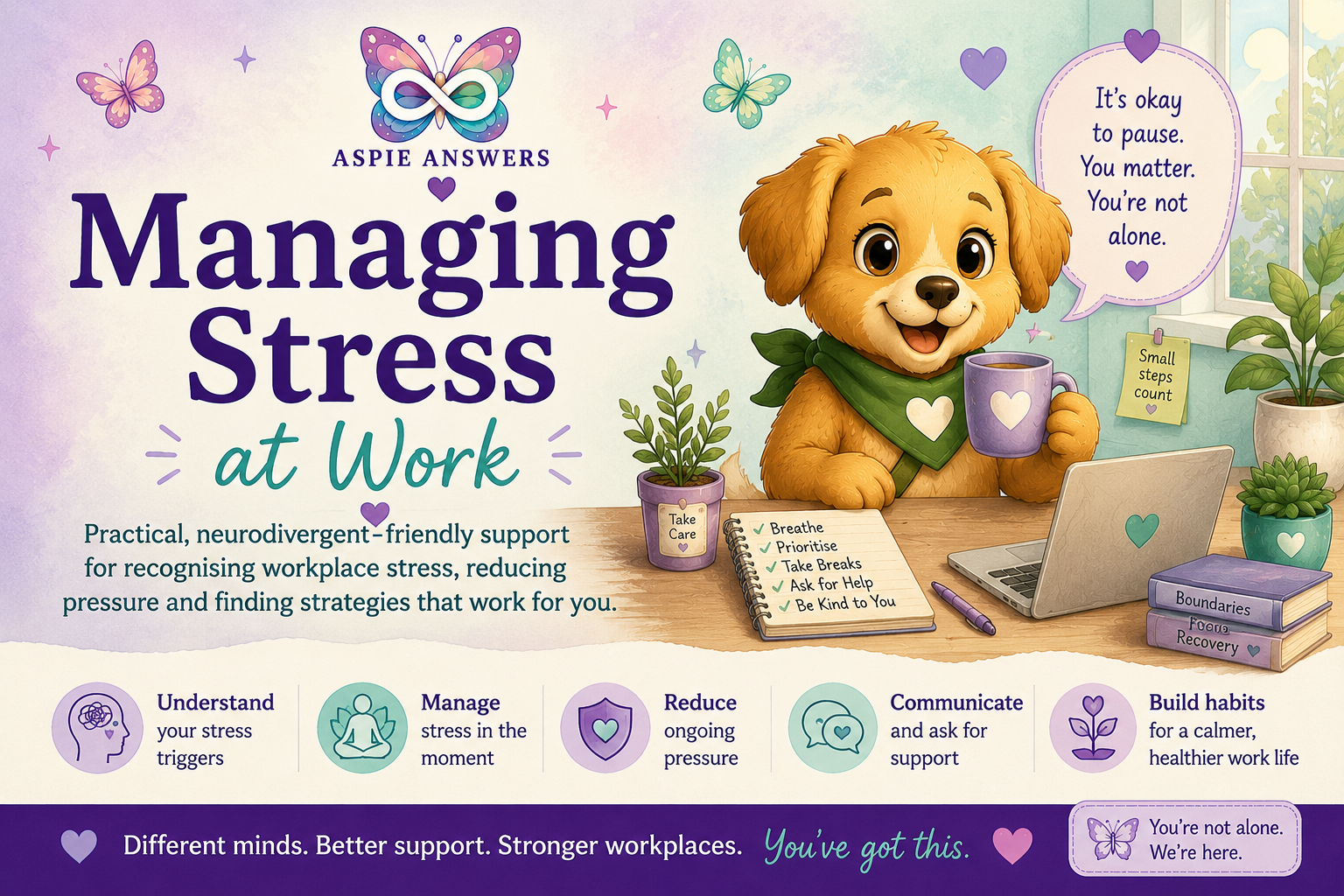
Managing Stress at Work
Work can bring deadlines, changing expectations, sensory demands, social pressure, interruptions and a lot to keep track of at once. When those demands build up, stress can quickly affect your energy, concentration, confidence and wellbeing.
Managing workplace stress isn't about forcing yourself to cope with everything. It's about recognising what creates pressure for you, understanding your limits, and finding practical strategies that make work more manageable.
On this page, we'll explore ways to recognise your stress signals, respond when pressure starts building, reduce unnecessary demands, communicate your needs and create healthier working habits.
You don't have to wait until you're completely overwhelmed. Taking a break, asking for clarification, adjusting a task or seeking support can all be sensible ways of looking after yourself at work.
A little reminder from Scout: You are allowed to pause. You are allowed to need support. And you don't have to handle every stressful workday by yourself. Small changes can make a meaningful difference.
What Does Workplace Stress Look Like?
Stress can show up differently for everyone. Understanding what creates pressure for you — and noticing your early warning signs — can make it easier to respond before everything becomes too much.
Stress Isn't Just About Being Busy
Workplace stress can happen when the demands being placed on you feel greater than the time, energy, information, support or resources you have available.
For neurodivergent people, pressure may also come from sensory environments, unclear instructions, unexpected changes, social expectations, executive functioning demands or having to constantly adapt to a workplace that isn't designed around how you work best.
Something that seems small to someone else can still use a significant amount of your energy. Your experience of stress is worth paying attention to.
Scout's Reminder
You don't need to compare your stress with somebody else's. What matters is recognising what your own mind and body are telling you and finding support that works for you.
Common Sources of Workplace Stress
There may be one obvious cause, or several smaller pressures building up together.
Workload & Deadlines
Too many tasks, competing priorities, unrealistic deadlines or not having enough recovery time between demands.
Sensory Demands
Noise, lighting, smells, movement, crowded spaces, uncomfortable temperatures or constant interruptions.
Communication Pressure
Unclear instructions, difficult conversations, meetings, phone calls or uncertainty about what somebody expects.
Unexpected Change
Sudden schedule changes, new responsibilities, last-minute requests or plans changing without enough time to adjust.
Executive Function Demands
Planning, prioritising, remembering instructions, switching between tasks or deciding where to begin.
Social & Workplace Expectations
Navigating workplace relationships, masking, interpreting unwritten rules or feeling pressure to appear okay when you're struggling.
Signs Your Stress May Be Building
Learning your early warning signs can give you an opportunity to respond sooner rather than waiting until you've reached your limit.
💜 Remember: noticing these signs doesn't mean you've failed at coping. They can be useful signals that something needs attention — perhaps a pause, clearer priorities, less stimulation, additional support or a change in workload.
Recognising Your Personal Stress Triggers
Once you start noticing what tends to increase your stress, you can begin looking for patterns. That can help you plan ahead, make adjustments and respond earlier when pressure starts to build.
Stress Can Have Patterns
You may notice that particular tasks, environments, times of day, people or situations regularly leave you feeling more overwhelmed or depleted. Identifying those patterns can give you useful information about what you need.
Awareness Gives You Options
Knowing your triggers doesn't mean you can remove every stressful situation. It can, however, help you prepare, reduce unnecessary demands, ask for support and choose strategies before your stress reaches its highest point.
What Might Be Increasing Your Stress?
Think about whether any of these areas regularly make your working day harder or use more energy than you expect.
Workload
The amount or complexity of work you're expected to manage.
- Too many tasks at once
- Unrealistic deadlines
- Competing priorities
- Not knowing what to do first
Work Environment
Sensory or physical aspects of the workplace.
- Noise and conversations
- Bright or flickering lights
- Busy shared spaces
- Frequent interruptions
Communication
Situations where information or expectations aren't clear.
- Vague instructions
- Unexpected phone calls
- Difficult conversations
- Too many meetings
Change & Uncertainty
Situations where you don't have enough time or information to prepare.
- Schedule changes
- New responsibilities
- Last-minute requests
- Unclear future plans
Social Demands
The energy required to navigate workplace relationships and expectations.
- Group discussions
- Office small talk
- Conflict or tension
- Masking throughout the day
Energy & Recovery
Stress can rise when your available energy is already running low.
- Working without enough breaks
- Long or demanding days
- Too little recovery time
- Repeated high-pressure days
💜 Pause & Notice
You don't need to answer these perfectly. Simply noticing what comes to mind can help you understand your own workplace stress pattern.
Which parts of my working day usually use the most energy?
Are there particular tasks or situations I regularly dread or feel overwhelmed by?
When during the day do I usually notice my stress starting to increase?
Are sensory demands, interruptions or social expectations adding extra pressure?
What tends to happen just before I become overwhelmed or shut down?
What changes have helped make difficult workdays easier in the past?
Try the Notice → Name → Need → Next Step Method
When stress begins building, this simple four-step check-in can help you work out what is happening and what might help.
What am I feeling or experiencing right now?
What seems to be creating the pressure?
What would make this situation more manageable?
What is one small action I can take now?
Scout says: You don't have to solve everything at once. Sometimes simply recognising “this is what's making today difficult” is an important first step toward finding something that helps.
What to Do When Stress Is Rising
When stress is increasing, the goal is not always to solve the whole situation immediately. Sometimes the most useful first step is to reduce the pressure enough to think more clearly about what needs to happen next.
🌿 First: make the next few minutes easier
If your mind is overloaded, asking yourself to instantly plan the entire day can add even more pressure. Start with one small action that lowers demand, gives you space or helps you reconnect with what matters most.
Pause Briefly
Stop adding new demands for a moment. A short pause can give your brain time to catch up before deciding what comes next.
Reduce Input
Lower unnecessary noise, notifications, conversation or visual input where your workplace and role allow.
Get It Out of Your Head
Write down the tasks, questions or worries you are trying to remember so working memory does not have to hold everything at once.
Choose One Priority
Ask what genuinely matters most right now instead of treating every demand as equally urgent.
Check Basic Needs
Hunger, thirst, pain, temperature, posture or needing a break can make workplace stress feel much harder to manage.
Tell Someone Early
If the pressure cannot be solved alone, asking for clarification or support earlier may create more options.
🌱 Try a Four-Step Stress Reset
This can be used when your thoughts are becoming scattered and you need a simple route back to the next manageable action.
🌿 Gentle Grounding During the Workday
Grounding does not need to be obvious or complicated. Small physical or sensory cues can sometimes help you reconnect with the present moment.
🚩 When stress is high, try not to…
- Keep adding new tasks without checking priorities.
- Force yourself through avoidable sensory overload.
- Assume every message requires an immediate response.
- Skip every break in an attempt to catch up.
- Make several major decisions at once if they can wait.
- Judge yourself for finding the situation difficult.
🌱 Instead, try to…
- Reduce the number of active priorities.
- Clarify what genuinely needs to happen now.
- Use written notes rather than memory alone.
- Take an appropriate short regulation break.
- Ask for support when the demand exceeds what you can manage.
- Focus on the next workable step.
💬 Useful Phrases When You Need a Moment
Prepared wording can help when stress makes it harder to find the right words quickly.
Sensory & Neurodivergent Stress at Work
Stress at work is not always caused by workload alone. Sensory demands, masking, transitions, communication, social expectations and executive function can all add extra pressure to the working day.
🧠 Sometimes the hardest part of the job is everything around the job
You may be capable of doing the actual task while still using a large amount of energy coping with the environment, remembering instructions, switching attention, reading social cues or trying to appear unaffected by stress.
Sensory Load
Noise, lighting, movement, smells, temperature and physical discomfort can steadily increase stress even when the work itself is manageable.
Masking
Monitoring your behaviour, facial expression, voice or natural regulation needs may use significant energy across the day.
Transitions & Change
Unexpected changes, interruptions and moving quickly between different tasks can make stress rise faster.
Executive Function
Planning, remembering, prioritising, task initiation and switching can add invisible mental effort to everyday work.
Communication Processing
Rapid verbal information, unclear expectations or having to respond immediately can increase cognitive and emotional pressure.
Social Demand
Meetings, teamwork, customer interaction, small talk and interpreting unwritten rules may use more energy than other people realise.
🔍 Notice the Hidden Workload
Some workplace demands use energy without appearing on your formal task list.
🎭 When Masking Adds to Workplace Stress
Masking can look different from person to person. You may not even notice you are doing it until you see how exhausted you feel once you leave work.
🌿 Reduce Unnecessary Neurodivergent Stress
Not every source of stress can be removed, but some demands can become easier when the environment, communication or routine changes.
Use Written Information
Written instructions, priorities or follow-up notes may reduce working-memory and communication pressure.
Reduce Sensory Input
Where appropriate, quieter areas, lighting changes or sensory supports may reduce the amount of energy used by the environment.
Create Predictability
Advance notice, clear schedules and visible routines may make changes easier to prepare for.
Protect Regulation Breaks
Brief quiet, movement or sensory resets may help prevent pressure building continuously across the day.
Slow Communication Down
Ask for time to process, clarification or a written summary when rapid verbal information becomes difficult.
Allow More Authentic Regulation
Where safe and appropriate, using natural regulation strategies may reduce the energy spent hiding them.
🚩 Signs neurodivergent stress may be building
- Sensory input feels increasingly difficult to tolerate.
- Communication requires more processing time than usual.
- Task switching becomes much harder.
- You feel pressure to hide how overwhelmed you are.
- Social contact leaves you significantly depleted.
- You need much longer recovery after work.
🌱 Things that may help
- Reduce one sensory or social demand.
- Move key information into writing.
- Use a predictable next-step plan.
- Protect quiet or regulation time where possible.
- Ask for clarification rather than guessing.
- Discuss workplace adjustments if the same barriers continue.
Reducing Ongoing Workplace Stress
If the same sources of stress keep appearing, it may help to change the system around the work rather than relying only on coping strategies in the moment.
🌿 A recurring stressor deserves a recurring solution
If every Monday, every deadline, every team meeting or every noisy shift creates the same problem, that pattern can give you clues about where a practical change may help most.
Clarify Priorities
Clearer priorities can reduce the pressure of trying to treat every task as equally urgent.
Create More Predictability
Visible schedules, advance notice and regular routines may reduce stress caused by uncertainty.
Reduce Interruptions
Protecting some uninterrupted work time can lower the repeated mental cost of stopping and restarting.
Externalise Information
Checklists, written instructions and task systems can reduce the stress of trying to remember everything.
Reduce Sensory Load
Appropriate changes to noise, lighting, workspace or timing may reduce stress before it builds.
Protect Recovery
Stress becomes harder to manage when breaks, evenings or weekends are repeatedly consumed by recovery.
🔍 Try a Workplace Stress Audit
Look at what repeatedly makes work harder, then ask whether the source can be removed, reduced, planned for or supported differently.
🌱 Use Predictable Routines to Lower Mental Load
A few dependable routines can remove repeated decisions and make the workday easier to navigate.
Start-of-Day Check
Review today's appointments, top priorities and anything that has changed before jumping into the first task.
One Main Task System
Keep work in a reliable place instead of carrying tasks across memory, sticky notes and several different apps.
Regular Recovery Points
Build short pauses into the day before you are already completely depleted.
End-of-Day Closure
Capture unfinished work, identify tomorrow's starting point and create a clearer transition away from work.
🚩 Stress often keeps building when…
- New work is added without existing priorities changing.
- Important information arrives through too many channels.
- You are interrupted throughout focused tasks.
- Breaks are regularly sacrificed to catch up.
- Changes arrive with little warning.
- The same sensory or communication barriers continue every day.
🌱 Consider changing…
- How priorities are agreed.
- Where tasks and instructions are recorded.
- When focused work happens.
- How changes are communicated.
- Where and when breaks happen.
- Which workplace supports are being used.
📅 A Simple Weekly Stress Reset
A short review can help prevent the same difficulties quietly carrying forward from one week to the next.
What created the most stress this week?
What support or strategy genuinely helped?
What could be made simpler or clearer next week?
What is one practical change you want to try?
Workload, Priorities & Healthy Boundaries
Stress can rise quickly when more and more work is added without anything else changing. Clear priorities and healthy boundaries can help make the workload more realistic and easier to understand.
🛡️ “Not all at once” can be a healthy workplace boundary
You may be able to complete many different tasks — but that does not mean every task can happen at the same time. A realistic workload needs priorities, available time and enough room for interruptions, breaks and unexpected work.
Priority Clarity
Knowing what matters first can reduce the stress of trying to decide between several competing demands.
Realistic Time
Deadlines need to reflect the actual amount of work and the time available to complete it.
Visible Workload
A clear task list can make it easier to show when new work is being added to an already full schedule.
Protected Breaks
Regularly sacrificing breaks may temporarily create more work time, but it can increase stress and reduce recovery.
Availability Boundaries
Clear expectations around messages, interruptions and response times can reduce the pressure to be available continuously.
End-of-Work Boundaries
Work stress can continue building when unfinished tasks and messages repeatedly follow you into recovery time.
🌿 Try Three Simple Priority Levels
When everything looks important, grouping tasks into broader levels can make the workload easier to see.
Time-sensitive or high-consequence work that genuinely needs current attention.
Work that matters but does not need to compete with the current top priority.
Lower-priority work that can safely move if the workload becomes too full.
🔍 Where Might the Workload Need a Boundary?
Repeated stress can be a clue that the current expectation needs to be clarified or renegotiated.
🚩 Signs the workload may be becoming unrealistic
- You never reach the end of the urgent list.
- Every new task feels like another crisis.
- You are routinely staying late to complete normal work.
- Breaks disappear whenever the workload increases.
- You are making more mistakes because you are rushing.
- You spend most of your recovery time worrying about unfinished work.
🌱 Useful responses may include
- Make the whole workload visible.
- Ask which tasks genuinely have priority.
- Negotiate deadlines when the available time does not fit.
- Pause before automatically accepting additional work.
- Protect breaks and focused work periods where possible.
- Raise workload concerns before overload becomes severe.
💬 Useful Workload & Boundary Phrases
Prepared wording can make it easier to talk about capacity without feeling you have to justify every detail.
Communication & Asking for Support
Stress can become harder to manage when you are unsure how to explain what is happening. Clear, practical communication can help other people understand the barrier and what may make work more manageable.
💬 You don't need the perfect explanation
You may not know exactly why something is difficult yet. Sometimes it is enough to describe what is happening, how it is affecting your work, and what practical support you think might help.
Clarification
Ask for clearer expectations, priorities, deadlines or instructions when uncertainty is adding stress.
Written Information
Written instructions or summaries may reduce memory pressure and make information easier to revisit.
Workload Review
Ask to review priorities when the volume of work is exceeding the time or capacity available.
Sensory Support
Discuss practical changes if the environment itself is repeatedly increasing stress.
More Predictability
Advance notice, scheduled check-ins or clearer routines may reduce stress caused by unexpected change.
Recovery Support
If stress is building because breaks or recovery are disappearing, discuss how the current work pattern can be made more sustainable.
🌿 Try: Barrier → Impact → Support → Review
This four-step structure can make a workplace conversation easier to prepare.
👥 Who Might You Speak With?
The right person depends on your workplace and what kind of support you need.
Manager or Supervisor
Often the first person for workload, priorities, deadlines, communication and everyday practical changes.
Human Resources
May help with formal workplace processes, adjustments, policies or wellbeing support.
Workplace Wellbeing Support
Some organisations have wellbeing teams, employee assistance or occupational support services.
Union or Employee Representative
May help you prepare for workplace conversations or understand employment processes.
Health & Safety
May be relevant when environmental or workplace conditions are affecting wellbeing or safe working.
Health Professional
May be appropriate when work stress is significantly affecting your health, functioning or recovery.
📝 Prepare Before the Conversation
If stress makes it harder to think or speak clearly in the moment, a few notes beforehand can help.
💬 Useful Phrases for Asking for Support
You can adapt these to suit your workplace and your own communication style.
📋 Keep Track of What Was Discussed
When workplace stress continues over time, a simple record can make it easier to remember what has been raised and what support has already been tried.
Build Your Personal Workplace Stress Plan
A personal stress plan can help you recognise what is happening sooner, remember what usually helps and know what to do when thinking clearly becomes harder.
🌿 Make the plan before you desperately need the plan
When stress is already very high, it can be difficult to remember every strategy, workplace contact or support option. A simple written plan gives you something concrete to return to.
My Main Triggers
Identify the situations, demands or environments that most often increase your workplace stress.
My Early Warning Signs
Record how stress first shows up for you before you reach your highest level of overload.
My Quick Supports
List the short strategies that help reduce pressure during the workday.
People I Can Contact
Know who you can approach for workload, wellbeing, communication or practical workplace support.
My Recovery Needs
Identify what helps you regulate and recover during and after demanding periods.
What Needs Reviewing
Record which repeated workplace stressors may need a larger change rather than another temporary coping strategy.
📝 Your Workplace Stress Plan
You can use these prompts as the basis for a worksheet, note, document or future Aspie Answers printable.
🚦 Create a Simple Green → Amber → Red Plan
A traffic-light system can make it easier to recognise different levels of workplace stress and respond before everything reaches the highest level.
🟢 Green — Managing Okay
Stress is present but feels manageable.
- Keep normal routines and breaks.
- Use your usual task and sensory supports.
- Notice any new pressures early.
🟠 Amber — Stress Is Building
Concentration, sensory tolerance or energy is beginning to change.
- Reduce avoidable demands.
- Clarify priorities.
- Use regulation or recovery strategies.
- Ask for support if needed.
🔴 Red — Overloaded
Your current capacity may be significantly reduced.
- Pause non-essential demands where possible.
- Move toward a safer or calmer environment.
- Contact the appropriate support person.
- Focus on immediate wellbeing and necessary next steps.
🤝 Decide Who Is Part of Your Support Plan
It can help to know in advance who you would contact rather than trying to work that out while already overwhelmed.
🔄 Review the Plan When Things Change
A stress plan does not need to stay exactly the same forever. Your job, environment, workload and support needs may change over time.
When Workplace Stress Is Becoming Too Much
Stress may need more attention when it stops being a temporary response to a difficult day and starts affecting your ability to recover, concentrate, regulate or manage life outside work.
💜 You don't have to wait until you completely run out of capacity
If the same pressure keeps returning, your recovery is taking longer or your usual coping strategies are no longer enough, that can be useful information that something larger needs to change.
Persistent Exhaustion
You may start the day already depleted or feel as though normal work is requiring much more energy than it used to.
Thinking Becomes Harder
Concentration, planning, memory, decisions or communication may become increasingly difficult.
Sensory Tolerance Drops
Noise, lighting, movement or other sensory input may become much harder to tolerate than usual.
Emotions Feel Harder to Regulate
Anxiety, irritability, frustration, shutdown or overwhelm may happen more easily.
Life Outside Work Shrinks
Evenings and weekends may increasingly be used just to recover enough to return to work.
Recovery Stops Resetting You
A normal break, evening or weekend may no longer bring you back to your usual level of functioning.
🔍 Is the Current Work Pattern Still Sustainable?
These questions can help you notice whether stress has become a repeated pattern that needs a bigger response.
🌿 When More Than a Quick Stress Strategy Is Needed
If stress is continuing or worsening, the next step may need to involve the work itself rather than simply adding more coping techniques.
Review the Workload
Look at whether the amount, pace or complexity of work needs to change.
Reduce Repeated Barriers
Sensory, communication or interruption demands may need practical changes.
Increase Recovery
Breaks, reduced demands, leave or other recovery time may need more priority.
Use Workplace Support
Speak with the appropriate manager, workplace contact or other support person about what is changing.
Document the Pattern
Record repeated stressors, their impact and any support already tried.
Seek Appropriate Health Support
Significant or persistent changes in wellbeing may also be worth discussing with an appropriate health professional.
🚩 Patterns worth taking seriously
- You are unable to recover properly between workdays.
- Your stress level is gradually increasing rather than settling.
- You are losing capacity for normal everyday activities.
- You are regularly pushing through strong overload signals.
- Your ability to work is declining despite trying harder.
- The same workplace conditions keep recreating the problem.
🌱 Possible next steps
- Reduce or reprioritise demands.
- Protect genuine recovery time.
- Discuss practical workplace changes.
- Use appropriate leave or support where available.
- Review whether the current pace can continue.
- Seek further support when stress is significantly affecting you.
🐢 Toby Turtle's Sustainability Check
Toby's role here is to help you look beyond one difficult day and ask whether the overall pattern is giving you enough chance to recover.
💬 When You Need to Say the Current Pattern Isn't Working
You do not need to have the perfect label for what is happening. It can be enough to describe the repeated impact and ask for a review.
Companion Support for Managing Stress at Work
Workplace stress can involve emotions, energy, sensory load, uncertainty and self-criticism. Scout, Toby Turtle and Hope the Dove each bring a different kind of support to help you respond more gently and sustainably.
🐶 Scout
Scout supports emotional reassurance, recognising feelings, reaching out for help and remembering that difficult workdays do not have to be managed alone.
On this page, Scout helps you slow down the emotional pressure long enough to notice what is happening, identify what you need and take one manageable next step.
You do not have to hide every sign that you are struggling. Sometimes recognising that the day is difficult and asking for support is part of managing stress well.
Scout Is Supported by Toby Turtle & Hope the Dove
Managing stress also involves pacing, recovery, calm and compassion.
🐢 Toby Turtle
Pacing • Wellbeing • Burnout PreventionToby helps you notice when stress is becoming a repeated pattern, when recovery is taking longer and when the current pace or workload may need to change.
🕊️ Hope the Dove
Compassion • Peace • Calm • KindnessHope supports a calmer and more compassionate response when stress leads to self-criticism, worry or feeling as though you should be coping better than you are.
🌿 Three Companions — Three Helpful Questions
Different moments of stress may need different kinds of support.
💜 Which Companion Might Help Today?
You may need different kinds of support at different stages of workplace stress.
Managing Stress at Work Resources
Worksheets and visual tools can help make stress easier to notice, understand and respond to. They can also make workplace conversations easier to prepare when stress affects memory or communication.
Workplace Stress Trigger Tracker
Record repeated tasks, environments, interactions and situations that increase workplace stress.
Planned / Check Resource BankGreen–Amber–Red Stress Check
Identify your personal signs of manageable stress, rising stress and overload, together with responses for each stage.
Planned / Check Resource BankMy Early Warning Signs Worksheet
Notice cognitive, sensory, physical and emotional changes that may appear before stress reaches its highest point.
Planned / Check Resource BankWorkload Pressure Review
Compare priorities, deadlines, available time and the demands that are making the current workload difficult to sustain.
Planned / Check Resource BankStress Conversation Planner
Prepare what you want to explain, how stress is affecting work, what support may help and what outcome you want from the conversation.
Planned / Check Resource BankWorkplace Boundary Check
Review workload, interruptions, availability, working hours, breaks and recovery boundaries.
Planned / Check Resource BankIn-the-Moment Stress Reset Card
A simple portable reminder for pausing, reducing pressure, identifying one priority and choosing a manageable next step.
Planned / Check Resource BankMy Personal Workplace Stress Plan
Bring triggers, warning signs, helpful strategies, support contacts and recovery needs together in one place.
Planned / Check Resource BankStress & Recovery Tracker
Track how long recovery takes after demanding workdays and whether the current work pattern is becoming harder to sustain.
Planned / Check Resource Bank🧰 Different Tools for Different Stress Needs
Managing stress does not always need another full planner. Sometimes a quick prompt, tracker or conversation aid is more useful.
🌸 Future Managing Stress at Work Collection
These resources can eventually form a coordinated workplace stress collection within the wider Aspie Answers Work & Employment resource library.
📘 Classic Edition
Clean, practical workplace stress tools for everyday adult use.
🐶 Companion Edition
Guided resources featuring Scout, Toby Turtle and Hope the Dove.
🌸 Kawaii Edition
Softer illustrated versions using friendly visual prompts and approachable layouts.
📚 Explore More Aspie Answers Resources
As these workplace stress tools are completed, they can connect with the wider downloads, worksheets and Work & Employment collections.
Managing Stress at Work FAQs
Workplace stress can raise a lot of questions about coping, support, boundaries, overload and when something needs to change. These answers cover some of the most common concerns.
💜 Is workplace stress normal?
Some workplace stress can happen during busy periods, changes, deadlines or difficult situations.
What matters is whether the stress settles again, whether you can recover, and whether the same pressures keep returning without enough support or change.
🧠 Why does work sometimes feel more stressful for neurodivergent people?
Workplace stress may include not only the visible task, but also executive function, sensory processing, communication, masking, transitions and social expectations.
These hidden demands can use significant energy even when the person is capable of doing the job itself.
🎧 Can sensory overload increase workplace stress?
Yes. Noise, lighting, movement, smells, temperature and interruptions can all increase stress and reduce concentration.
Sensory pressure can also make other demands, such as communication or task switching, feel much harder.
🌿 What should I do when stress suddenly rises at work?
Start by reducing the immediate demand where possible. Pause briefly, lower unnecessary sensory input, write down what you are trying to remember and identify one clear next step.
If the situation cannot be managed alone, ask for clarification, support or a review of priorities.
📋 What if my workload is the main source of stress?
Make the workload visible and identify which tasks genuinely have priority. If more work is being added than can fit into the available time, the priorities or deadlines may need to change.
A useful question can be: “If this becomes the priority, which current task should move?”
🛡️ Is setting workplace boundaries okay?
Healthy workplace boundaries can clarify workload, availability, working hours, response times, interruptions and recovery.
A boundary does not have to mean refusing to help. It can simply make clear what is realistically possible with the time and capacity available.
💬 How can I ask for help if stress makes it hard to explain myself?
Try describing one specific barrier, how it affects your work, and what practical support might help.
You can also prepare notes beforehand or ask to communicate some of the information in writing.
☕ Will taking breaks make me less productive?
Not necessarily. Appropriate breaks can support concentration, sensory regulation, physical comfort and energy.
Repeatedly skipping breaks to keep up can sometimes increase stress and make recovery harder later.
🐢 How do I know when workplace stress is becoming too much?
Pay attention to patterns such as persistent exhaustion, reduced concentration, lower sensory tolerance, emotional overload and needing much longer recovery outside work.
If your usual strategies are no longer helping and the pattern keeps worsening, the workload, environment or wider support may need a more substantial review.
🤝 Who can I talk to about workplace stress?
Depending on your workplace, this could include a manager, supervisor, HR contact, wellbeing service, health and safety representative, union or employee representative, or another appropriate workplace support.
Significant or persistent changes in health or functioning may also be worth discussing with an appropriate health professional.
🏡 What if work stress follows me home?
A closing routine may help create a clearer transition out of the workday. Capture unfinished tasks, identify tomorrow's starting point, close work systems where possible and move intentionally into recovery time.
If most evenings or weekends are being used simply to recover enough to return to work, that pattern is worth reviewing.
🌱 Do I need to use every stress-management strategy?
No. The goal is not to collect as many techniques as possible. Choose strategies that match the actual stressor and that are realistic in your workplace.
Keep what genuinely helps and change what does not.
Continue Your Workplace Success Journey
Managing stress connects with workload, wellbeing, communication, executive function, time, relationships and the wider experience of creating a more sustainable working life.
Explore More Workplace Success Support
Continue with the area that best matches the workplace challenge or support you want to explore next.
Workplace Wellbeing
Explore sensory needs, energy, boundaries, recovery and building a more sustainable relationship with work.
Explore Workplace WellbeingWorkplace Productivity
Explore planning, priorities, focus and practical systems for making progress without relying on constant pressure.
Explore ProductivityWorkplace Communication
Explore support for instructions, questions, meetings, feedback, workplace conversations and asking for help.
Explore CommunicationWorkplace Relationships
Explore teamwork, professional boundaries, misunderstandings, conflict and building healthier working relationships.
Explore RelationshipsExecutive Function at Work
Explore planning, task initiation, working memory, organisation, switching and focus support.
Explore Executive FunctionTime Management
Explore schedules, time awareness, reminders, transitions and practical ways to make the workday easier to see.
Explore Time Management💼 Explore the Wider Work & Employment Hub
The Work & Employment Hub connects workplace success with job preparation, interviews, workplace skills, employment support, resources and other practical guidance as the collection continues to grow.