
Mental Health Topics A–Z
Browse mental-health topics alphabetically when you already know what you would like to learn about.
Browse Topics A–Z
Mental Health • Education • Understanding • Wellbeing
Accessible mental-health learning, clearer explanations and practical educational resources designed to help people understand experiences, build knowledge, ask questions and find useful next steps.
If you or someone else may be in immediate danger, at risk of serious harm or experiencing an emergency, contact the emergency service appropriate to your location.
If urgent mental-health or crisis support is needed but the situation is not an immediate emergency, use the dedicated Crisis Support pathway.
Go to the Crisis Support Main IndexMental-health education can give us language for experiences, help us understand different perspectives and make it easier to identify questions we may want to ask.
You do not need to learn everything at once. Choose one topic, save something for later, ask questions and take breaks when information becomes tiring or overwhelming. Use Low-Stim View if you prefer a quieter page.
Aspie Answers provides general educational information, lived-experience-informed perspectives and practical learning resources. Information on this hub is not intended to diagnose a condition or replace personalised medical, psychological, psychiatric, counselling or other professional care.
Search the learning pathways and cards on this page without leaving the hub.
Use the wider website search if the topic you need is not part of this hub.
There is no single correct starting point. Choose the pathway that best matches what you want to understand.
Browse mental-health topics alphabetically when you already know what you would like to learn about.
Browse Topics A–ZReturn to the wider Aspie Answers doorway connecting mental-health education, wellbeing, neurodivergent experiences and support.
Mental Health HubIf you are looking for practical everyday support rather than education alone, move into our dedicated support pathway.
Mental Health SupportBegin with Mental Health Foundations if you want a broad introduction. Use Topics A–Z if you already have a topic in mind. Move to the Mental Health Support Hub when your main goal is finding practical tools or everyday support.
Understanding some basic concepts can make more detailed mental-health information easier to navigate.
Explore mental health as part of everyday wellbeing rather than something that matters only when a person is unwell.
Learn how mental wellbeing, distress, symptoms, diagnoses and everyday functioning can overlap without meaning exactly the same thing.
Explore how thoughts, emotions, behaviour, physical sensations and environmental experiences may influence one another.
Learn about connection, rest, safety, routines, support, meaningful activity and other factors that may help support wellbeing.
Understand how stress responses may affect thoughts, emotions, energy, concentration and the body.
Recovery does not always mean returning to exactly how things were before. It can include learning, adapting, receiving support and building a life that feels more manageable.
Mental-health experiences vary greatly. Learning about a topic can help you understand possibilities, but recognising a few similarities does not by itself establish a diagnosis.
Learn about anxiety, worry, fear, panic, overload and how these experiences may affect everyday life.
Learn About AnxietyUnderstand low mood, depression, changes in motivation and some of the ways these experiences can affect daily life.
Learn MoreExplore burnout, depleted capacity, recovery, pacing and the effects of ongoing demands.
Explore BurnoutLearn about stress, pressure, coping and what may help people respond to everyday demands.
Learn About StressGentle educational information about trauma, emotional safety, recovery and support.
Explore Trauma & WellbeingContinue into the full topic directory for more mental-health learning.
Browse A–ZMany mental-health experiences can overlap with physical health conditions, medication effects, sleep difficulties, stress, trauma, disability, neurodivergence and major life changes.
If symptoms are persistent, distressing, changing or affecting everyday life, consider seeking appropriate professional advice so your individual circumstances can be considered.
Similar experiences can have different causes. This is one reason careful, individual assessment matters when a diagnosis or treatment decision is being considered.
Difficulties with sleep, concentration, energy, motivation, sensory processing or emotional regulation may occur in more than one condition or situation.
Physical health, medication, trauma, stress, neurodivergence, disability, environment and life changes may all influence how someone feels or functions.
Educational information can help people ask better questions, but it cannot replace an appropriate individual assessment where one is needed.
Neurodivergence and mental health can interact in complex ways. Sensory environments, executive-function demands, masking, communication, social expectations, accessibility and burnout may all influence wellbeing.
Explore autistic experiences, sensory needs, communication, masking, burnout and wellbeing without assuming that every autistic person is the same.
All About AutismExplore ADHD, executive-function differences, emotional regulation, motivation and everyday mental wellbeing.
All About ADHDExplore recognition, masking, autism, ADHD, identity and mental wellbeing through women's experiences.
Explore This HubLearn about different learning needs, support, accessibility and how educational experiences can affect confidence and wellbeing.
Learning DisabilitiesExplore experiences and support needs that may not be immediately visible to other people.
Hidden DisabilitiesMove from education into practical neurodivergent-friendly supports and strategies.
View SupportsExplore masking, sensory load, accessibility, executive functioning, burnout and mental wellbeing without treating neurodivergence itself as a mental illness.
Explore Neurodivergence & Mental HealthThese pathways explain wellbeing and coping concepts. The practical Mental Health Support Hub contains the more hands-on tools and worksheets.
Learn about recognising emotions, regulation, escalation, recovery and different ways people respond to strong feelings.
Emotional RegulationExplore self-care as a flexible and individual practice rather than another checklist people have to perform perfectly.
Self-Care & ResetLearn how mood, energy, sleep, stress and everyday functioning may interact.
Mood & EnergyExplore different coping strategies and why one tool may help in one situation but not another.
Explore Coping SkillsLearn about grounding and calming approaches for stress, distress and overwhelm.
Grounding & CalmingReflection can help people notice patterns, identify needs and organise their thoughts without needing to have every answer.
Reflection ResourcesMental-health literacy means having enough knowledge to better recognise, understand and talk about mental-health experiences — including knowing when further help may be useful.
Learn common mental-health, psychology and wellbeing words in clearer, more accessible language.
Glossaries & DefinitionsGood mental-health education should leave space for questions, different experiences and uncertainty rather than pretending everything has one simple answer.
When exact clinical, legal, treatment or medication information matters, use current trustworthy professional and official sources alongside general education.
Question stereotypes and oversimplified ideas about mental illness, neurodivergence, recovery and wellbeing.
Research and professional knowledge are important, but listening to people's lived experiences can also improve understanding and compassion.
Different people prefer different language when talking about diagnoses, disability, neurodivergence and mental health. Respect individual preferences.
Olive Owl and Twinkle Owl are part of the official Aspie Answers Companion Universe V2.0. Their established roles make them especially suited to learning, education and study support.
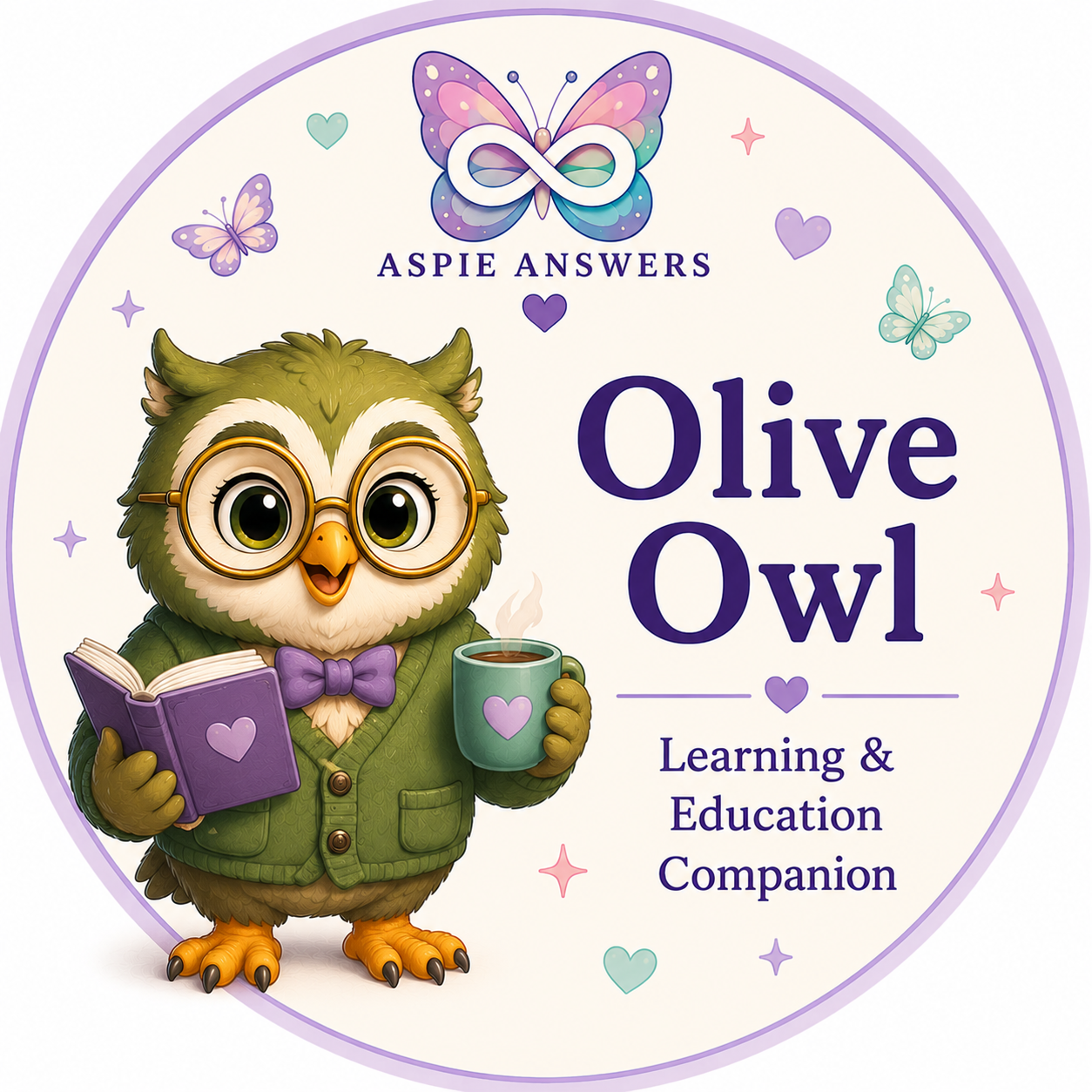
Olive supports learning, study, school, homework and life-skills education. He helps encourage a steady approach to information, breaking learning into clearer and more manageable pieces.
Olive's reminder: You do not need to know everything before you begin.
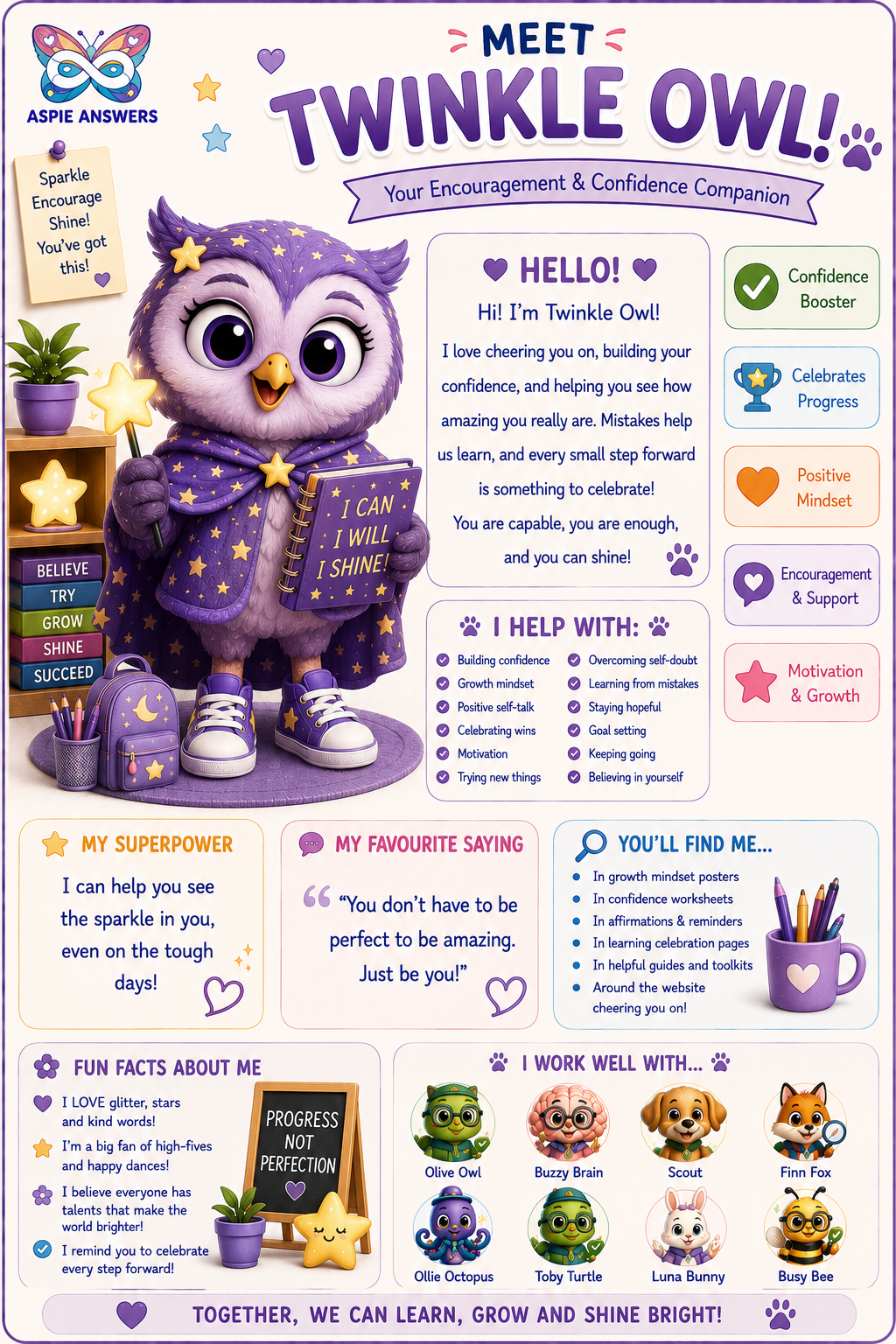
Twinkle supports learning encouragement and helps make room for curiosity, questions, repetition and taking time with difficult ideas. She reminds us that learning does not have to happen all at once.
Twinkle's reminder: Curiosity can light the way.
Olive Owl and Twinkle Owl are educational Companion characters designed to make learning feel more approachable and encouraging. They are not medical or mental-health professionals and do not replace personalised professional advice or care.
Use check-ins, reflection pages, coping tools and practical resources alongside your learning.
Tools & WorksheetsFind accessible definitions and specialist glossary pathways, including mental-health terminology.
Mental Health GlossaryLearn how to choose and adapt resources without feeling you have to complete every worksheet or tool.
Using ResourcesFind selected mental-health guides, learning materials and useful quick links together.
Mini LibraryExplore the wider Aspie Answers collection of printable learning tools, worksheets and resources.
Resources LibraryWhen learning turns into needing practical help, coping strategies or further support, continue into the Support Hub.
Mental Health SupportEducation can help you understand what may be happening. When you need practical help, professional services, peer/community support or urgent support, use the doorway that matches the situation.
Explore practical everyday support for anxiety, low mood, burnout, stress, emotional regulation, self-care and coping.
Go to the Mental Health Support HubFind pathways for counselling, therapy, psychology, psychiatry, telehealth, low-cost options and inclusive professional support.
Find Mental Health Support ServicesExplore peer support, support groups, lived-experience communities, family/carer spaces and online or in-person community connection.
Find Support & CommunityFind organisations, broader services, directories and support pathways beyond the Mental Health education system.
Explore Support & DirectoriesUse the dedicated Crisis Support pathway when urgent or crisis support information is needed.
Go to the Crisis Support Main IndexIf changes in mood, thoughts, behaviour, sleep, appetite, energy, daily functioning or emotional wellbeing are worrying you, consider talking with an appropriately qualified health or mental-health professional.
Understanding mental health can take time. You are allowed to ask questions, change your understanding, learn at your own pace and return to information when you are ready.
One useful idea or one better-understood experience can be enough for today.
Learn • Understand • Reflect • Grow
Aspie Answers provides general educational information, lived-experience-informed resources and practical guidance. It does not diagnose conditions or replace personalised professional care.
↑ Back to the Beginning