
Page display options

Family Life
Family life can hold routines, relationships, sensory needs, communication differences, responsibilities, laughter, tiredness, changing plans and many different ways of being together. This page brings those everyday pieces into one practical, neurodiversity-affirming space.
A whole-family doorway
This page is for neurodivergent people, parents, carers, whānau, siblings, partners and other household members who want practical ways to make everyday family life more understandable and manageable.
Neurodivergent family members
For people navigating home life with autism, ADHD, learning differences, sensory needs, mental health needs or other forms of neurodivergence.
Parents, carers & whānau
For adults balancing support, routines, appointments, communication, advocacy and their own wellbeing.
Siblings & partners
For family members who may also need information, space, reassurance, connection and support.

Make home life easier to follow
Predictability can reduce the amount of information everyone has to hold in their head. Useful routines should support the household without becoming rigid rules that create extra stress.
Morning & evening routines
Use simple steps, visual reminders and realistic timing rather than expecting everyone to remember the whole sequence.
Shared household tasks
Make expectations visible, divide jobs by capacity where possible and avoid treating equal as meaning identical.
Food, meals & daily rhythms
Consider sensory preferences, energy levels, predictability and low-pressure ways of eating together.
Rest and recovery
Build decompression into the day instead of waiting until everyone is already overloaded.
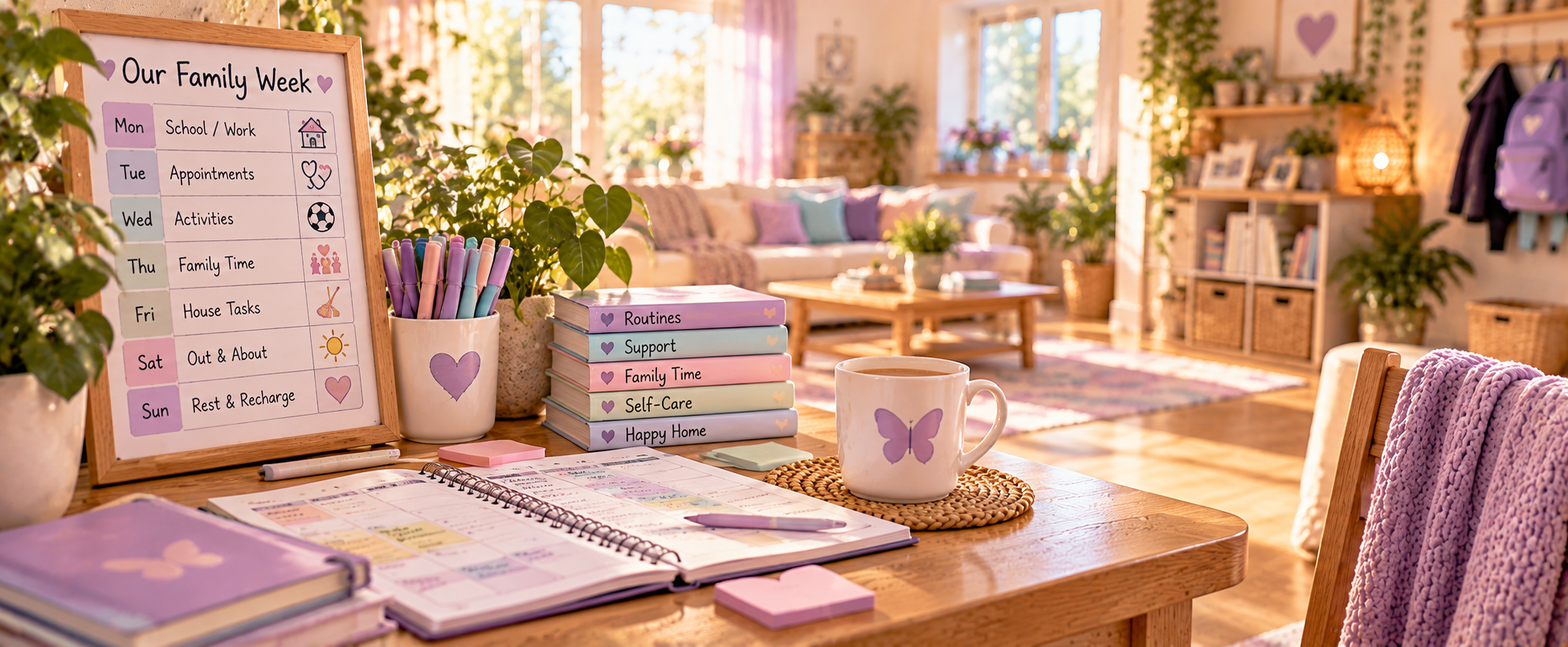
Externalise the family workload
Calendars, whiteboards, shared lists and visible routines can take pressure off memory and reduce repeated verbal prompting.
- Keep family plans somewhere everyone can see or access them.
- Include recovery time, not only appointments and obligations.
- Break larger household jobs into smaller steps.
- Give extra notice before changes where possible.
- Use reminders without turning them into constant correction.
- Review routines when they stop working instead of assuming someone is failing them.

Different communication styles can still connect
Family communication can include speech, text, writing, visual supports, gestures, shared activities, quiet company and time to process. Connection does not have to look the same for every family member.
Allow processing time
Some people need longer before answering questions, making decisions or discussing something emotional.
Reduce communication pressure
Offer written or visual options, avoid repeated questioning and make room for quieter ways of participating.
Repair after conflict
Return to difficult conversations when people are calmer, clarify what happened and focus on what would help next time.
Make space for different needs
One family member needing quiet and another needing movement does not make either need wrong.
Support every relationship without making everything equal
Siblings and other family members may experience different rules, supports, responsibilities and amounts of adult attention. Clear explanations and individual time can help reduce confusion and resentment.
Explain differences respectfully
Talk about different needs without making one person the problem or expecting siblings to become mini-carers.
Protect individual space
Where possible, create places or times where each person can rest, play, study or be alone.
Make room for individual attention
Short, predictable one-to-one moments can matter as much as large family activities.
Celebrate different strengths
A family does not need everyone to be good at the same things or contribute in the same way.
Home can be a place to recover from the outside world
Small environmental changes can make home life easier when people experience noise, light, smell, touch, clutter or movement differently.
- Create at least one lower-stimulation area where possible.
- Use headphones, softer lighting, curtains or sensory tools without shame.
- Keep some predictable foods, clothes or routines available.
- Plan noisy household jobs with warning and recovery time.
- Remember that sensory needs can change from day to day.


Prepare for change without expecting perfect flexibility
Family outings and life changes can bring excitement and stress at the same time. Preparation can help people understand what is happening, what may feel difficult and what support is available.
Day trips & appointments
Share the plan, expected timing, transport, food, toilets, waiting, sensory conditions and how to leave if needed.
Holidays & travel
Bring familiar comfort items and routines where possible, and avoid over-scheduling every day.
Unexpected changes
Name what changed, what stayed the same and what the new plan is.
Bigger family transitions
Moving home, changing school, separation, bereavement, new family members or changing support needs may require extra time and reassurance.
Home life is affected by what happens outside home
A difficult school, work or community day can show up later as exhaustion, withdrawal, irritability, shutdown, sensory overload or a greater need for routine. The behaviour seen at home may be the end of a long day of coping.
After-school decompression
Consider food, quiet, movement, low-demand time or preferred activities before expecting conversation or homework.
Work and adult responsibilities
Neurodivergent adults may also need recovery after work, appointments, social contact or caregiving.
Shared calendars
Bring school, work, health and family commitments together so clashes and high-demand weeks are easier to see.
Low-capacity days
Have a simpler version of family routines for days when energy or regulation is lower.
Support should include the people doing the supporting
Parents, carers, partners and other family members can become overloaded too. Sustainable family support makes room for rest, boundaries, connection and practical help rather than expecting one person to carry everything.
Share the invisible workload
Appointments, forms, reminders, school communication, planning and emotional support all count as family work.
Notice burnout signs
Exhaustion, irritability, reduced capacity and feeling constantly “on” may be signs that something needs to change.
Accept practical help
Meals, transport, childcare, respite, advocacy or someone attending an appointment can all reduce pressure.
Keep some connection that is not about support
Shared humour, interests, favourite shows, pets, walks, games or quiet time can help family relationships feel bigger than appointments and problems.
Different neurodivergent needs can exist in the same household
One person may need quiet while another regulates through movement. One may rely on routine while another struggles to follow routines consistently. A useful family plan acknowledges these differences instead of forcing one person’s coping style onto everyone else.
Choose the pathway that best matches what your family needs now
Parents, Family & Whānau
Return to the main family hub for broader family, parenting, wellbeing and support pathways.
Routines & Visual Supports at Home
For practical routines, First/Then supports, visual schedules and flexible home systems.
Visual Supports Library
Explore visual schedules, communication cards, task sequences, regulation supports and everyday visual tools.
Parents & Carers Mental Health
For caregiver wellbeing, emotional load and mental-health support.
Learning Differences & Learning Disabilities
For education, learning differences and support pathways across ages.
Health & Body
For healthcare, assessment, allied-health and health-information pathways.