I feel stressed or overloaded
Explore warning signs, workload, uncertainty, pressure and practical ways to reduce unnecessary demands before stress continues to build.

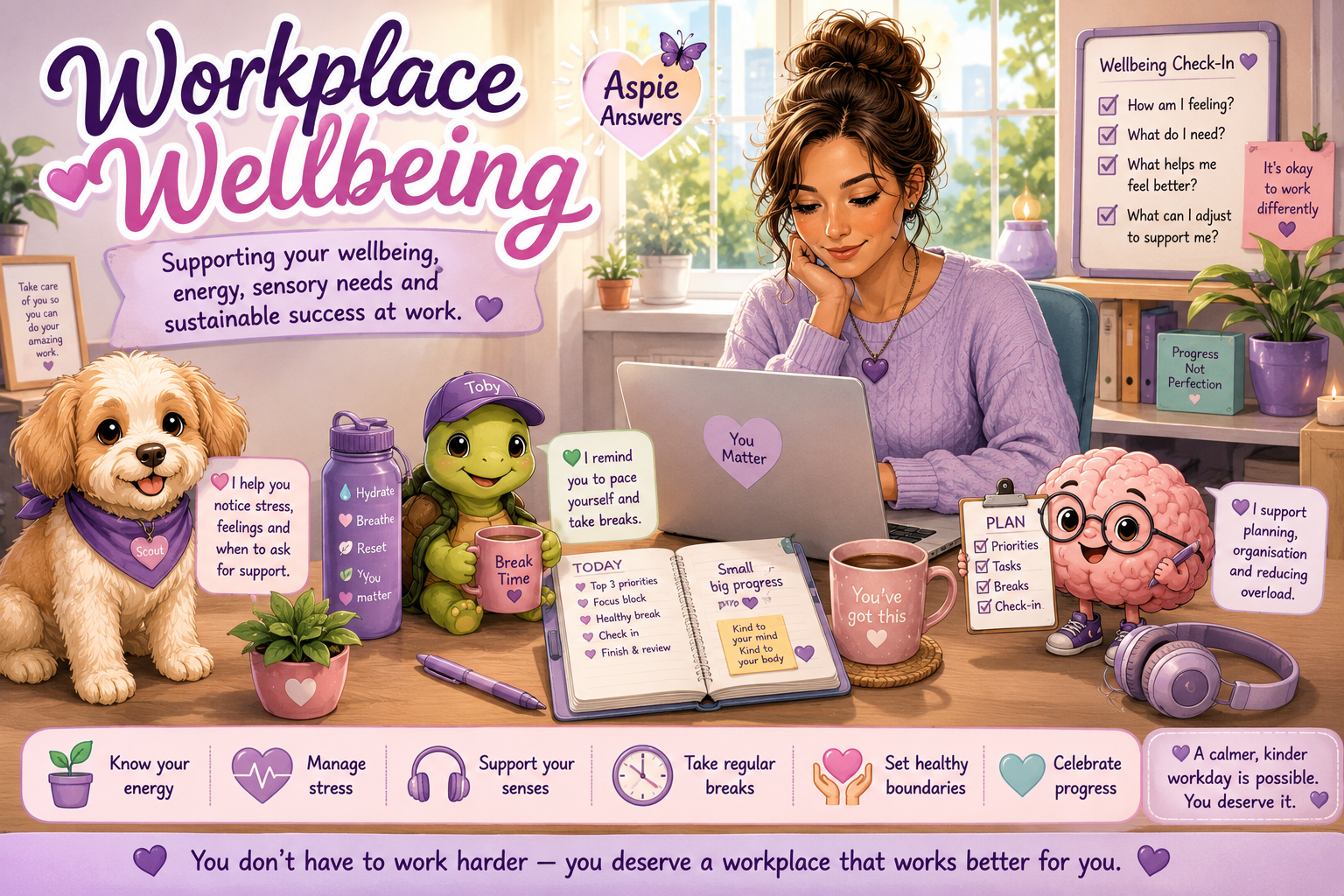
Workplace wellbeing is about more than simply coping with a difficult day. It includes your mental and emotional wellbeing, physical comfort, sensory environment, energy, recovery and whether the way you are working can be sustained over time.
For neurodivergent people, wellbeing at work may improve when the environment, expectations and support around the job are clearer, safer and better matched to individual needs.
You do not need to solve every workplace difficulty at once. Start with the area that is creating the most pressure and explore one practical change or support.
Explore warning signs, workload, uncertainty, pressure and practical ways to reduce unnecessary demands before stress continues to build.
Look at noise, lighting, movement, social demands, workspace comfort and other sensory factors that may be using your energy.
Explore pacing, recovery, breaks, boundaries, workload and the warning signs that your current working pattern may need to change.
You might begin by noticing four parts of your current workday. There is no right answer — this is simply a way to identify where extra support may be useful.
Workplace wellbeing is not one single feeling. It is the combination of physical comfort, mental health, emotional safety, sensory needs, energy, relationships and whether your working life feels manageable over time.
A workplace may look successful from the outside while still being exhausting or difficult to sustain. Looking at wellbeing means asking not only whether the work is being completed, but also what the work environment, expectations and routines are costing you physically, mentally and emotionally.
This includes stress, concentration, worry, decision fatigue, workload pressure and whether your mind has enough space to recover.
Comfort, movement, hydration, rest, posture, fatigue and the physical demands of the workplace all affect how sustainable work feels.
Feeling respected, being able to ask questions and knowing that mistakes or uncertainty can be discussed safely can reduce unnecessary stress.
Noise, lighting, movement, smells, temperature and other sensory demands can affect concentration, stress and available energy.
Work should leave enough room for breaks, recovery and life outside the workplace rather than repeatedly using every available resource.
Supportive communication, clear expectations, appropriate adjustments and knowing where to seek help can make workplace demands easier to manage.
Everyone's balance will look different. These questions can help you notice which part of workplace wellbeing may need attention.
Stress can build gradually. Learning your own early warning signs can make it easier to respond before pressure becomes much harder to manage.
Sometimes overload shows up as slower thinking, increased forgetfulness, irritability, sensory sensitivity, difficulty switching tasks or simply needing much more effort to complete work that would normally feel manageable.
Concentration, planning, memory or decision-making may become more difficult as stress increases.
Tasks may require much more effort than usual, or exhaustion may arrive earlier in the workday.
Noise, lights, movement or other sensory input may become harder to tolerate when your system is already under pressure.
Finding words, processing instructions or responding to questions may require more time and effort.
Irritability, anxiety, frustration or overwhelm may increase when demands keep stacking up.
Work stress may continue after you leave, making it harder to sleep, relax or recover for the next day.
Small adjustments made earlier may prevent a difficult day from becoming a much larger overload.
Pause, move, hydrate, step somewhere quieter or reduce input for a few minutes if your workplace allows it.
Identify what genuinely needs attention now instead of trying to keep every demand equally active.
Where possible, use a quieter space, different lighting or other appropriate sensory supports.
Uncertainty can add extra stress. Ask which work matters most or whether a deadline can move.
Write down the next action, current priority or important instruction instead of relying on working memory.
If the pressure cannot be solved by personal strategies alone, involve the appropriate workplace support person.
Stress often becomes easier to address when you can identify where the demand is coming from.
It may help to describe the specific workplace demand and what it is affecting rather than feeling you need to explain everything at once.
Workplace environments can contain constant sensory information. Noise, lighting, movement, temperature, smells, touch and visual clutter may all affect concentration, stress and available energy.
A person may be able to complete the work itself while still using a large amount of energy coping with the environment around the work. Reducing unnecessary sensory demands can make the same job feel much more manageable.
Conversations, phones, machinery, music or unpredictable sounds may make concentration harder or increase fatigue.
Bright, flickering or harsh lighting may contribute to discomfort, headaches, eye strain or reduced concentration.
Constant movement, busy spaces or visual clutter can make it harder to keep attention on the task in front of you.
Heat, cold or poor airflow may affect comfort and make normal work demands harder to tolerate.
Perfume, cleaning products, food or workplace materials may become distracting or overwhelming.
Seating, clothing, equipment, repetitive movement and workspace setup can affect how much energy is available for the work itself.
Instead of assuming the whole workplace is simply “too much”, try noticing whether particular sensory demands repeatedly create the biggest impact.
What is appropriate will depend on the workplace, role, safety requirements and individual needs.
Where appropriate, headphones, ear protection, quieter spaces or reduced background audio may help.
Softer lighting, natural light, screen adjustments or a different workstation may reduce visual discomfort.
A different desk location may reduce movement, noise, glare or other repeated sensory interruptions.
Brief planned opportunities to reduce input, move or reset may help prevent sensory stress building continuously.
Where workplace requirements allow, consider clothing, temperature, seating or equipment that reduces avoidable discomfort.
Some tasks may be easier in quieter periods or locations where sensory demands are lower.
Describing the specific workplace barrier and its impact can make it easier to identify a practical adjustment.
Your available energy is not necessarily the same every day. Understanding what uses your energy — and what helps restore it — can make working life more sustainable.
A workday can appear successful because everything was completed while still costing far more energy than was sustainable. Workplace wellbeing includes looking at what is left afterwards — not only what was achieved during working hours.
You do not need an exact measurement. A simple energy check can help you decide whether today's workload and pace need adjusting.
You have reasonable concentration and energy available and can manage your normal workload with usual supports.
Work is beginning to require more effort. This may be a good time to protect breaks and reduce unnecessary demands.
Concentration, communication or regulation may be harder. Focus on essential work and use additional support where possible.
Continuing to push may increase overload and recovery time. Immediate rest, reduced demands or further support may be needed.
Energy is not only used by the visible task. Neurodivergent workers may be managing several additional demands at the same time.
Pacing is about spreading demands more realistically rather than repeatedly pushing until you have nothing left.
Where your role allows, avoid stacking every demanding task, meeting or interaction into the same part of the day.
A short break may be more helpful before exhaustion than a much longer recovery period after overload has already happened.
On lower-capacity days, identify what genuinely needs to happen rather than expecting yourself to maintain maximum output.
Moving between tasks, meetings, locations or social situations can use energy too. Build transition space where possible.
A schedule may appear manageable today but still be unsustainable if several demanding days happen without enough recovery.
If the workload repeatedly exceeds your available capacity, personal pacing strategies may not be enough. The work itself may need reviewing.
Try checking your energy at more than one point in the day. Patterns can be easier to notice when you stop relying only on how you feel once work is finished.
A sustainable job should ideally leave some capacity for eating, household tasks, relationships, interests, rest and the rest of your life. If work repeatedly requires all available energy and recovery takes most evenings or weekends, that pattern is worth paying attention to.
Boundaries can protect your energy, wellbeing and ability to work sustainably. They help make expectations around workload, availability, communication and recovery easier to understand.
Healthy boundaries are often about clarity: what you are responsible for, what can realistically fit into your workload, when you are available and when something needs to be discussed rather than silently absorbed.
Understanding what can realistically fit into your role helps prevent every new request from becoming an automatic extra priority.
Clear working hours, break expectations and response times can reduce pressure to be continuously available.
Knowing when and how you are expected to respond can reduce the feeling that every message requires immediate action.
Clear responsibilities can reduce confusion about what belongs to you and what belongs to another person or team.
Recovery is harder when work continually follows you into evenings, weekends or other parts of your life.
Knowing when you are approaching overload can help you act before your available capacity is completely depleted.
Boundaries often become visible when the same pressure keeps repeating.
Boundaries are often easier to maintain when they are specific and connected to the work rather than left as vague personal limits.
When a new urgent task arrives, ask which existing priority should move rather than assuming all deadlines remain unchanged.
Where possible, keep work within agreed hours and treat ongoing extra time as something to review rather than the normal solution.
Planned breaks can support regulation and energy. Repeatedly sacrificing them may be a sign the workload needs attention.
Agreed periods for concentrated work can reduce the expectation of constant interruption or immediate availability.
Written responsibilities, priorities and deadlines may make it easier to notice when expectations have expanded.
A small boundary conversation early may be easier than waiting until stress or overload has become much harder to manage.
Boundaries can feel easier when you have practical wording ready.
Some people find it difficult for their brain to recognise that the workday has ended. A short closing routine can create a clearer boundary between work and recovery.
Breaks can help protect concentration, energy and regulation across the workday. The most useful break often depends on what kind of demand has been using your capacity.
Short recovery points used earlier may help prevent stress and sensory load from continuing to build. A break is not wasted time if it helps you return to work with more usable capacity.
Reduce noise, light, movement or other input for a short period when your nervous system needs less stimulation.
Step away from problem-solving, detailed concentration or decision making and allow your mind to shift to something simpler.
After meetings or sustained interaction, some quiet or reduced communication may help restore social energy.
Stretch, walk, change posture or move your body after long periods of sitting or repetitive work.
Food, water, medication, bathroom needs, temperature and physical comfort are basic needs, not distractions from work.
A short change of location, fresh air or quieter space may help break the buildup of workplace stress.
Not every break restores the same kind of energy.
Not every workplace or role allows a long break whenever you need one. Smaller regulation moments may still help between formal breaks.
Give your eyes and attention a short change of focus.
Use a small physical routine as a brief pause before continuing.
Unclench your jaw, lower your shoulders or adjust your posture.
Give yourself a brief pause before moving immediately into the next demand.
Write down the thoughts or tasks you are trying not to forget.
Silence unnecessary alerts or move away from avoidable sensory input where appropriate.
A short routine can make it easier to recognise that you are taking a genuine pause rather than simply switching to another demanding task.
If workplace routines repeatedly prevent necessary breaks, it may be worth discussing the practical impact on concentration, regulation or wellbeing.
Burnout can develop gradually when demands continue to exceed available capacity and recovery. Noticing changes earlier may help you respond before work becomes increasingly difficult to sustain.
Everyone can feel exhausted after a difficult shift or busy week. What matters is the pattern: whether exhaustion, overload or reduced functioning continues, becomes harder to recover from, or keeps returning because the underlying demands have not changed.
You may feel depleted before work begins or find that ordinary tasks require far more energy than they used to.
Concentration, memory, planning, decision-making or communication may become noticeably harder.
Noise, light, touch, movement or other sensory input may become much harder to tolerate than usual.
Work that once felt manageable or meaningful may begin to feel unusually difficult to approach.
Anxiety, frustration, irritability, tearfulness or emotional shutdown may happen more easily.
Evenings, weekends or leave may no longer feel sufficient to restore your usual level of functioning.
These questions may help you notice whether the issue is becoming a longer-term pattern rather than a temporary difficult period.
If the current pattern is no longer sustainable, the solution may need to involve the work environment or workload — not just more personal coping strategies.
Identify whether priorities, deadlines or the volume of work need to change.
Sensory, social or interruption load may need practical adjustments where possible.
Breaks, leave, lower-demand periods and time away from work may need greater priority.
Speak with the appropriate manager, support person, HR contact, union or other workplace resource where relevant.
Record what is contributing to overload and what adjustments or priorities have been agreed.
Persistent or significant changes in wellbeing may also be worth discussing with an appropriate health professional.
You may find it easier to describe the repeated impact on your work and functioning rather than feeling you need to find the perfect label for what you are experiencing.
When someone has been running beyond their capacity for a long time, recovery may take longer than expected. The goal is not simply to rest enough to return to the same unsustainable pattern.
Sometimes workplace wellbeing improves through personal strategies. Other times the work environment, expectations or way information is provided may need practical changes too.
Asking for clearer information, a more manageable environment or a practical adjustment does not mean you have less to contribute. Useful support can make it easier to use your skills consistently.
Written instructions, priorities or follow-up notes may reduce working-memory demands and uncertainty.
Quieter spaces, appropriate sound support, lighting changes or workspace adjustments may reduce sensory strain.
Appropriate regulation or recovery breaks may help prevent overload from building across the day.
Clear routines, advance notice and visible schedules may reduce the stress of unexpected changes.
Agreed priorities can make workload easier to manage when several demands compete for attention.
Predictable opportunities to ask questions or review workload may be easier than waiting until problems become urgent.
The most useful support is usually connected to a specific workplace difficulty rather than added simply because it is commonly suggested.
Written key points, checklists or documented steps may help.
A quieter location or appropriate noise-reduction support may be worth discussing.
Advance notice, written updates or clearer transition information may help where possible.
Workload, breaks, meeting load, sensory demands or work patterns may need reviewing.
Specific outcomes, deadlines and priorities may reduce unnecessary uncertainty.
A priority or workload review may be more useful than adding another personal productivity tool.
You do not necessarily need to explain every personal detail. It can be enough to describe the barrier, the effect on your work and the practical change that may help.
The right person will depend on your workplace, role and the type of support you need.
Often the first person for workload, priorities, communication, routines and day-to-day practical changes.
May help with workplace policies, formal adjustment processes, wellbeing support or employment procedures.
May be relevant where environmental or workplace conditions affect safety, comfort or wellbeing.
May provide support with workplace conversations, rights, procedures or difficult employment situations.
Some organisations have wellbeing teams, employee assistance services or occupational support.
May be appropriate where work is significantly affecting health, functioning or recovery.
Prepared wording may make workplace conversations easier to begin.
When workplace wellbeing issues continue over time, keeping a simple record may help you notice patterns and remember what has already been discussed.
Workplace wellbeing can involve energy, emotions, stress, recovery and self-compassion. Toby Turtle, Scout and Hope the Dove each bring a different kind of support to help make working life feel more sustainable.
Toby Turtle is our pacing, wellbeing and burnout prevention companion. Toby helps you notice your available energy, recognise when demands are becoming too much and build rest and recovery into working life.
Workplace wellbeing is not about doing less simply for the sake of it. It is about finding a pace that gives you a better chance of continuing without repeatedly reaching exhaustion.
Emotional reassurance and compassion matter too. Scout and Hope the Dove support the emotional side of workplace wellbeing.
Scout supports emotional reassurance, recognising how you are feeling and remembering that asking for help is allowed. Scout is especially helpful when workplace stress leaves you feeling overwhelmed, discouraged or alone.
Hope brings a gentler voice to difficult workplace moments. Hope reminds you that struggling does not mean you have failed, and that kindness, calm and self-compassion belong in workplace wellbeing too.
You do not have to approach every workplace wellbeing problem in the same way. Try asking which kind of support you need most at that moment.
Different days may call for different kinds of support. There is no single “right” companion to choose.
Practical worksheets, planners, trackers and check-ins can help turn workplace wellbeing ideas into something easier to notice, record and use in everyday working life.
Reflect on stress, sensory demands, energy, workload, recovery and support needs across the workday.
Planned / Check Resource BankNotice which tasks, environments, meetings and times of day use the most energy and what helps restore capacity.
Planned / Check Resource BankPlan sensory, movement, mental and regulation breaks around the parts of the workday that are most demanding.
Planned / Check Resource BankIdentify personal early warning signs, repeated workplace pressures and practical responses before overload becomes harder to manage.
Planned / Check Resource BankExplore boundaries around workload, working hours, availability, interruptions, responsibilities and recovery.
Planned / Check Resource BankDescribe a workplace barrier, its impact, possible support and what may need to be discussed or reviewed.
Planned / Check Resource BankRecord sensory triggers, helpful environments, regulation strategies and possible workplace supports.
Planned / Check Resource BankBuild a workday that considers priorities alongside breaks, energy, sensory load, transitions and recovery.
Planned / Check Resource BankCreate a simple transition out of work and identify what helps your brain and body move into recovery time.
Planned / Check Resource BankNot every workplace wellbeing resource needs to be a traditional planner. Different formats can support different needs.
Workplace Wellbeing can eventually become its own coordinated resource collection within the wider Aspie Answers Work & Employment resources, with matching editions for different audiences and needs.
Clean, practical workplace wellbeing worksheets for everyday adult use.
Guided wellbeing resources featuring Toby Turtle, Scout, Hope the Dove and other relevant companions.
Friendly illustrated versions with supportive visual prompts and approachable layouts.
As Workplace Wellbeing resources are completed, they can connect into the wider Aspie Answers resource library, printables and future Work & Employment collections.
Workplace wellbeing can look different for every person and every job. These answers cover some common questions about stress, sensory needs, energy, boundaries, recovery and workplace support.
Workplace wellbeing includes how work affects your mental, emotional and physical wellbeing, sensory comfort, available energy and ability to recover.
It is not only about whether you can complete your job. It also considers whether the way you are working is realistic and sustainable over time.
Work may involve additional executive function, sensory, communication, social and transition demands that are not always visible to other people.
Managing noise, remembering instructions, switching tasks, interpreting expectations or masking can all use energy alongside the work itself.
Yes. Noise, lighting, movement, smells, temperature and physical comfort can affect concentration, stress and energy.
Sensory demands may not appear on a job description, but they can still add significantly to the effort required to complete the workday.
That pattern is worth noticing. Completing the work does not necessarily mean the current way of working is sustainable.
Consider what is using the most energy, whether breaks and recovery are sufficient and whether any workload, sensory or workplace supports could reduce unnecessary strain.
Breaks can support concentration, sensory regulation, physical comfort and energy. Waiting until you are completely exhausted may require more recovery than taking a smaller break earlier.
If workload regularly makes normal breaks impossible, the workload itself may need reviewing.
Healthy workplace boundaries are often about clarity rather than selfishness. They help define workload, responsibilities, availability, working hours and recovery time.
Clear boundaries can make expectations easier for both the worker and the workplace to understand.
Burnout-like patterns may involve persistent exhaustion, reduced concentration, increased sensory sensitivity, emotional overload or recovery taking much longer than usual.
One difficult day does not necessarily mean burnout. Look for ongoing changes and whether your usual recovery is no longer enough.
Depending on the workplace and situation, practical support might include clearer written instructions, defined priorities, predictable check-ins, sensory adjustments, advance notice or changes to how work is organised.
The most useful support usually addresses a specific barrier rather than trying to change everything at once.
Not necessarily. Sometimes it is enough to explain the practical barrier, how it is affecting your work and what change may help.
For example, you might explain that a noisy environment is making detailed concentration difficult and ask whether a quieter option is available.
Capacity can vary with sleep, health, stress, sensory load, workload, social demands and life outside work.
Flexible strategies can help you respond to the capacity you actually have rather than expecting every workday to feel exactly the same.
Some recovery after a demanding day is normal. What may need attention is a repeated pattern where nearly all evenings, weekends or time away from work are needed simply to become functional enough to return.
No. Sustainable pacing does not mean always moving slowly. It means adjusting effort to the task, available energy and recovery you have.
Some days you may have plenty of capacity. Other days may need more breaks, fewer demands or a different pace.
Workplace wellbeing connects with communication, organisation, productivity, executive function, relationships and the wider experience of working successfully and sustainably.
Continue with the area that best matches the workplace barrier or support you want to explore next.
Return to the main Workplace Success pathway and explore practical guidance across working life.
Explore Workplace SuccessExplore planning, focus, priorities, sustainable progress and practical strategies for getting work done.
Explore ProductivityExplore clearer communication around instructions, questions, meetings, feedback, boundaries and asking for support.
Explore CommunicationExplore teamwork, trust, professional boundaries, misunderstandings and working relationships.
Explore RelationshipsExplore support for planning, task initiation, working memory, switching, organisation and focus.
Explore Executive FunctionExplore schedules, reminders, transitions, time awareness and making work time easier to manage.
Explore Time ManagementThe Work & Employment Hub can also connect you with job preparation, interviews, workplace skills, employment support, resources and other practical work-related guidance as the collection continues to grow.
We use cookies to improve your experience on our site. By using our site, you consent to cookies.
Manage your cookie preferences below:
Essential cookies enable basic functions and are necessary for the proper function of the website.
These cookies are needed for adding comments on this website.
Statistics cookies collect information anonymously. This information helps us understand how visitors use our website.
Google Analytics is a powerful tool that tracks and analyzes website traffic for informed marketing decisions.
Service URL: policies.google.com (opens in a new window)
SourceBuster is used by WooCommerce for order attribution based on user source.