
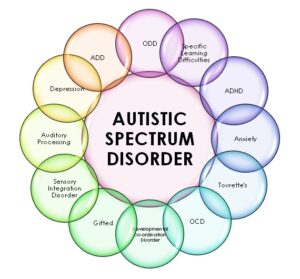
WHAT ARE THE DIFFERENT TYPES OF AUTISM?
KEY POINTS TO REMEMBER [BRIEF INFORMATION] Description: Have you ever thought of what are the different types of autism are there that are available for diagnosis? Autism is a “spectrum disorder,” meaning that people with autism may have a wide range of mild, moderate, or severe symptoms. But do all people with an autism spectrum diagnosis have the same disorder, no matter what their symptoms? How Autism Diagnoses Have Changed From 1994 to May 2013, the autism spectrum was represented by five autism spectrum diagnoses in the fourth version of the official Diagnostic and Statistical Manual of Mental Disorders (DSM-IV). They included Asperger’s syndrome, pervasive developmental disorder—not otherwise specified (PDD-NOS), autistic disorder, childhood disintegrative syndrome, and Rett syndrome. Because there was overlap among the diagnoses, practitioners (as well as teachers and therapists) sometimes used more general terms like “severe autism,” “mild autism,” and “high-functioning autism.” These terms, however, aren’t true diagnoses at all; they’re just descriptions. And while they were intended to help parents and teachers better understand where a child fell on the autism spectrum, each practitioner may have had their own idea of what “mild” or “severe” might look like. Autism Spectrum Disorder Debuts In 2013, the fifth version of the Diagnostic Manual (DSM-5) was published. In the DSM-5, there is just one diagnosis for all variations of autism, called “autism spectrum disorder” (ASD). What Are the Different Types of Autism? Autism is a “spectrum disorder,” meaning that people with autism may have a wide range of mild, moderate, or severe symptoms. But do all people with an autism spectrum diagnosis have the same disorder, no matter what their symptoms? How Autism Diagnoses Have Changed? From 1994 to May 2013, the autism spectrum was represented by five autism spectrum diagnoses in the fourth version of the official Diagnostic and Statistical Manual of Mental Disorders (DSM-IV). They included Asperger’s syndrome, pervasive developmental disorder—not otherwise specified (PDD-NOS), autistic disorder, childhood disintegrative syndrome, and Rett syndrome. Because there was overlap among the diagnoses, practitioners (as well as teachers and therapists) sometimes used more general terms like “severe autism,” “mild autism,” and “high-functioning autism.” These terms, however, aren’t true diagnoses at all; they’re just descriptions. And while they were intended to help parents and teachers better understand where a child fell on the autism spectrum, each practitioner may have had their own idea of what “mild” or “severe” might look like. Autism Spectrum Disorder Debuts In 2013, the fifth version of the Diagnostic Manual (DSM-5) was published. In the DSM-5, there is just one diagnosis for all variations of autism, called “autism spectrum disorder” (ASD). Everyone with symptoms of autism is given a diagnosis of autism spectrum disorder. Within that diagnosis are three levels. Those with Level 1 are the highest functioning, and those with Level 3 are considered severely impaired. Doctors and other practitioners still use the older terms sometimes, as they are more descriptive than, for example, “Level 2 autism spectrum disorder.” They may use the older terms informally, and use the new definitions for billing code purposes. What Is Asperger’s Syndrome? Asperger’s syndrome describes individuals at the highest-functioning end of the autism spectrum. The term—and the diagnosis—was removed from the diagnostic manual in 2013, but virtually everyone in the autism community continues to use it because of its usefulness in describing a very specific group of people. People with Asperger’s syndrome generally develop spoken language in the same way as typically developing children but have a tough time with social communication. These difficulties become more obvious as they get older and social expectations increase. Because people with Asperger’s syndrome are often very intelligent (but “quirky”) the disorder is sometimes nicknamed “geek syndrome” or “little professor syndrome.” Key points about Asperger’s syndrome: Asperger’s syndrome is no longer a valid diagnosis, per the DSM-V. Asperger’s syndrome was and is still often used to describe people with “high-functioning” autism. Most people with the symptoms of Asperger’s syndrome are of normal or above normal intelligence with strong verbal skills and significant difficulties with social communication. Many people with Asperger’s syndrome have significant sensory challenges. People with symptoms of Asperger’s syndrome are now given a diagnosis of Level 1 autism spectrum disorder. What Is Pervasive Developmental Disorder? Pervasive developmental disorder is a term that, between 1994 and 2013, meant exactly the same thing as autism spectrum disorder. If your child was diagnosed before 2013 you may have heard this term from an evaluator or doctor, but it is no longer in general use. Key points about Pervasive Developmental Disorder: The term pervasive developmental disorder is no longer in general use. The term was synonymous with autism spectrum disorder. People with PDD have a wide range of developmental differences which can be mild or severe. What Is Mild Autism? The term mild autism is not an official diagnosis. It’s simply a more descriptive term than Asperger’s syndrome or autism. Generally, speaking, when people use the term mild autism they are referring to individuals whose symptoms fit an autism spectrum diagnosis, but who have strong verbal skills and few behavioral issues. Those individuals may, however, have significant problems with social communication. They may also have problems coping with too much sensory input, such as loud noises or bright lights. Key points about mild autism: Mild autism is essentially similar to or identical to Asperger’s syndrome. Symptoms of mild autism may be difficult to recognize until the person is under stress or coping with complex social situations. Most people with mild autism are now considered to have Level 1 autism spectrum disorder. What Is High Functioning Autism? Like “mild” autism, high functioning autism (sometimes shortened to HFA) is a commonly used term. At one point (before 2013), the term was used to distinguish autism from Asperger’s syndrome. The official distinction made by practitioners before 2013 was that people with HFA had or have speech delays, while people with Asperger s syndrome have normal speech development. Of course, these days there is no Asperger’s syndrome, making the