
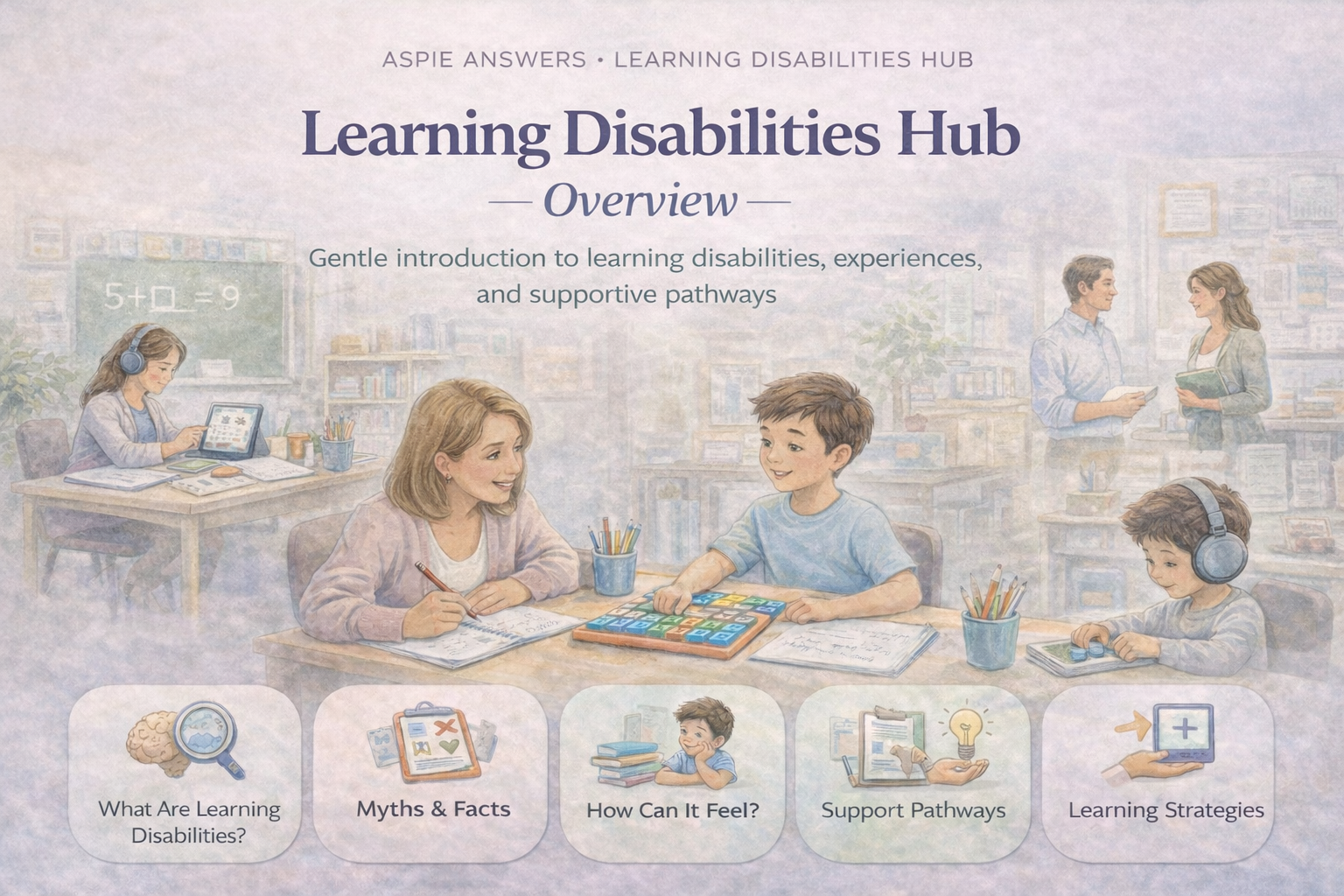
Learning Disabilities Hub Overview banner image

ASPIE ANSWERS • LEARNING DISABILITIES HUB

Learning Disabilities Hub — Overview

Learning disabilities can affect how someone reads, writes, processes numbers, remembers information, or follows instructions — but they don’t reflect intelligence or potential. This overview introduces what learning disabilities are, how they can feel, and the kinds of supports that make learning (and life) easier.

🧠 Neurodivergent-friendly 🏫 School + learning supports 🧩 Practical strategies 💬 Inclusive language
Gentle notice: This page may mention school stress, learning struggles, assessment, or support systems. Take breaks when needed.

What are learning disabilities?

A learning disability is a difference in how the brain takes in, processes, stores, or responds to information. It can affect specific skills (like reading, writing, or maths) even when someone is bright, capable, and trying hard.

Key idea

Learning disabilities are about how someone learns — not how smart they are.

  • Strengths and challenges often sit side-by-side
  • Support is about access, not “special treatment”
  • Many people mask difficulties to avoid judgement

What it can affect

Skills can vary by person and change depending on stress, fatigue, and environment.

  • Reading, spelling, comprehension
  • Writing, organising ideas, handwriting
  • Maths, number sense, time, sequencing
  • Memory, processing speed, following multi-step instructions
Reminder: If a learner is struggling, it doesn’t mean they’re lazy — it often means the task isn’t accessible yet.

Common types

These labels can be helpful, but everyone’s learning profile is unique.

Dyslexia

Differences with reading, spelling, decoding, and written language processing.

Dysgraphia

Difficulties with handwriting, written expression, and organising writing.

Dyscalculia

Challenges with maths skills, number sense, time, and sequencing.

Auditory / visual processing differences

Difficulty processing what is heard or seen — especially in busy environments.

Myths & facts

Myth: “They’ll grow out of it.”

Fact: Supports and strategies help over time — needs may change, but difference is real.

Myth: “They’re not trying.”

Fact: Many learners work twice as hard just to keep up — especially when masking.

How it can feel

Learning challenges can affect confidence, stress levels, and belonging — not just schoolwork.

In the classroom

Fear of being called on, slower processing, or difficulty keeping up with instructions.

At home

Homework battles, exhaustion, shutdowns, or frustration after “holding it together” all day.

Support pathways

Support should reduce barriers and protect dignity — not increase pressure.

School / learning supports

  • Extra time, breaks, reduced reading load where possible
  • Alternative formats (audio, visual, step-by-step)
  • Notes provided, predictable routines, clear instructions
  • Learning support / RTLB / SENCO (or local equivalents)

Home supports

  • Short sessions + movement breaks
  • One instruction at a time
  • Celebrate effort, not speed
  • Tools that make learning easier (not “cheating”)

Learning strategies

These strategies are commonly helpful — choose what fits the learner.

Reading supports

  • Text-to-speech / audiobooks
  • Coloured overlays or page rulers
  • Short chunks + summaries

Writing supports

  • Speech-to-text
  • Graphic organisers / mind maps
  • Typing instead of handwriting where needed

FAQ

Quick answers — we can expand these into dedicated pages later.

Can someone be “gifted” and still have a learning disability?
Yes. Many people have strong intelligence and creativity, with specific learning challenges alongside strengths.
What’s the biggest support that helps right away?
Reducing shame. Then: clear instructions, accessible formats, and tools like text-to-speech or extra time.
Do learning disabilities always need a formal diagnosis?
Not always. Supports can start based on observed needs, but a diagnosis can help access accommodations and services.