
Page display options

Strength-Based Parenting — Recognising & Nurturing Your Child’s Strengths
A neuroaffirming guide to noticing what is already strong, meaningful and valuable in your child or young person — while still supporting the areas where life is difficult.
For adults supporting children and young people to grow without losing themselves
This page is for parents, carers, whānau, guardians and other trusted adults supporting children and young people, including those who are autistic, ADHD, AuDHD, otherwise neurodivergent, disabled, learning differently, anxious, highly sensitive to their environment, or simply developing in their own individual way.
When difficulties dominate the conversation
Balance necessary support with recognition of interests, effort, abilities, personality and identity.
When comparison is creeping in
Shift attention away from what peers are doing and toward the child’s own growth and needs.
When confidence has taken a knock
Repeated correction, failure, bullying or misunderstanding can affect self-belief. Genuine recognition can help rebuild a more balanced self-view.
When you want to support autonomy
Notice where the young person can make choices, lead, teach others, solve problems or build independence.
See the whole person — not only the parts that need support
Strength-based parenting means actively noticing abilities, interests, values, effort, coping strategies, creativity, humour, kindness, persistence, self-knowledge and ways of thinking that are meaningful to the child or young person.
What comes naturally?
Look for tasks, ideas, relationships or activities where the young person seems engaged, capable, interested or energised.
What matters to them?
A strength does not have to impress adults. Interests and abilities can matter because they bring joy, identity, belonging or regulation.
What helps strengths grow?
Time, access, equipment, encouragement, quiet space, mentors, clubs, books, technology or simply being taken seriously can all help.
What still needs support?
Recognising strengths should sit alongside accommodations and practical help where tasks remain genuinely difficult.
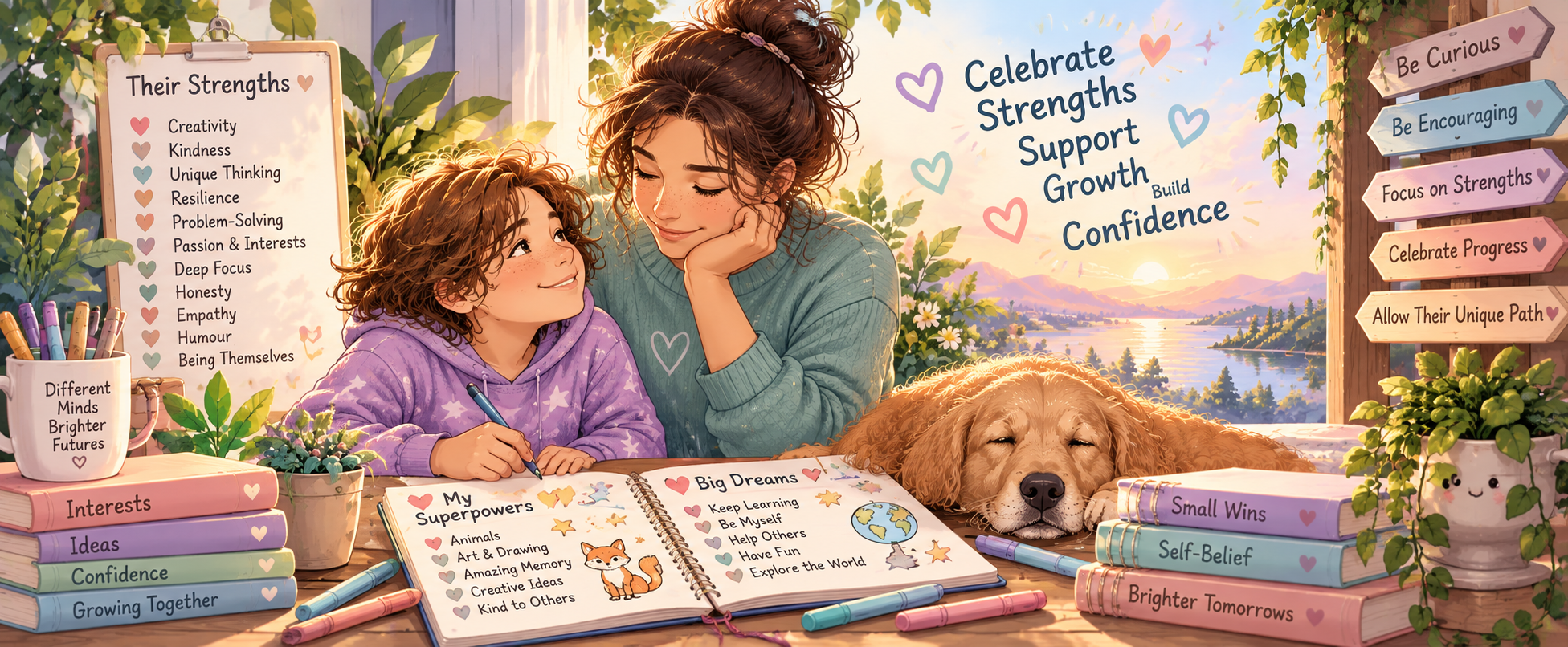
Strengths can be quiet, ordinary and deeply important
Not every strength is an obvious talent or achievement. A young person may show strength through honesty, persistence, deep focus, careful observation, fairness, humour, loyalty, empathy, creativity, memory, curiosity, pattern recognition, advocacy, recovery after a hard day, or simply knowing what they need.
Thinking strengths
Pattern recognition, detail, logic, imagination, memory, curiosity, unusual connections or deep knowledge.
Relationship strengths
Kindness, loyalty, honesty, humour, empathy, fairness, advocacy or caring deeply about others.
Self-knowledge strengths
Recognising sensory needs, asking for a break, choosing a regulation tool, identifying limits or communicating preferences.
Creative strengths
Art, building, writing, music, storytelling, design, imaginative play, coding, making, collecting or experimenting.
Persistence strengths
Returning to something after difficulty, practising a skill, adapting, problem-solving or continuing despite setbacks.
Everyday strengths
Remembering a routine, helping with a task, caring for a pet, making someone laugh, preparing for school or recovering after overload.

Interests can be a doorway into learning, connection and confidence
Strong interests may provide enjoyment, regulation, expertise, motivation, friendship, identity and a safe place to recover from demanding environments. Rather than treating an intense interest as automatically “too much,” it can help to ask what role it is playing.
- Make time for interests without requiring them to become productive or educational.
- Use interests as bridges into new skills when the young person enjoys that approach.
- Look for community, clubs, books, events or people who share the interest.
- Respect repetition when it is comforting or meaningful.
- Notice when an interest supports regulation after school or social demands.
- Avoid turning every strength into a performance expectation.
- Let interests change over time without treating that change as failure.
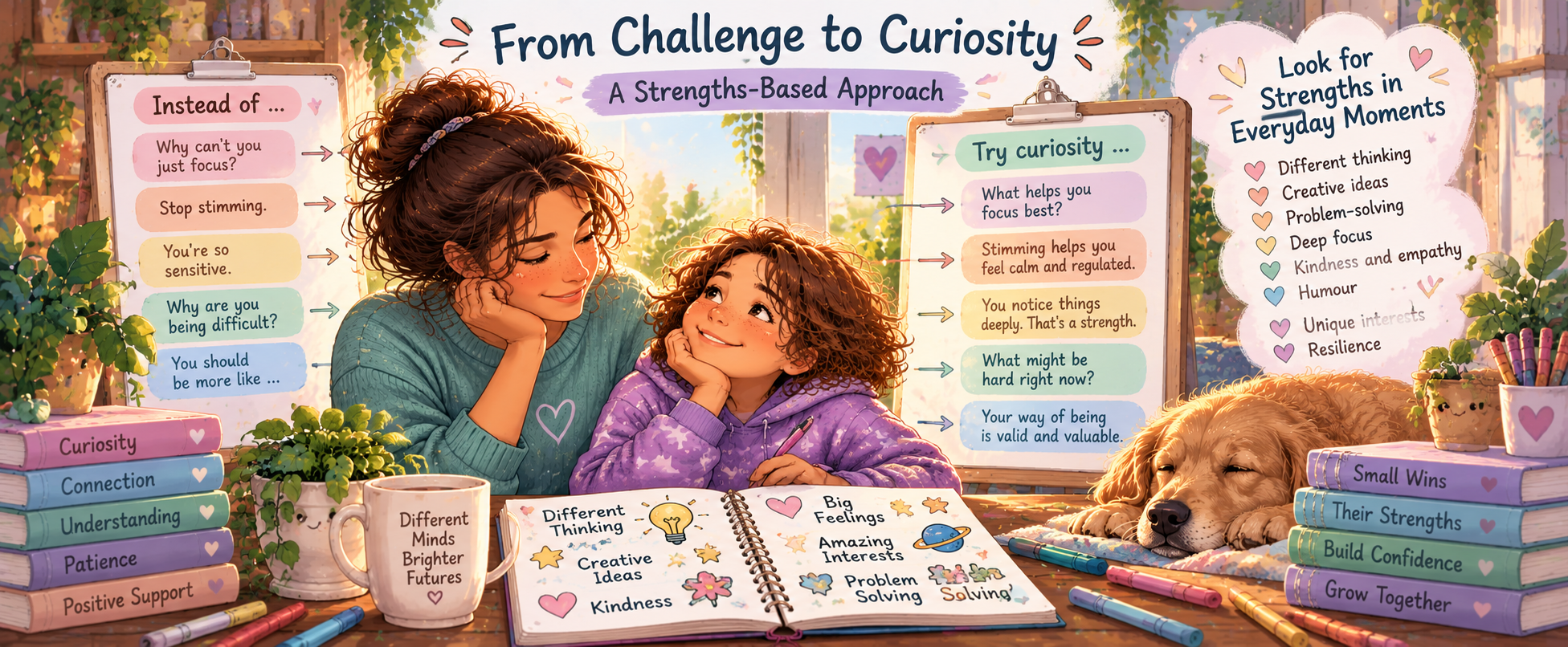
Ask what may be underneath the behaviour
A strength-based approach does not mean every behaviour is safe or workable. It means responding to difficulty with curiosity before assuming laziness, defiance, attention-seeking or lack of effort.
Instead of “Why can’t you just focus?”
Try: “What helps you focus best?” Then look at noise, movement, interest, task length, timing and executive-function load.
Instead of “Stop stimming.”
Ask whether the movement is helping regulation. Redirect only if something is unsafe, harmful or preventing another person’s access.
Instead of “You’re too sensitive.”
Try: “You noticed that strongly. What would make this more manageable?”
Instead of “You’re being difficult.”
Try: “Something seems hard right now. Is it the task, the environment, the timing, or something else?”
Instead of comparison
Focus on the young person’s own starting point, capacity and progress rather than what another child can do.
Instead of praise for masking
Notice authentic communication, self-advocacy, recovery, asking for help and using supports — not just appearing “fine”.

Support progress without making independence the only goal
Growing independence can be valuable, but needing support is not failure. A strengths-based approach helps the young person practise choice, decision-making, problem-solving and self-advocacy while keeping supports available where they are still useful.
Offer meaningful choices
Let them choose between workable options, decide the order of compatible tasks or help shape plans that affect them.
Celebrate effort carefully
Notice persistence, trying a new strategy, asking for help, taking a break at the right time or returning after difficulty.
Build self-advocacy
Support phrases such as “I need more time,” “That is too loud,” “Can you show me?” or “I need a break.”
Respect pace
Development is not a race. A young person may move quickly in one area and need much more support in another.
A strength may look different in different environments
A child who appears quiet at school may be highly expressive at home. Someone who struggles with worksheets may show sophisticated knowledge through conversation, building, technology or a special interest. Environment, communication style, sensory load and safety can all affect what others get to see.
- Share genuine strengths with educators and support people alongside support needs.
- Ask how the young person best demonstrates understanding.
- Look for ways to use interests without making them a reward that can always be removed.
- Include strengths in transition plans, learning plans and goal-setting where appropriate.
- Ask the young person what they want others to know about them.
- Watch for settings where strengths disappear because the person is overloaded, unsafe or masking heavily.
You matter in this picture too
Strength-based parenting is easier when adults have enough capacity to be curious, flexible and patient. Exhaustion, stress, financial pressure, advocacy, appointments and constant decision-making can make that much harder.
Notice small wins
Look for moments of connection, humour, recovery, communication or cooperation — not only completed tasks.
Check your expectations
Ask whether an expectation reflects the young person’s needs and capacity or simply what adults think someone their age “should” do.
Use repair
Adults get overwhelmed too. A sincere apology and reconnection can be more valuable than trying to parent perfectly.
Protect your capacity
Rest, boundaries, shared responsibilities, practical help and your own support all matter.

Choose the next route that matches what you need
Parents, Family & Whānau
For the broader family doorway, including everyday family life, relationships, support and growing independence.
Parents & Carers Mental Health
For emotional wellbeing, mental-health concerns, regulation, safety, advocacy and carer wellbeing.
Everyday Help
For routines, planning, organisation, life-admin and practical everyday supports.
Learning Differences & Learning Disabilities
For broader understanding and support around learning differences and disabilities.
Resources & Downloads
For worksheets, guides, planners and downloadable support materials.
Support & Directories
For professional, community and practical services when more individualised support is needed.