
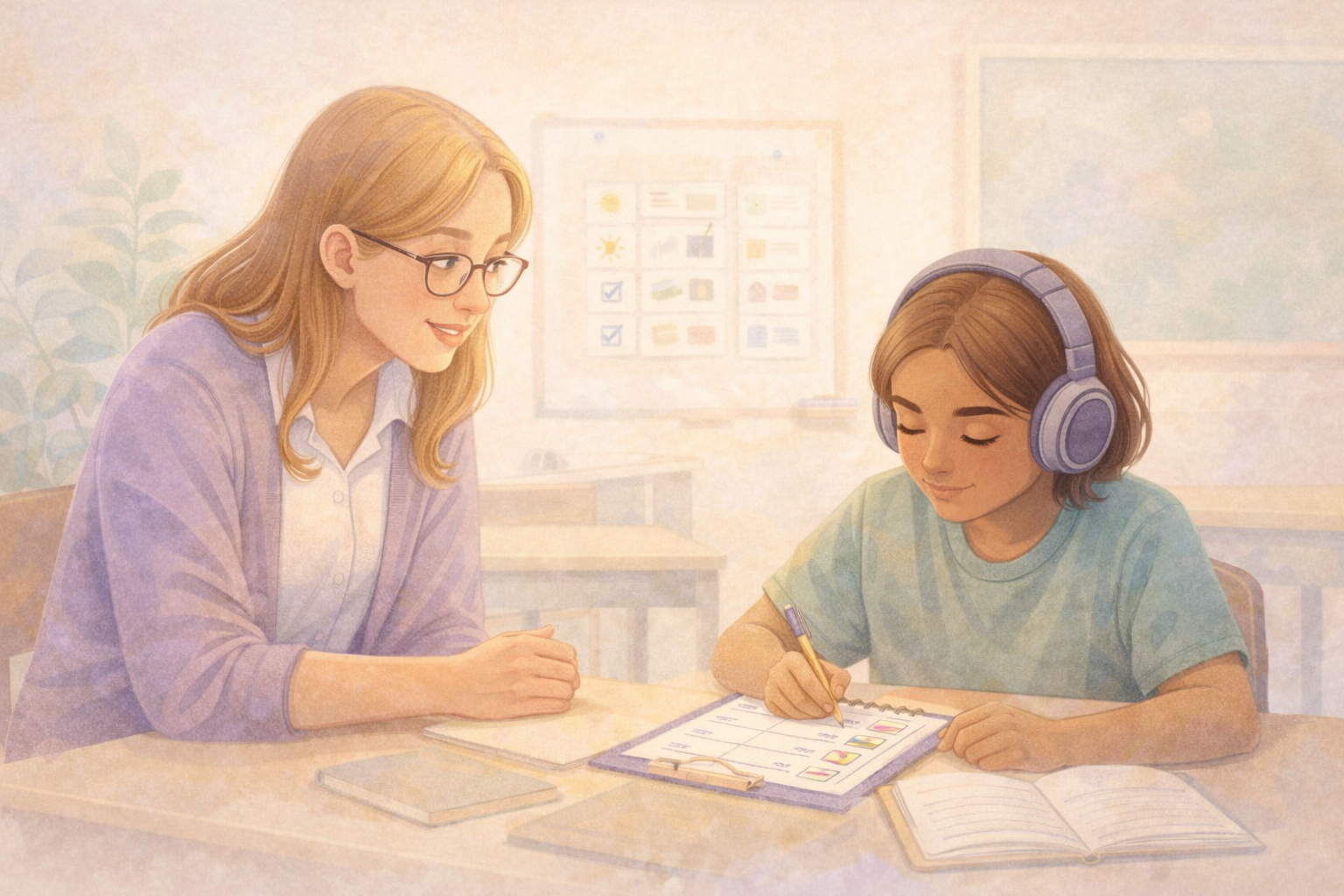
Invisible Disabilities at School

Invisible Disabilities at School banner

ASPIE ANSWERS • HIDDEN DISABILITIES HUB

Invisible Disabilities at School

Many learners are carrying needs you can’t always see — pain, fatigue, sensory overload, anxiety, neurodivergent traits, or chronic illness. This page shares practical support ideas for school life, with a focus on dignity, safety, and access.

🏫 School supports 🧠 Neurodivergent-friendly 🧩 Practical adjustments 💬 Supportive language

Overview

Invisible disabilities in school often show up as “behaviour” or “lack of effort” — when it’s actually overwhelm, pain, executive function strain, sensory barriers, or fluctuating energy. The goal is not to force compliance — it’s to remove barriers and build trust.

Gentle reminder: A learner doesn’t need to “look unwell” to deserve support. Start with curiosity: “What makes this hard?”

What it can look like at school

These patterns can have many causes — they’re signals, not labels.

Energy + attendance

Late arrivals, missed days, needing breaks, “fine at school → crash at home.”

Processing + learning

Slow processing, forgetting instructions, needing repetition, difficulty starting tasks.

Sensory overwhelm

Noise/light sensitivity, headaches, shutting down, leaving class, avoiding assemblies.

Behaviour changes

Irritability, “refusal,” anxiety, perfectionism, fidgeting, meltdowns or shutdowns.

Common barriers

These are the “friction points” that can make school feel unsafe or exhausting.

Environment

  • Noise, bright lights, crowded spaces
  • Unpredictable changes, transitions, sudden tasks
  • Long days without recovery time

Demands

  • Multiple instructions at once
  • Time pressure + public answering
  • Homework load during flare-ups

Supports that actually help

Pick a few supports first — consistency matters more than doing everything.

Low-effort adjustments

  • Quiet seat / sensory break card
  • Step-by-step instructions (written + spoken)
  • Extra processing time and check-in prompts
  • Reduced workload during flare-ups

Access tools

  • Headphones/ear defenders, sunglasses/hat
  • Movement breaks, fidgets, alternative seating
  • Visual schedule, “first/then,” timers
  • Safe space plan + trusted adult
Tip: If a learner is “fine” in the morning and falling apart later, try front-loading the hardest tasks earlier, then building in recovery breaks.

Simple scripts (learner + adult)

Short phrases can reduce stress and help needs get met faster.

For learners

  • “I need a quiet break for 5 minutes.”
  • “Can you write that instruction down?”
  • “This is too much right now — can we do it in steps?”

For adults

  • “What part is hardest — noise, steps, or time?”
  • “Let’s make a plan for hard days.”
  • “You don’t need to prove it. Let’s focus on what helps.”

FAQ

Quick answers — we can expand these into dedicated pages later.

Do learners have to “prove” an invisible disability to get support?
Support should be based on impact and access needs. If it’s safe and appropriate, documentation can help with formal accommodations — but day-to-day support can still begin with practical adjustments and compassionate understanding.
What’s a simple way to request help at school?
Keep it short: “This is hard because of ___; what helps is ___.” Example: “Noise makes it hard to focus. Headphones and a written instruction help.”
What if the learner looks “fine” at school but melts down at home?
This is common with masking and adrenaline. A “good day” can still be exhausting. Add recovery time, reduce overload, and create a predictable support plan.