
Puysegur Point Lighthouse New Zealand
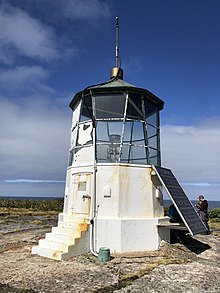
The Puysegur Point Lighthouse is located on a remote headland overlooking the Tasman Sea at the southwest corner of New Zealand’s South Island. The Puysegur Point headland is near the entrance to Rakituma / Preservation Inlet in Fiordland National Park. View from Puysegur Point Milford Sound / Piopiotahi New Zealand with Fiordland National Park in green Location Southland, New Zealand Nearest town Te Anau, New Zealand Coordinates 45°25′S 167°43′E Area 12,607 km2 (4,868 sq mi) Established 1952 Governing body Department of Conservation The lighthouse marks the northwest point of the entrance to Foveaux Strait, separating Stewart Island from the South Island. Puysegur Point is one of the most isolated and inaccessible lighthouses in New Zealand. The original wooden lighthouse tower was destroyed in an arson attack on 8 February 1942. A replacement lighthouse was constructed using equipment that had recently become surplus from the Godley Head and Cape Foulwind lighthouses, and a new light was commissioned in January 1943. Puysegur Point is a headland located in the far southwest of the South Island of New Zealand. It lies within Fiordland National Park on the southern head of Preservation Inlet and is 145 kilometers (90 mi) west-northwest of Invercargill. The name ‘Puysegur’ was bestowed by Lieutenant Jules Dumont d’Urville or Midshipman Jules de Blosseville during a South Pacific expedition of La Coquille; probably in honor of the French naval officer Antoine-Hyacinthe-Anne de Chastenet de Puységur (1752–1809). Jules de Blosseville Born 29 July 1802 Rouen, France Died August 1833 Near Greenland Allegiance Kingdom of France Service/branch French Navy Years of service 1818–1833 Rank Lieutenant Commands held Lilloise Battles/wars Invasion of Algiers Other work Explorer of the South Pacific Puysegur Point has been said to be the windiest place in New Zealand, with gales recorded on an average of 48 days a year. A large earthquake in this region on 15 July 2009 pushed Puysegur Point closer to Australia by 30 centimetres (12 in).Humpback whales pass the point during annual migrations Lighthouse A lighthouse on the point was first illuminated on 1 March 1879. The original wooden lighthouse was destroyed in an arson attack in 1942. The lighthouse was operated by permanent lighthouse keepers from its establishment in 1879 until it was temporarily shut down in 1980, with a further period of staffed operation from 1987 until it was fully automated and destaffed in 1989. Lighthouse overview Situated on the southwest extremity of Fiordland in the South Island, Puysegur Point was notorious within the lighthouse service for being very isolated and desolate. Lighthouse feature: Details Location: latitude 46°10’ south, longitude 166°36’ east Elevation: 45 metres above sea level Construction: cast iron tower Tower height: 5 metres Light configuration: modern rotating beacon Light flash character: white light flashing once every 12 seconds Power source: batteries Range: 19 nautical miles (35 kilometres) Date light first lit: 1879 Automated: 1943 Demanned: 1990 Getting to Puysegur Point Lighthouse Puysegur Point Lighthouse is accessible to the public; however, access is difficult due to its isolated location. There is no public access to enter the lighthouse. There is very little left of the original light station apart from the lighthouse itself. One of the houses has been retained and is used by maintenance staff when on maintenance visits. Find this on the map: Puysegur Point The landing Landing shed at Otago Retreat The main access to Puysegur Point and the lighthouse is via a track from a beach landing point at Otago Retreat – a narrow waterway between the mainland and Coal Island in Preservation Inlet to the northwest of the point. The name Otago Retreat originates from the passage of the schooner Otago that found shelter in this narrow passage during a voyage accompanying the survey ship HMS Acheron on a survey of the South Island around 1850-51. There are buildings remaining at the landing that formerly served the lighthouse. One of the buildings is a Department of Conservation shelter, known as the Landing Shed. The History of Puysegur Point Lighthouse Construction of the wooden lighthouse was difficult because no suitable landing area could be found near the site. All materials and equipment had to be landed some 3 kilometers away and a track cut through the heavy bush to transport everything to the site. This same access was used until 1977, after which a helicopter was used to bring in supplies. The Puysegur Point Lighthouse was completed in February 1879. The light was first lit in March of that same year. In 1942 the tower at Puysegur Point burnt to the ground. According to the official report, the fire was lit “by a demented person, a hermit of the area”. The tower was completely destroyed. A fire was also lit in one of the keeper’s houses, however, it was put out before much damage was done. In January 1943, the lantern room from Godley Head was installed to replace the wooden one. A new light powered by diesel-generated electricity replaced the original oil-powered light. Operation of the Puysegur Point light In 1980 the keepers were withdrawn and the lighthouse was replaced with two automatic lights; on Cape Providence and Windsor Point. In 1987 the Windsor Point light was shut down and the Puysegur Point light was re-established. The station was one of the last to be automated. The last keepers were withdrawn in 1990. In 1996 the original light was removed and replaced with a modern rotating light within the original tower. The new light is fitted with a 35-watt tungsten halogen bulb and is powered by battery banks charged from solar panels. The light is monitored remotely from Maritime New Zealand’s Wellington office. Life at Puysegur Point light station After only a year of operation, the principal keeper noted the job was harder at Puysegur Point than at most stations. “We often have to work in very bad weather, besides being tormented with thousands of sand flies while working. Therefore I hope, Sir, you will grant us a rise in salary for each of us is doing our best to deserve it!” Instead of