
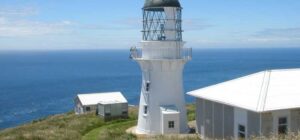
Stephens Island Lighthouse New Zealand
The Stephens Island / Takapourewa lighthouse is one of New Zealand’s most powerful lights with a range of 18 nautical miles (33 km; 21 mi). Perched 183 meters (600 ft) up, on top of Stephens Island, it guards Cook Strait and Tasman Bay / Te Tai-o-Aorere, at the top of the South Island / Te Wai Pounamu. The light flashes white once every six seconds from a white cast iron tower. The light is operated remotely from Maritime New Zealand’s Wellington office. It was first lit on 29 January 1894 and did not become automated until 31 March 1989, one of the last in New Zealand to be automated. Entry to the site and tower is by permit only, because it is part of the Stephens Island Nature Reserve, managed by the Department of Conservation. Today it is home to tuatara, no people, and an urban myth about a cat named Tibbles. Lighthouse overview Stephens Island Lighthouse marks the north western approach to Cook Strait, at the top of New Zealand’s South Island. Lighthouse feature: Details Location: latitude 40°40’ south, longitude 174°00’ east Elevation: 183 metres above sea level Construction: cast iron tower Tower height: 15 metres Light configuration: modern rotating beacon Light flash character: white light flashing once every 5 seconds Power source: batteries charged by solar panels Range: 18 nautical miles (33 kilometres) Date light first lit: 1894 Automated: 1989 Demanned: 1990 Getting to Stephens Island Lighthouse Stephens Island Lighthouse is not accessible to the public. Public access to Stephens Island is restricted to permit holders only due to its status as a nature reserve. The island is a nature reserve administered by the Department of Conservation. At least 30,000 tuatara and other rare species of wildlife live on Stephens Island. Find this on the map: Stephens Island Early history The scar of the vertical tramway 126 years after construction The Māori name for the island, Takapourewa, originates from it once being covered in the takapou trees. Takapou – more commonly known as matipo – trees grew right down to the water’s edge, giving the effect that the island floated in the sea. The Maori word for float is rewa; hence, Takapou-rewa. In 1770, Captain James Cook sailed past and named the island after Sir Philip Stephens, the Secretary of the British Admiralty Board. Captain James Cook FRS (7 November 1728[NB 1] – 14 February 1779) was a British explorer, cartographer, and naval officer famous for his three voyages between 1768 and 1779 in the Pacific Ocean and to New Zealand and Australia in particular. He made detailed maps of Newfoundland prior to making three voyages to the Pacific, during which he achieved the first recorded European contact with the eastern coastline of Australia and the Hawaiian Islands, and the first recorded circumnavigation of New Zealand. Cook joined the British merchant navy as a teenager and joined the Royal Navy in 1755. He saw action in the Seven Years’ War and subsequently surveyed and mapped much of the entrance to the St. Lawrence River during the siege of Quebec, which brought him to the attention of the Admiralty and the Royal Society. This acclaim came at a crucial moment for the direction of British overseas exploration, and it led to his commission in 1768 as commander of HMS Endeavour for the first of three Pacific voyages. In these voyages, Cook sailed thousands of miles across largely uncharted areas of the globe. He mapped lands from New Zealand to Hawaii in the Pacific Ocean in greater detail and on a scale not previously charted by Western explorers. He surveyed and named features, and recorded islands and coastlines on European maps for the first time. He displayed a combination of seamanship, superior surveying and cartographic skills, physical courage, and an ability to lead men in adverse conditions. In 1779, during Cook’s third exploratory voyage in the Pacific, tensions escalated between his men and the natives of Hawaii, and an attempt to kidnap chief Kalaniʻōpuʻu led to Cook’s death. Whilst there is controversy over Cook’s role at the forefront of British colonialism and the violence associated with his contacts with indigenous peoples, he left a legacy of scientific and geographical knowledge that influenced his successors well into the 20th century, and numerous memorials worldwide have been dedicated to him. As the new colony grew in the 1850s, the island was identified as an obvious location for one of a scheme of lighthouses to be erected on significant headlands along New Zealand’s 15,000 kilometers (9,300 mi) long coastline. The site was first proposed in 1854, and again in 1888 after the bark Weathersfield was shipwrecked nearby. Several factors, including remoteness, turbulent Cooks Strait, and steep terrain, made it difficult and hazardous to build. In addition, it is the highest elevation above sea level of any lighthouse in New Zealand. Before the lighthouse and associated dwellings could be built, a work party arrived in 1891 to construct a boat landing ledge and vertical tramway up the precipitous cliffs. The original light components were sourced from Edinburgh and France. The eventual £9,349 cost was twice the price of many other New Zealand lighthouses. Back then, its five-wick paraffin lamps made it the brightest lighthouse in New Zealand The native māpou (red matipo) was cleared to make way for sheep and cattle, and vertical tramway. Habitat destruction and feral cats are blamed for the silencing of the birdsong of the native tūī, bellbird, and tīeke. By way of contrast, when Edward Lukins, a collector of natural history specimens, visited shortly after the occupation, he recorded 31 species of birds, along with two species of land snails and four lizards For the keepers and their families, it was a lonely and hard posting, with a perpendicular climb from boat to home. Besides keeping the light lit, they acted as wildlife rangers and coast watchers during the Second World War.Isolation made illness a serious risk. For example, in May 1909, a doctor and nurse were urgently sent out from Wellington to stifle an outbreak of scarlet fever. On a brighter note, in 1947, the lighthouse was featured on a four-pence postage stamp.At one time, there were three keepers and a small school. In the mid-1960s, Jeanette Aplin and her family lived on the island for six